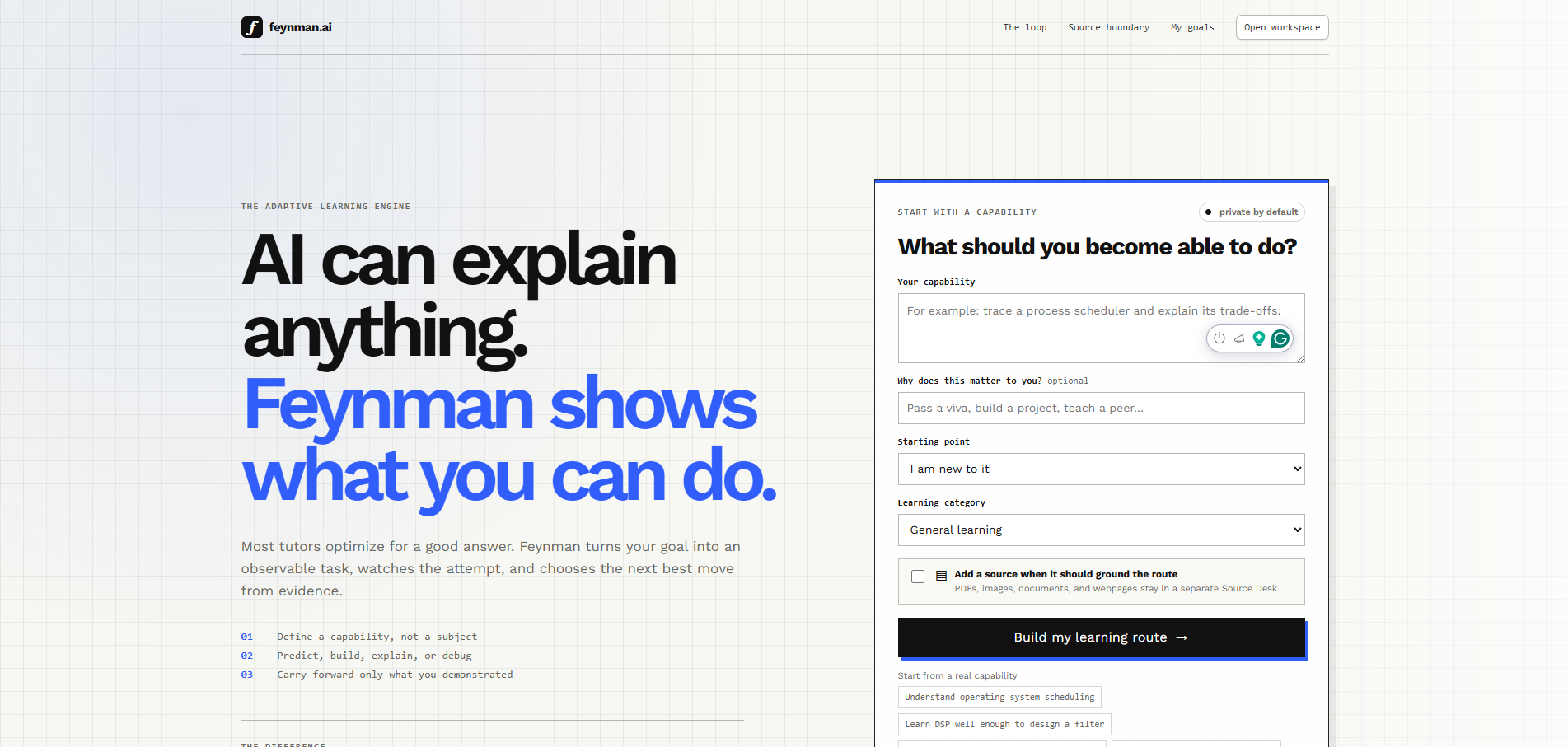
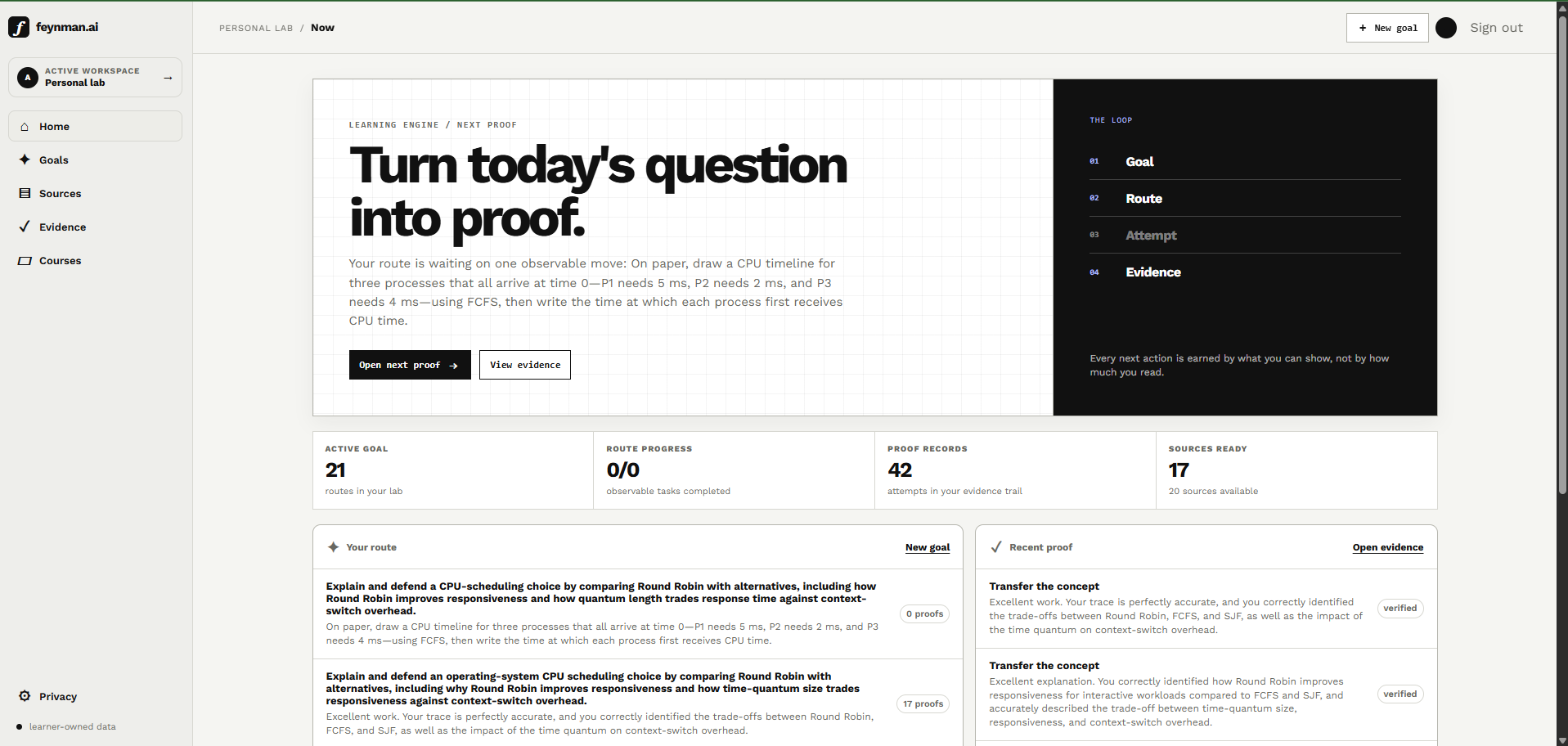
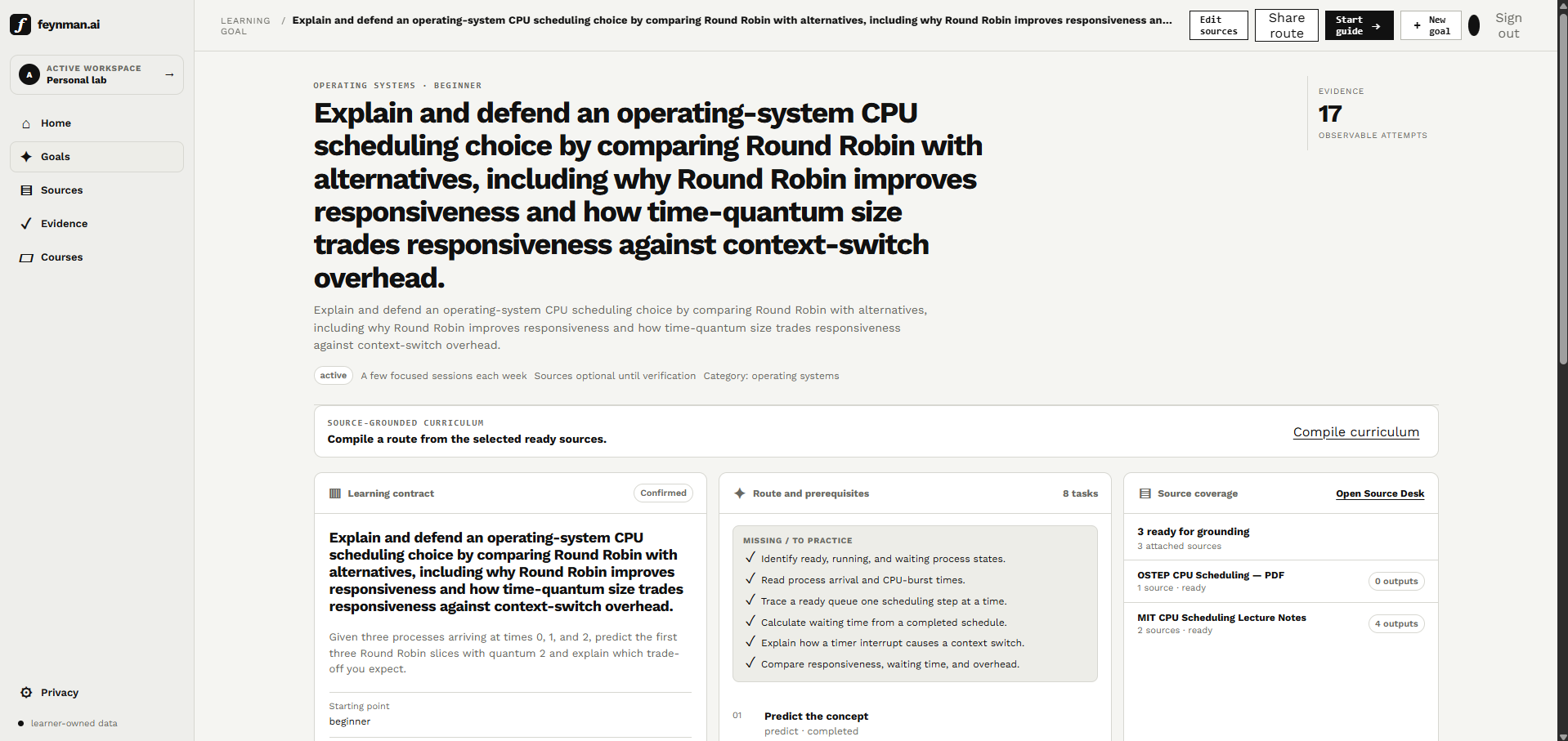
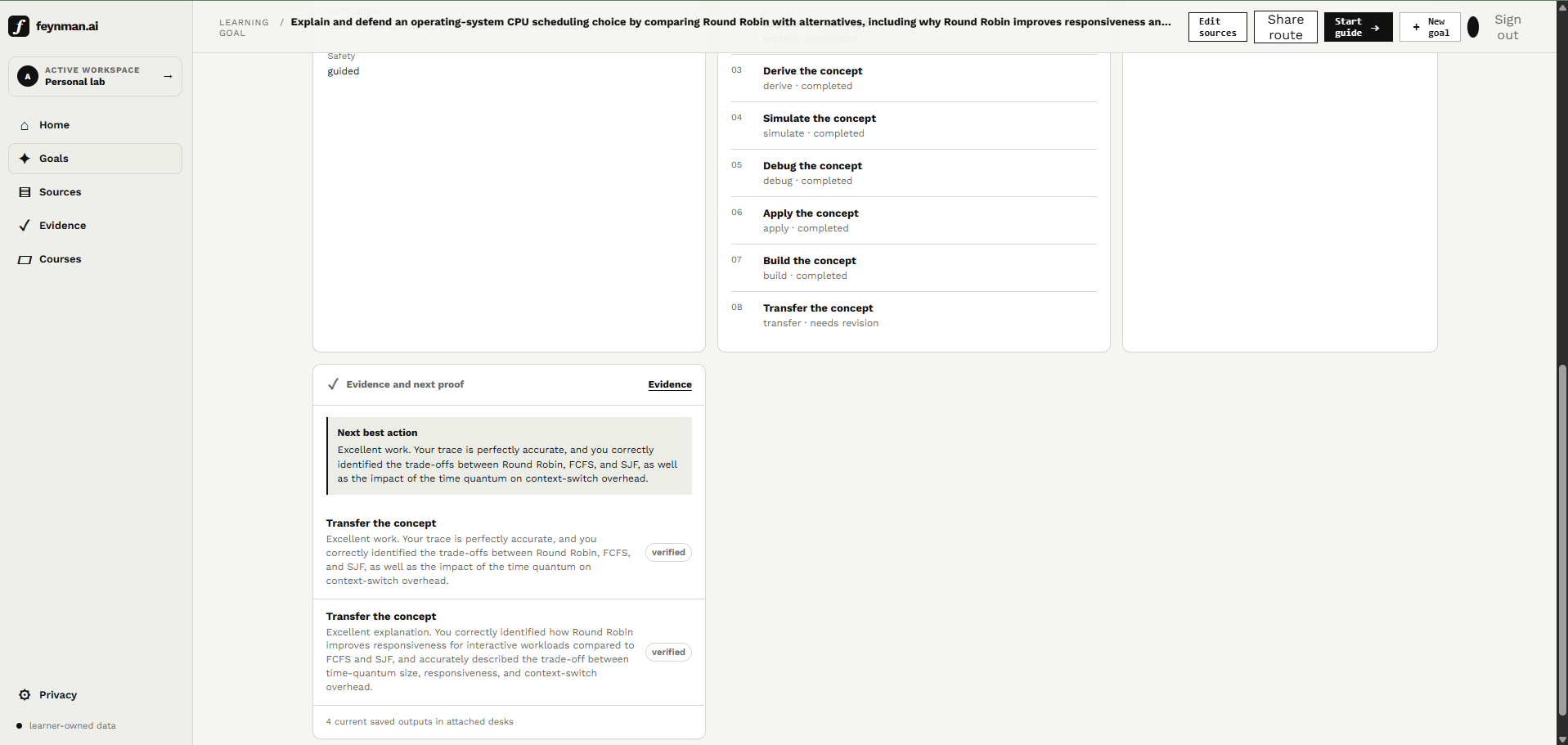
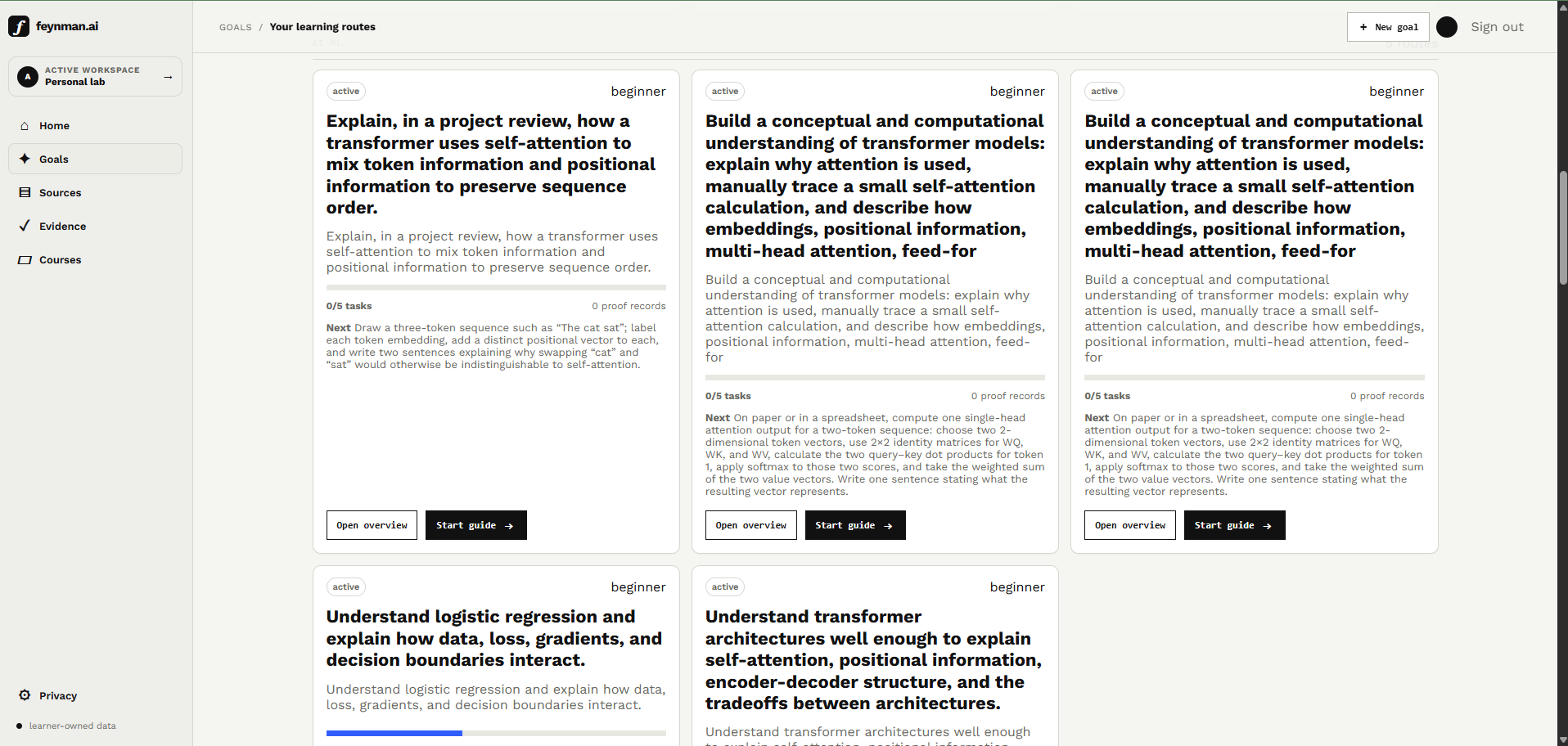
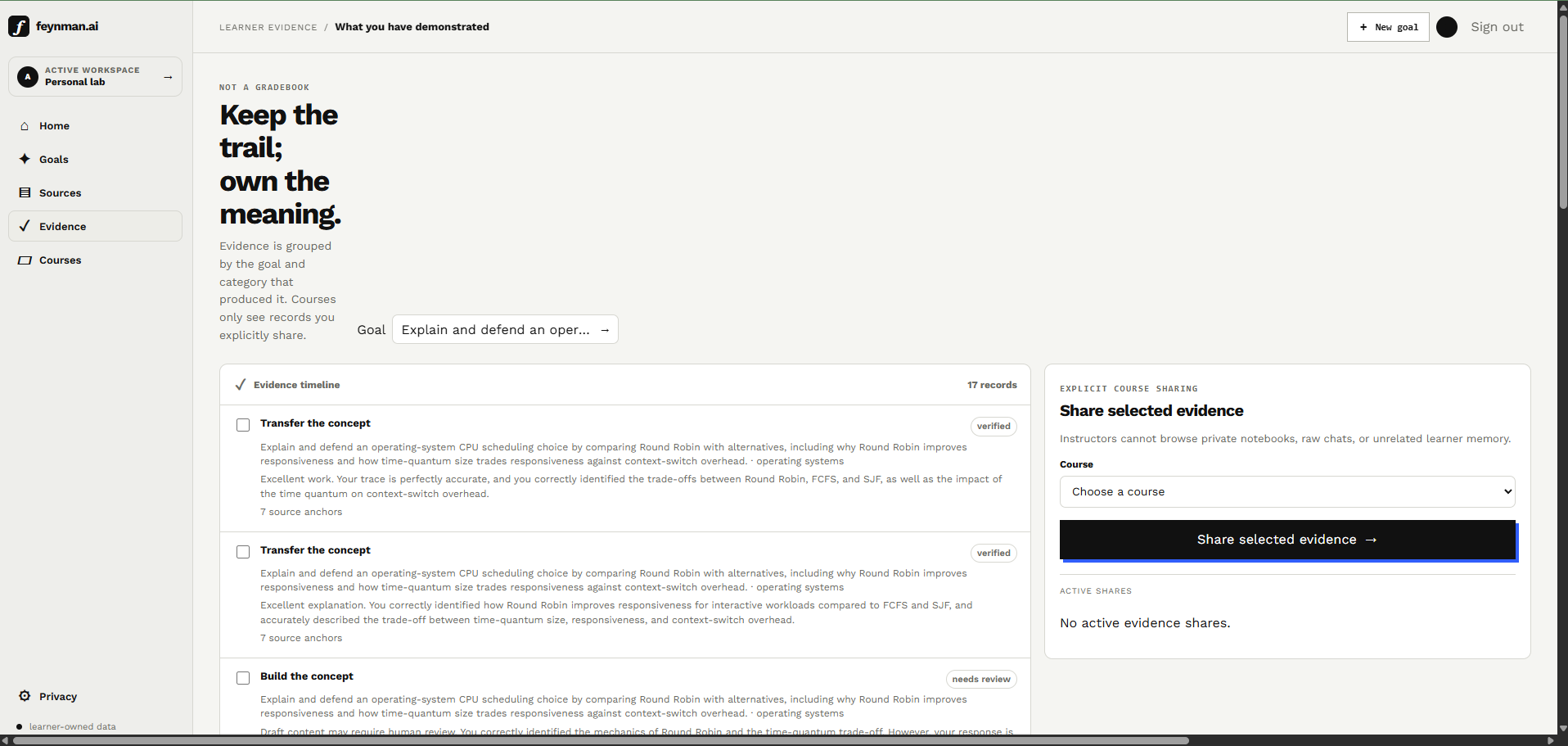
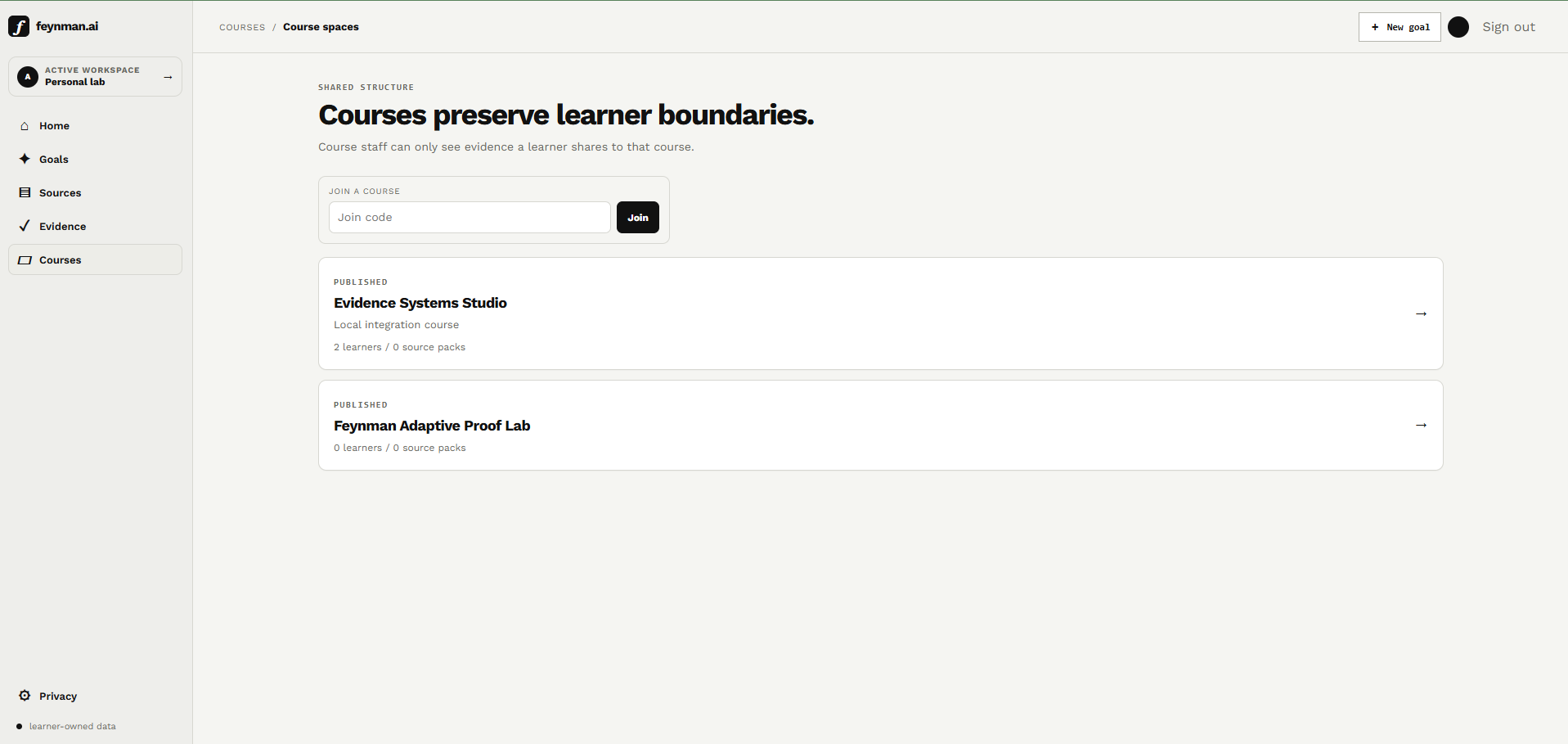
If AI gives the answer, who did the learning? Feynman is an evidence-first adaptive learning runtime that refuses to mark understanding from reading or chatting. A learner states a goal, edits an AI-proposed contract, and must predict, explain, trace, or debug before the route advances. When an attempt is wrong, Feynman routes to remediation - not a badge. The result is a learner-owned evidence record of what they actually did, not what the model said. Built with Codex + GPT-5.6; 151 backend tests, 58 frontend tests, and browser acceptance verified. The future of education is not a more persuasive answer box. It is a system that helps a learner struggle safely, explain in their own words, and leave with evidence they can inspect.
The problem
At 11:48 p.m., a student reads a perfect AI explanation of Round Robin scheduling and feels ready. At 9:00 a.m., the time quantum changes, the answer is gone, and they freeze.
The problem is not that the explanation was bad. The problem is that being shown a correct answer was mistaken for being able to reason alone.
That mistake has a name: unproductive success. The learner looks successful now, but has not yet retrieved, explained, applied, or tested the idea independently. This is not an argument against AI tutors. It is an argument against using fluent output, completed content, or a chat history as proof of learning.
The risk is real. A 2026 study, AI Makes You Smarter but None the Wiser, found that people using AI on logical-reasoning questions improved performance by three points versus a norm population while overestimating their own performance by four points; a second study of 452 people replicated the pattern. Fernandes et al., 2026 AI can help someone finish a task while making it harder to see what they can do without help. Feynman is designed to make that overconfidence visible - and correctable - before it matters.
The required solution
We do not need less AI. We need an AI learning system that does not confuse a good answer with learner evidence.
Feynman is an evidence-first adaptive learning runtime. A learner states what they want to become able to do. Feynman turns that into an editable learning contract, a source-bounded route, and one active task. The learner must predict, explain, trace, derive, debug, simulate, or apply before the route can advance.
Goal -> Learning contract -> Active task -> Observable attempt -> Evidence -> Next best action
Reading, chat, and generated answers do not change learner state. Observable attempts do.
When an attempt is weak, Feynman does not give a badge. It identifies the gap and chooses a specific next move: retry, prerequisite repair, worked example, source verification, or a changed-case task. When an attempt is stronger, Feynman saves the reasoning, confidence, source context, feedback, and next task as bounded, inspectable evidence.
What a judge can verify in one minute
- Create the goal: "Understand operating-system scheduling."
- Edit the learner-owned contract instead of accepting a black-box plan.
- Open the scheduler task and predict the process trace before seeing an explanation.
- Deliberately submit the wrong reasoning: choose a scheduler but ignore the time quantum or context-switch trade-off.
- Watch Feynman record the misconception and route the learner to remediation rather than mark the task complete.
- Retry with a source anchor and a corrected explanation.
- Open the Evidence Rail: see the verified attempt, the feedback that justified it, and the changed-case next task.
That is the whole thesis on screen: the AI answer is not the achievement; the learner's observable action is.
What we built
Feynman has three focused surfaces:
- Source Desk: PDFs, pasted text, webpages, and arXiv references become selected, page-, block-, and visual-anchored source context.
- Activity Canvas: one active task at a time. Today that includes Operating Systems traces, graphics reasoning, ML error analysis, research-paper learning, and tightly bounded academic medical activities.
- Evidence Rail: the learner's attempt, confidence, citation context, feedback, and next action stay visible and durable.
The Source Desk pipeline
A notebook is not a PDF viewer and it is not a pile of chat context. It is bounded, durable source memory.
PDF / image / document / pasted text / public URL / arXiv link
        |
        v
validate type + size + signature, then hash the source
        |
        v
extract text blocks, tables, and bounded visual assets
        |
        v
attach stable page / block / visual anchors
        |
        v
atomically rebuild notebook-scoped knowledge pack
        |
        v
learner selects ready sources
        |
        +--> cited chat          +--> Studio outputs          +--> source-backed learning task

source replaced or deleted --> rebuild pack + mark dependent claims stale
For an uploaded PDF, Feynman stores structured text blocks, page-linked images, extraction metadata, and a content hash. Mistral OCR is used when configured; a visible local extraction fallback keeps supported files usable when OCR is unavailable. Embedded images are retained, and vector-figure pages can be rendered into bounded source visuals when the runtime supports it. A vision-capable provider may enrich a source visual into a diagram graph, but an unavailable provider is shown as unavailable rather than replaced with a made-up diagram.
For a public webpage, Feynman validates the URL, bounds the response, strips scripts and raw markup, preserves readable text, metadata, tables, and a small set of approved visual assets. An arXiv /abs/... reference is normalized to its PDF before extraction. Raw PDF bytes, raw HTML, remote-image URLs, scripts, and trackers are discarded after extraction; the durable notebook memory is the normalized blocks, assets, metadata, and stable anchors.
That boundary matters after ingestion too. A learner explicitly selects ready sources before asking a question or generating an artifact. The server retrieves only that scoped knowledge pack and saves citation anchors with the result. If a source is replaced or deleted, Feynman rebuilds the pack and marks dependent artifacts, chats, curriculum state, and source-supported evidence stale rather than quietly presenting old claims as current.
What Feynman supports today
| Surface | Supported tools | What stays accountable |
|---|---|---|
| Source Desk inputs | PDFs; images; .txt, Markdown, and CSV; Word and PowerPoint files; pasted text; public webpages; and arXiv references. |
Uploads are size/type/signature checked. Only normalized blocks, bounded visual assets, metadata, hashes, and anchors become notebook memory. |
| Source-grounded Studio | Study guide, quiz, slide deck, flashcards, formula sheet, source table, mind map, narrated lesson, and learner-authored notebook notes. | Every generated output is scoped to selected ready sources and carries source IDs/anchors. |
| Active learning canvas | General routes for predict, explain, compare, apply, debug, analyze, and transfer; specialized workbenches for DSP, Operating Systems, Computer Graphics, AI/ML, historical/research-source analysis, and academic medical mechanisms. | A tool does not create mastery by itself. Feynman records the learner's submitted interaction, explanation, source scope, rubric result, confidence, and next action. |
| Evidence and adaptation | Retry, prerequisite repair, worked example, source verification, difficulty increase, changed-case transfer, and human-review routing. | Reading, chat, and generated outputs do not advance learner state on their own. Removed sources invalidate dependent claims. |
Medical work is academic and source-cited; personal diagnosis, treatment, dosing, prescription, and triage are blocked. Finance can be learned as concepts and source analysis, never as a personalized trade, security, or portfolio recommendation.
The demo focuses on Operating Systems scheduling traces because they make active reasoning visible: process states change, decisions have consequences, and wrong answers produce observable failures. Other domains show the runtime can generalize; Operating Systems proves the loop works.
Behind those surfaces is an adaptive route engine. It keeps track of the goal, selected sources, attempt, rubric result, confidence, and decision so a refresh does not reset the learner back to a generic chat. It can retry, remediate, explain, raise difficulty, ask for transfer, or request human review. It also keeps source memory separate from learner evidence, scopes feedback to selected sources, and invalidates claims when their source disappears.
The local alpha has passed 151 backend tests, 58 frontend tests, production build checks, and browser acceptance across sign-in, sources, goal creation, remediation, evidence persistence, and mobile flows. Acceptance report
Why Feynman is different
NotebookLM makes sources searchable and cited. ChatGPT Study Mode can guide thinking with questions and feedback. Coursera distributes expert instruction. LeetCode evaluates code attempts.
Feynman learns from all of them, but makes one thing primary: a learner-owned record of what the learner actually did. Not what the model said. Not what page they opened. Not whether a video finished. What they attempted, what they could explain, what source grounded the feedback, what remains uncertain, and what should happen next.
Research foundation, translated into product rules
Retrieval practice improves both retention (g = 0.63) and transfer (g = 0.53) over non-testing alternatives in a major meta-analysis. Self-explanation prompts show a mean benefit of g = 0.55. Adesope, Trevisan, and Sundararajan, 2017; Bisra et al., 2018 That is why Feynman asks for an attempt before a polished explanation.
Carefully scaffolded problem-solving before instruction also improved conceptual learning and transfer in a meta-analysis of 53 studies and 166 comparisons (g = 0.36, 95% CI 0.20 to 0.51). Sinha and Kapur, 2021 That is why a wrong answer becomes a repair path, not a dead end.
Transfer is the stress test of understanding. Barnett and Ceci's taxonomy makes the key distinction: recognition alone cannot establish whether a learner can apply an idea when the context changes. Feynman changes the numbers, scenario, or constraints to test that application. Barnett and Ceci, 2002
Feynman applies these ideas; it does not claim that it has already proven better learning outcomes. That is the next study.
Why now, why OpenAI
GPT-5.6 can generate a correct explanation of priority inversion in seconds. But building a system that asks for a learner trace before it uses an explanation to advance the route, evaluates the reasoning, and repairs a misconception requires Codex. The hard part is not the answer. It is the decision system that knows when an answer is not enough.
OpenAI Build Week is the right place for Feynman because GPT-5.6 and Codex make it practical for a small team to build and test the hard part of this idea: not a polished chat screen, but a full product with durable learning state, source boundaries, browser-tested interactions, and regression tests. The learner runtime remains provider-neutral. When a server-side OpenAI-compatible provider is configured, the app displays provider and model provenance; credentials stay server-side. Codex desktop authentication is never forwarded into learner requests.
Why Codex was essential
Feynman could not be built responsibly as one clever prompt. The route engine has to agree with the database, source permissions, evidence rules, APIs, frontend controls, tests, and the browser. GPT-5.6, working through Codex, was the engineering partner for that system: tracing a source from ingestion through durable anchors to a selected-source answer; designing typed contracts and migrations; implementing route decisions and stale-state safeguards; and writing regression coverage around the hard boundaries.
Codex browser automation was equally important. We used isolated real-browser sessions after implementation changes to sign in, create and edit a goal, submit a deliberately weak scheduler trace, observe remediation, select a source anchor, retry, and confirm verified evidence persisted after refresh. The same sweep created a Source Desk notebook, added a public webpage and an arXiv reference, checked page/block/visual metrics and source-scoped citations, generated saved outputs, and exercised desktop, tablet, and mobile states. It was not screenshot theatre: it was how we reproduced and repaired real integration failures across the Django API, Next.js UI, auth boundary, source scoping, and responsive layout.
The final acceptance report records 151 backend tests, 58 frontend tests, type checking, production build checks, and the browser route sweep. It also records the honest limitation: the isolated browser did not expose a native local-file chooser, so the final browser pass does not claim a local PDF upload click was exercised. The code and automated coverage remain, but the claim stays narrow.
That is why Codex mattered here. It let us build, inspect, break, and repair the decision system behind the demo—not merely generate the words shown in it.
Impact with boundaries
India reported nearly 4.33 crore higher-education enrolments in 2021-22. Feynman is designed as a practice and evidence layer around difficult courses, labs, research reading, and internships - not as a shadow university. Institutions keep curriculum, grading, credits, and degrees; learners keep their evidence and choose what to share. AISHE; UGC Academic Bank of Credits
Feynman is educational support, not credentialing, clinical decision support, or investment advice. Medical activities are source-cited and academic; personal diagnosis, treatment, prescription, and triage are blocked. Financial learning explains concepts but does not recommend securities, trades, or portfolios. WHO AI guidance; SEBI investor guidance
Closing
The shift we want is human: a student stops asking, "Did I finish it?" and starts saying, "Let me show you."
Feynman makes learning visible, repairable, and ready for the next problem.
References
Learning science and AI calibration
- Fernandes et al. (2026). AI Makes You Smarter but None the Wiser. Computers in Human Behavior.
- Adesope, O. O., Trevisan, D. A., & Sundararajan, N. (2017). Rethinking the Use of Tests: A Meta-Analysis of Practice Testing. Review of Educational Research.
- Bisra, K., Liu, Q., Nesbit, J. C., Salimi, F., & Winne, P. H. (2018). Inducing Self-Explanation: A Meta-Analysis. Educational Psychology Review / ERIC record.
- Sinha, T., & Kapur, M. (2021). When Problem Solving Followed by Instruction Works: Evidence for Productive Failure. Review of Educational Research.
- Barnett, S. M., & Ceci, S. J. (2002). When and Where Do We Apply What We Learn? A Taxonomy for Far Transfer. Psychological Bulletin.
Institutional context and safety boundaries
- Government of India, Ministry of Education. All India Survey on Higher Education 2021-22: enrolment release. Press Information Bureau.
- University Grants Commission. Academic Bank of Credits regulations. UGC.
- World Health Organization. Ethics and governance of artificial intelligence for health: Guidance on large multi-modal models. WHO.
- Securities and Exchange Board of India. Financial Education Booklet. SEBI.
Product context
- Google. NotebookLM help: source-grounded features. NotebookLM Help.
- OpenAI. ChatGPT Study Mode. OpenAI Help Center.
- Coursera. Terms and learner experience context. Coursera.
- LeetCode. Start your coding practice. LeetCode Support.

Log in or sign up for Devpost to join the conversation.