-
-
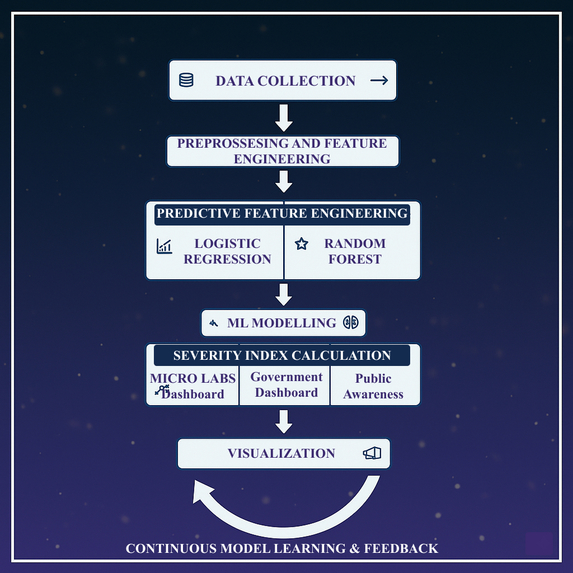
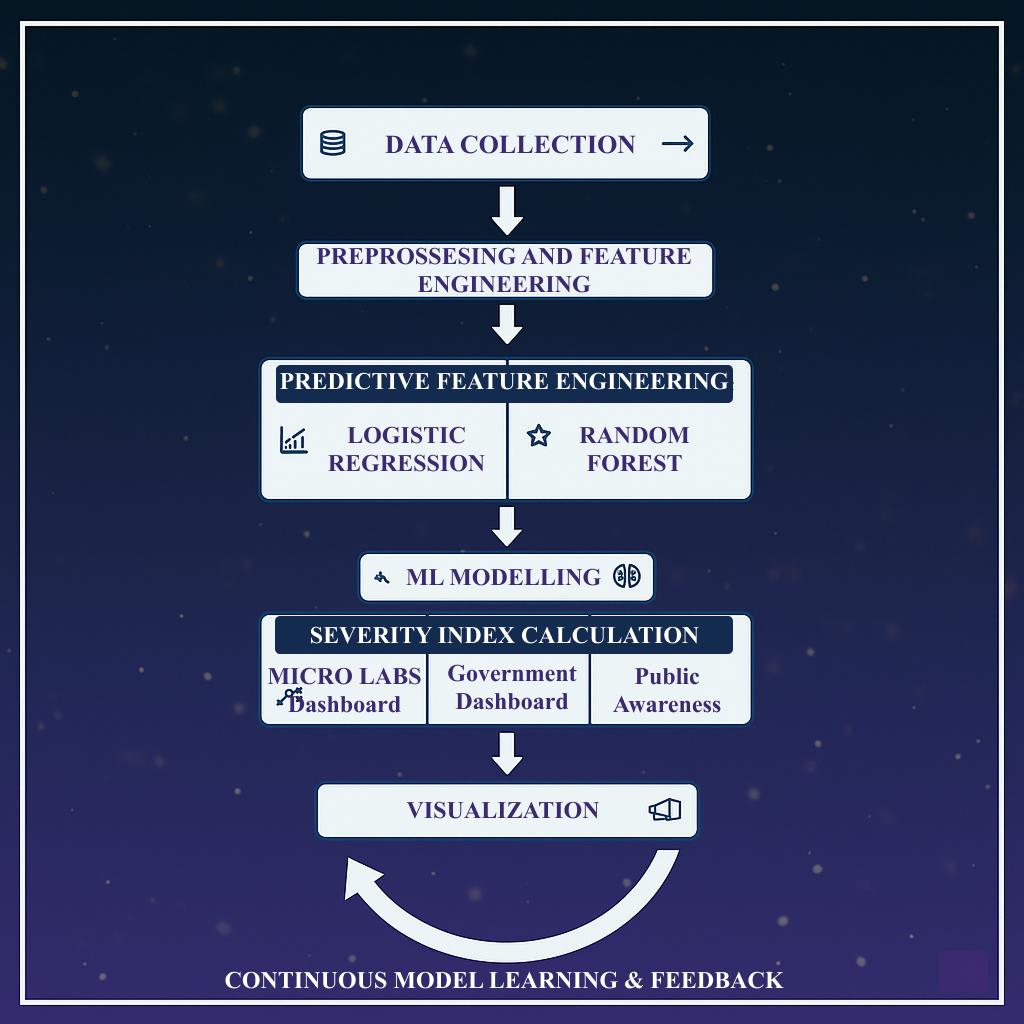
Workflow of FeverCast360
-
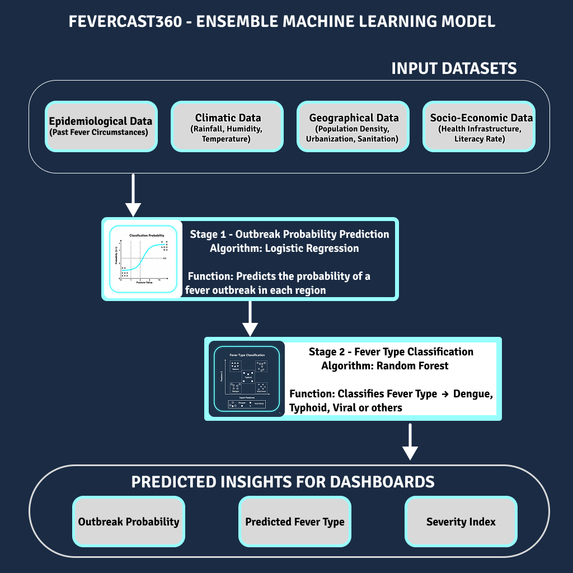
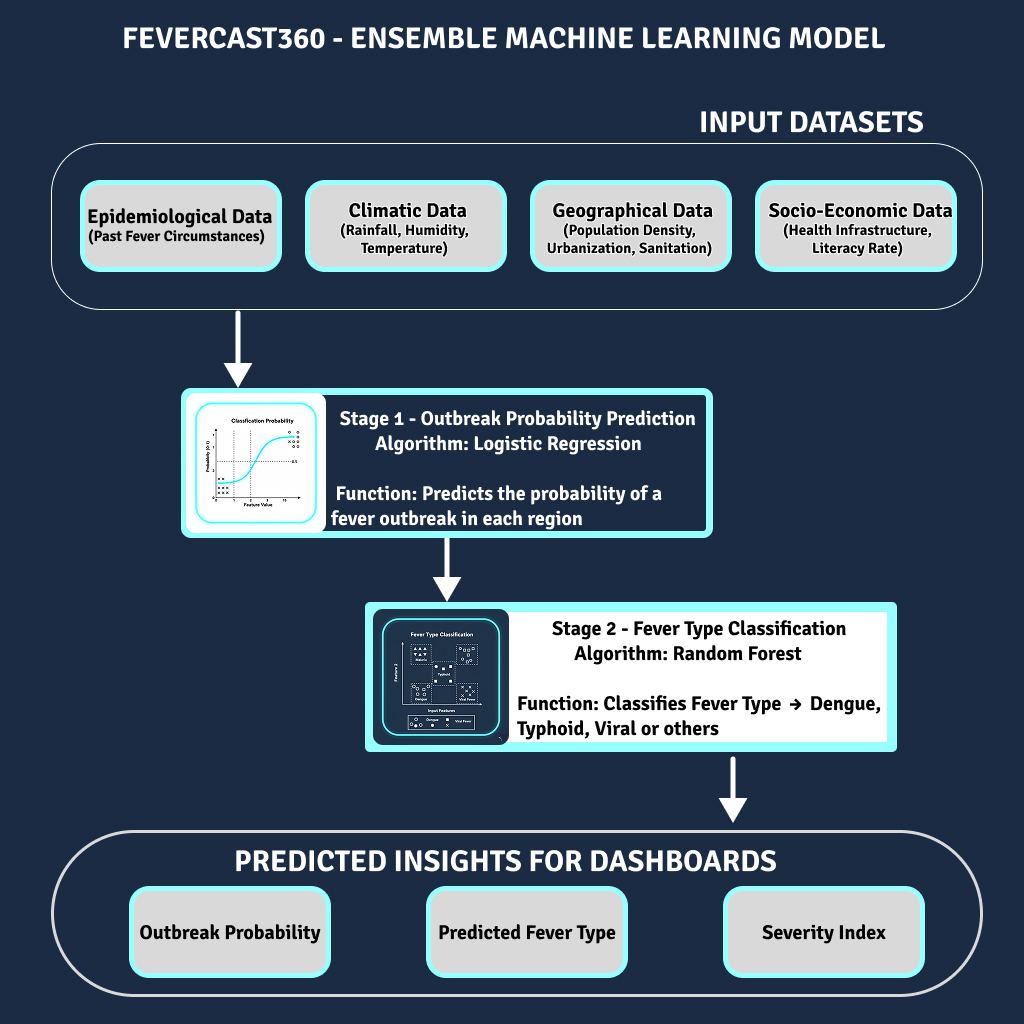
FeverCast360 - Ensemble Model Architecture
-
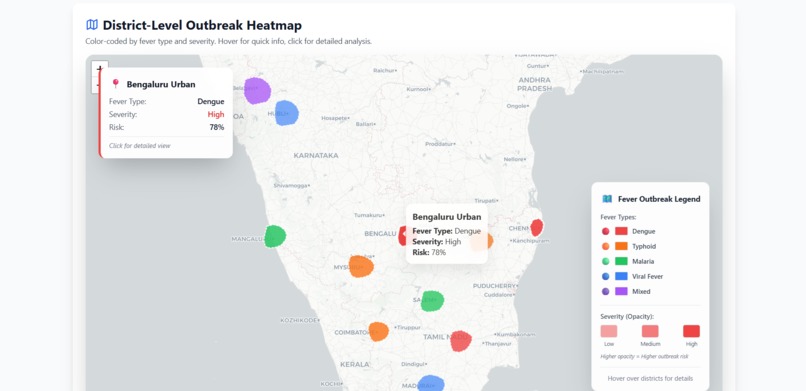
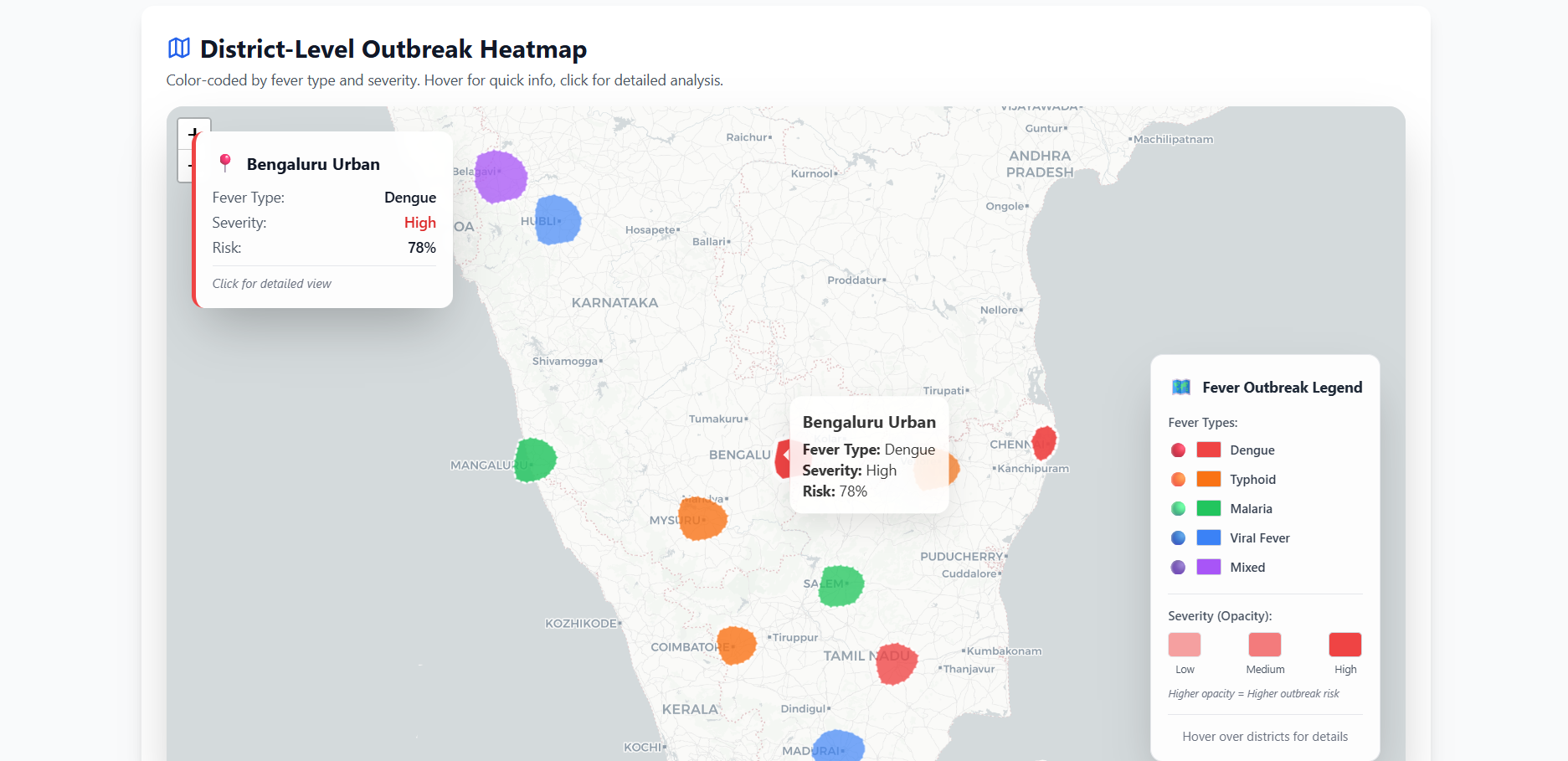
Visualization of Fever Outbreaks
-
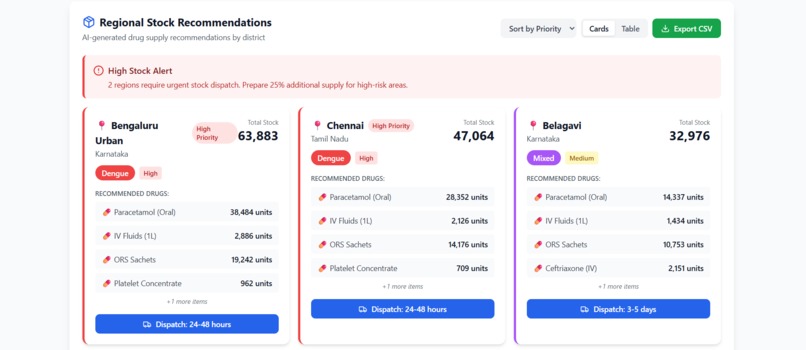
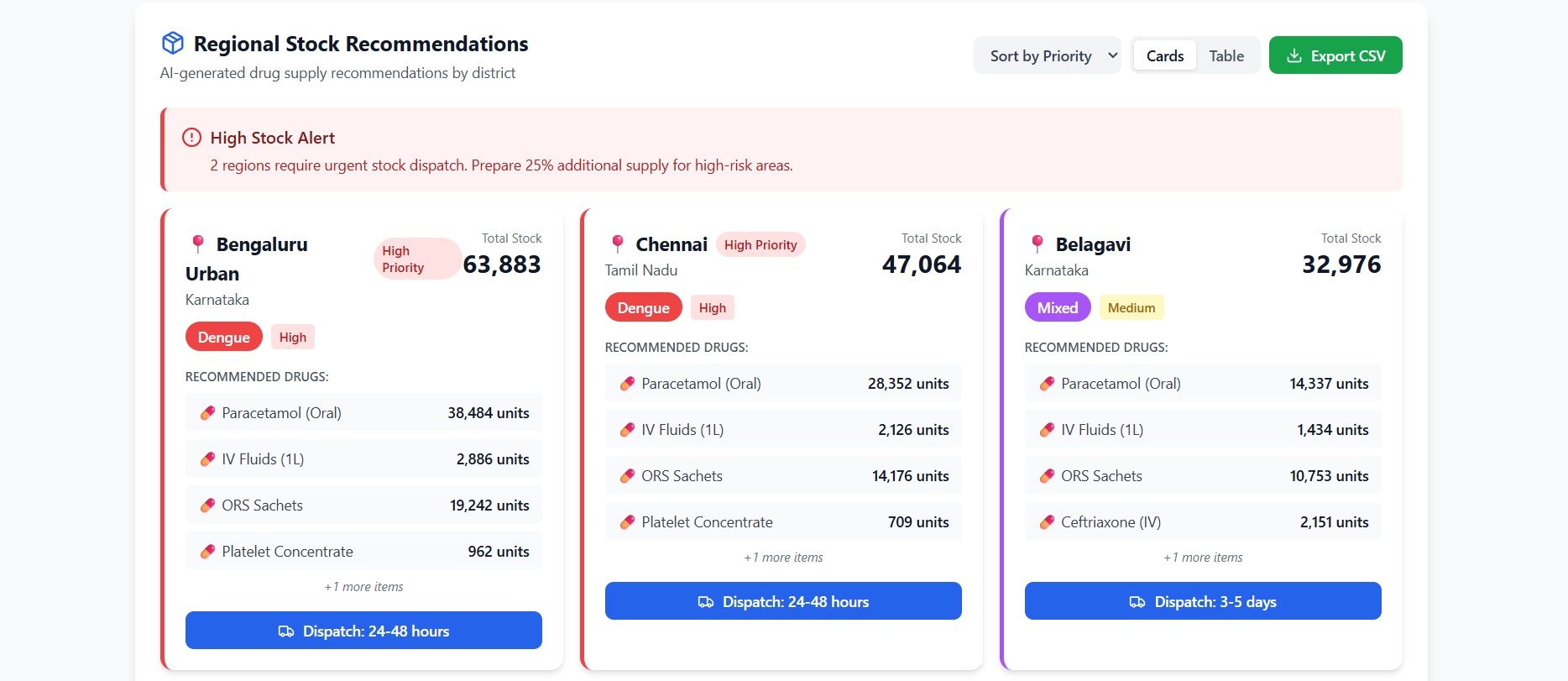
Regional Stock Recommendation
-
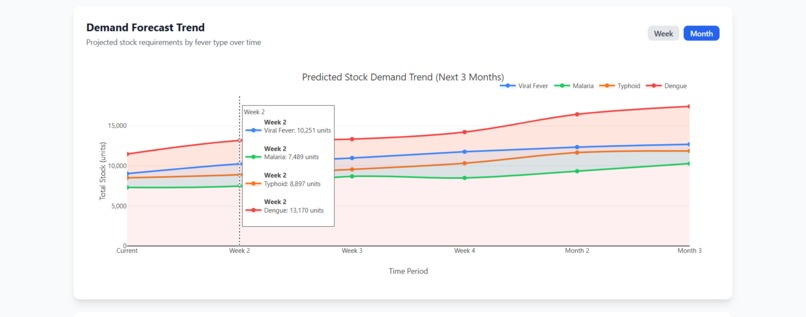
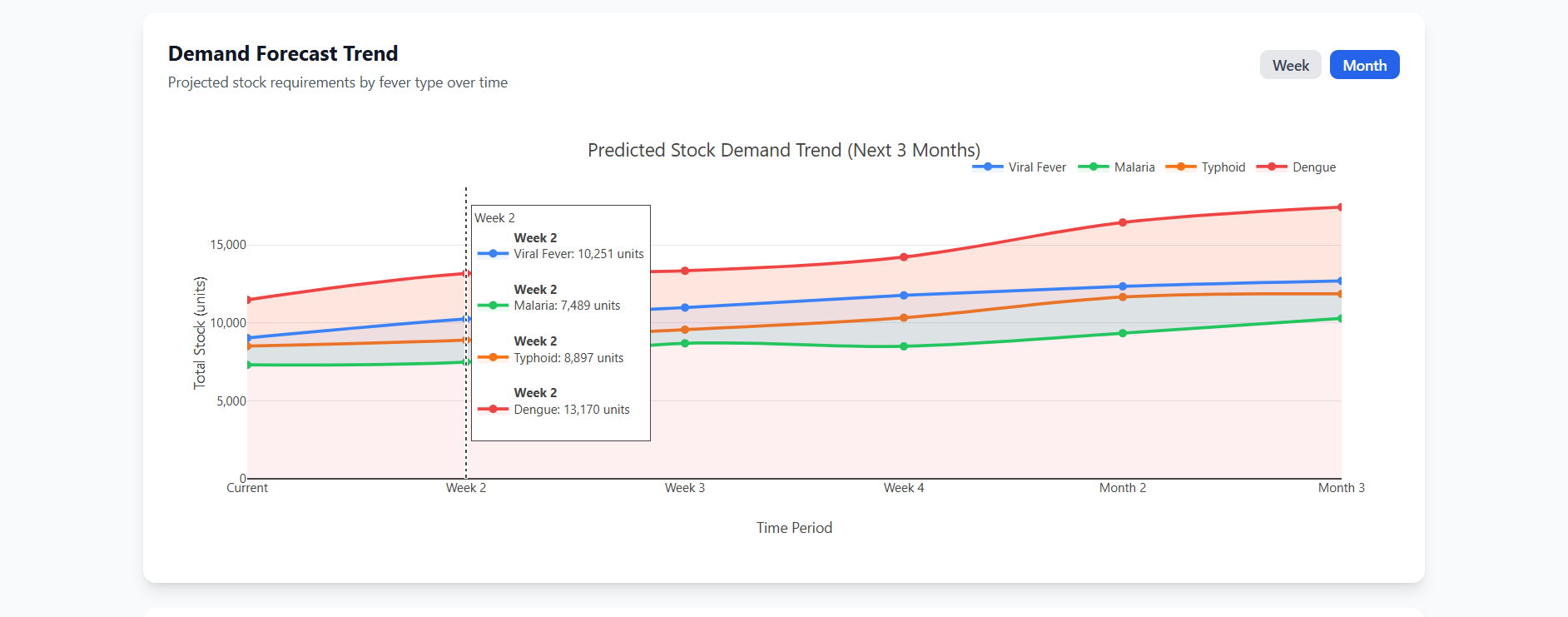
Demand Forecast Trend
-
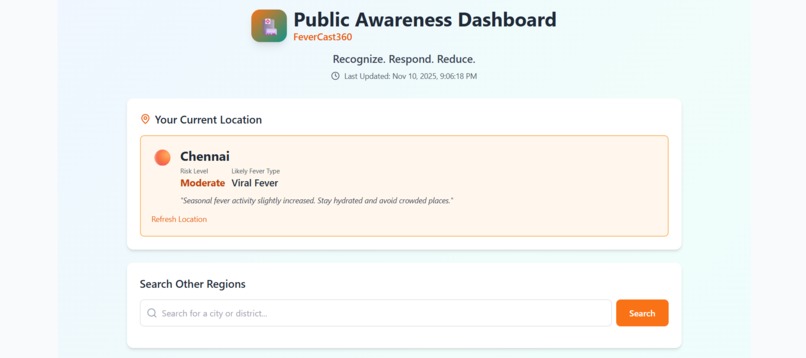
Public Awareness Dashboard
-
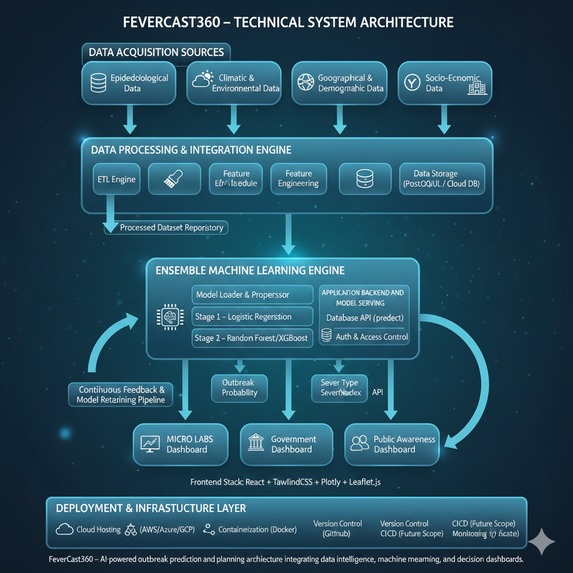
Architecture Diagram
Inspiration
As the well-known proverb says, “Prevention is better than cure.” Early prediction of a health threat can save countless lives and prevent widespread suffering.
We have witnessed the devastating impact of the global COVID-19 pandemic — an event that reminded us how unpredictable and uncontrollable some outbreaks can be. However, not all diseases emerge without warning. Common fever outbreaks such as Dengue, Typhoid, and Viral Flu often follow identifiable patterns influenced by epidemiological, geographical, and socio-economic factors.
This realization inspired us to build FeverCast360 — an intelligent platform that leverages real-time data to predict potential fever outbreaks before they escalate, empowering healthcare institutions, laboratories, and government bodies to take proactive measures. Our goal is simple yet powerful: to transform reactive healthcare into preventive intelligence.
What it does
FeverCast360 is an AI-powered outbreak prediction and preparedness platform that forecasts fever outbreaks such as Dengue, Typhoid, and Viral Flu across different regions.
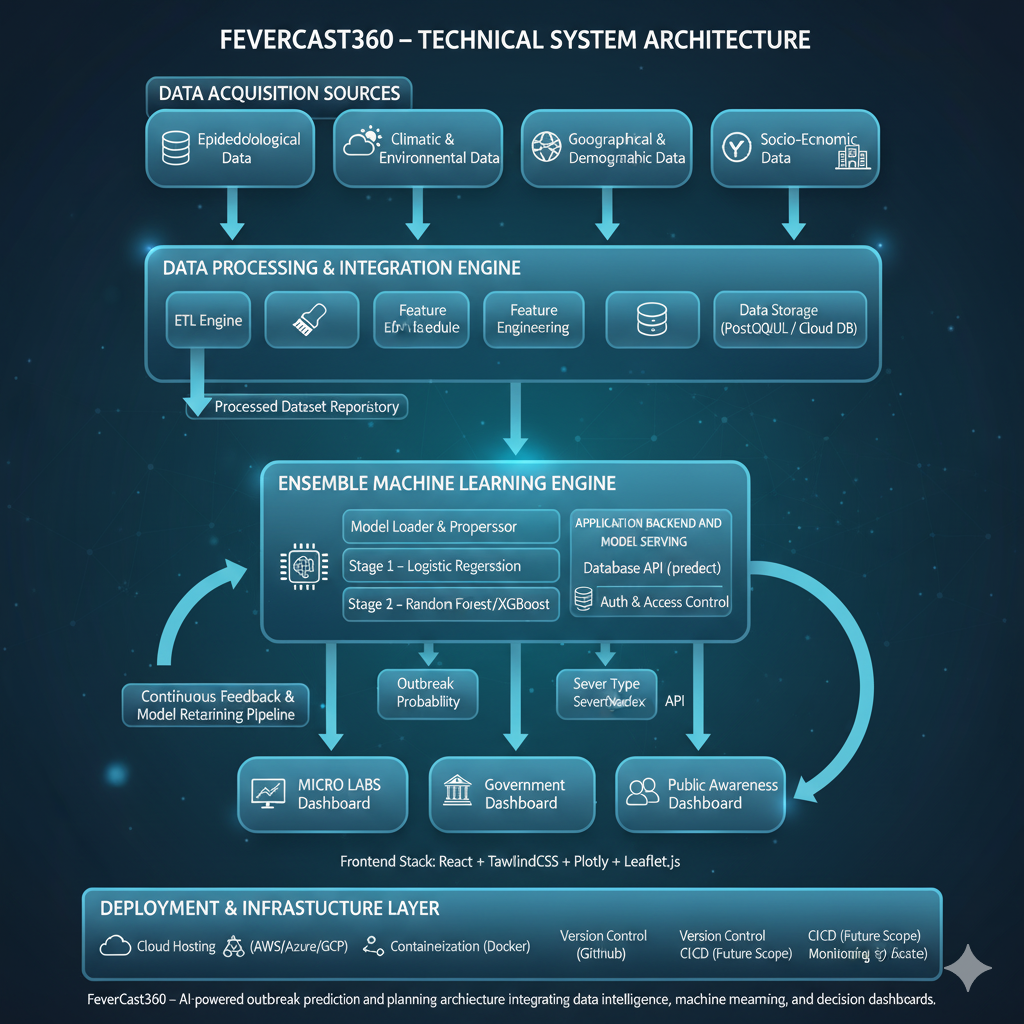
It collects and analyzes epidemiological, climatic, geographical, and socio-economic data to identify patterns and correlations that signal a potential fever outbreak. Using a two-stage machine learning model, it first predicts the probability of an outbreak and then classifies the likely fever type for each region.
The results are transformed into actionable insights through three interactive dashboards:
🏭 MICRO LABS DASHBOARD: Predicts drug and diagnostic stock requirements and helps in regional supply planning.
🏛️ Government Dashboard: Displays heatmaps and severity indicators to support early intervention and health resource allocation.
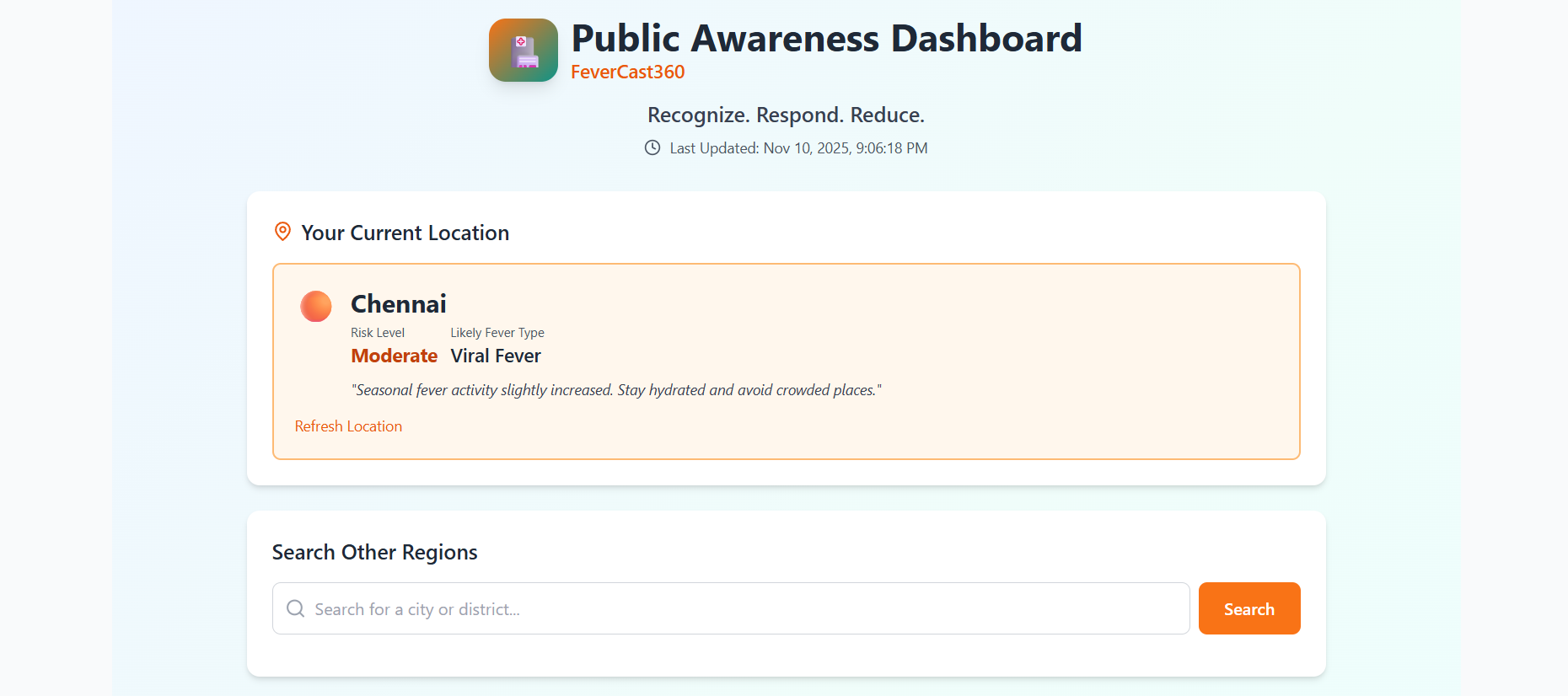
👥 Public Awareness Dashboard: Provides community alerts, risk levels, and preventive recommendations to keep citizens informed.
In short, FeverCast360 turns raw data into predictive intelligence, enabling all stakeholders to act before an outbreak turns into an emergency.
How we built it
We built FeverCast360 as a complete data-driven intelligence system that combines data engineering, machine learning, and interactive visualization to predict and analyze fever outbreaks in real time.
Our development process was structured into several key stages:
🧩 1. Data Acquisition & Preparation
We gathered diverse datasets from multiple sources, including epidemiological records, climatic data, and geographical & socio-economic indicators. The data was cleaned, normalized, and integrated into a unified format. We engineered new features such as rainfall variation, humidity index, and lag-based fever counts to capture temporal and environmental dependencies.
🧮 2. Ensemble Machine Learning Model
At the core of FeverCast360 lies a two-stage Ensemble Model that combines both linear and nonlinear learning approaches:
Stage 1 — Logistic Regression: Predicts the probability of a fever outbreak in a region based on climatic, demographic, and epidemiological features.
Stage 2 — Random Forest / XGBoost: Classifies the type of fever (Dengue, Typhoid, or Viral) for high-risk regions using both raw features and the outbreak probability as input.
A Severity Index is then computed by combining the outbreak probability and fever-type confidence to represent the overall risk intensity in each area.
⚙️ 3. Backend Integration
The trained ensemble model was integrated into a FastAPI backend that exposes REST endpoints for real-time predictions (/predict, /region, /severity). The backend manages:
Input preprocessing and model inference
Secure access control for different user types
Storage of predictions and feedback data in a PostgreSQL database
This setup allows seamless communication between the ML engine and the web application.
💻 4. Visualization & Dashboards
We built an intuitive frontend using React and TailwindCSS, with Plotly and Leaflet.js for dynamic data visualization. The system features three interactive dashboards tailored for different stakeholders:
🏭 MICRO LABS DASHBOARD: Provides drug stock predictions and regional supply planning insights.
🏛️ Government Dashboard: Displays real-time heatmaps and severity trends for outbreak monitoring.
👥 Public Awareness Dashboard: Shares localized risk alerts and preventive guidance for citizens.
Each dashboard fetches live predictions through the backend API and visualizes the data with color-coded severity indicators.
🔁 5. Continuous Learning & Model Improvement
FeverCast360 supports continuous retraining — updated epidemiological and climate data can be reintegrated periodically to improve prediction accuracy. Feedback collected from users (such as ground-level reports or test outcomes) helps refine the model and adapt to seasonal or regional changes.
Challenges we ran into
Building FeverCast360 was both a technical and analytical challenge, as it required combining diverse data domains and ensuring real-world accuracy. Some of the major challenges we faced include:
🧠 1. Data Availability and Standardization
Collecting relevant and reliable datasets across different regions was one of our biggest challenges. Epidemiological data is often scattered, unstructured, or reported at varying time intervals, while climatic and demographic datasets follow different formats. We had to invest significant effort in data cleaning, normalization, and temporal alignment to make all sources compatible for model training.
🌦️ 2. Feature Correlation and Dependency
Diseases like Dengue and Typhoid have multiple influencing factors — rainfall, sanitation, humidity, and population density — which are interdependent. Identifying the right combination of features that truly impact outbreak probability was complex. We solved this using feature engineering and correlation analysis, ensuring our ensemble model captures both linear and nonlinear dependencies.
⚙️ 3. Model Balance Between Accuracy and Interpretability
While deep learning models could offer higher accuracy, they lack explainability — a crucial factor when presenting predictions to health authorities. We had to design an ensemble model that maintains interpretability (Logistic Regression) while achieving high prediction accuracy (Random Forest/XGBoost). This balance required multiple rounds of testing and tuning.
🧩 4. Integration of Multi-Stage ML Pipeline
Connecting the two-stage ensemble model (outbreak prediction and fever classification) in a seamless workflow was another challenge. We needed to ensure that the Stage 1 output (probability) was efficiently fed into Stage 2 without latency or loss of precision during inference in the API pipeline.
🖥️ 5. Real-Time Visualization and Data Mapping
Creating an intuitive dashboard that accurately visualizes outbreak severity and drug demand required integrating geospatial visualization (Leaflet.js) with real-time ML results. Ensuring smooth data refresh, color-coded intensity representation, and responsive design across multiple dashboards (MICRO LABS, Government, Public) was technically demanding.
🔁 6. Model Retraining and Scalability
Since disease patterns change seasonally, we needed to design a continuous learning pipeline that allows retraining the model as new data arrives. We also had to ensure the system can scale efficiently if extended to multiple states or additional fever categories.
Accomplishments that we're proud of
Developing FeverCast360 has been an inspiring and challenging journey — from conceptualizing the idea to building a functional prototype that brings predictive intelligence into healthcare. While some components are still under development, we have made significant progress in creating a strong foundation for a complete outbreak prediction ecosystem.
🧠 1. Established the Core Framework of an End-to-End Predictive System
We successfully designed and partially implemented the end-to-end architecture of FeverCast360 — covering data collection, preprocessing, machine learning, and dashboard visualization. The system currently operates with functional modules for data processing and model-based prediction, and we are progressing toward full integration and deployment across all layers.
⚙️ 2. Developed and Tested an Ensemble ML Prototype
We built and validated a working prototype of our ensemble model, combining Logistic Regression (for outbreak prediction) and Random Forest/XGBoost (for fever-type classification). Initial testing on sample datasets showed promising results, and we are continuing to refine and train the model using larger, region-specific datasets to improve accuracy and reliability.
🧩 3. Built Multi-Sector Dashboards for Practical Use
We developed interactive dashboards for different user groups —
*🏭 MICRO LABS DASHBOARD for analyzing drug and supply needs,
*🏛️ Government Dashboard for outbreak heatmaps and severity visualization, and
*👥 Public Awareness Dashboard for citizen-level alerts. These interfaces provide an early glimpse into how predictive data can support real-world decision-making.
🌍 4. Integrated Diverse Multi-Domain Datasets
We successfully merged epidemiological, climatic, and socio-economic datasets into a unified analytical structure. This data integration is the backbone of FeverCast360 and enables our model to identify region-specific risk patterns that influence fever outbreaks.
🧠 5. Designed a Scalable and Retrainable Architecture
The architecture of FeverCast360 is built with modularity and scalability in mind. It supports continuous retraining as new datasets become available, ensuring the model can evolve with changing climatic and epidemiological conditions.
💬 6. Brought Preventive Thinking Into Healthcare Analytics
Our proudest achievement is proving that data-driven prediction can make healthcare more preventive than reactive. Even in its current prototype stage, FeverCast360 demonstrates how early warnings can empower governments, labs, and citizens to prepare in advance.
What we learned
Working on FeverCast360 helped us grow both technically and analytically. We learned how complex, multi-domain data can be transformed into meaningful insights for preventive healthcare.
Data Integration Matters: Combining epidemiological, climatic, and socio-economic data taught us how data quality and consistency directly impact model accuracy.
Hybrid ML Design: Developing an ensemble model showed us how linear and nonlinear algorithms can complement each other for balanced performance and interpretability.
Explainability Equals Accuracy: In healthcare, we learned that transparent and interpretable predictions matter as much as accuracy.
Building Scalable Systems: We understood the importance of modular, API-driven design for connecting ML models with real-time dashboards.
Continuous Learning Mindset: Iterating with incomplete data and feedback improved our approach to retraining and validation.
Overall, we learned how data science, thoughtful design, and collaboration can drive proactive healthcare innovation.
What's next for FeverCast360
While FeverCast360 is currently at its prototype stage, it has strong potential to evolve into a large-scale predictive healthcare platform. Our next steps focus on improving model performance, expanding data coverage, and enabling real-world deployment.
🔍 Expand Dataset Coverage: Integrate more detailed epidemiological and climate data from national and global health agencies to enhance regional prediction accuracy.
🧠 Improve Model Precision: Refine the ensemble model with larger, real-time datasets and incorporate temporal and spatial analysis for dynamic outbreak forecasting.
☁️ Cloud Deployment: Deploy the platform on a cloud infrastructure (AWS / Azure) for real-time data streaming, faster model inference, and broader accessibility.
📊 Enhanced Dashboards: Add advanced analytics features — region comparison, trend analysis, and resource recommendation — for deeper insights on the MICRO LABS DASHBOARD and Government Dashboard.
🔁 Continuous Learning Pipeline: Automate the retraining process so the model self-updates with new data and adapts to seasonal and environmental changes.
🌍 Scalability and Collaboration: Scale FeverCast360 to multiple states or nationwide implementation through partnerships with healthcare institutions and public health authorities.
Our long-term vision is to make FeverCast360 a reliable, data-driven decision support system that empowers governments, laboratories, and citizens to stay one step ahead of fever outbreaks.

Log in or sign up for Devpost to join the conversation.