-
-
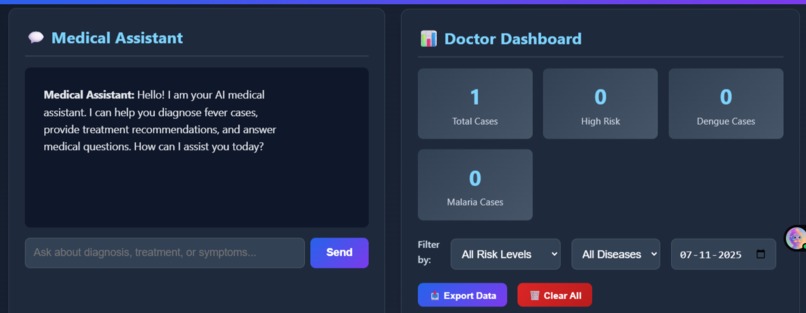
Doctor-dashboard
-
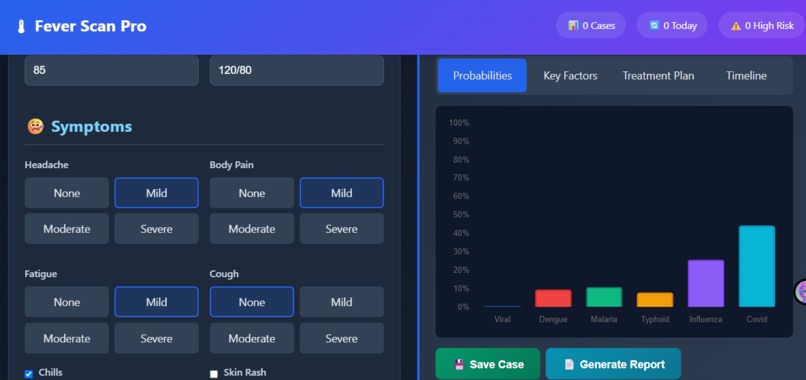
Analysis Page
-
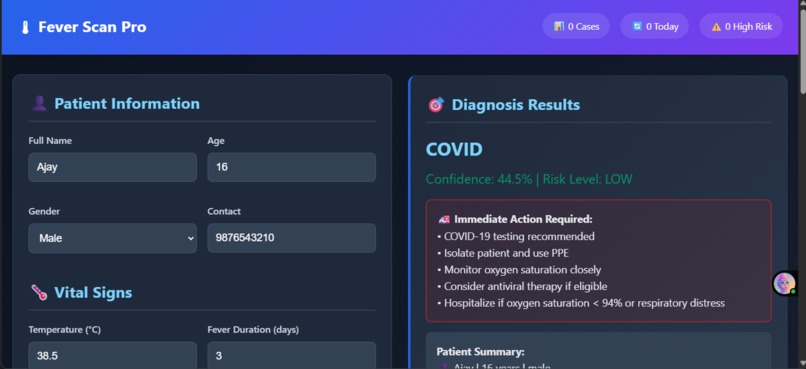
Disease-prediction
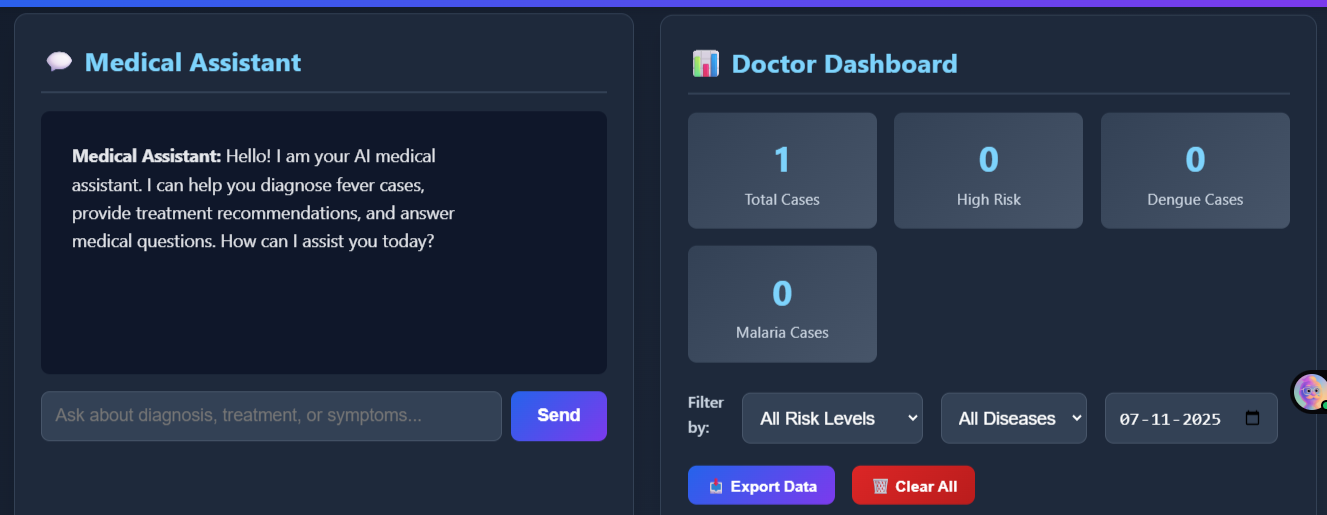
🌡️ About the Project — Fever Scan Pro
🔍 Inspiration
During the rise of vector-borne and viral fevers like Dengue, Malaria, and COVID-19, early diagnosis became a critical need — especially in rural or resource-limited areas.
This inspired me to build an AI-powered standalone system that could assist doctors and patients in quickly predicting disease risk using simple inputs and visual analytics — without needing an internet connection or server.
⚙️ How I Built It
I developed Fever Scan Pro as a fully browser-based application using:
- HTML, CSS, and JavaScript for UI and core logic.
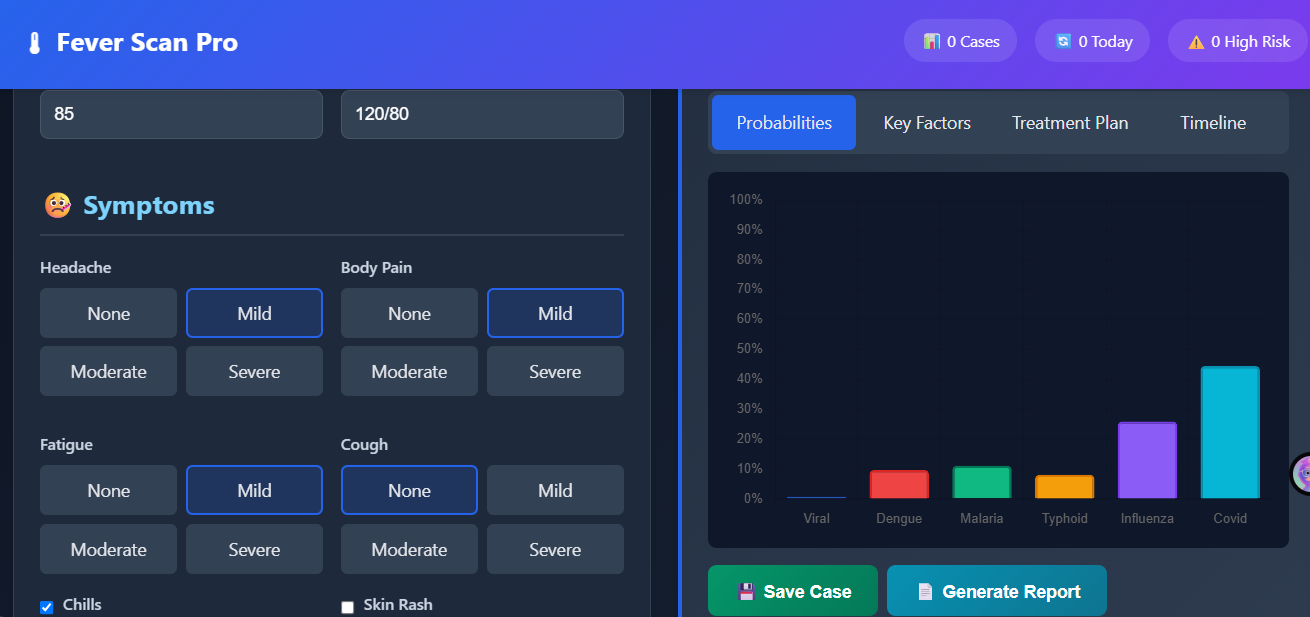
- Chart.js for probability visualization.
- html2canvas for report generation.
- A custom AI model based on a weighted rule system that estimates disease probabilities using normalized symptom and lab data.
For feature normalization, I implemented a function based on: [ x' = \frac{x - x_{min}}{x_{max} - x_{min}} ] which standardizes medical readings (like temperature, WBC count, or platelet count) before computing softmax probabilities: [ P_i = \frac{e^{z_i}}{\sum_{j=1}^{n} e^{z_j}} ]
🧠 What I Learned
- Building complex logic purely in client-side JavaScript without backend dependencies.
- Designing a responsive medical dashboard that adapts across devices.
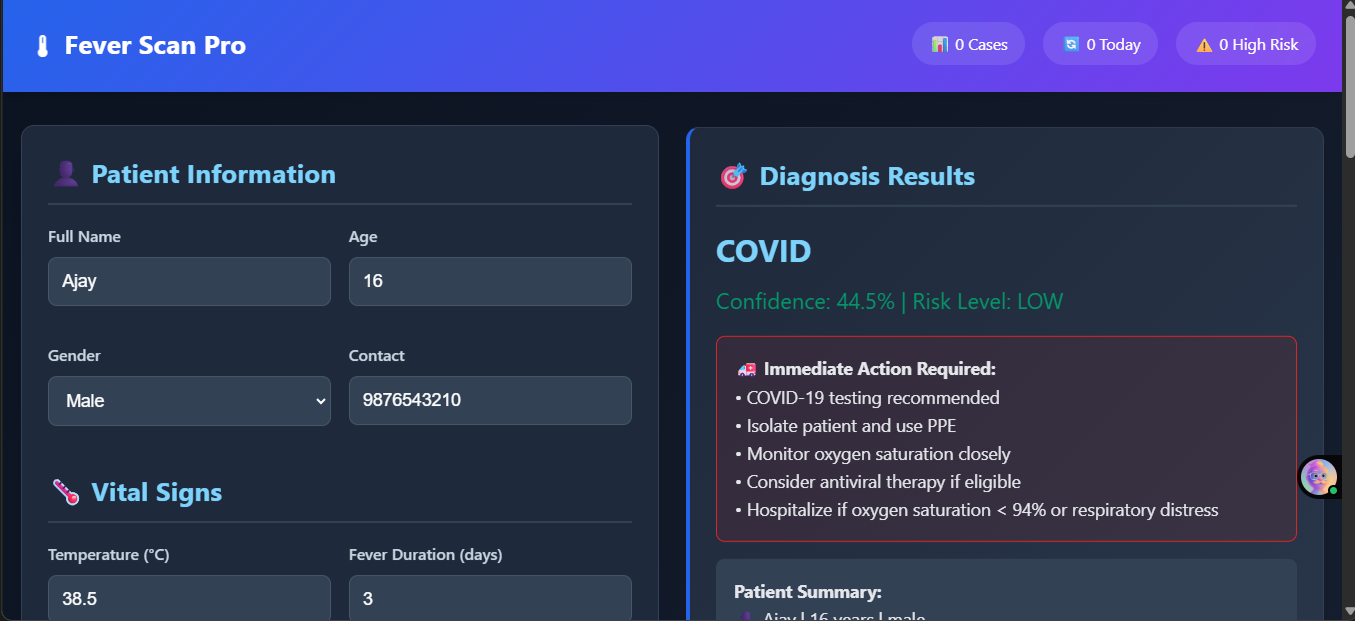
- Handling AI explainability by showing confidence scores and feature contributions.
- Implementing data storage using localStorage for persistent patient data.
🧩 Challenges Faced
- Balancing accuracy vs. interpretability in a rule-based AI model.
- Structuring large-scale JavaScript logic within a single HTML file.
- Managing state updates and real-time data visualization efficiently.
- Ensuring user privacy and offline functionality without a database or API backend.
🩺 Outcome
Fever Scan Pro can predict multiple fever-related diseases, display dynamic confidence graphs, provide personalized treatment recommendations, and generate medical reports — all instantly from a web browser.
It bridges the gap between AI and healthcare accessibility, proving that impactful diagnostic tools can exist even without complex infrastructure.
Built With
- browser
- css
- html
- javascript


Log in or sign up for Devpost to join the conversation.