Inspiration
Every monsoon and winter season in India, fever-related illnesses surge across communities. Families often struggle to understand whether a fever is mild, a sign of infection, or an emergency requiring immediate hospital care. During outbreaks, hospital lines become long, and clinicians get overwhelmed with unnecessary visits. We asked ourselves: “How can we use technology to provide early, reliable fever guidance and reduce panic, delays, or unsafe self-medication?” That question inspired us to create an AI-supported Fever Helpline — a fast, accessible system that helps users assess symptoms, guides them with evidence-based advice, and connects them to real clinicians with consent.
What it does
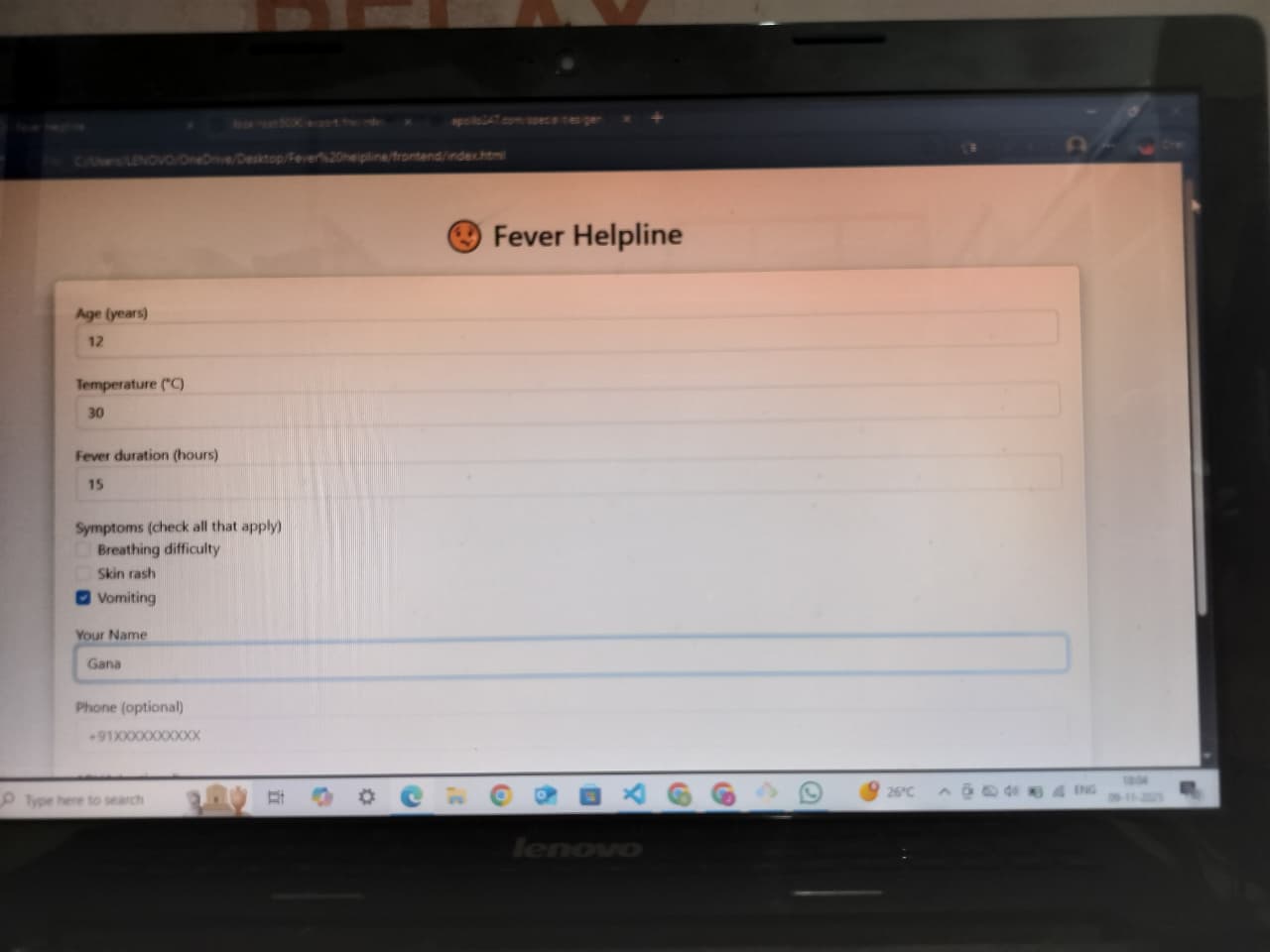
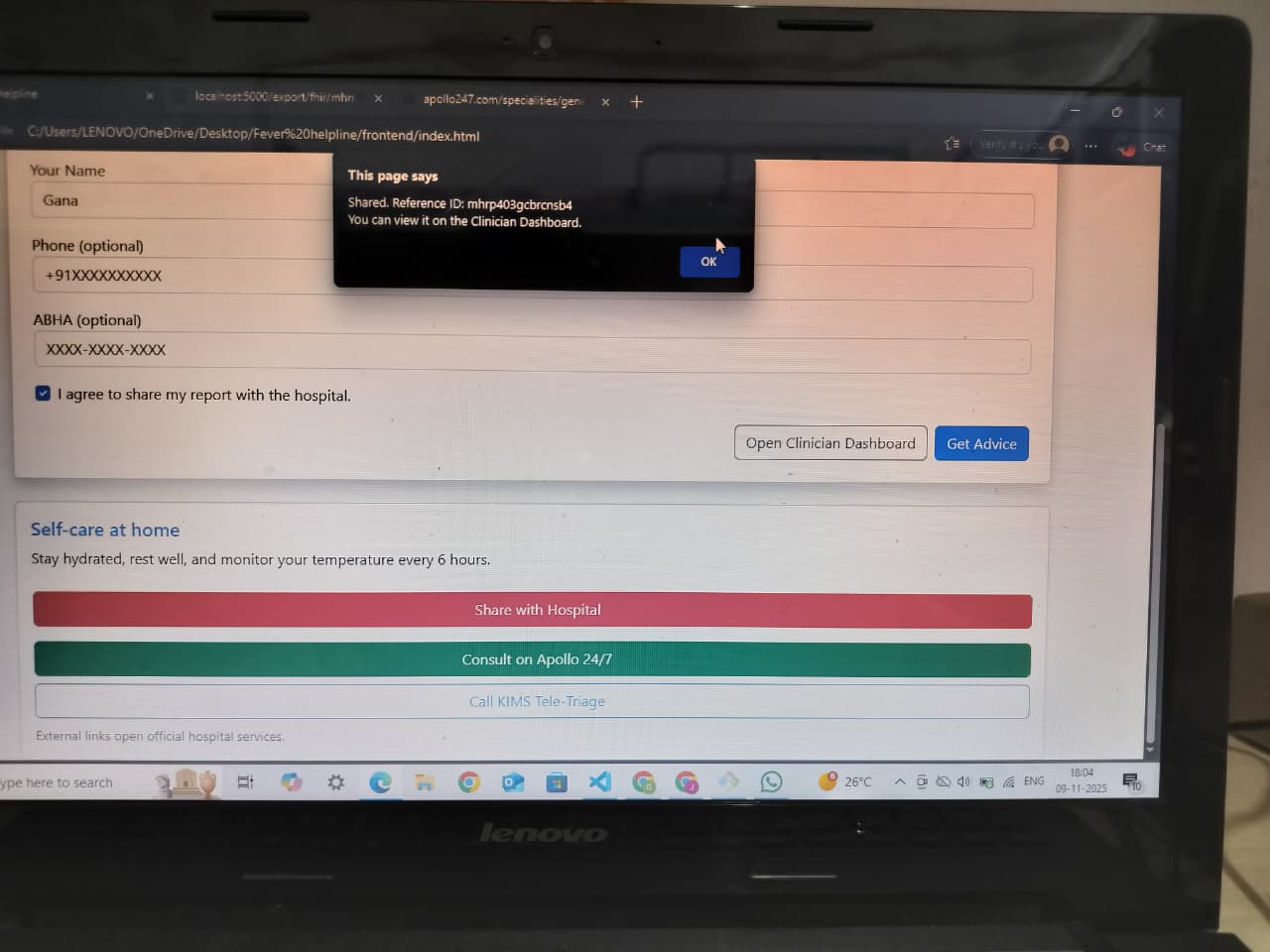
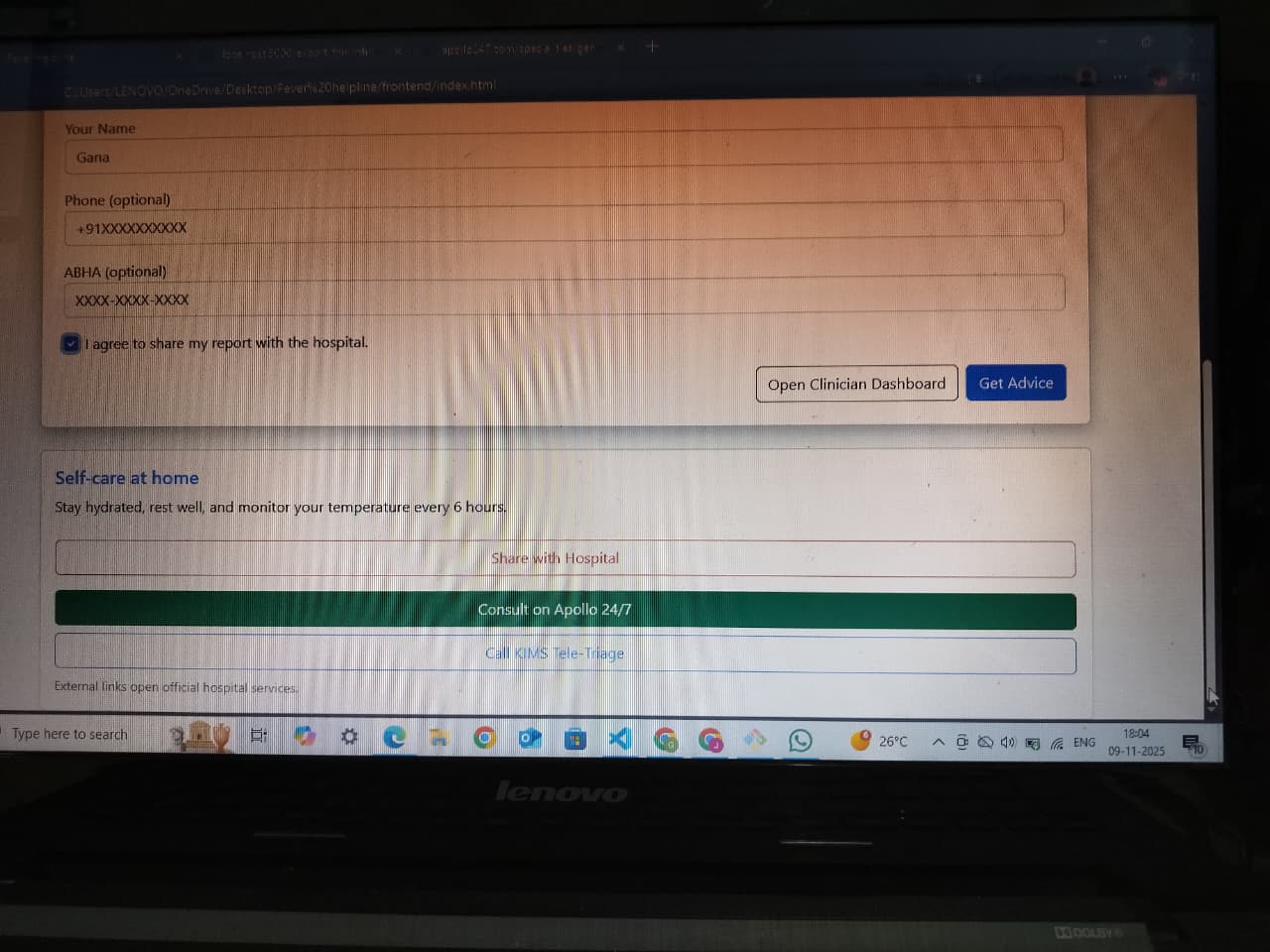
Fever Helpline is a smart, AI-supported fever guidance and triage platform designed to help people make safe health decisions quickly. It collects basic symptom details such as age, temperature, duration of fever, and red-flag symptoms like difficulty breathing or rash. Based on these inputs, it provides instant guidance on whether the user should rest at home, consult a doctor soon, or seek emergency care. The platform includes: Real-time symptom triage using a simple, conservative rule-based model Evidence-based advice tailored to the user’s inputs ABHA (Ayushman Bharat Health Account) support for structured health records Consent-based sharing of reports with hospitals A clinician dashboard where healthcare providers can view escalations in real-time FHIR export for each triage report (ABDM-ready format for interoperability) One-tap escalation options to external hospital services (e.g., Apollo, KIMS) The goal is to make fever-related decision-making fast, safe, and accessible for everyone—especially during seasonal outbreaks.
How we built it
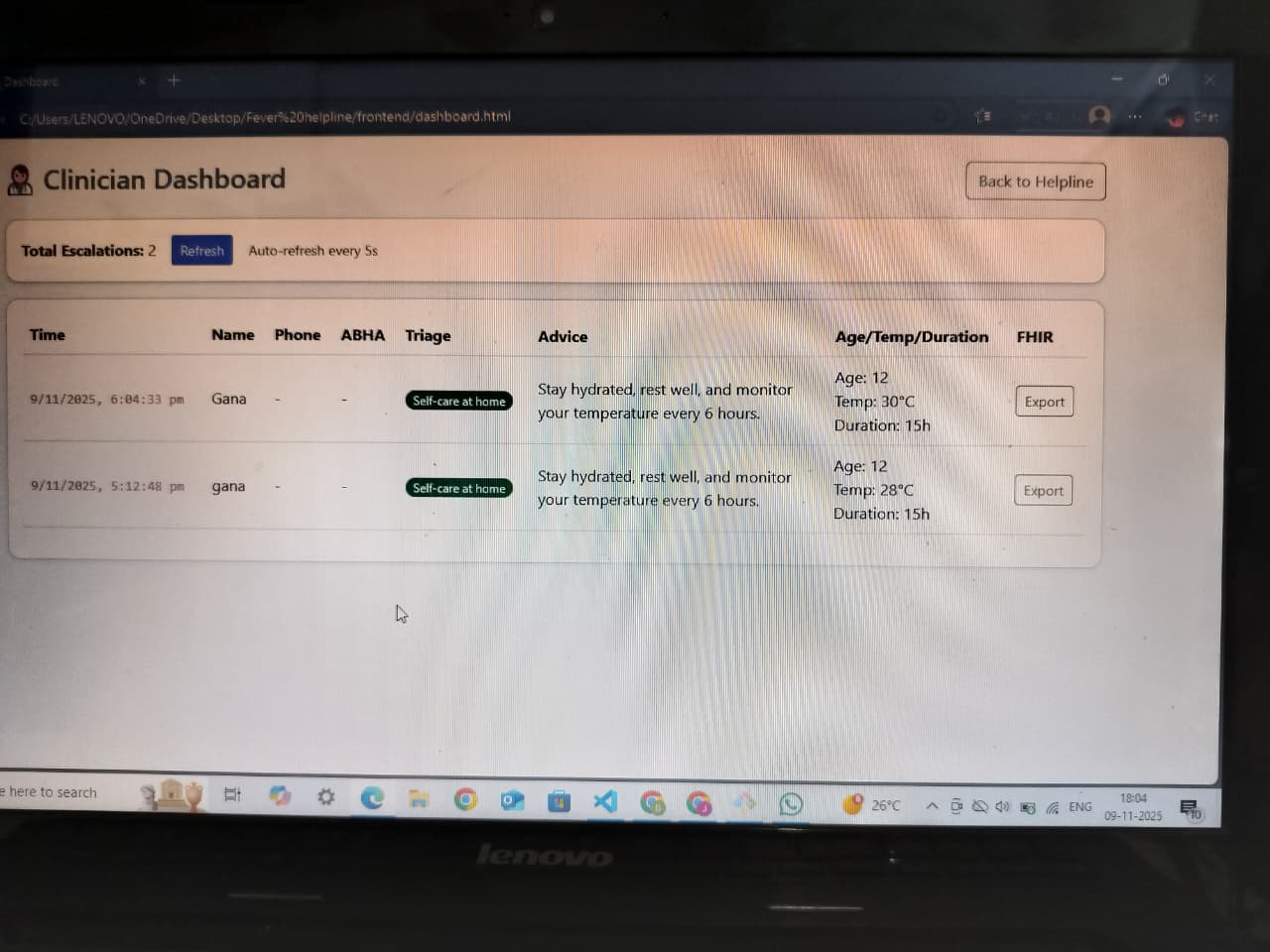
Frontend (User Facing) Clean, responsive interface built using HTML, CSS (Bootstrap) and JavaScript Dynamic symptom form with: Age Temperature Duration Additional symptoms (breathing issues, rash, vomiting) ABHA (optional) Consent checkbox Backend (Logic & API) Node.js + Express Custom rule-based triage engine (our scoring logic) Example model: Risk Score=𝑤1(Temp)+𝑤2(Duration)+𝑤3(Symptoms)Risk Score=w1(Temp)+w2(Duration)+w3 (Symptoms) Stores escalations and ABHA-linked reports in structured JSON Generates FHIR Bundle exports (ABDM-ready format) Clinician Dashboard Real-time view of escalations Auto-refresh every 5 seconds Shows: Name, Phone, ABHA Symptoms Risk level (color-coded) Downloadable FHIR report
Challenges we ran into
Challenges We Faced
- Making triage simple but safe Medical triage is complex — we had to: Avoid overconfidence Avoid diagnosing Use conservative rules to reduce risk
- Handling consent and data flow Designing ABDM-style consent flow in a simple way meant: Asking for ABHA without forcing it Only sharing data when user agrees
- Smooth backend–frontend communication Issues included: CORS errors Ensuring correct API endpoints after deployment Updating API_BASE when moving to public hosting
- Making it real-time Creating a dashboard that updates automatically every few seconds while keeping it lightweight was a challenge.
- Representing real hospital connectivity We couldn’t integrate with hospitals’ internal systems directly, so we: Used official teleconsult links Added FHIR export to prepare for future ABDM interoperability
Accomplishments that we're proud of
- Built a complete end-to-end solution in limited time
We delivered a fully functional fever triage system within the hackathon timeline—covering frontend, backend, hospital escalation flow, clinician dashboard, and FHIR export.
- Designed a safe and reliable triage model Our rule-based logic successfully identifies high-risk situations and suggests the right level of care. It prioritizes safety, clarity, and avoids medical overconfidence while still providing meaningful guidance.
- Added ABHA readiness and consent-based sharing We implemented ABHA support, structured data storage, and consent-driven report sharing—bridging our solution toward future ABDM interoperability. This is a rare and complex capability for a hackathon project.
- Real-time clinician dashboard
We built a clean, auto-refreshing dashboard that displays escalation cases instantly. Clinicians can view details like symptoms, ABHA, triage level, and can even export structured FHIR records.
- Hospital connectivity We integrated quick access to real hospital teleconsult and helpline services (Apollo 24/7, KIMS). This demonstrates how the solution can be used in real-world scenarios.
- Smooth user experience Our interface is simple, intuitive, and built to handle high-pressure health situations. It guides users step-by-step without overwhelming them with medical jargon.
- Privacy-first design
We made consent mandatory before sharing any data and avoided storing sensitive information unnecessarily—aligning with ethical healthcare principles.
- Learned complex health-tech concepts We grasped: FHIR standards ABDM ecosystem concepts Basic medical triage principles Secure data flow design All while building something practical and usable.
- Team collaboration Our team worked seamlessly across frontend, backend, data, UX, and healthcare logic—turning an idea into a working prototype in a short time.
What we learned
- How to design for healthcare
Importance of clear explanations and avoiding medical jargon
The value of safety-first triage: when unsure, escalate
How to design consent-based sharing, inspired by ABDM principles
- Structured medical data Learned basics of FHIR and clinical coding Created a minimal FHIR bundle including: Patient Observation Encounter DiagnosticReport
- The importance of privacy Only share user data when explicit consent is given: Share=Consent∧Valid InputShare=Consent∧Valid Input
What's next for Fever Helpline
We have built a strong MVP foundation. The next steps will focus on expanding functionality, improving reliability, and strengthening integration with real healthcare infrastructure:
- Full ABDM Integration
Move from basic ABHA + FHIR export to full integration with the ABDM Sandbox Gateway, enabling:
Secure consent flows
Fetching historical records
Sharing encrypted fever reports to certified healthcare providers
- Machine Learning–based Fever Prediction Train ML models on real/population data to predict: Outbreak trends High-risk zones Severity probability based on multiple parameters 🌎 3. Multilingual, Voice-Assisted Helpline Enable: Hindi, Telugu, Tamil, Kannada, Marathi, Bengali support Voice/IVR-based assistance for low-literacy users
- Live Hospital Integration Partner with real hospitals to: Automate appointment booking Launch teleconsult channels Send clinician-specific notifications

Log in or sign up for Devpost to join the conversation.