-
-
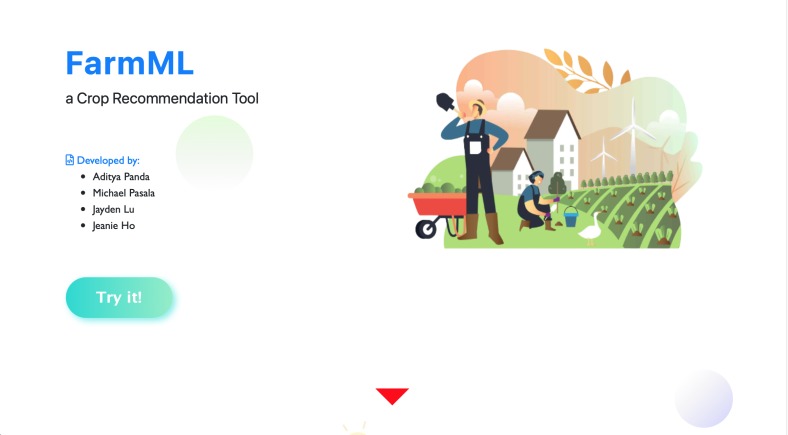
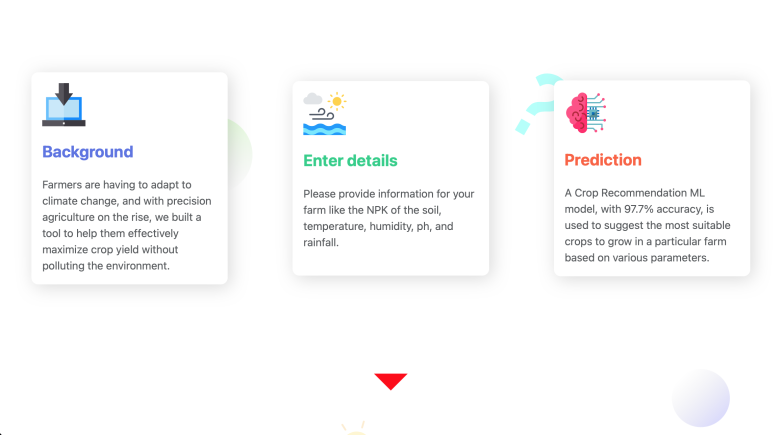
Lander webpage
-
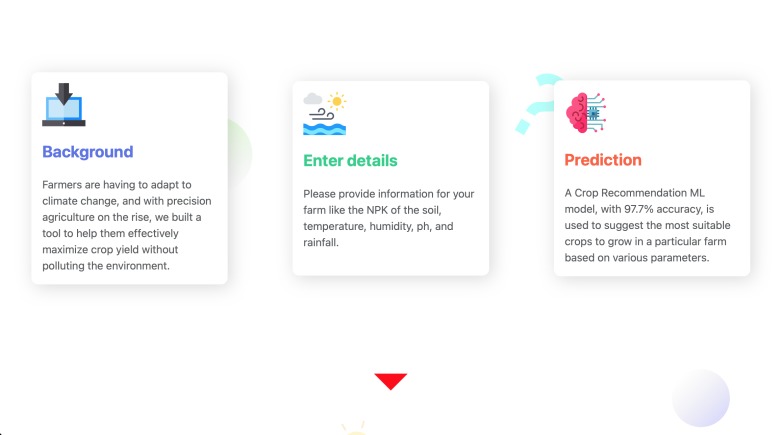
Information webpage
-
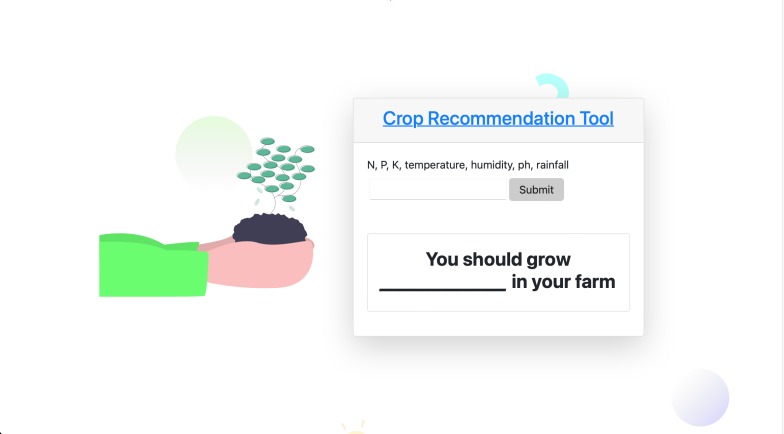
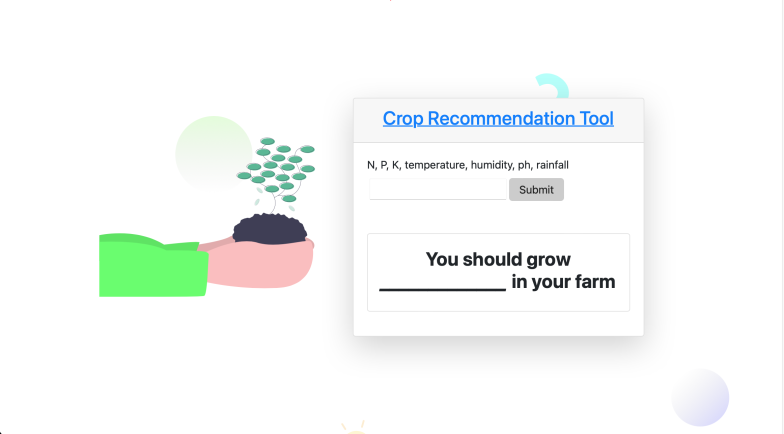
Tool webpage
Inspiration
Recently, there has been a trend of lower agricultural engagement: lower employment over time (here) combined with increasing urbanization and a changing climate has led to stress on food production and farmers' livelihoods. Its in this way, we want to help farmers maximize the efficiency of their land use, allowing food production to be continued more sustainably in a changing, challenging future.

What it does
Farmers can input baseline indicators of their soil quality--ratio of nitrogen, phosphorous, potassium, pH--as well as their regional temperature, humidity, and average rainfall. Then, farmers receive a recommendation for a crop type most suitable to maximize productivity and profitability for the farmer.
How we built it
We primarily utilized a K-nearest-neighbor model as the machine learning algorithm to learn from our training data. For the web-application, we used HTML and CSS as well as Flask to create our tool.
Challenges we ran into
Initially, we experienced a lot of trouble identifying the right dataset to fit our problem scope. On the World In Data (website), there were many potential datasets, but they failed to provide us with the right input variables or were very hard to use. In the end, we used Crop Recommendation Dataset on Kaggle.
Another issue we ran into was connecting the front end and back end (a.k.a. transmitting inputs from the user to python script and getting the return value to the web app). However, this challenge was also where our group learned the most, and we eventually implemented a full-stack design.
Accomplishments that we're proud of
We have 97.7% accuracy for our KNN model (validated for the testing data split).
What we learned
- Front end and full-stack implementation
- Strengths and weaknesses of several machine learning algorithms
- Evaluating the quality of different datasets
What's next for FarmML
We plan on branching out to a more diverse selection of crops and using region-specific crop data/availability of crops to farmers for a more customized recommendation.
We could also factor in the sustainability of each crop to the environment, or recommend sustainable farm practices such as crop rotation for predicting crop types in concurrent years.
Built With
- css
- flask
- html5
- javascript
- keras
- machine-learning
- python
- tensorflow


Log in or sign up for Devpost to join the conversation.