-
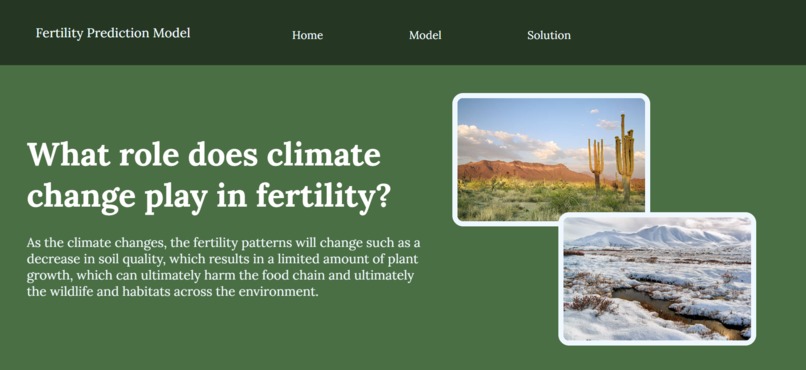
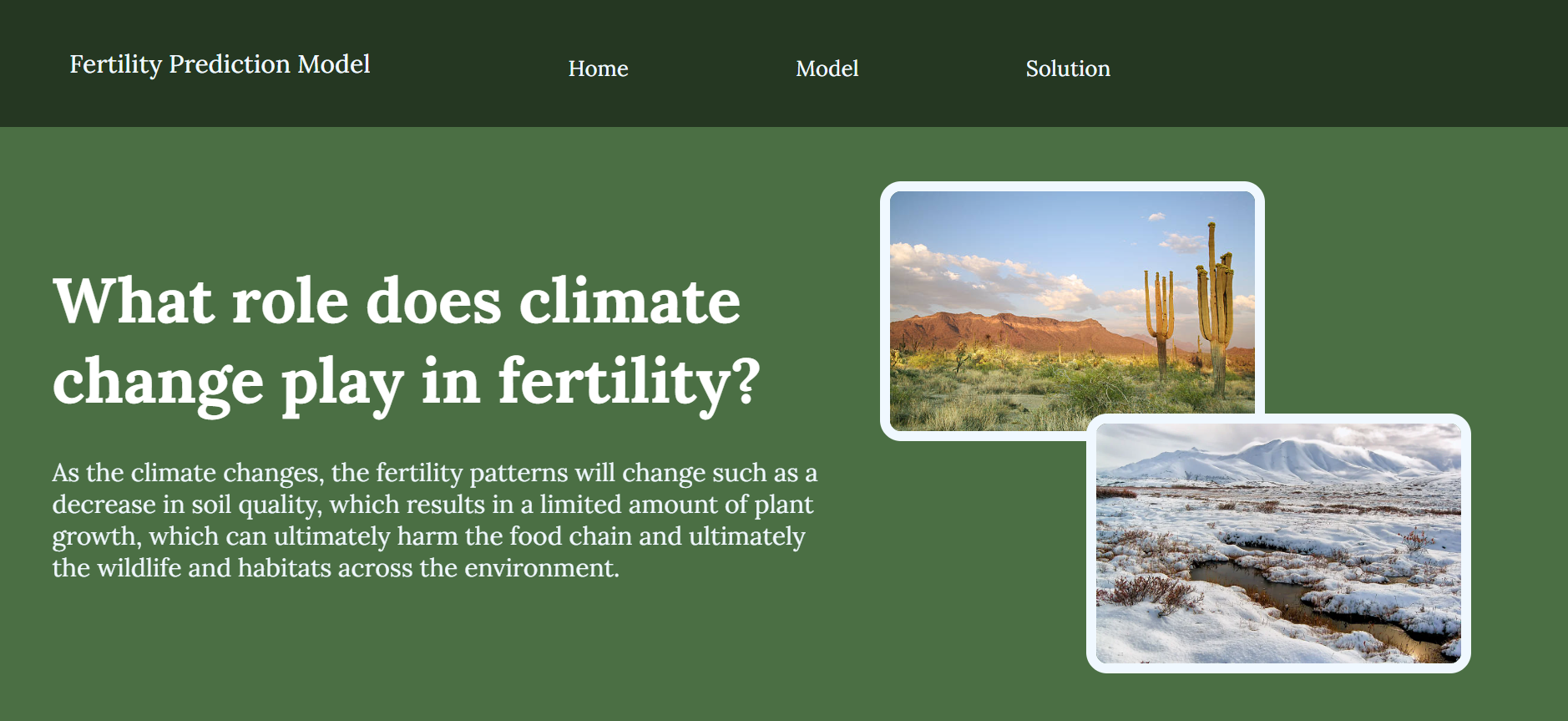
Home Page with Navigation Bar
-
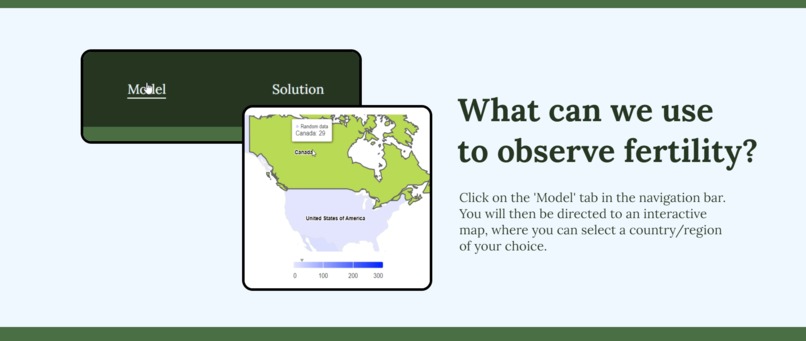
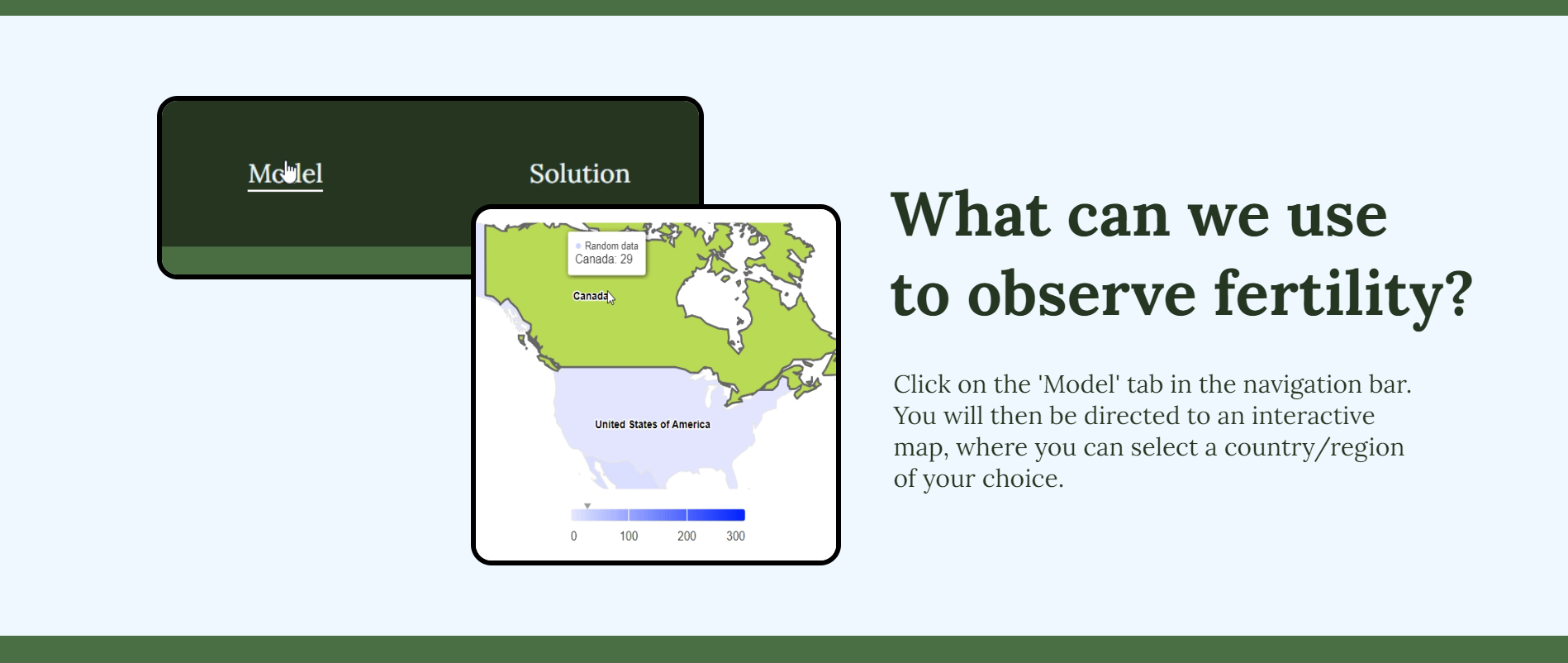
Second part of home page
Inspiration
I went on a walk outside and I noticed different patches of land. One patch of land just so happens to be dry and dusty and another patch of land is moist and muddy. By looking at the land, I begin to ponder of the impacts of lands that are both dry and dusty AND moist and muddy across the world and how they affect the habitat of civilians and wildlife. I was also reminded by the "Fertile Crescent" which kickstarted the transition of humans from the tribal hunter-gatherer lifestyles to a lifestyle based off of agriculture and cultivation of crops. This further empowered me to understand the correlation of climate and weather between fertile, nutrient-dense land sustainable for farming and any major cultivations required. Thus introduced the "Fertility Prediction Model", where predictions on fertility over the land were made.
What it does
The fertility prediction model assesses and predicts trends in fertility over a selected country. The fertility prediction model evaluates the level of fertility based on soil quality, climate and the rainfall distribution of the land. Once the fertility prediction model makes it's assessment, then the fertility prediction model will provide solutions for future generations and possibly future governments so that they can take the most appropriate action.
How we built it
The production of this web application was full-stack as it integrated both front-end and back-end principles. For front-end, the React library of JavaScript as well as JSX and CSS were used in the development and styling of the website template. For back-end, Express.js and Docker were used to handle front-end code and changes made to the front-end code through user input. We also added the Hugging Face library in JavaScript to produce preventative solutions towards helping an area maintain it's current fertility. To store, retrieve and manipulate data, MySQL was used with both the front-end and the back-end code. As for managing different versions and collaborating on code seamlessly, the Git tool was used to push and pull changes made to and from the GitHub repository (respectively).
Challenges we ran into
There were a lot of challenges in particular that we ran into, such as:
- Looking for different categories of data from different websites
- Accidental deletion of crucial files (luckily Git was used)
- Overlap of images and text in the website for different screen sizes
- Misalignment of JSON files in the main source folder of the repository.
Accomplishments that we're proud of
Despite the challenges we've faced there were also some accomplishments that we were proud of, such as:
- Success in communication between front-end and back-end code
- Success in configuring databases and seamlessly using it with back-end code
- Successfully predicting changes in fertility, climate and rainfall through multi-linear equations and then displaying the information through line charts.
- The layout and animation of the website through React.
- The use of Generative AI through Hugging Face to produce a preventative solution towards helping an area maintain it's current fertility.
What we learned
Upon competing in this hackathon there were several interesting lessons which helped all of us build a greater dossier of skills, more specifically we learned about React and Express.js and how they serve as a powerful library and framework, respectively, for web development. We also learned about important tools to handle code and data such as MySQL, Git and Docker.
Besides technical skills with real tools to help us develop this powerful web application we also learned about skills related to working in a team, such as communication, collaboration and leadership. Those 3 qualities that exist in everyone in a group will further enhance team chemistry and will also serve as foundational personality blocks
What's next for Fertility Prediction Model
We hope to improve our skills in React, Express, MySQL, Docker and Git to develop an even more powerful fertility prediction model that is supported on any device possible not only through layout but through computational power used as well.

Log in or sign up for Devpost to join the conversation.