-
-
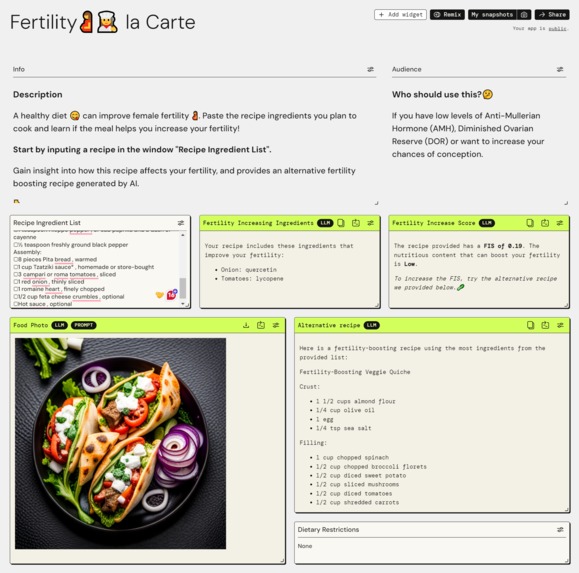
User Playground
-
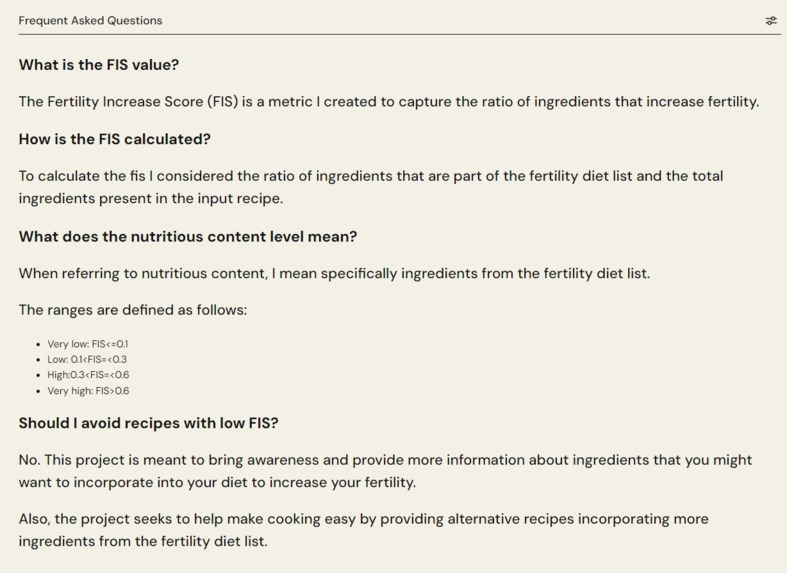
FAQ
-
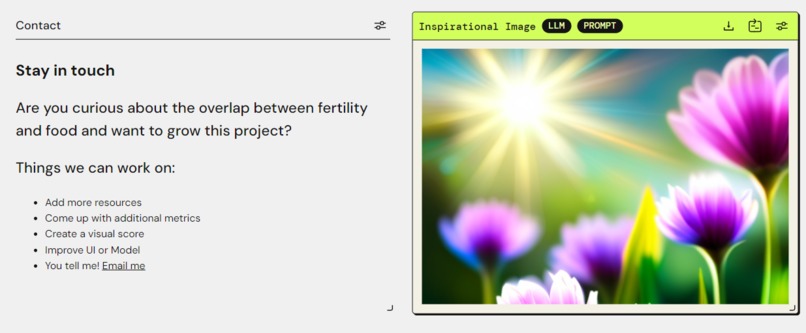
Contact
-
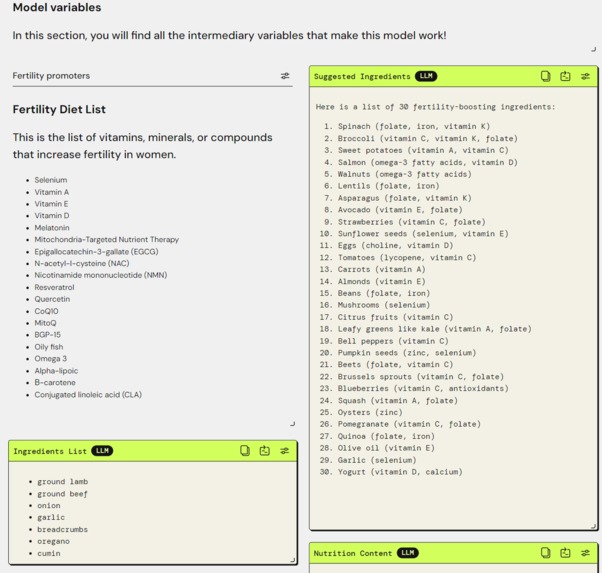
Model variables - top
-
Model variables - bottom
-
Citations
Inspiration
I learned recently that I have low Anti-Mullerian Hormone, a hormone produced by cells in ovarian follicles and it's used as a marker of ovarian reserve (or fertility). At first, I felt devastated because I thought there was nothing I could do about it -typically as women age we are bound to lose our fertility. However, I started learning from multiple research studies that even though my chances would be lower than someone without the condition (or younger), I could still increase by 40-60% my AHM, rehabilitate my follicles and increase chances of conception without any additional treatment. So I decided to make it easier for women who either fall into conditions like Diminished Ovarian Reserve (DOR) or low AHM, or simply, they just want to be as fertile as they can, by bringing awareness of the effects of our daily meals. We can improve our fertility if we choose fertility-boosting ingredients. That's how Fertility🤰👩🍳 à la Carte was born.
What it does
The app works in two steps:
1. Understanding your meal
Meal awareness
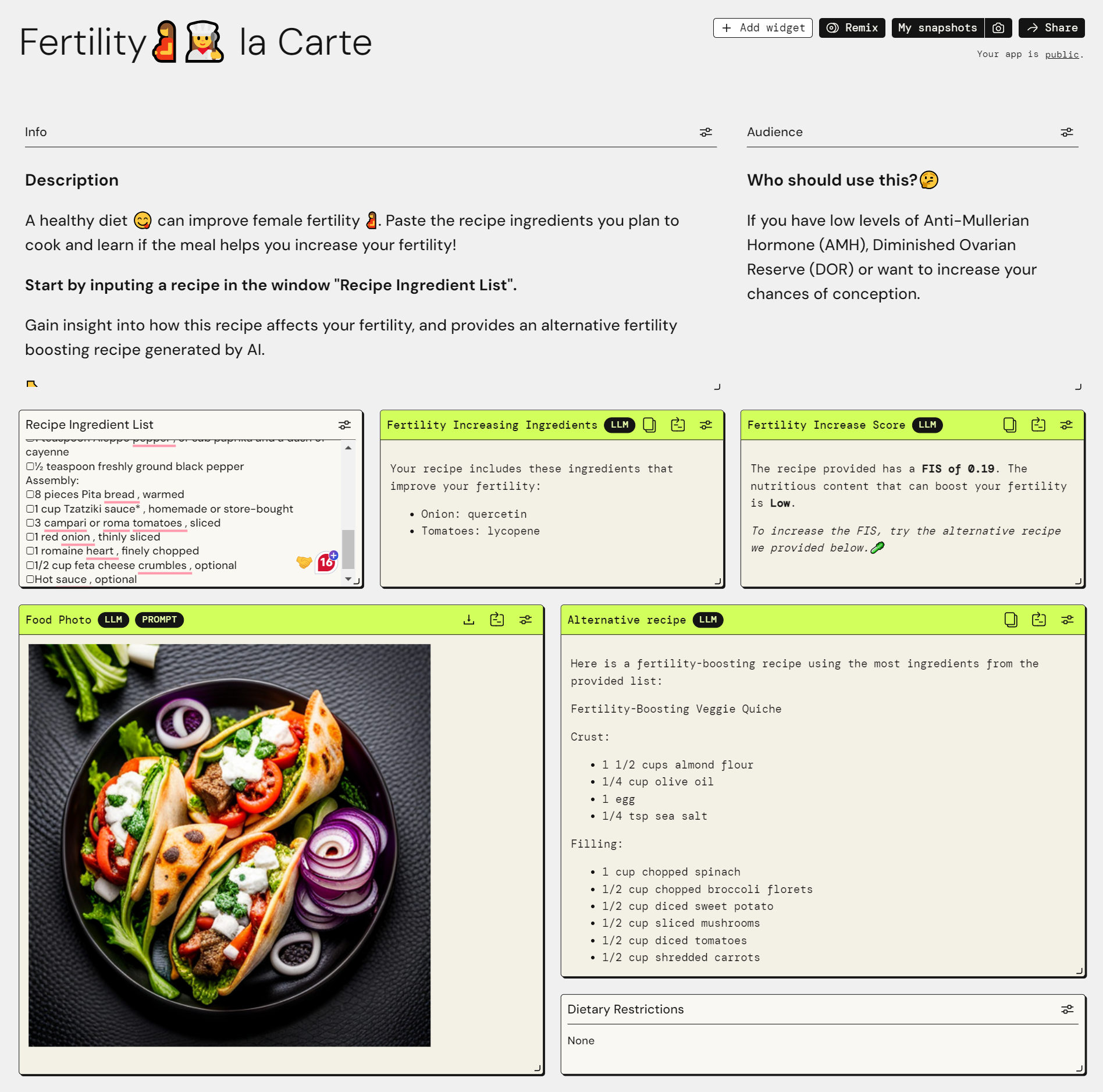
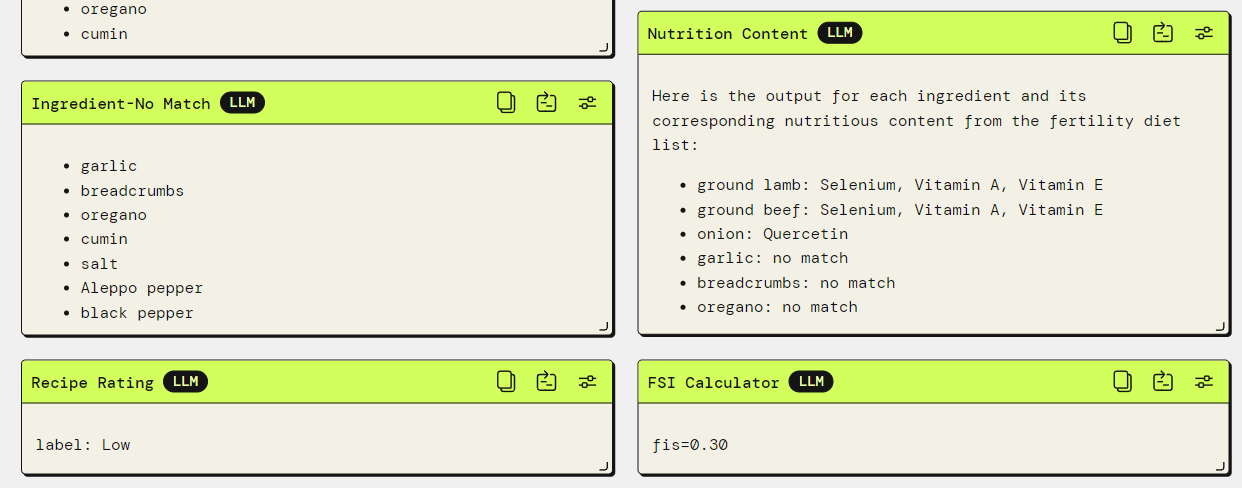
The user provides a recipe they are interested in cooking. Fertility🤰👩🍳 à la Carte analyzes the ingredients present in the recipe and shares which ones fall in the category of "fertility-boosting."
Rating
Aditionally, it provides a Fertility Increasing Score (FIS), a value between 0 to 1, and a rating between Very Low, Low, High, Very High. The FIS is the ratio of fertility-boosting ingredients and total ingredients in the recipe.
2. Fertility-boosting Alternative
Given the original recipe inputed, and a list of ingredients that boost fertility, Fertility🤰👩🍳 à la Carte provides an alternative recipe for you to cook. The alternative recipe will have a higher FIS.
Additional information
Ingredient awareness
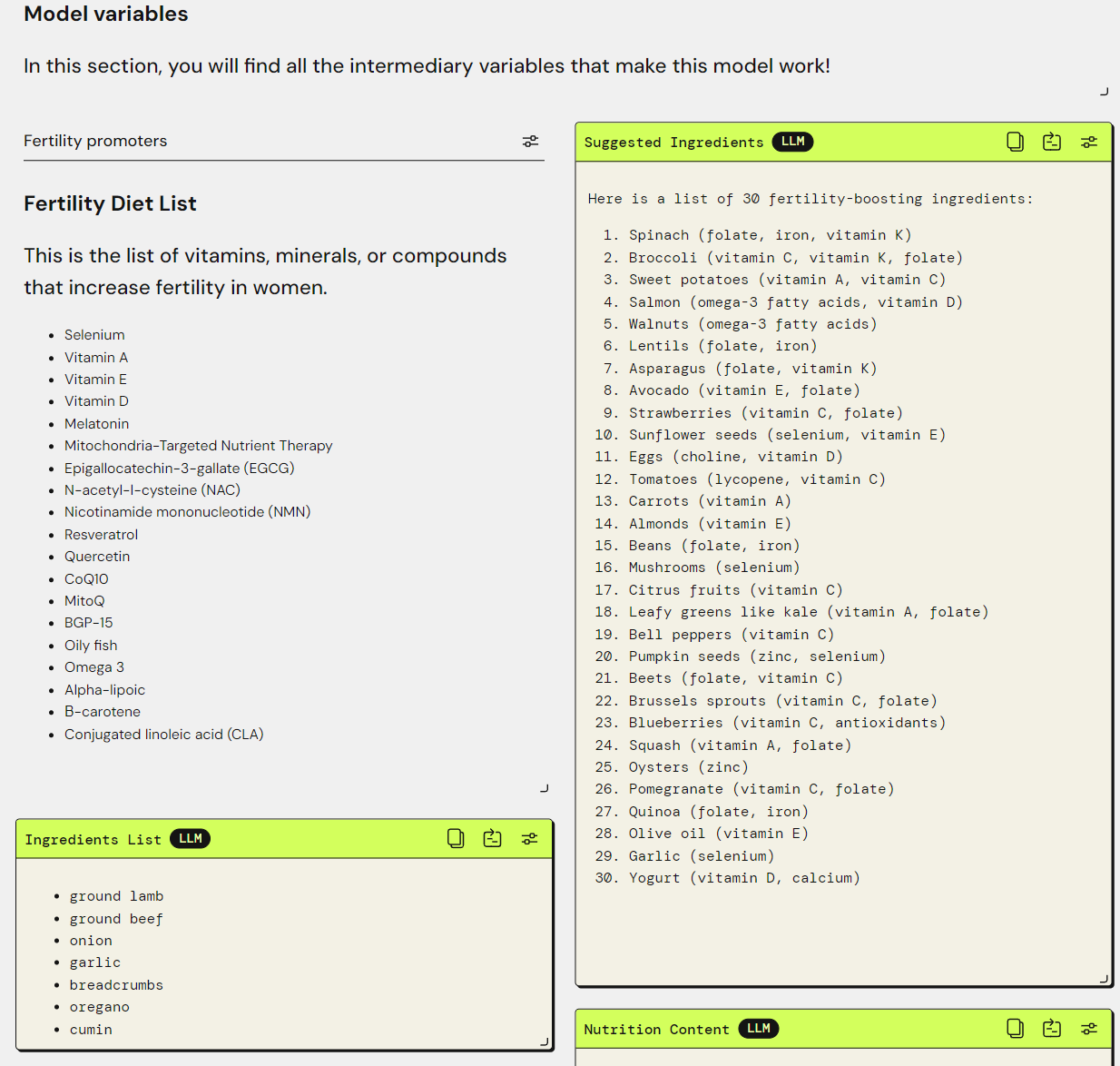
We also provide a list of ingredients that may help increase female fertility. The user can learn and become aware of ingredients to keep in their pantry or fridge.
Food Photo
The food photo tries to guess the user's original recipe based on the ingredients input. I am a firm believer in deconstructing dishes by their ingredients, so the generative model tries to do it. When the model doesn't show a photo of the meal accurately, it serves as an inspirational tool by showcasing ingredients in a new visual and appealing way. Whenever the user prepares the alternative recipe suggested, they can use the food photo to break molds of their original expectation and feel motivated to prepare something different.
How I built it
The application is divided into four main areas:
- User playground
- Learn more - FAQ
- Model variables (backstage)
- Citations
User playground
The user playground is the main face of our app. It quickly explains the audience and how to use the app. In there you find the user input window, the recipe analysis with the food photo, and the alternative fertility-boosting recipe. The user can also incorporate dietary restrictions. I expect users to spend most of their time here.
Learn more - FAQ
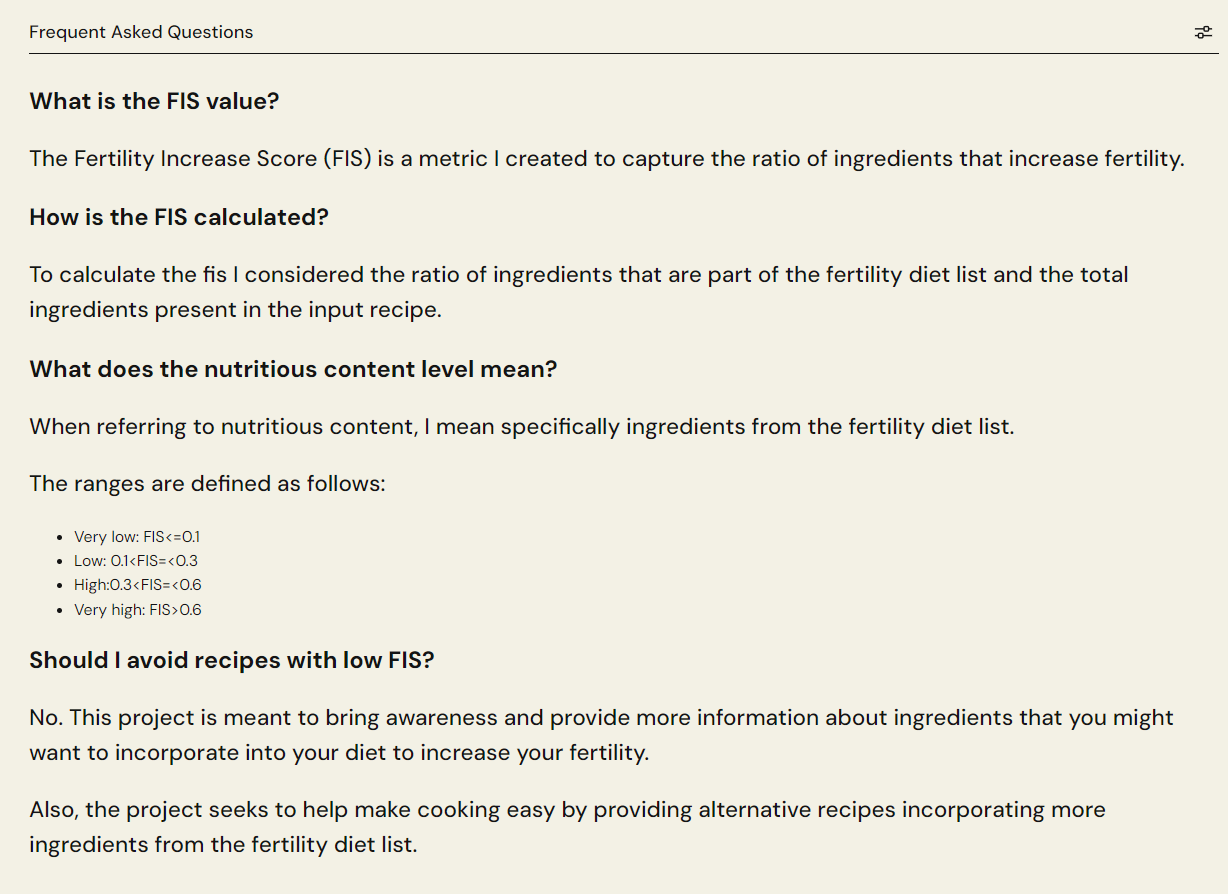
I created a metric to guide the users, the Fertility Increasing Score (FIS). Given that this is a new metric and user's might be interested in learning how is calculated and why they should trust it, I created a FAQ section. In the FAQ I cover what is the FIS, how it's calculated, how are the ratings (Very Low, Low, High, Very High) defined, and the intent of the metric.
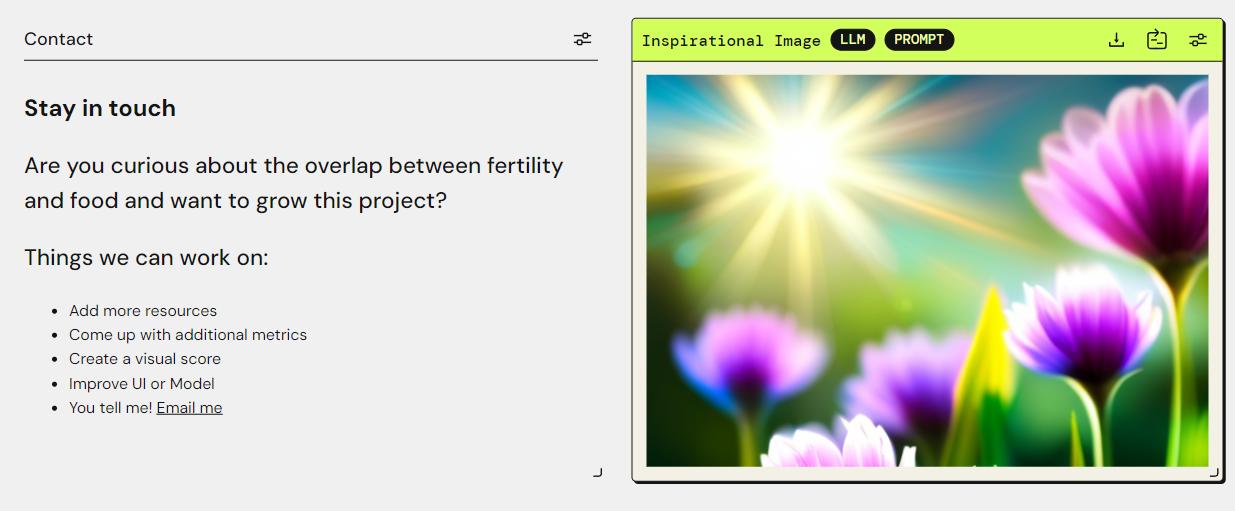
I also included a section with my contact information so I can receive feedback from users on how to make this app better. Next to it, I added an inspirational image to prompt the users with a feeling of friendship and fertility and make me seem approachable (compared to a wall of text).
Model variables
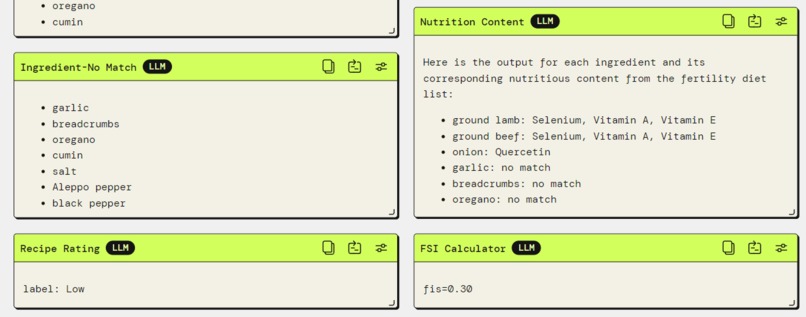
This section is comprised of the model variables I needed in order to create the user playground. Giving too long prompts in a window reduces the accuracy of the output. I needed consistent outputs, and therefore, provide smaller, chuck-sized tasks to the LLM. In there, the user gains transparency of what's happening "backstage."
Citations
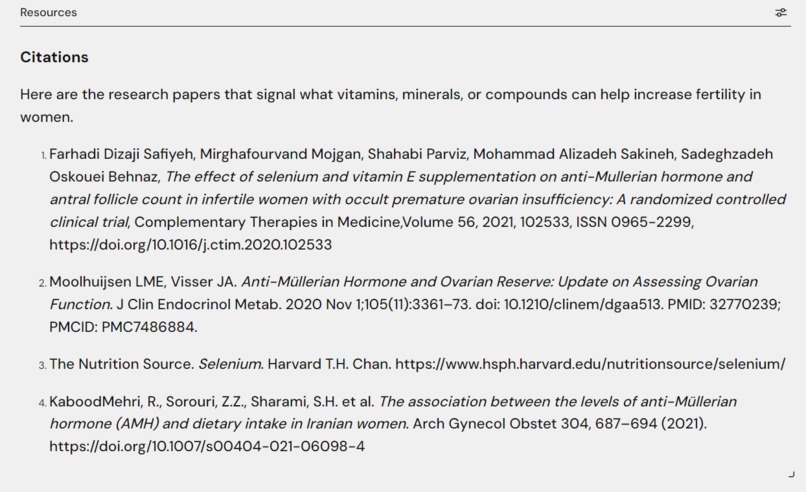
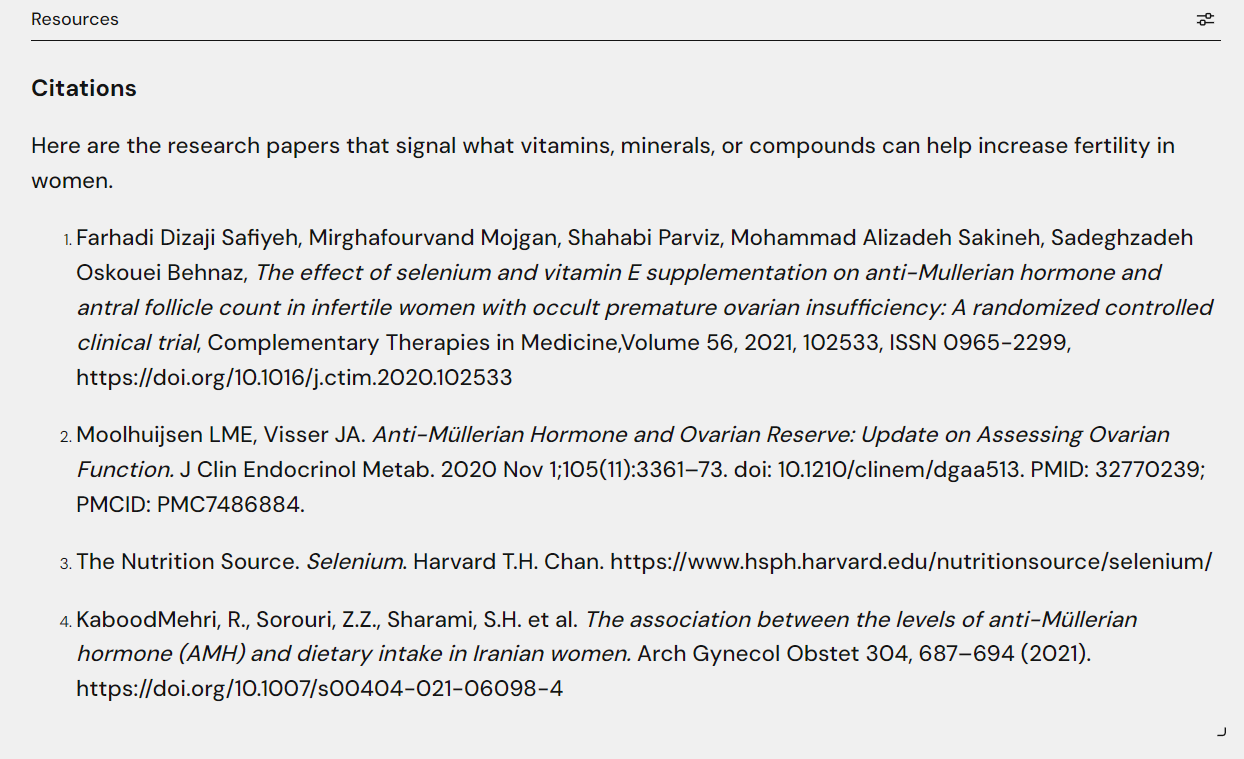
For those who are wondering, "Is this actually real? is the creator trying to bring false hope to women looking to conceive?" I included the citations. Research papers or high-reputation sources from which I extracted the list of vitamins, minerals, and compounds that have been proved to increase fertility. Some of them are particularly focused on DOR and low levels of AMH.
Challenges I ran into
The PartyRock app builder surprised me due to its quick learning curve. Although, I faced the following challenges:
No training option - coming up with the FIS metric sparked the idea of adding an image of a rating label. I wanted a simple square colored in red, orange, yellow, or green with the corresponding rating label (e.g. High), so visually, the user could see if the recipe had a good amount of fertility boosting ingredients. The stable diffusion model didn't cooperate. No text was possible to incorporate. I tried using emoticons, but the model would not produce them. Producing any kind of face would result in a weird-looking human-like shape that would disturb the user. So I decided to not at a visual label and keep a text with an explanation. I spent a good amount of time here, with bad results. If I could input a couple of few shot examples to train the model, I think it would have worked well.
Proper outputs - When I provided long instructions, the LLM output was not consistent. So, I had to divide the different stages of analysis into smaller models.
No link to user input - I wanted to generate some information like the suggested ingredients list and an inspirational image always, the moment the user opens the app. It turns out those windows would remain blank because they would not detect a change. I had to link them to the user input, even if not information from there was needed and so the LLM would run. It would be nice if one could by default initialize those windows without the need of a specific link to the user input.
Markdown limitations - I wanted to show each paragraph with hanging indentation when adding the citations. This was impossible. Usually, one could try to add HTML tags in the markdown that would have solve this issue. Instead, the window would not recognize this, and I left the current formatting. Additionally, I wish I could control the text size; a lot of the text looks quite large.
Color limitations - It would have been nice if I could change the color of the app to make it clearer where the input is. I asked people to test it, and initially, it was confusing where they needed to input the recipe. After multiple feedback sessions, I optimized the text and window location and made it clearer. I still think having more control over the window color could help.
Accomplishments that I'm proud of
Well, first of all, I am proud that I investigated about this issue, typically bringing isolating emotions and reducing mental health due to feeling powerless. I learned that I have power in my fertility!
Regarding the app, I'm proud that the users who have tried it have found it interesting and have told me comments regarding awareness and the app being very informative. I hope they become inspired to incorporate ingredients the boost fertility whenever they try to conceive or maybe use it as a new meal prepping lifestyle. My goals was to bring awareness to female fertility through meal planning and cooking, and especially now, when women are deciding to conceive later in their life (past 30s).
I'm also proud of making the app easy to digest. A lot of people might find it time consuming, or complicated reading into all the research papers and then extract the information to improve their meal plans.
What I learned
I learned that anyone can build an interactive app in a very short amount of time, as long as they keep tweaking and improving the outputs. Patience is key, as well as understanding the limits of a LLM.
Additionally, I learned that I value transparency. I think my application might seem overwhelming compared to other apps that are simple (no citations, or model variables), maybe making it less appealing. So I wish I could have an option to "show more or less" option, so the User Playground remained clean and simple, but if the user wanted to learn more, they could click to make visible other parts of my model.
What's next for Fertility🤰👩🍳 à la Carte
I would love to focus on the following:
- I would love to get more user feedback to understand what kind of outputs users would like to see.
- Add high-rating recipes and allow the user to save them into their account.
- Add visual ratings.
- Increase the resources on the topic and provide more accurate associations between ingredient and their nutrition content related to boosting fertility.
- Create a space for a community of users to share the recipes they found to be high in fertility.
- Add a space for women who conceived after being detected with DOR or AHM, thanks to their diet changes.
- Share resources that will raise awareness about measuring female fertility so more women know their current fertility condition (e.g., blood kits that provide the level of AMH or other similar hormones). Knowledge is power!
Built With
- claude
- partyrock
- stablediffusion


Log in or sign up for Devpost to join the conversation.