-
-

Ferris Homepage
-
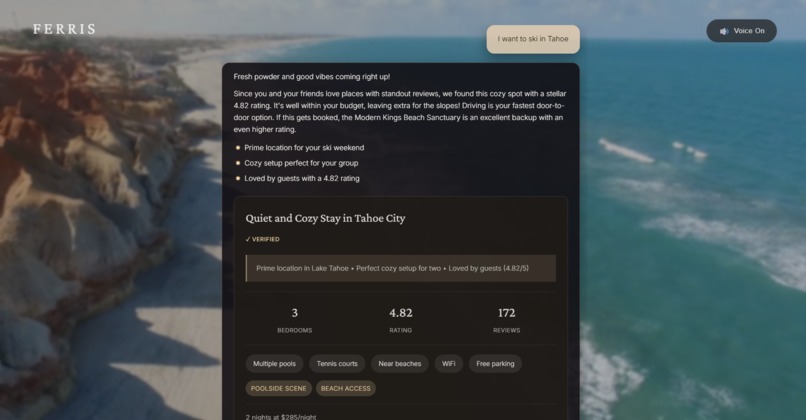
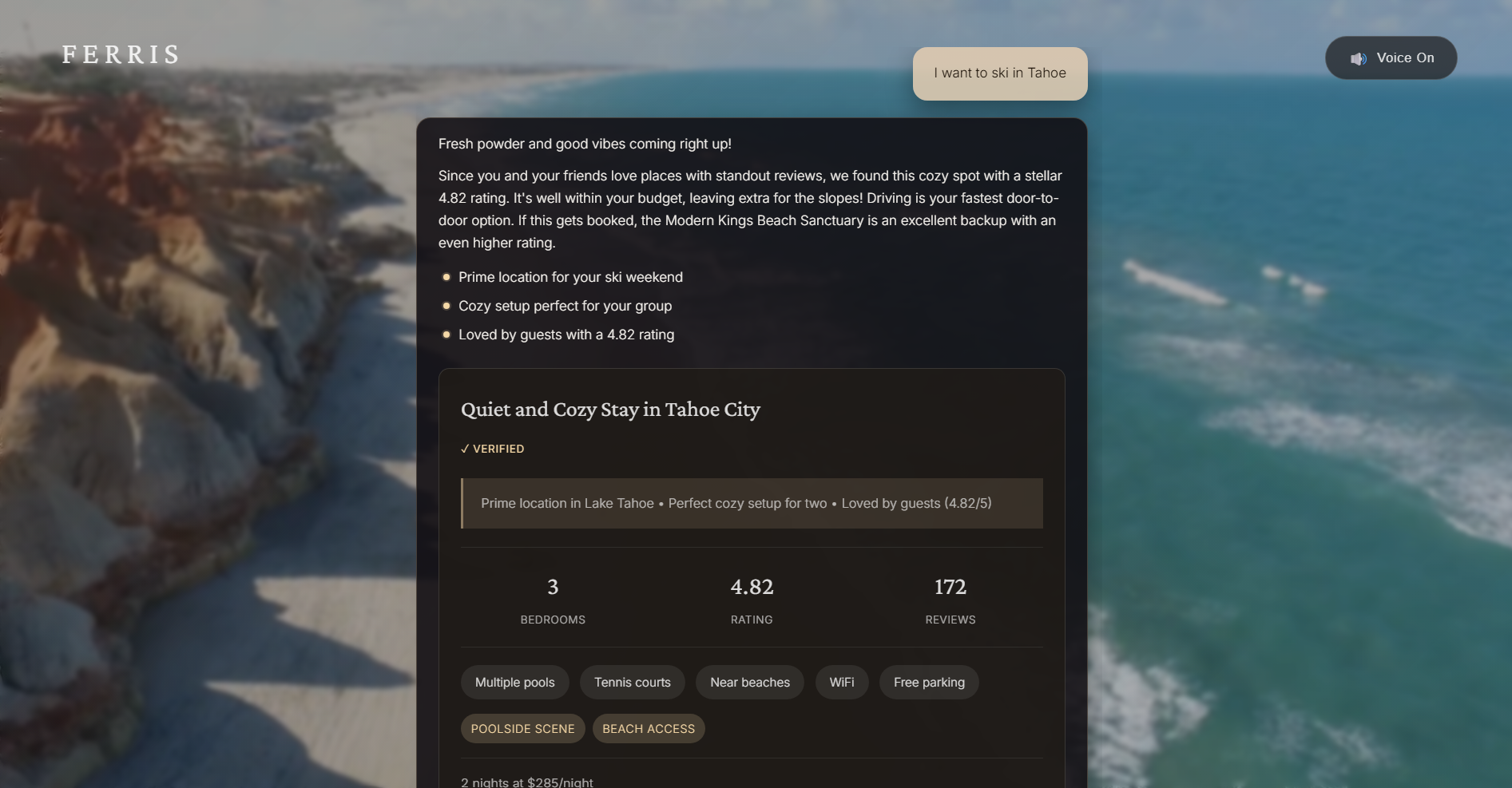
User Prompting
-
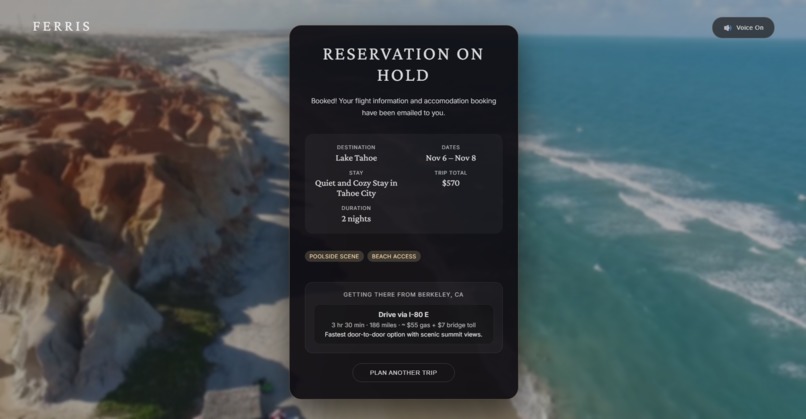
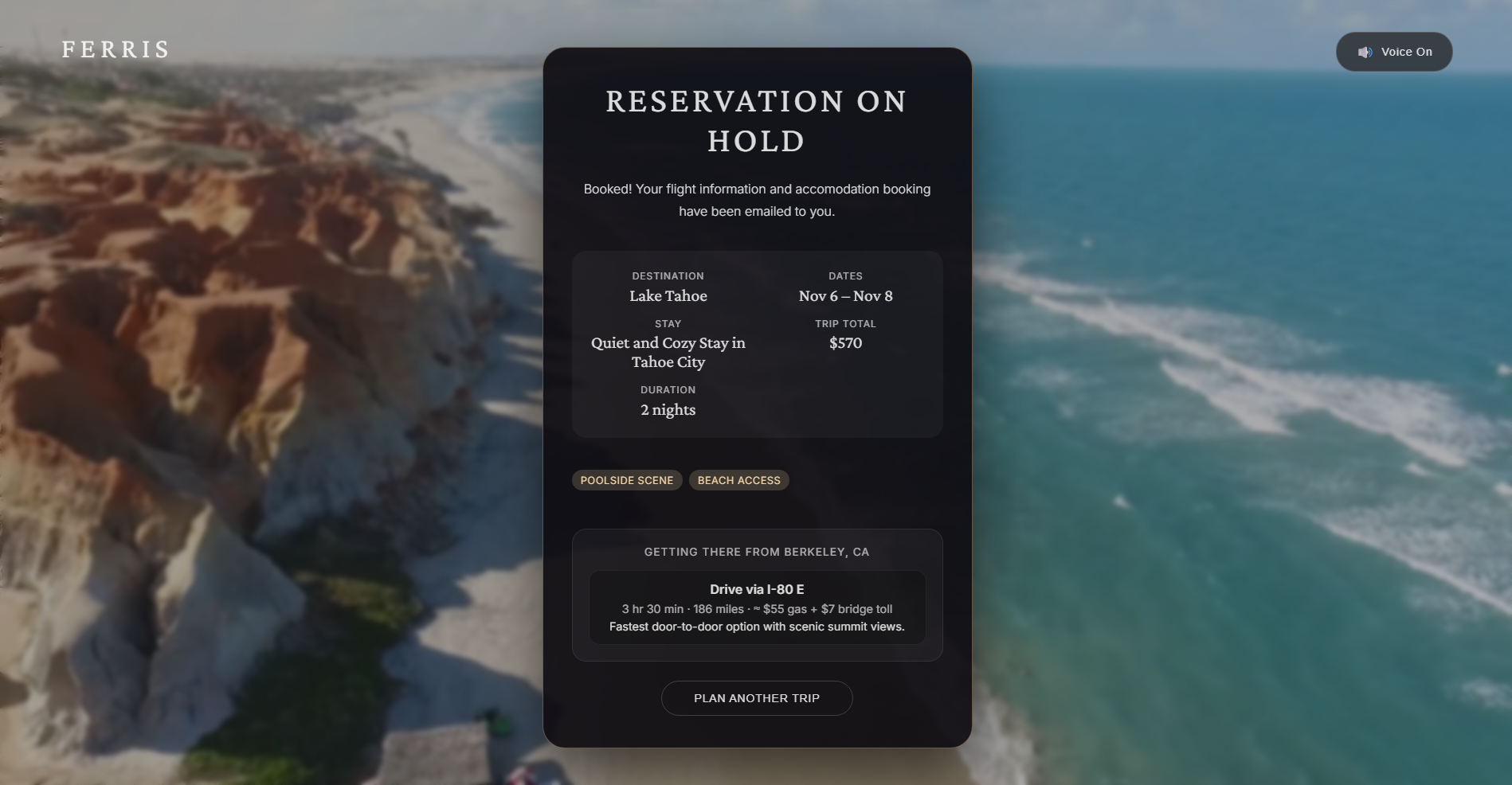
Trip Booking

Inspiration
Every friend group has that one person who ends up doing all the work when it comes to planning a trip, researching stays, comparing prices, checking reviews, and coordinating with everyone else. We have all been there, and we know how exhausting it can be. What should be a fun and exciting experience quickly turns into hours of tabs, spreadsheets, and indecision.
Ferris was inspired by those moments when trip planning felt more like a chore than a getaway. We wanted to build something that takes the stress out of travel planning, so people can spend less time worrying about logistics and more time looking forward to the adventure itself.
By combining conversational AI, personalized recommendations, and natural voice interactions, Ferris brings back the joy of spontaneity, making trip planning as effortless as saying, “Find me a place for three near the beach this weekend.”
What it does
Ferris is an all in one travel booking agent that feels like a local guide who knows every hidden gem in town. Tell Ferris what kind of trip you want — “a weekend in San Diego for three people under eight hundred dollars” — and it instantly builds a complete itinerary with curated stays, restaurants, and attractions that match your vibe and budget.
Too tired to type? Just talk to Ferris like you would to a friendly local. Ferris listens, understands what you want, and handles everything from finding the right place to booking it for you.
With Ferris, trip planning feels personal and effortless, as if a trusted local friend planned it all for you.
How we built it
We leveraged AI to bring our vision of a friendly local travel agent to life. Ferris was built to understand natural language, make smart recommendations, and turn them into real bookings all within seconds.
On the backend, we used FastAPI with Python 3.11 to handle user input, itinerary generation, and booking logic. Our AI agent parses intent, ranks potential stays, and selects the best match using our custom scoring model. For data, we worked with mock Airbnb listings to simulate a real booking experience.
On the frontend, we built a responsive web app and a clean conversational interface that feels personal and natural. Voice interactions are powered by Deepgram for real time speech to text and text to speech, allowing users to talk to Ferris as if chatting with a local expert.
We also explored Vertex AI for advanced prompt orchestration and model serving, enabling faster and more context aware recommendations.
Everything comes together in a smooth 60 second flow. The user shares their travel idea, Ferris finds the one perfect place, and booking is only one word away: BOOK.
Challenges we ran into
One of the main challenges we faced was teaching the model to truly understand what users want. Translating natural and often vague requests like “a cozy weekend escape near the beach” into structured preferences required careful prompt design, fine tuning, and iteration. We had to make the system smart enough to infer intent while still keeping the experience simple and conversational.
Another challenge was generating accurate and relevant trip recommendations from our dataset. We worked to balance creativity with precision so that Ferris could suggest options that felt personal while still staying within the user’s budget and preferences.
We also spent time thinking about how to simplify the booking flow. Too many options can cause decision fatigue, but too little flexibility can feel restrictive. Finding the right balance in how much user input to allow became a key design question throughout development.
Accomplishments that we're proud of
We are proud of building a complete working prototype of Ferris in a short time. It was exciting to bring together different technologies and turn our vision into a real and interactive product.
Travel planning is a complex problem that involves understanding preferences, locations, and budgets all at once. We are proud that Ferris provides a simple and human way to solve that challenge. Seeing our idea come to life and watching it help people plan trips effortlessly was one of the most rewarding parts of the project.
What we learned
We learned how to approach a real world challenge through the creative use of AI tools and APIs. Building Ferris taught us how to combine different technologies to solve an existing problem in a more natural and user centered way.
We also learned how to use AI to improve our productivity and prototyping speed. From generating ideas to refining the user experience, AI helped us move faster and focus more on building a product that feels personal and helpful.
What's next for Ferris
We plan to integrate richer and more complex data sources from travel platforms such as Expedia to provide smarter and more accurate recommendations. As we expand, Ferris will learn from a wider range of listings, destinations, and pricing data to deliver even more personalized trip plans.
With more user interactions, we also aim to better understand individual preferences over time. This will allow Ferris to anticipate what users like and suggest trips that truly feel tailored to them, just like a travel agent who knows you best.
Built With
- css
- deepgram
- fastapi
- gemini
- html
- javascript
- python
- railway
- uvicorn


Log in or sign up for Devpost to join the conversation.