-
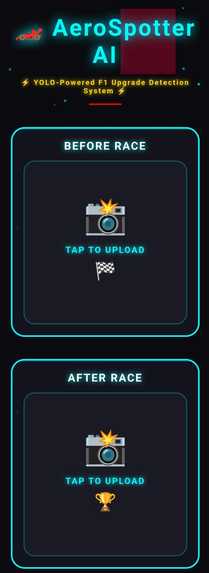
Prototype of our project idea
-
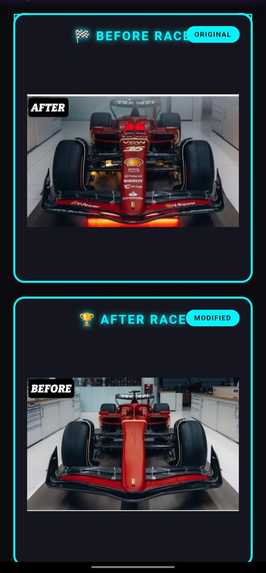
Prototype of our project idea
-
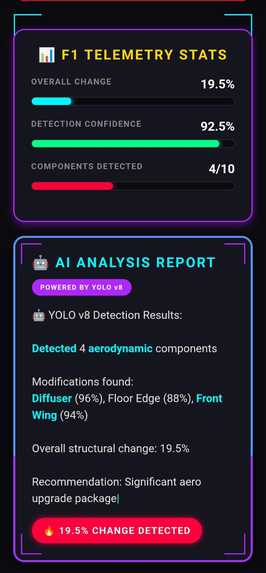
Prototype of our project idea
-
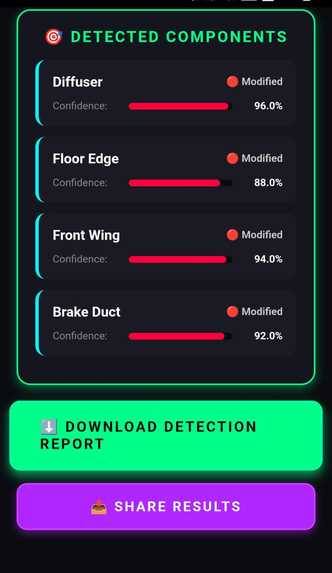
Prototype of our project idea


Inspiration
Our inspiration was sparked the moment we saw the Trackshift brochure. The event is sponsored by the MoneyGram Haas F1 Team, and Challenge Track 1 (Visual Difference Engine) explicitly lists "F1 car design tracking" as a key application. As F1 fans, we're fascinated by the intense, secretive nature of F1 development, where a tiny change to a wing or sidepod can mean the difference between winning and losing. We are instantly driven to build the exact tool that a team like Haas could use to gain a competitive edge, an "AI detective" to automatically spot these subtle upgrades.
What it does
AeroSpotter AI is our intelligent web platform concept designed to automate the detection of physical design changes on F1 cars.
The process is a unique three-stage pipeline: Align -> Diff -> Identify.
Input: An engineer provides a "before" image (e.g., car at Race 1) and an "after" image (e.g., car at Race 2).
Process (The AI Engine):
- ALIGN: The tool won't just subtract the images. It will first use computer vision to find and match keypoints, correcting for different camera angles and distances to perfectly align them.
- DIFF: Once aligned, it will perform a "smart" subtraction to create a clean "difference mask" that highlights only the meaningful, physical changes.
- IDENTIFY: Finally, it will run a YOLO AI model on this mask to draw a bounding box around the change and classify what part it is (e.g., "front wing," "sidepod intake").
Output: The engineer sees a final "diff" image that clearly pinpoints the new component, turning raw photos into actionable intelligence.
How we plan to build it
Our plan for the 24-hour hackathon is to build a full-stack application. We have a clear, two-part strategy to build in parallel.
The AI Engine (Backend): This is the core of our project. We will use Python, OpenCV, and Flask. The engine will be responsible for the "Align -> Diff -> Identify" pipeline. We will use OpenCV's feature-based registration (like ORB) to calculate a Homography matrix ($$H$$), allowing us to align the images and create a clean "difference mask."
The Platform (Frontend): We will build a user-facing dashboard using HTML, Tailwind CSS, and JavaScript. This polished, responsive interface will allow an engineer to upload their two images and see the final AI-generated analysis.
The frontend will communicate with the backend via a simple Flask API, sending the images for processing and receiving the results.
Anticipated Challenges (Challenges we plan to run into)
Our primary anticipated challenge is image registration. We know a "naive" pixel subtraction will be useless because real-world photos are never taken from the same position, angle, or lighting.
The core technical hurdle will be implementing a robust alignment algorithm using OpenCV. This means we will have to spend significant time learning and tuning the theory behind feature descriptors, keypoint matching, and homography to get a stable transformation. This is the "impossible" part for most, and it's the main battle we are preparing to fight and win.
Accomplishments that we're proud of (Our Plan's Strengths)
Our pride comes from the robustness of our plan. We aren't just planning a "hello world" script. We are planning an end-to-end computer vision pipeline that solves the real problem.
Our proudest accomplishment will be successfully implementing the Image Registration step. Our research confirms this is the key, and our plan to solve it (using ORB, findHomography, and RANSAC) is a complex, multi-stage process used in real-world applications. We're proud that our idea tackles the hardest part of the challenge head-on.
What we learned (Our Core Research)
Our research into this problem confirms that the project's success is 90% image alignment and 10% AI. We've learned that an idea that sounds simple ("spot the difference") is often incredibly complex in practice.
The "magic" isn't just plugging in a YOLO model; it's the unglamorous but critical work of robust feature matching and perspective warping in OpenCV. We've learned that a successful solution must solve this alignment problem first, which is why it's the absolute core of our plan.
What's next for AeroSpotter AI
Our plan for the hackathon is to build and connect our two main components: the JavaScript frontend and the Python/OpenCV engine, linked via a Flask API.
After that, our plan is to:
- Integrate YOLOv8: Plug in the pre-trained AI model to perform the final "Identify" stage.
- Full Automation: We plan to build a web scraper that automatically downloads images of each team's car from every race weekend, creating a "visual change-log" for the entire season.
- Broader Applications: This "Visual Difference Engine" is a powerful, reusable platform. We will create spin-offs for the other challenge applications, such as
AeroSpotter-Infra(to find cracks in bridges) orAeroSpotter-QC(for manufacturing inspections).

