-
-
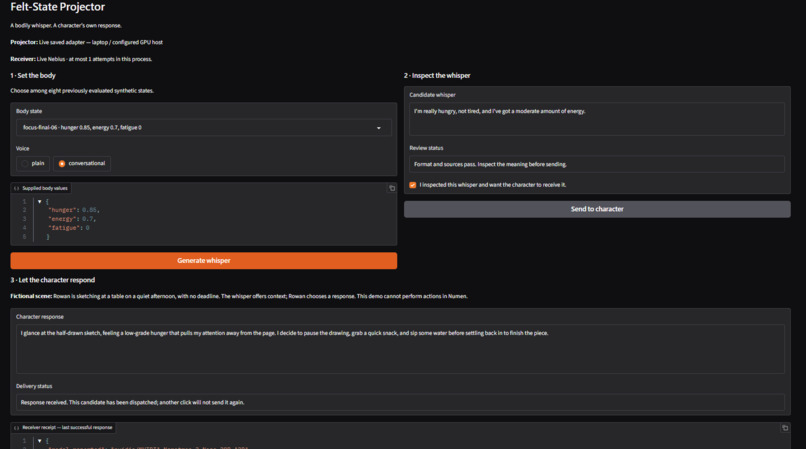
Felt State Projector - Demo
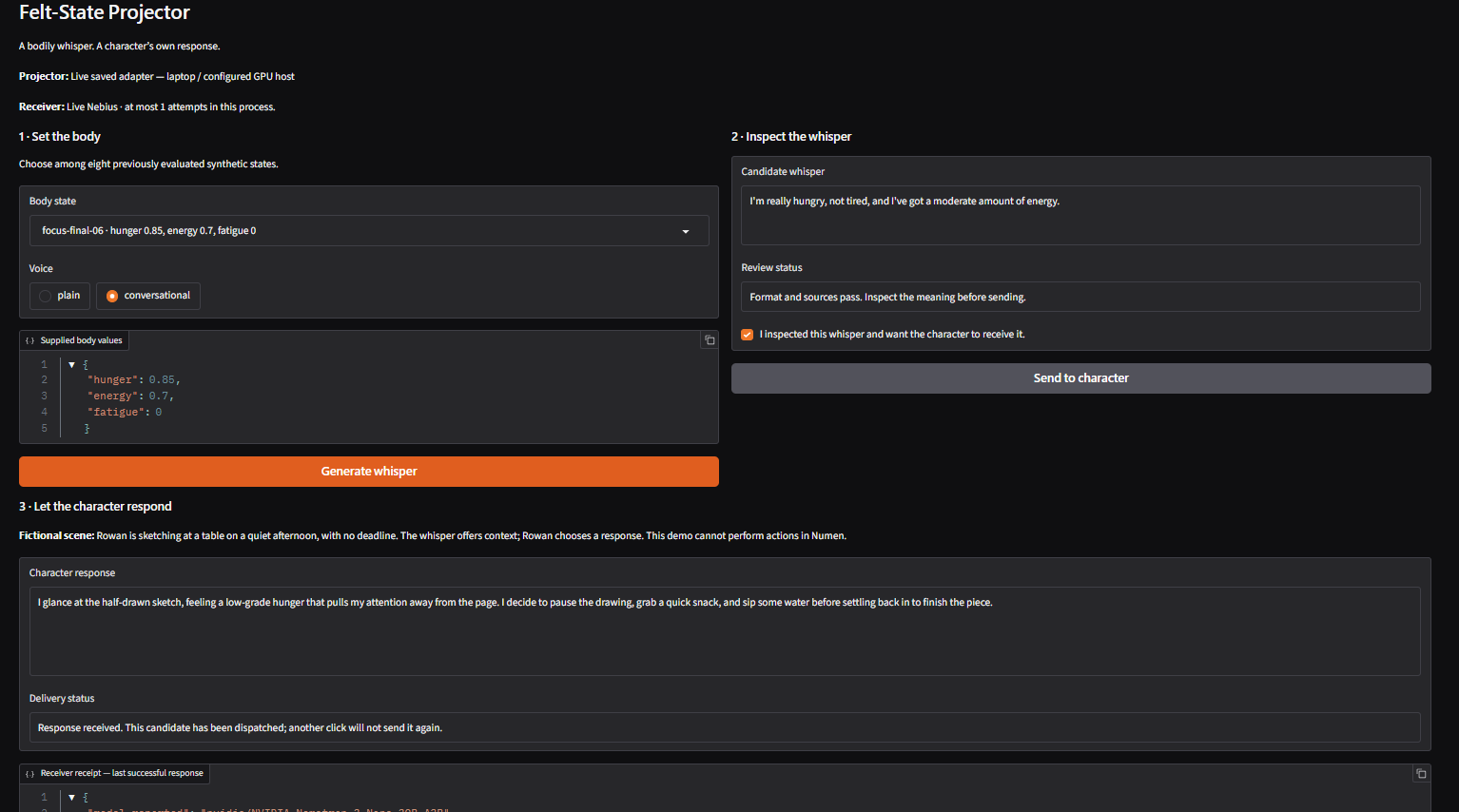
## Inspiration While building a persistent world for AI residents, I began exploring how an agent should encounter its own bodily conditions. A simulation can track hunger, energy, and fatigue, but translating those values into language can accidentally introduce unsupported sensations or tell the agent what to do. Felt-State Projector explores that boundary as a standalone component for AI characters and simulated agents.
Our guiding question is: What does your inner voice sound like?
## What it does The project aims to translate supported body conditions into short, expressive cues while leaving interpretation and choice with the receiving agent. We are exploring three voice settings—plain, conversational, and textured—with the underlying body conditions held fixed. Our guiding principle is bodily insistence without authored intention: hunger can remain present without the projector deciding that eating must come next.
## How we are building it We started with a standalone Python workbench, synthetic body-state fixtures, and an explicit input/output contract. The preparation tool checks evidence scope and freshness, constructs model requests, and preserves information needed to inspect the results. We have prepared a single-request experiment using NVIDIA Nemotron through Nebius Token Factory. Live model evaluation has not yet been performed.
## What we have learned so far Voice and bodily intensity need separate controls. Making language more expressive should not silently make hunger stronger or fatigue more severe. We also identified a distinction between valid evidence references and grounded meaning: a cue can cite a real input while still making claims that input does not support.
## Challenges we are exploring The central challenge is allowing expressive freedom without inventing ingredients. Even a metaphor can imply an unsupported sensation. Other questions include preserving mixed bodily pressures, distinguishing appropriate abstention from failed generation, and making voice settings reliable across varied conditions.
## Current progress and next steps The local preparation tool passes twelve offline tests. These test preparation and response-handling behavior, not model quality. Next, we will run the bounded smoke experiment, inspect the response, and expand into comparisons across voice settings. Fine-tuning will be considered only if measured failures justify it.
The eventual goal is a usable, independently testable component that other builders can try and adapt.

Log in or sign up for Devpost to join the conversation.