Behind the Design: Fellowship Bastion
Project: Fellowship Bastion: Guardian of the Eldree
Meta Horizon Username: @kakapro007
Inspiration
The spark for Fellowship Bastion came from a heart-pounding fantasy image: standing at the foot of an ancient, glowing world tree as an overwhelming tide of darkness crawls out from the shadows.
As a lifelong fan of high-fantasy epics—particularly J.R.R. Tolkien’s The Lord of the Rings—I was always captivated by the bi-tragic heroism of holding the last line of defense. Whether it was the Hornburg at Helm’s Deep or the White Tree of Gondor, the emotional weight of protecting a living symbol of hope was incredibly powerful.
I wanted to translate that emotional high into a mobile game. However, looking at the current mobile landscape, many tower defense games felt too detached; you place static turrets on a path and watch them shoot from a distance. On the other end, modern Roguelike survival games offered instant gratification but lacked deep, strategic spatial puzzle-solving.
Design Goal
My goal was to bridge these two worlds. I wanted to create a game where:
- Dynamic Alliance: Your defense consists of actual characters representing an epic alliance of Humans, Elves, and Dwarves, whose positioning on a staggered Hex Grid matters.
- The Eldree: You protect a living entity—the Eldree (the Sacred Tree of Light)—acting as both your core health pool and your source of magical progression.
- High-Dopamine Loops: The high-dopamine drafting loops of modern Roguelikes breathe immediate, unpredictable variety into every single run.
What It Does
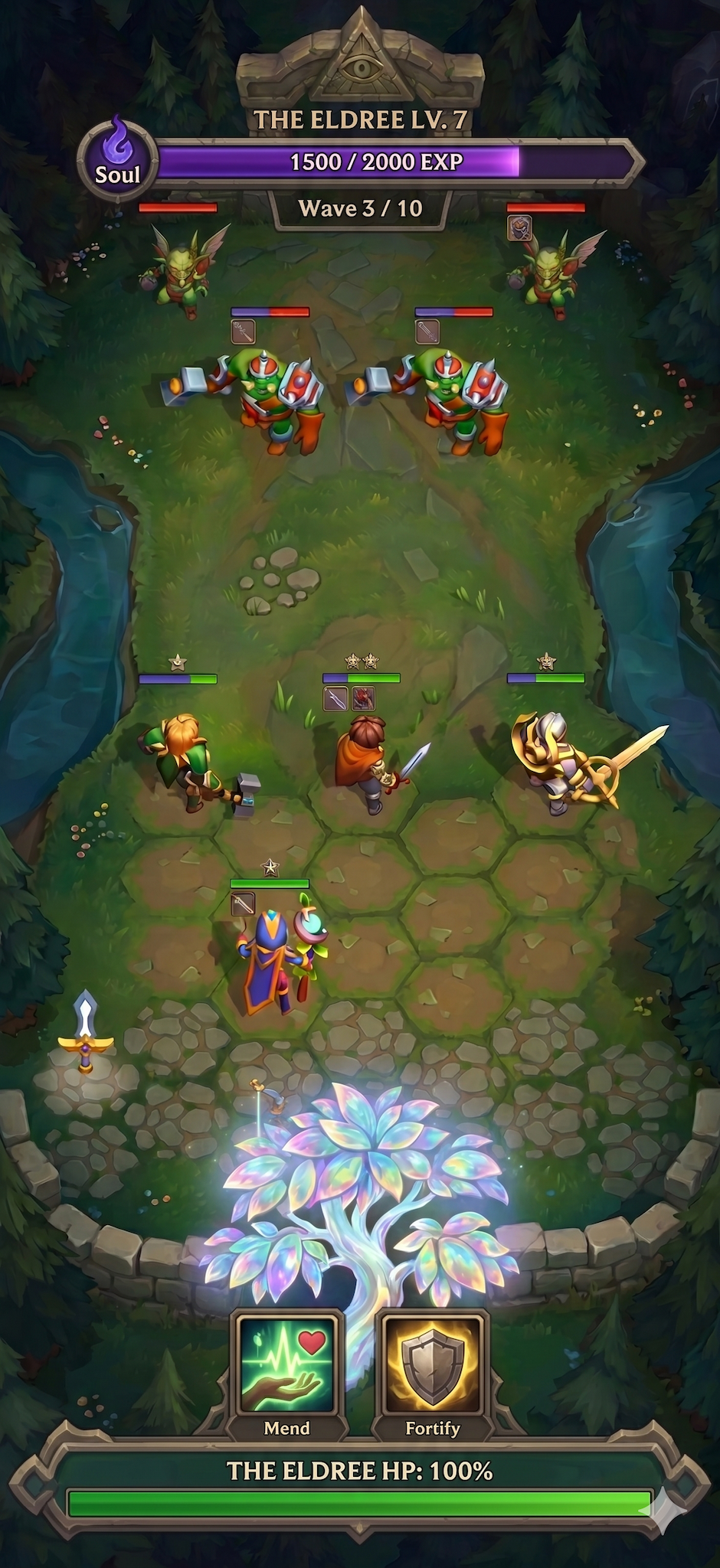
Fellowship Bastion is a portrait-mode mobile tactical tower defense game featuring a bottom-up lane defense structure combined with high-frequency Roguelike ability drafting.
Instead of standing on traditional fortress walls, 5 Heroes are deployed directly on a staggered, two-row Hexagonal Grid configured in a 3-vanguard, 2-rearguard layout at the bottom of the screen. Their sacred charge is to protect the Eldree, rooted at the bottom center of the interface.
Hordes of the Shadow Army descend relentlessly from the top of the screen. As Heroes slay these foes, the Eldree siphons their cleansed spirits into Essence. When the EXP bar fills, time freezes to present the player with a Roguelike Blessing (1-out-of-3 card draft) bestowing elemental weapon-imbues, area-of-effect spells, or defensive barriers.
By strategically placing classes adjacent to each other on the hex grid, players trigger unique spatial synergies (e.g., placing a Knight in front of a Ranger to activate armor buffs) and coordinate high-damage elemental reactions (e.g., combining an Elf's frost arrow with a Dwarf's fire axe to trigger a [Frostfire Burst]).
How We Built It
We built this design from the bottom up in three structured phases, ensuring all mechanics serve the physical limitations of mobile devices:
- Designing the Spatial Arena: Instead of a standard path, I designed a compact, staggered 5-hex layout configured in two rows (3 Vanguard, 2 Rearguard) sitting directly above the roots of the Eldree. This structure was designed mathematically to fit the vertical real estate of tall, portrait mobile screens with 19.5:9 aspect ratios, placing all drag-and-drop interactions within a comfortable 35% thumb-reach safety zone at the bottom.
- Establishing the Matrix (Factions & Classes): To give the grid strategic weight, I established a strict Faction-Class matrix. Factions (Elves, Dwarves, Humans) determine the elemental traits (Frost, Fire, Lightning), while Classes (Knight, Warrior, Ranger, Mage, Healer) determine combat roles and ranges.
- Drafting the 6-Week Roadmap: I mapped out a highly aggressive, rapid-prototyping schedule. By trimming all meta-progression, locking the game down to 3 core heroes, 1 single map, and 6 elemental cards, I constructed an actionable engineering roadmap to validate gameplay before producing heavy assets.
Challenges We Ran Into
Every design journey is paved with compromises, and building Fellowship Bastion introduced several critical creative and technical hurdles:
- Fighting "Feature Creep": In my initial brainstorming sessions, the game was massive, featuring procedurally expanding maps, dynamic environmental hazards, and permanent guild lobbies. Realizing that a bloated plan would result in a messy prototype, I aggressively cut features to design a tight, highly validated 6-week MVP schedule focusing purely on proving the spatial strategy loop first.
- Balancing Mobile Screen Readability: On mobile, screen space is precious. Having 5 lanes of descending enemies, projectile visual effects, floating damage numbers, and a 5-hex grid could easily lead to an unreadable "visual noise." I resolved this by utilizing the 60-30-10 Color Rule: keeping the background dark (60%), characters vibrant (30%), and reserving bright Neon Cyan and Gold (10%) exclusively for active spell effects, level-up particles, and UI buttons.
- Making the Healer Class Active: In many tower defense games, healers are passive, boring units. I struggled to find a way to make the Healer class feel satisfying. My solution was to design the Healer's projectiles to not only restore ally health but to actively target and cleanse the Eldree's roots. If a rogue enemy slips past your frontlines, placing a Healer near the tree lets you actively repair the core objective, turning the Healer into a high-stakes clutch savior.
Accomplishments That We're Proud Of
- Seamless Genre Fusion: We successfully bridged the gap between rigid tower defense positioning and fluid, high-dopamine Roguelike choices. Every level-up represents a genuine tactical pivot that can save a failing defense in real-time.
- Tactile Spatial Puzzle: We created a deep spatial puzzle using simple geometric link checks. Players do not need to read heavy text walls to understand synergies; placing a melee unit in front of a ranged unit immediately visualizes a bright link line of glowing energy, making tactical positioning incredibly intuitive.
- A Scalable Design Matrix: The Faction-Class matrix is incredibly flexible. While the MVP utilizes only 3 Heroes, the architecture is designed to scale to 15 unique Hero combinations without breaking the core balance of the game.
What We Learned
- Coherence Over Polish: The judges of Meta Horizon value a unified, consistent vision. It is far better to have stylized, consistent semi-chibi placeholders where every element belongs to the same universe, than to mix gorgeous, mismatched high-end assets.
- Scope is a Design Mechanic: Designing a game is like packing a suitcase for a long journey. If you try to bring everything, you won’t be able to move. Constraining the MVP to a strict 6-week timeline forced me to find the absolute purest, most fun core of my gameplay.
- Design for the Device: A mobile game must be played, not just looked at. Every design decision—from the bottom-up portrait lanes to the time-freeze card overlay—was driven entirely by the physical ergonomics of single-handed, thumb-only mobile play.
What's Next for Fellowship Bastion: Guardian of the Eldree
As Meta Horizon shifts its focus towards mobile-first, high-performance social experiences, we plan to evolve Fellowship Bastion beyond a single-player game:
Synchronous Mobile Co-op ("Duo Eldree" Mode)
Players will be able to instantly invite friends from Messenger or their Horizon feed to join real-time battles. Two players collaborate on a unified screen, managing a combined 10-Hex Grid to protect twin, interconnected Eldree trees. This mode introduces deep strategic coordination—such as one player drafting frost/support blessings while the other builds heavy fire/cleave damage to trigger cross-player elemental combos.
Remixable UGC Level Editor
Utilizing the high-performance Meta Horizon Engine and Horizon Studio tools, we would build an in-game "Level Editor." Players can customize spawn lanes, set custom wave speeds, restrict specific class selections, and place physical barriers on the board. These levels can be published directly to Meta Horizon as "Remixable Worlds," allowing other creators in the community to clone, tweak, and share their own tactical scenarios, driving endless organic community engagement.
Built With
- javascript
- meta
- metahorizon


Log in or sign up for Devpost to join the conversation.