

FeederSync Aqua
From water pumping to freshwater resilience
Agricultural irrigation sits at the intersection of two resources that are becoming increasingly constrained: water and energy.
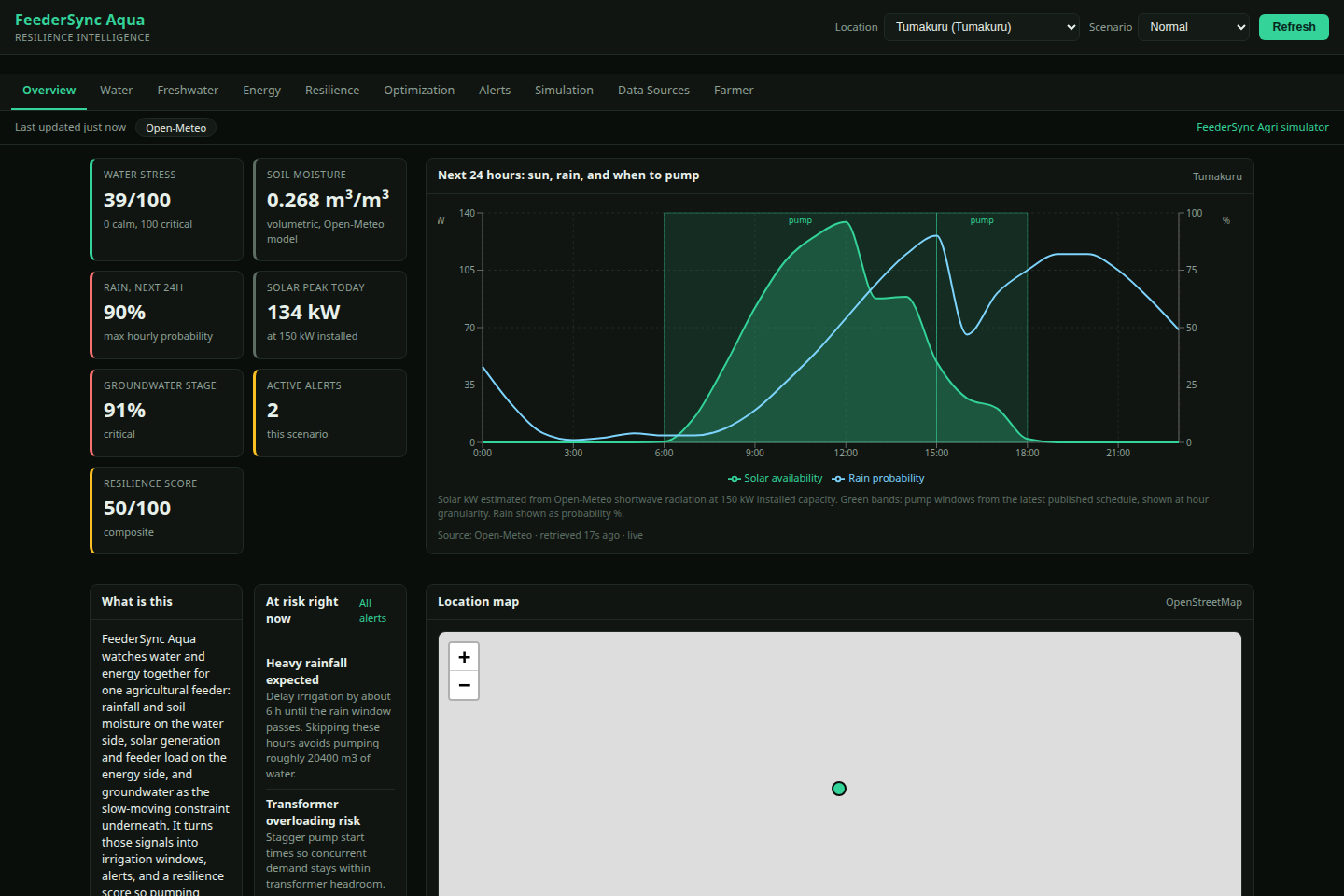
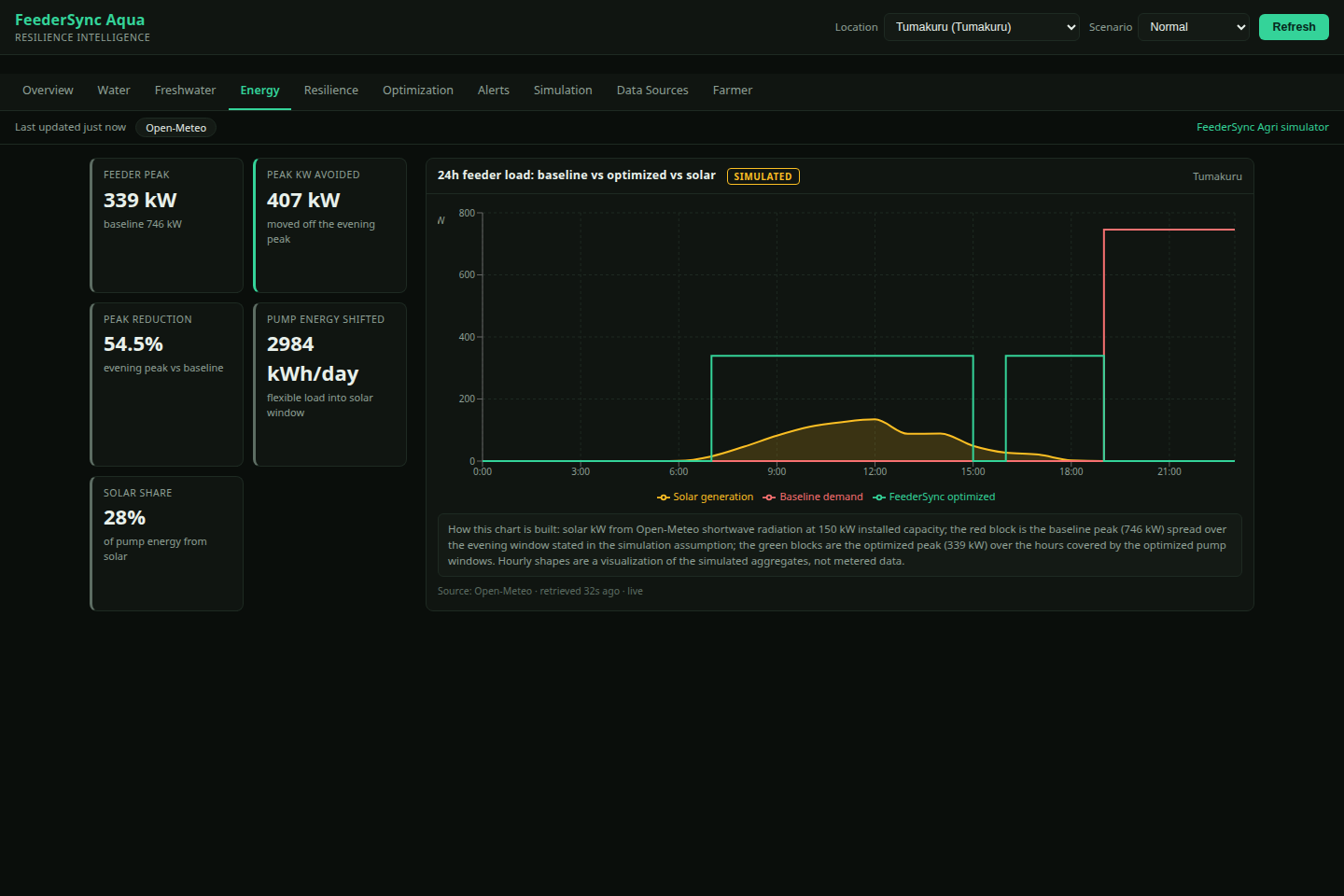
In many regions, farmers receive electricity for irrigation at inconvenient hours, while solar generation is available during the day. This creates a paradox: renewable energy can be available when irrigation demand is low, while farmers may be forced to operate pumps at night. At the same time, unnecessary pumping can increase pressure on already stressed water resources.
This inspired us to build FeederSync Aqua, an AI-powered water-energy resilience platform that coordinates irrigation with solar availability, weather, soil moisture and groundwater conditions.
The goal is not simply to make pumps smarter.
The goal is to make water and energy systems work together.
What FeederSync Aqua does
FeederSync Aqua acts as an intelligent coordination layer between agricultural pumps, electricity infrastructure and water-resource signals.
The system follows four stages:
Forecast
- Forecast day-ahead solar generation and feeder demand.
- Incorporate weather and environmental signals.
Optimize
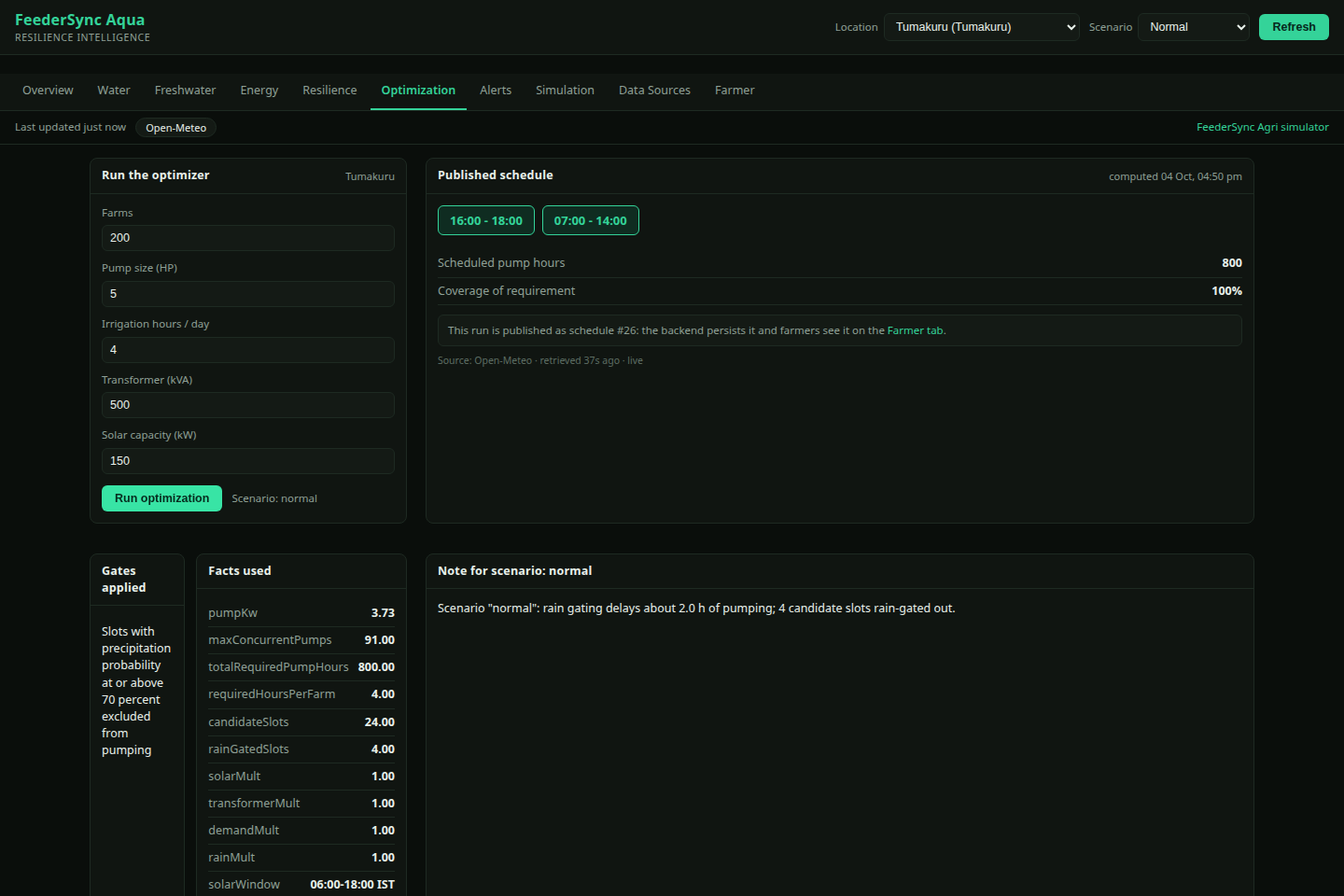
- Generate irrigation slots inside the available solar window.
- Respect transformer capacity and feeder constraints.
- Use soil-moisture information to avoid unnecessary irrigation.
Dispatch
- Coordinate pump operation through retrofit controllers.
- Provide schedules through app, SMS or IVR.
- Maintain manual override and farmer control.
Measure and settle
- Compare metered energy movement against a weather-normalized baseline.
- Quantify the value of shifting irrigation.
- Enable transparent farmer incentives through digital payments.
The original architecture is deliberately hardware-light. Existing pump infrastructure can be retained while intelligence is added through a software and edge-control layer.
Why water is at the center
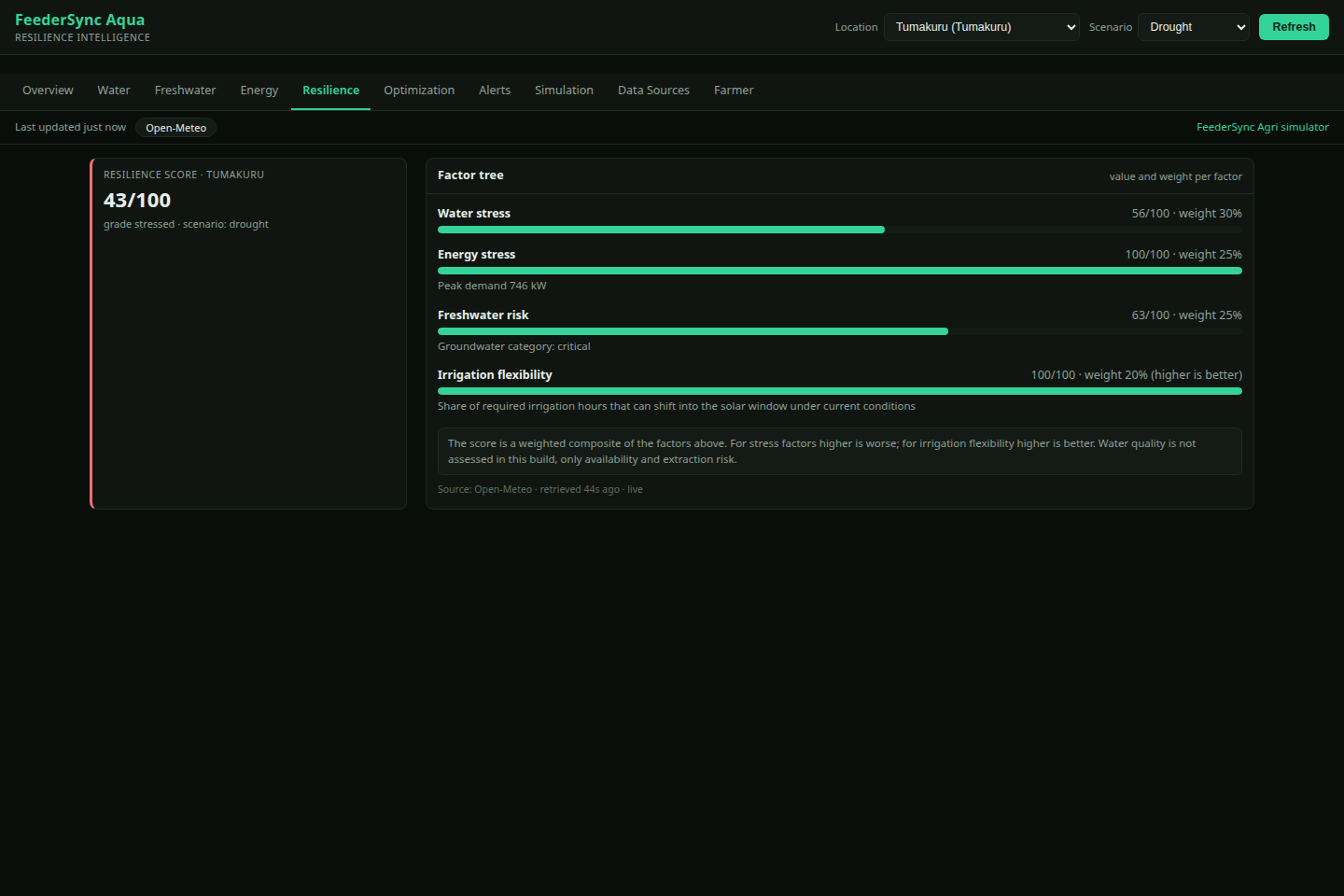
The key insight behind FeederSync Aqua is that water resilience cannot be treated independently from the systems that move water.
Irrigation decisions depend on more than electricity availability.
They depend on:
- soil moisture
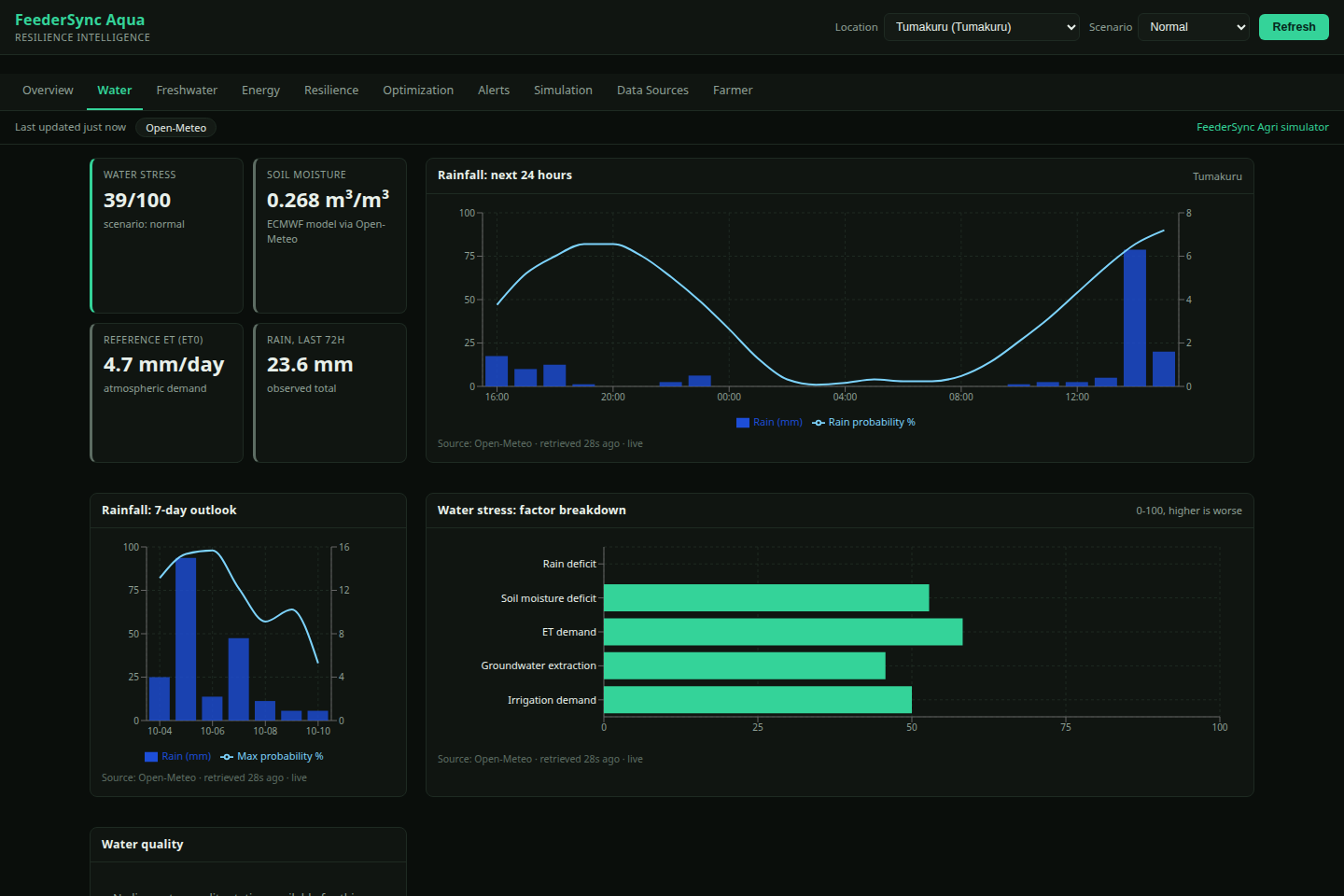
- rainfall and weather
- irrigation demand
- groundwater conditions
- solar availability
- feeder capacity
- pump operation
- water-use efficiency
Our longer-term architecture therefore extends the scheduling engine toward groundwater-depth sensing and water-table-linked irrigation decisions. This is part of the proposed scale-up roadmap.
This creates a feedback loop:
Environmental conditions → AI assessment → irrigation decision → water/energy outcome → measured data → improved future decisions
That is the foundation for a more resilient freshwater system.
How we built it
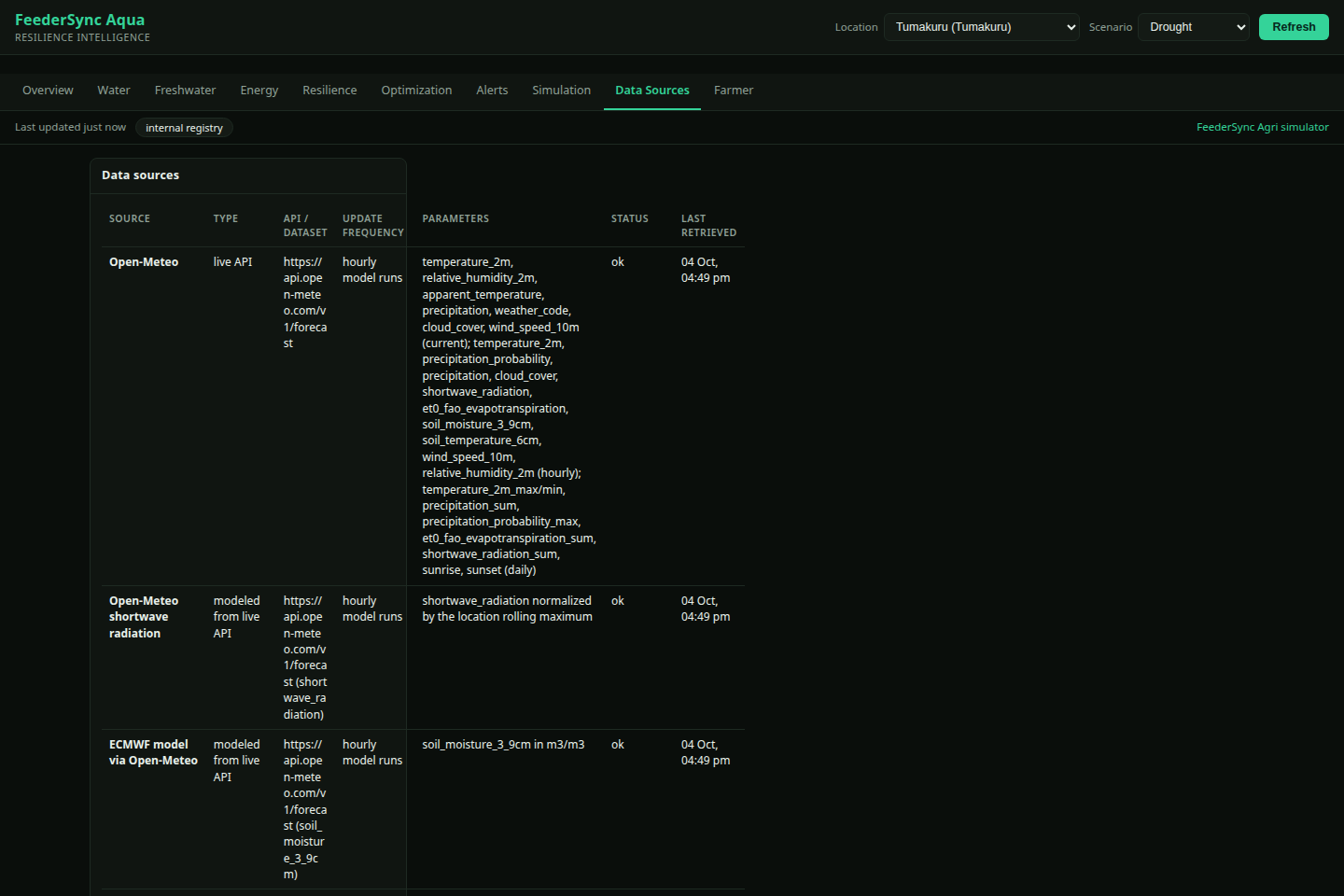
The prototype combines environmental, energy and operational data into a decision pipeline.
Weather + Solar Forecast
          +
Feeder / Pump Data
          +
Soil Moisture
          +
Water Resource Signals
          ↓
   Forecasting Layer
          ↓
  Optimization Engine
          ↓
 Irrigation Scheduling
          ↓
 Edge Pump Control
          ↓
 Water + Energy Outcomes
          ↓
 Measurement & Feedback
The forecasting layer uses gradient-boosted models for day-ahead solar and load prediction. The optimization layer then generates staggered pump slots while respecting transformer capacity and soil-moisture conditions.
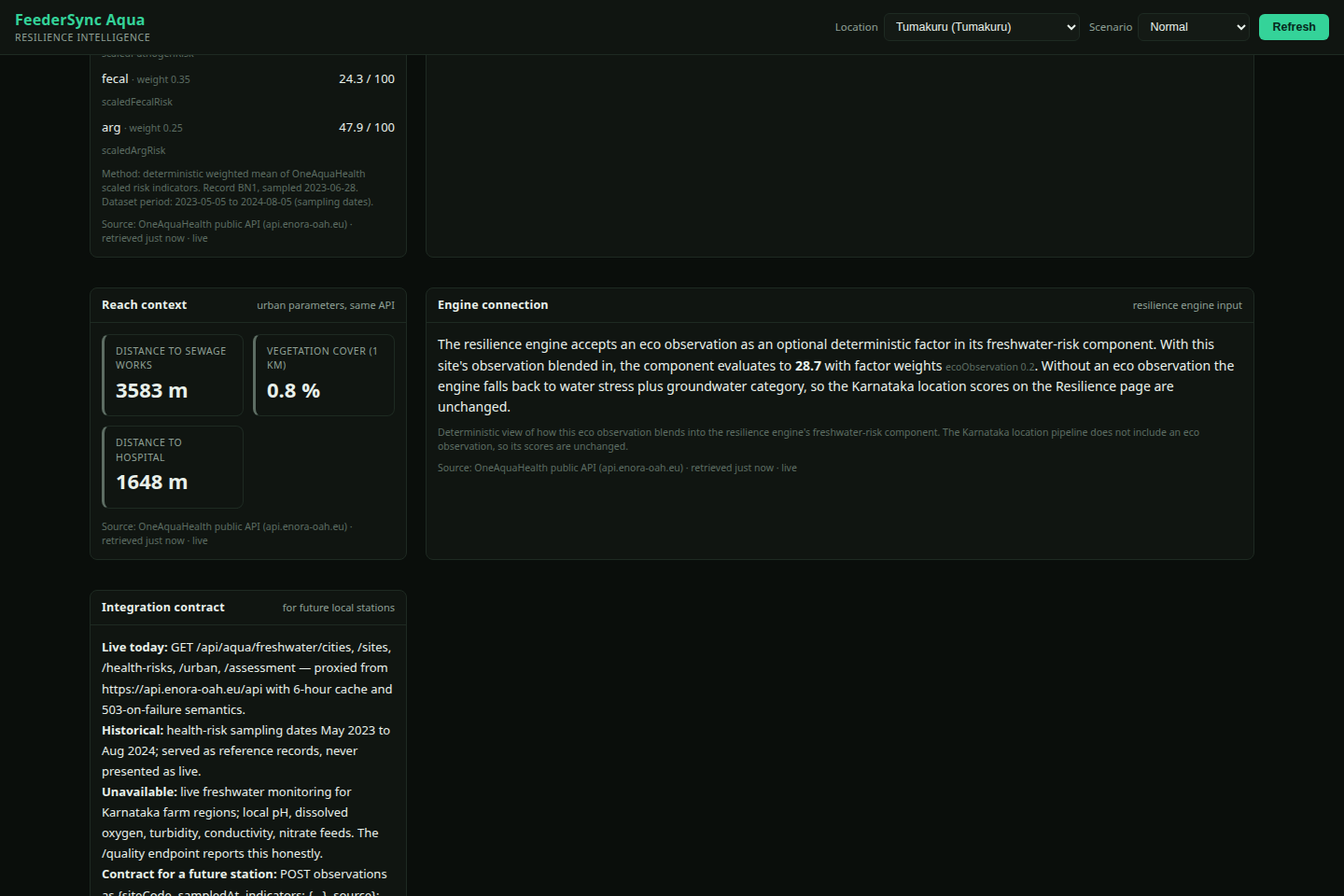
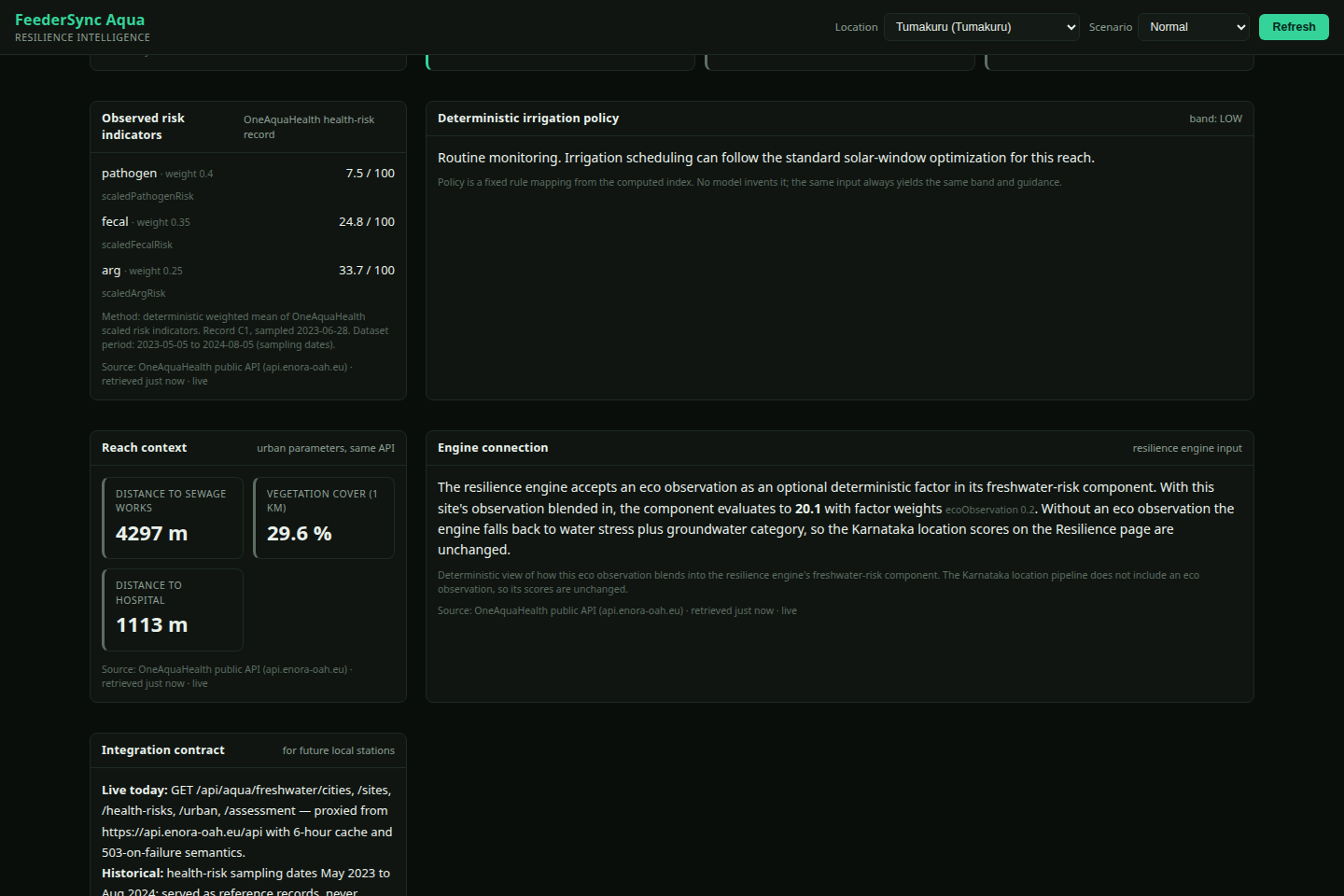
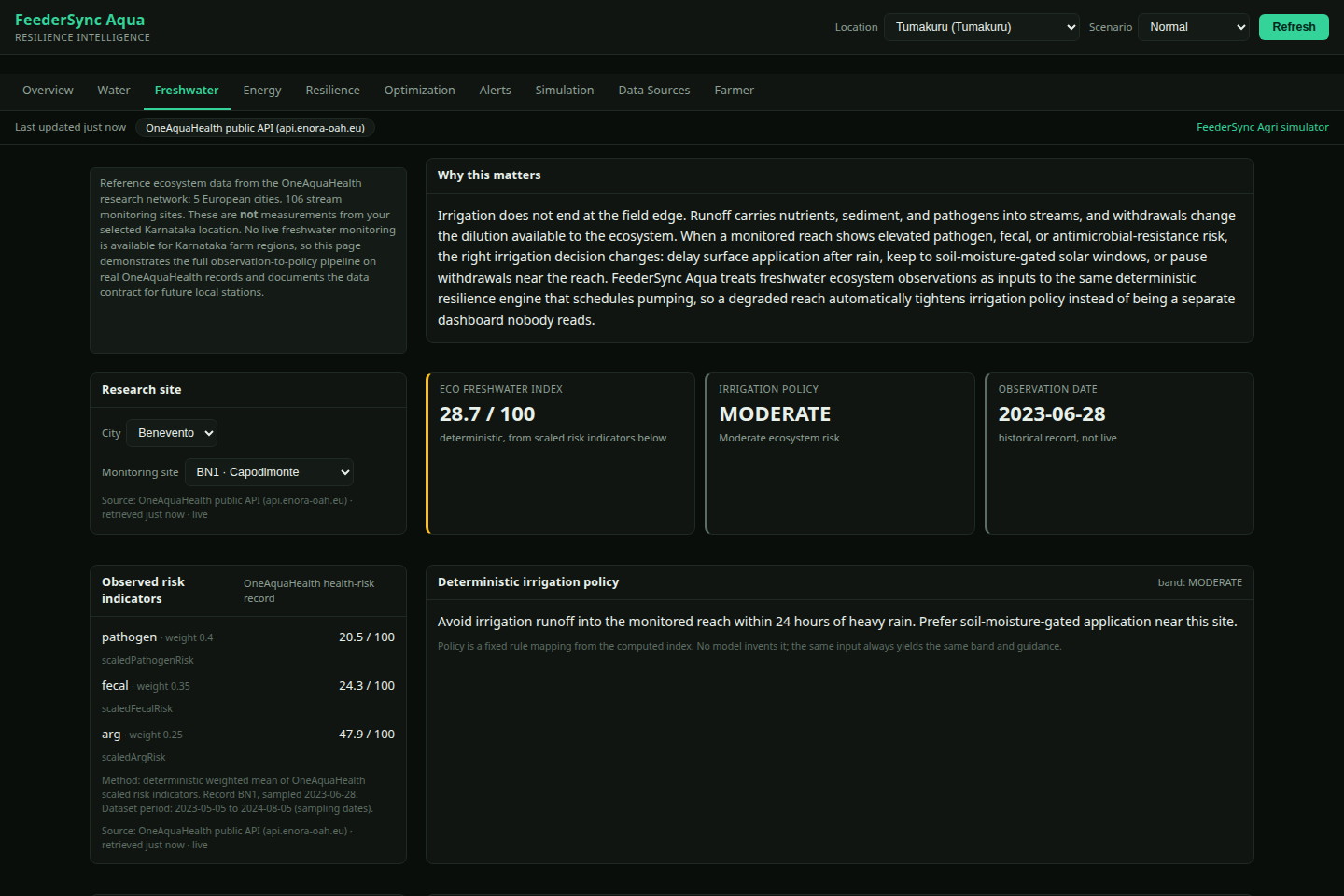
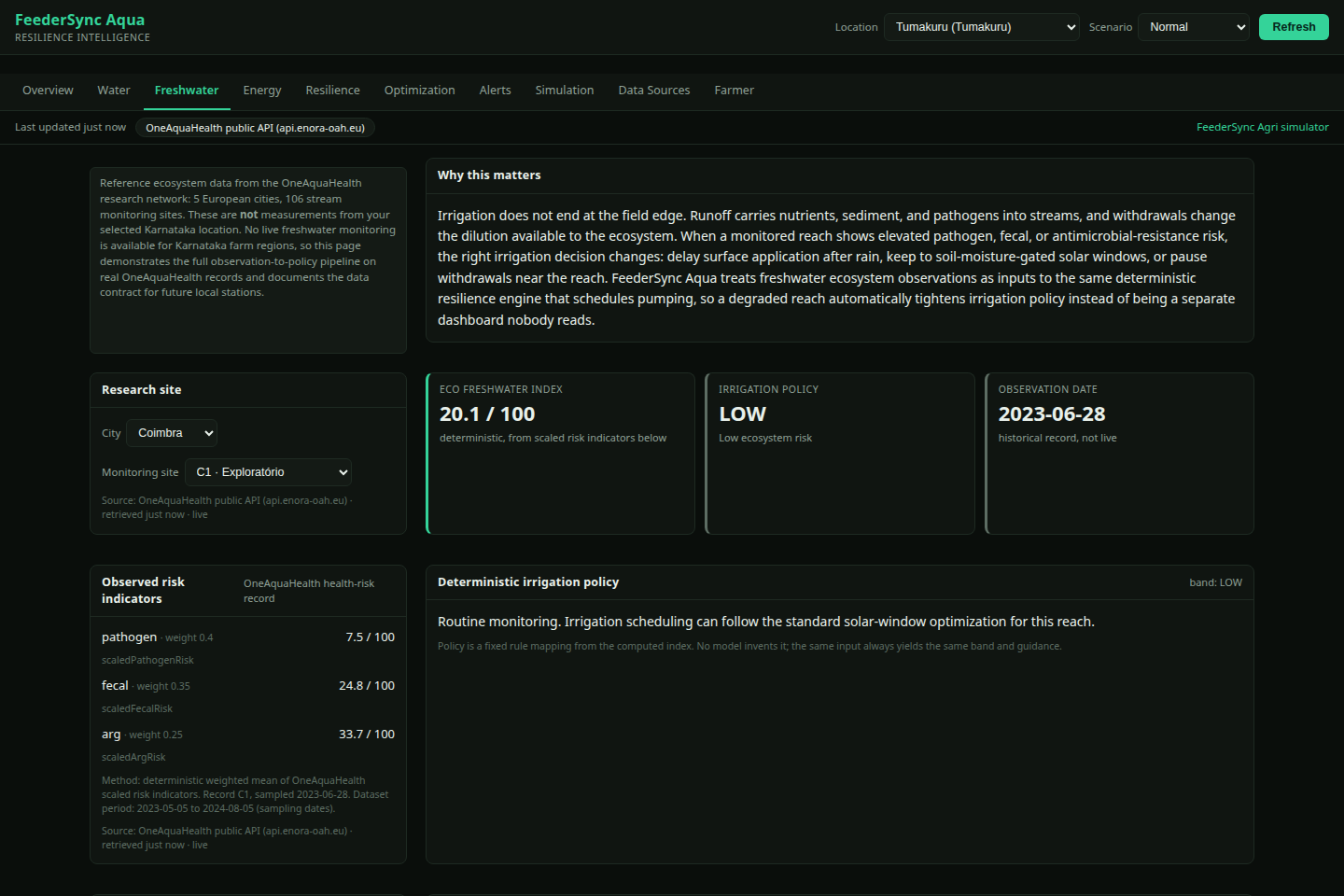
For the OneAquaHealth adaptation, we extend this architecture toward freshwater resilience by treating water-resource indicators as first-class inputs rather than treating irrigation as only an energy-management problem.
What we learned
One of the biggest lessons was that the optimization problem is not simply:
When is electricity cheapest?
It is:
When is irrigation environmentally appropriate, operationally feasible and beneficial for both the farmer and the surrounding resource system?
That changes the architecture considerably.
A technically optimal pump schedule can still be a bad decision if the soil is already sufficiently moist, rainfall is imminent, groundwater conditions indicate stress, or the local infrastructure cannot support the required load.
We therefore designed the system around constraints rather than a single optimization target.
Prototype impact
We created a feeder-level simulation using 200 farmers with 5 HP pumps and explicitly stated tariff and behavioral assumptions.
The simulation produced:
- 70.7% reduction in evening peak load
- 51.8% lower simulated DISCOM power cost
- ₹31.3 lakh simulated annual saving per feeder
- ₹782 simulated additional farmer income per month
- 12% reduction in simulated water intensity per hectare
These numbers are simulation results, not field-validated claims. The purpose of the simulation was to test whether coordinated irrigation could create measurable value across both energy and water dimensions.
The farmer experience
The technology is designed around a simple principle:
The farmer should not have to become an energy-market operator or environmental data scientist.
A farmer can receive a local-language notification with the recommended irrigation window.
For example:
Your pumping slot: 11:30 AM – 1:30 PM
The controller can start the pump automatically, while soil-moisture conditions can prevent an unnecessary cycle. The farmer can also retain manual control.
The intended result is straightforward: irrigation happens when it is useful, water is not pumped unnecessarily, renewable energy is better utilized, and the farmer receives an incentive for participating.
Challenges
The hardest part was balancing competing objectives.
We had to consider:
- grid constraints
- solar variability
- irrigation requirements
- farmer convenience
- water conservation
- environmental uncertainty
- remote-control trust
- incentive design
Another challenge was avoiding a solution that required replacing existing agricultural infrastructure.
Our approach is therefore based on retrofit rather than replacement, with a manual fail-safe and an FPO acting as a local trust layer.
What comes next
The immediate next step is a controlled pilot with approximately two feeders and 400 farmers, followed by expansion toward 100 feeders through DISCOM and PM-KUSUM partnerships.
The longer-term roadmap adds groundwater-depth sensing and water-table-linked scheduling, allowing the system to move from energy-aware irrigation toward genuinely water-aware and ecosystem-aware irrigation intelligence.
Why FeederSync Aqua matters
FeederSync Aqua is built around a simple idea:
Freshwater resilience is a systems problem.
Water, energy, agriculture, weather and community behavior are connected.
Instead of optimizing each component independently, FeederSync Aqua aims to coordinate them through an intelligent decision layer.
The result is a platform designed to help farmers use water more intelligently, help energy systems absorb flexible agricultural demand, and create the data foundation needed for more resilient freshwater management.
From smarter irrigation to healthier water systems.
Built With
- artificial-intelligence
- data-analytics
- edge-computing
- energy-management
- environmental-monitoring
- forecasting
- groundwater
- iot
- machine-learning
- optimization
- predictive-analytics
- python
- renewable-energy
- resilience-informatics
- smart-agriculture
- soil-moisture
- solar-energy
- water-conservation
- water-management


Log in or sign up for Devpost to join the conversation.