-
-
Cover Image
Inspiration
Surveys are the powerful tool proven all over the world to get the feedback about a product or a service from the end customers or clients. This helps to strategize the business or to make changes to the business model or the product or service accordingly. Along with assessing the rating-based feedback, there is a trend now to try to assess the customer mood as much possible through many ways. One of the efficient methods identified is to analyze and derive the customer mood or emotions based on the text feedback provided as part of survey responses. With Quickbase tool being used in many different business verticals and for tons of use cases, it becomes now important to see how the user survey creations can be managed and automated to seek the responses and analyze them more effectively within Quickbase
With Pipelines capability, the customer satisfaction surveys can be made configurable and automated to send them periodically to clients/customers and seek responses with the capability of sending multiple reminders automatically after periodic intervals. Also, with the emergence of sophisticated text analysis methods using machine learning models, it becomes easy now to derive the sentiment of the customer by providing the feedback text as input. By integrating it with Quickbase, it will open myriad of possibilities to automate many of the analyses of Quickbase data that will add great value to the business.
What it does
Feedback Emotion Miner Powered by QuickBase & Machine Learning is a productivity tool that helps organizations derive and aggregate insightful information using Sentiment Analysis such as customer buying trends, areas of improvement, customer relationships etc.
The user surveys automatically created in periodic intervals and the follow-up email notifications are sent to seek the responses from client stakeholders automatically. The survey submissions are analyzed to arrive at average rating and sentiment scores that help to gauge the sentiment of our clients and accordingly take proactive actions.
How we built it
Separate Quickbase tables are created to manage the clients, client surveys for different products/services and questionnaire.
Pipelines are used to create the user surveys based on configured time intervals to seek feedback from client stakeholders/end users.
Email Notifications are configured to periodically remind and seek the responses from end users automatically
Python is used for coding the sentiment model code which is then deployed in Azure Functions which provides server less web service setup
In python Script, QuickBase API is used to query the feedback data entered by the User in survey form.
After preprocessing on that data, VADER Sentiment Analyzer model of Natural Language Processing is used to derive the sentiment based on textual feedback.
Post Sentiment Analysis, Pipeline “Incoming JSON” webhook channel action is used to update the sentiment score back to Quickbase.
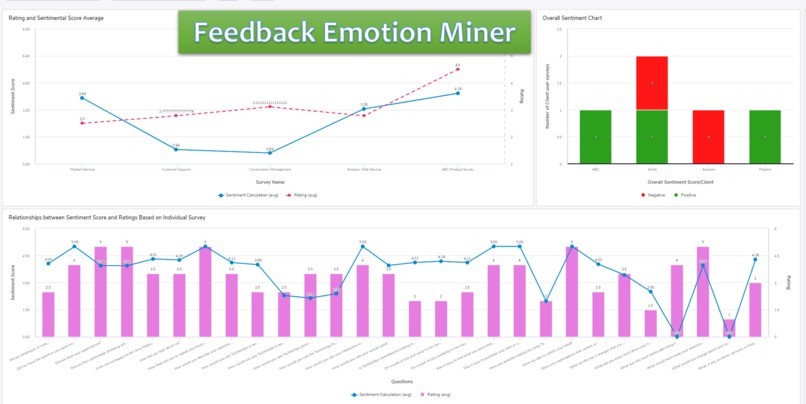
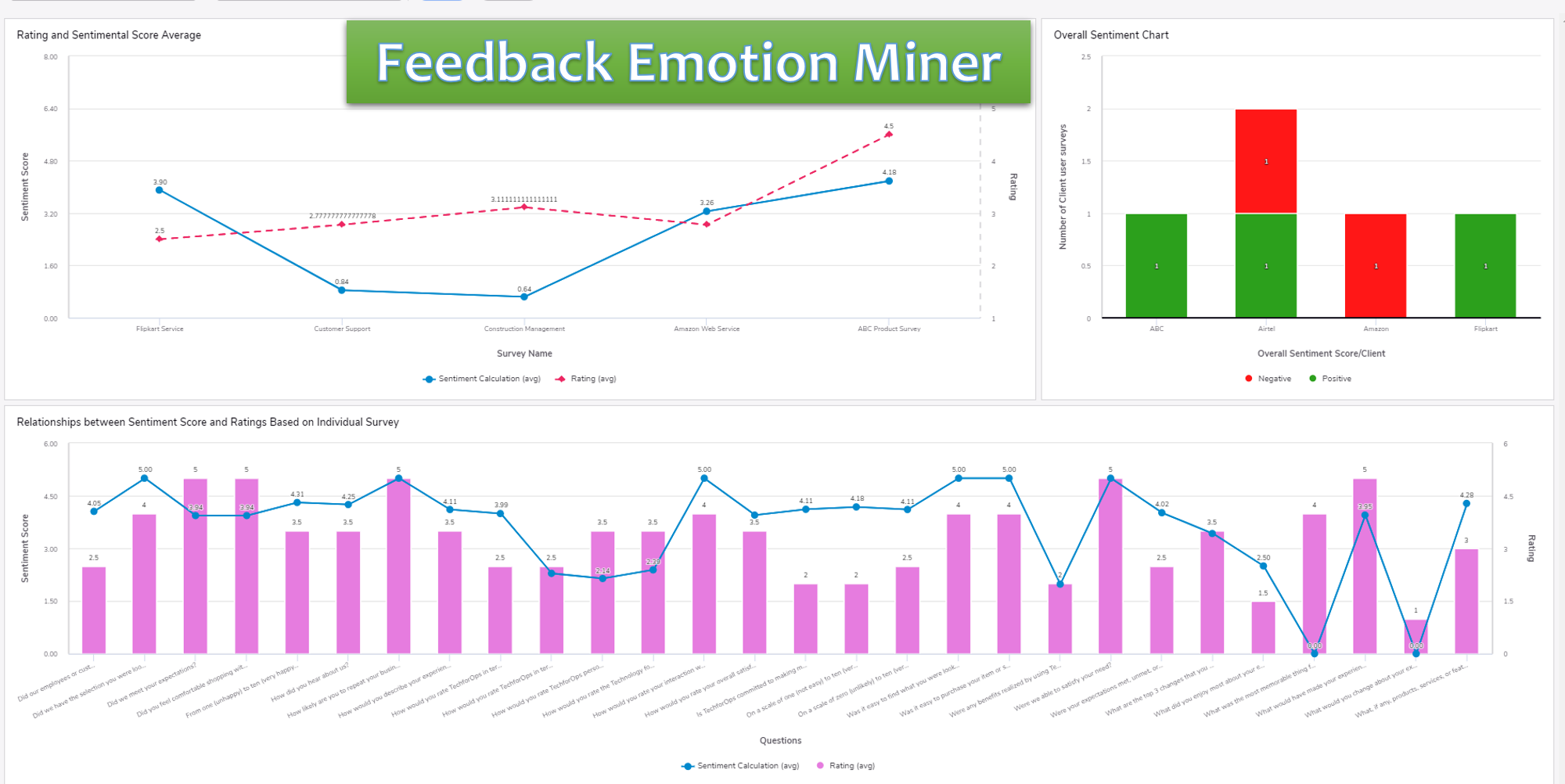
Quickbase Executive Dashboard is used to visualize the sentiment scores derived using the ML model and the numeric rating entered by the client stakeholders.
Challenges we ran into
1) Auto-creation of survey questions based on master questionnaire and to show them in a generic survey format 2) Hosting the python code that performs the sentiment analysis 3) Posting back the sentiment score back to Quickbase after the variable time taken by the ML model to run the sentiment analysis
Accomplishments that we're proud of
We showcased how to trigger a python web service that runs a ML model to get the analysis/prediction outcome back to Quickbase
Efficiently used Pipelines to create surveys along with Questions and capturing the sentiment score back to the QB table
What we learned
Innovatively use Pipelines to do various internal operations within Quickbase and to send/receive data to/from external web services
What's next for Feedback Emotion Miner
This framework can be used in future to develop many other use cases with Quickbase as a backend as well as front-end solution with Machine Learning Analysis and Artificial Intelligence functionality added.
Built With
- azure
- azure-functions
- machine-learning
- python
- qb-pipelines
- quickbase
- sentiment-analysis
- vader


Log in or sign up for Devpost to join the conversation.