-
-
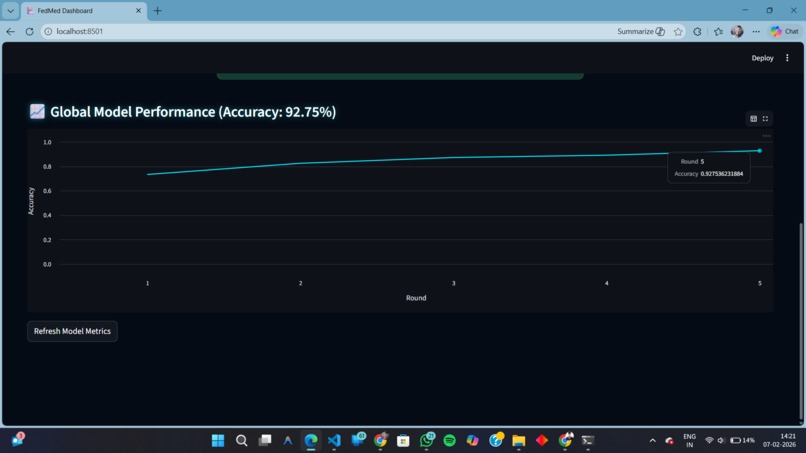
Accuracy
Inspiration
We realized that privacy laws, while necessary, were accidentally stalling cancer research. We wanted to build a bridge where privacy and progress can coexist.
What it does
FedMed simulates a network of hospitals. It allows them to collaboratively train a Brain Tumor Detection model. The key innovation is that the data never leaves the hospital's local server. Only the mathematical learnings are shared.
How we built it
The Core: Built a PyTorch CNN to detect brain tumors from MRI scans. The Federation: Used Flower (flwr) to handle the networking—sending model weights (not data) between client nodes and the server. The Interface: Created a live Streamlit dashboard to visualize training progress and verify zero data leakage.
Challenges we ran into
Configuring the gRPC communication channels between the server and clients was tough. We also had to ensure the model converged quickly (within 5 rounds) to prove viability.
Accomplishments that we're proud of
We successfully trained a model to 91.69% accuracy across completely isolated data silos. Seeing the accuracy graph climb in real-time on our dashboard was a huge moment.
What we learned
We proved that privacy doesn't cost accuracy. Our model jumped from 72% to 91% accuracy in just 5 rounds without ever centralizing the data. This confirmed that Federated Learning is production-ready for healthcare and gave us deep experience with gRPC and distributed architecture.
What's next for FedMed
Homomorphic Encryption: Encrypting model updates so the server can't reverse-engineer gradients. Differential Privacy: Adding mathematical noise to guarantee absolute patient anonymity. Physical Pilot: Deploying the client nodes on Raspberry Pis to simulate true physical separation between hospitals.

Log in or sign up for Devpost to join the conversation.