Inspiration
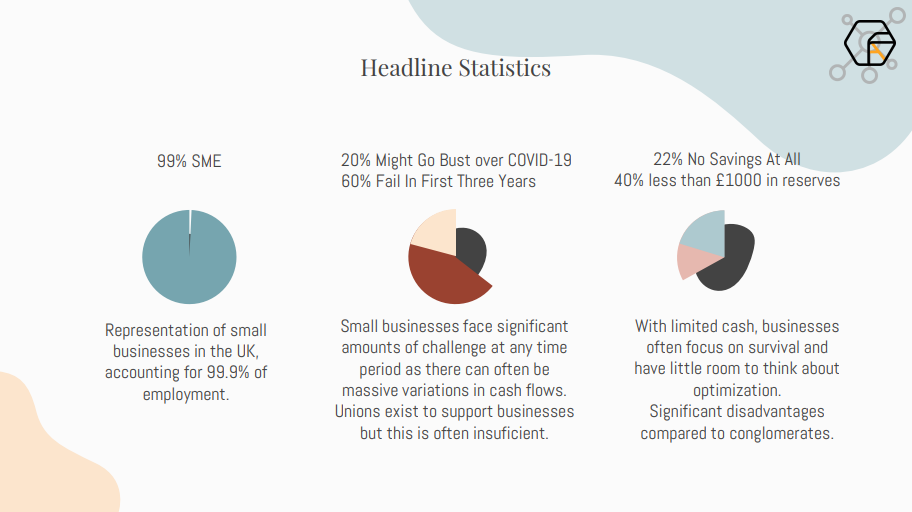
Since COVID-19, many local businesses have been affected adversely and many have closed. The challenges of running a business are not unique to this time, and we hope to come up with a solution that can allow these businesses to have better insight into ways to improve financially.
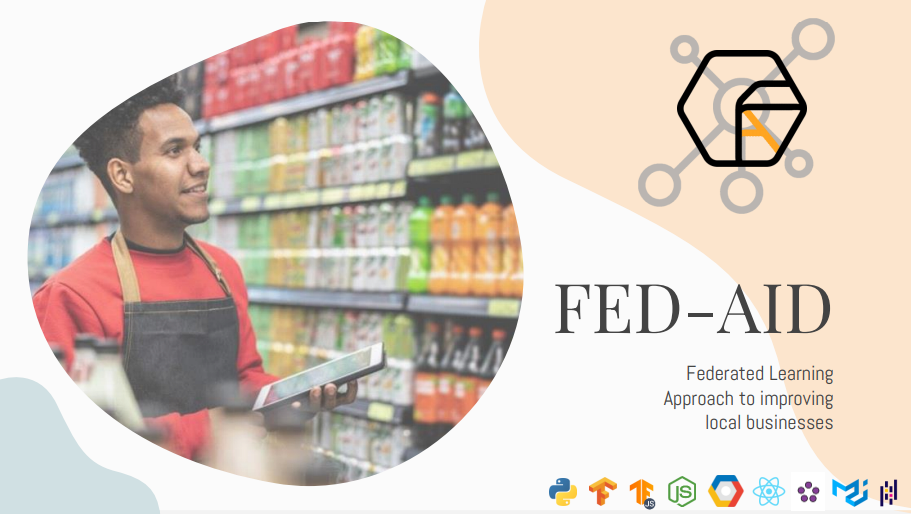
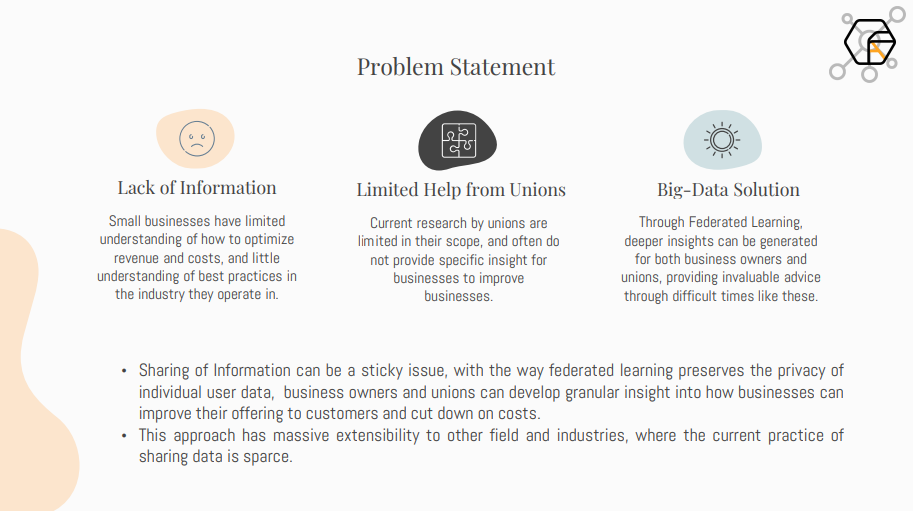
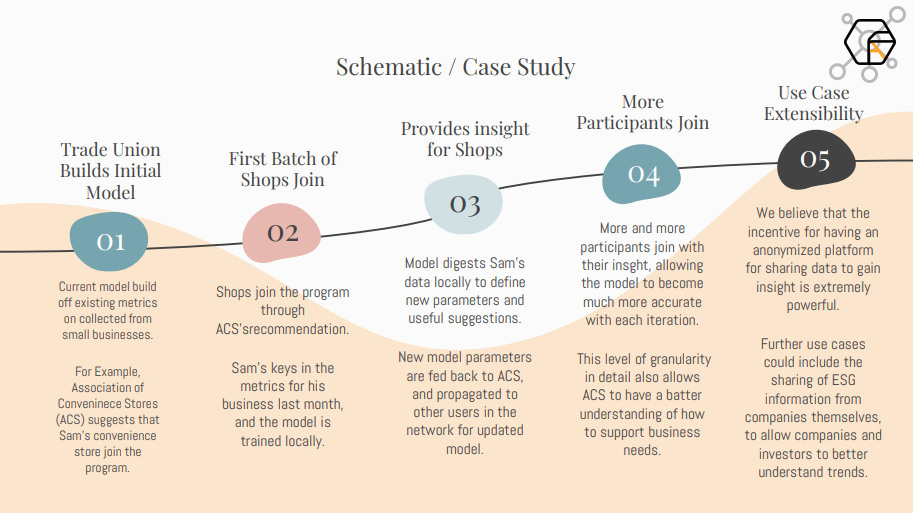
Recognizing the problems that local businesses face in terms of limited data analytics and access, we came up with FED-AID, a federated learning approach that can help local businesses (like convenience stores) to gain better insight into how to make more revenue and cut costs effectively. This goes far beyond the type of analysis and aid that associations and unions currently provide. With the federated learning approach, businesses are incentivized to anonymously contribute, which can help the in the overall understanding of industry trends with a higher degree of accuracy.
FED-AID also hopes to be massively extensible to other use-cases as well, where current data-sharing procedures are sparse and where anonymity is extremely important.
What it does
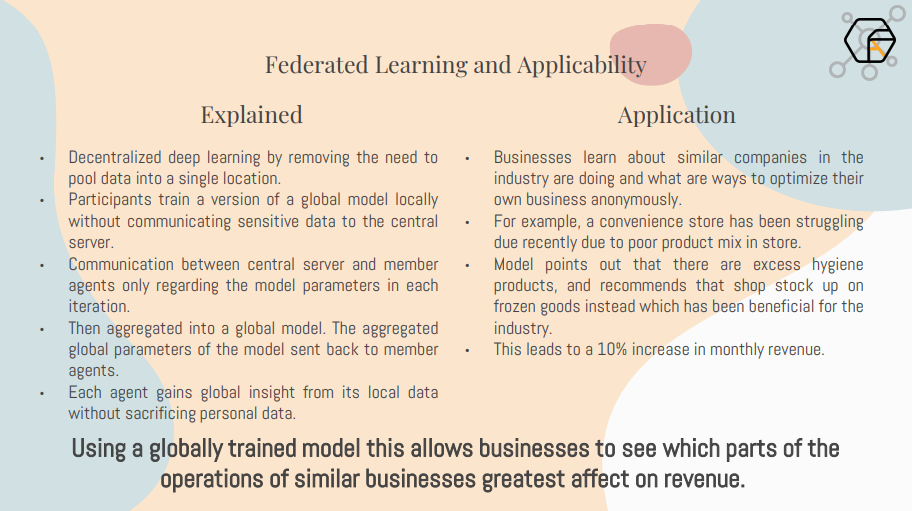
With FED-AID, small businesses are incentivized to provide metrics on their business into the federated learning algorithm to gain insight into how they stack up against similar businesses in the same industry. We then use a simple ML algo (which can be evolved over time for accuracy) to provide predictions of how much revenue they can potentially make, and how they can change different aspects of their business to achieve a higher revenue, and potentially cut costs as well.
FED-AID provides will provide recommendations such as ‘sell more frozen foods’, optimizing the product mix in stores to increase revenue. All these recommendations will be statistically significant as we increase the number of participants in this program.
Similarly, it also provides participants with industry trends that will be much accurate and granular than what is being done.
How we built it
We built FED-AID through using Python, TensorFlowJS, Node.js, Google Cloud, ReactJS, JavaScript, Material-UI and Federated Learning.
Challenges we ran into
The first challenge that we’ve come across is that such data is proprietary and as such, a synthetic dataset was generated for the proof of concept.
In this example, the business logic of the solution is extremely vital and we had to think about different restrictions imposed by the use case. Unlike conventional federated learning, shops like convenience stores do not have significant computational power, and as such, we had to work around these limitations to find a solution that is quick to deploy and feasible.
We also had to address the challenge of incentivizing these shops to contribute to the network. We believe that the superior insight into the industry has tackled this, and will also provide immense value for the shops in ways to improve their own businesses.
For our project to be extensible, we are required to have anonymity as a key tenet of our approach. The incentives then must be significant enough for them to want to join the project.
Accomplishments that we're proud of
We are really proud of coming up with a novel solutions that would positively benefit small businesses in terms of helping them tide through difficult times and potentially their businesses around. We also believe that this approach provides massive improvements over the current analysis done by associations and unions, which can benefit the sector as a whole.
Most importantly, we see widespread applications for such an approach. This proof of concept serves as just one sample of how federated learning can improve data analysis, transparency and ensure anonymity if we incentive users to join.
What we learned
A key takeaway for us is to think of how a federated learning approach can be beneficial to individuals that might traditionally been against data sharing for various reasons. Therefore, the correct incentivization is key to the success of such a project. However, through thinking about different use cases, we see the benefits to individual firms can be immense.
For example, ESG disclosure by public listed firms is not standardized and firms see no incentive to publish specific information relative to their company. Through a federated learning approach, there is a strong use case for training models anonymously, and for firms to have access to models which can be useful in planning for their own ESG targets.
What's next for FED-AID
We built FED-AID as an evolving project, where with every new contributor, better models for any specific industry will improve. We believe this project has substantial potential to scale in terms of allowing many non-public companies to contribute data anonymously and develop deeper insight into industry trends, apart from just revenues, costs and the percentage of specific inventories a company should hold.
Built With
- javascript
- keras
- material-ui
- pandas
- react
- tensorflow
- tensorflow.js

Log in or sign up for Devpost to join the conversation.