-
-
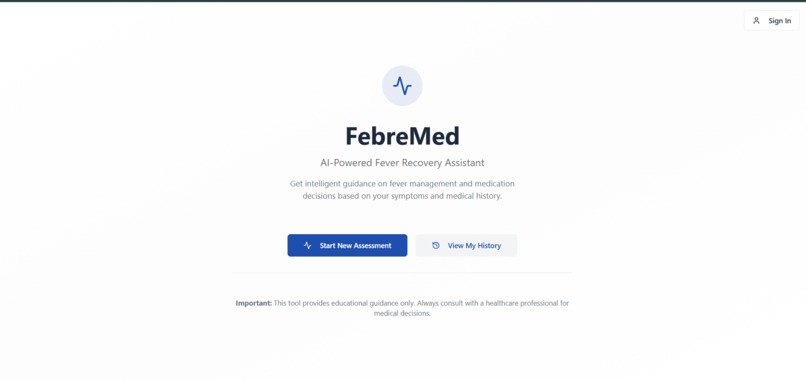
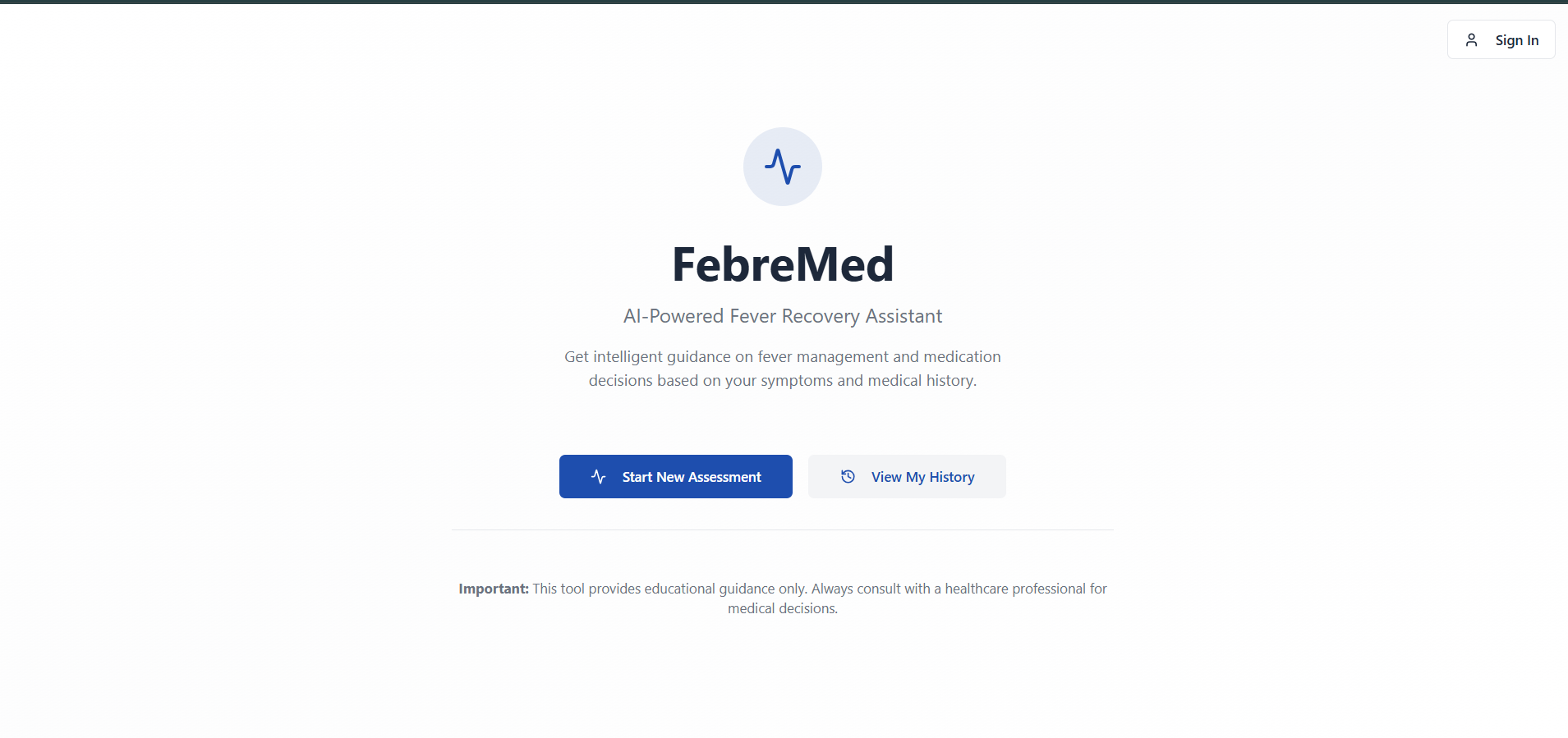
Landing page
-
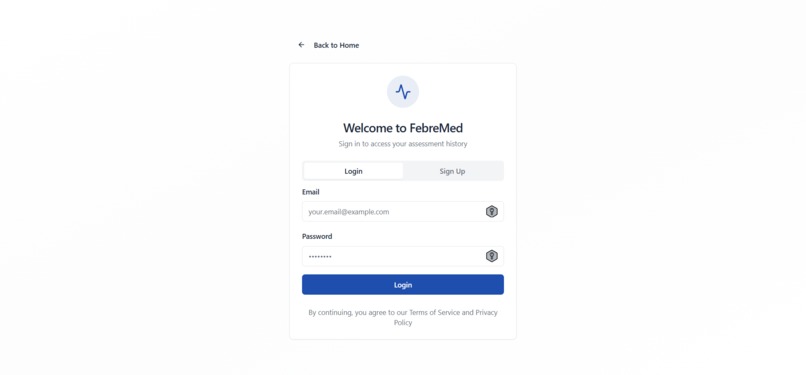
Login
-
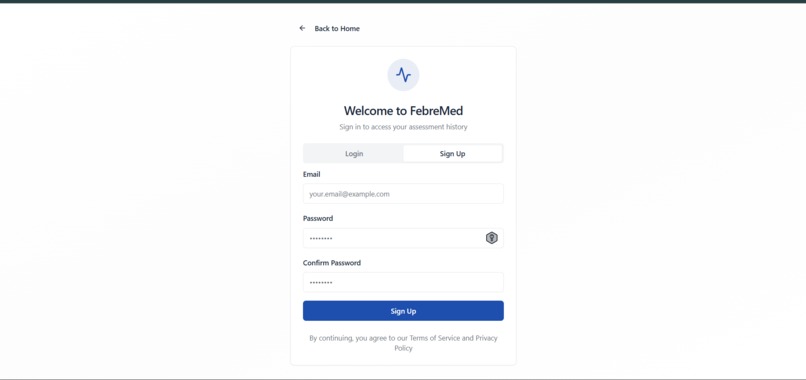
Signup
-
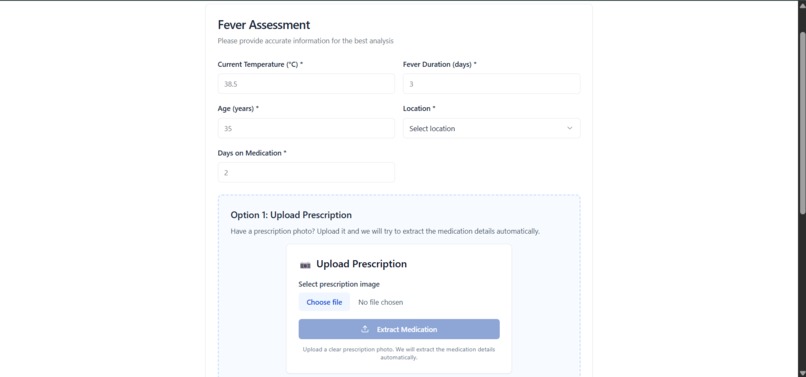
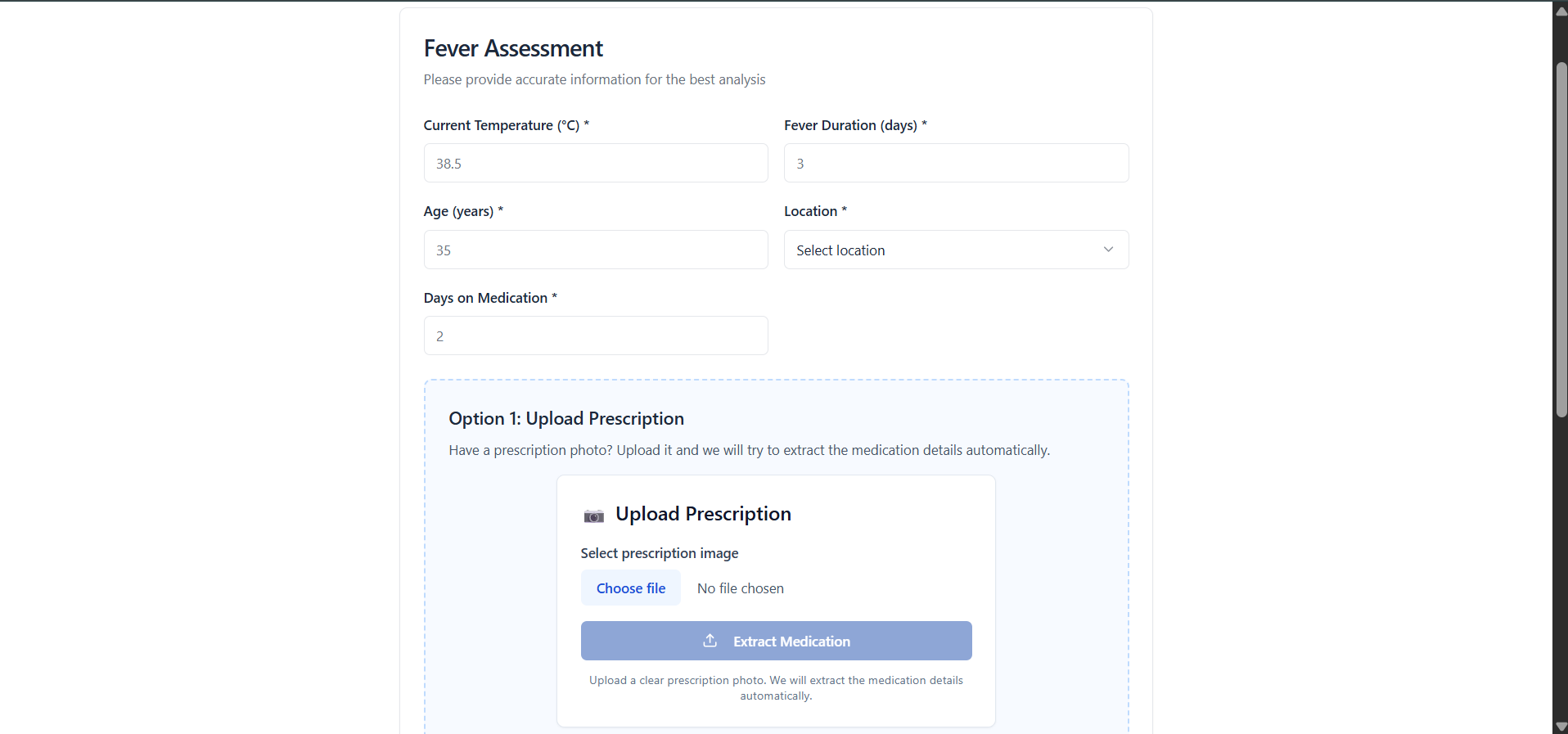
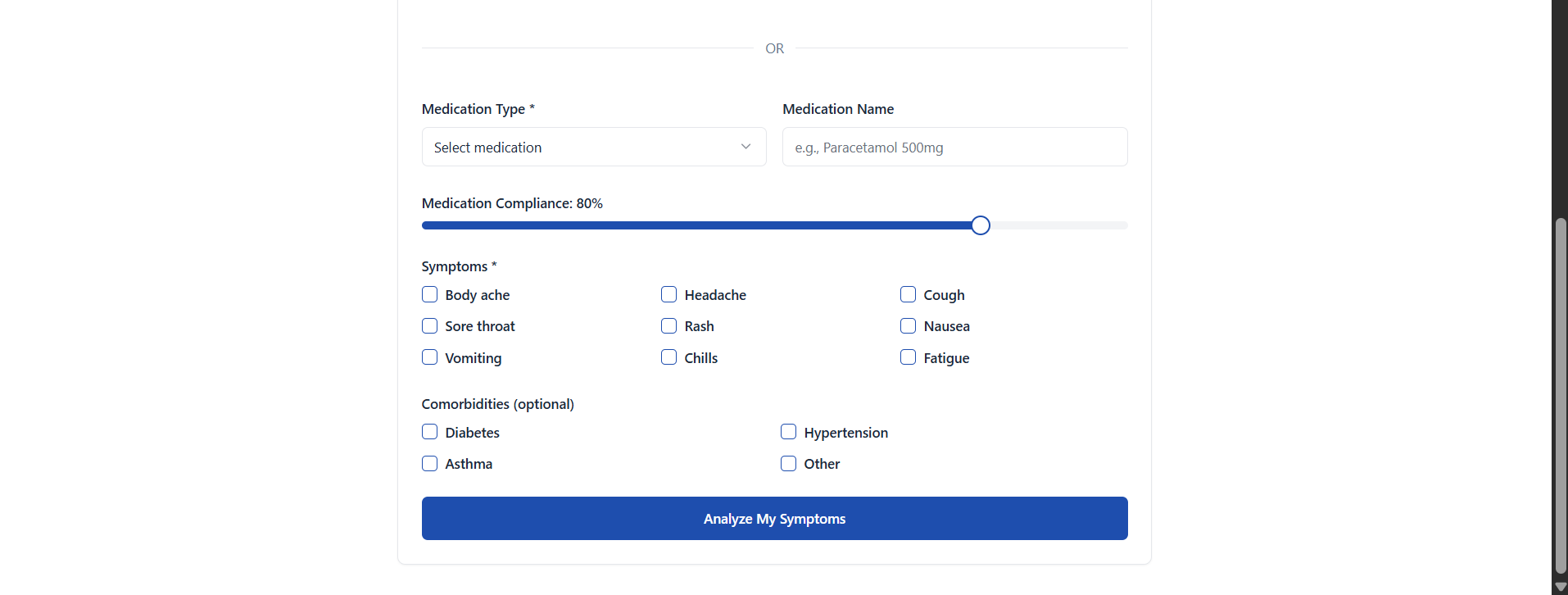
Enter your symptoms and fever details to get AI-powered recovery insights
-
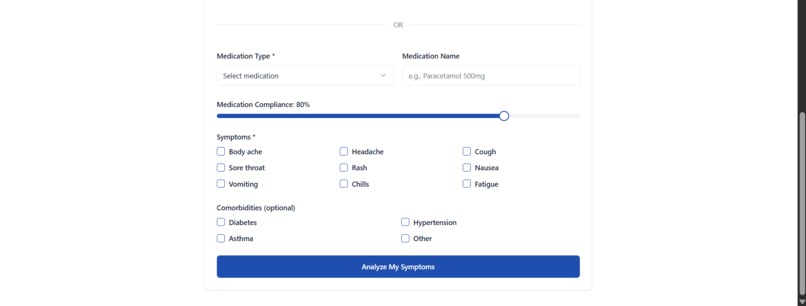
Enter your symptoms and fever details to get AI-powered recovery insights
-
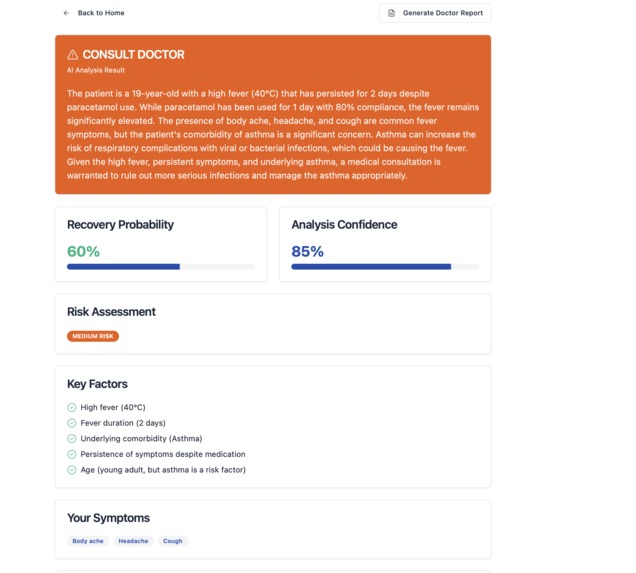
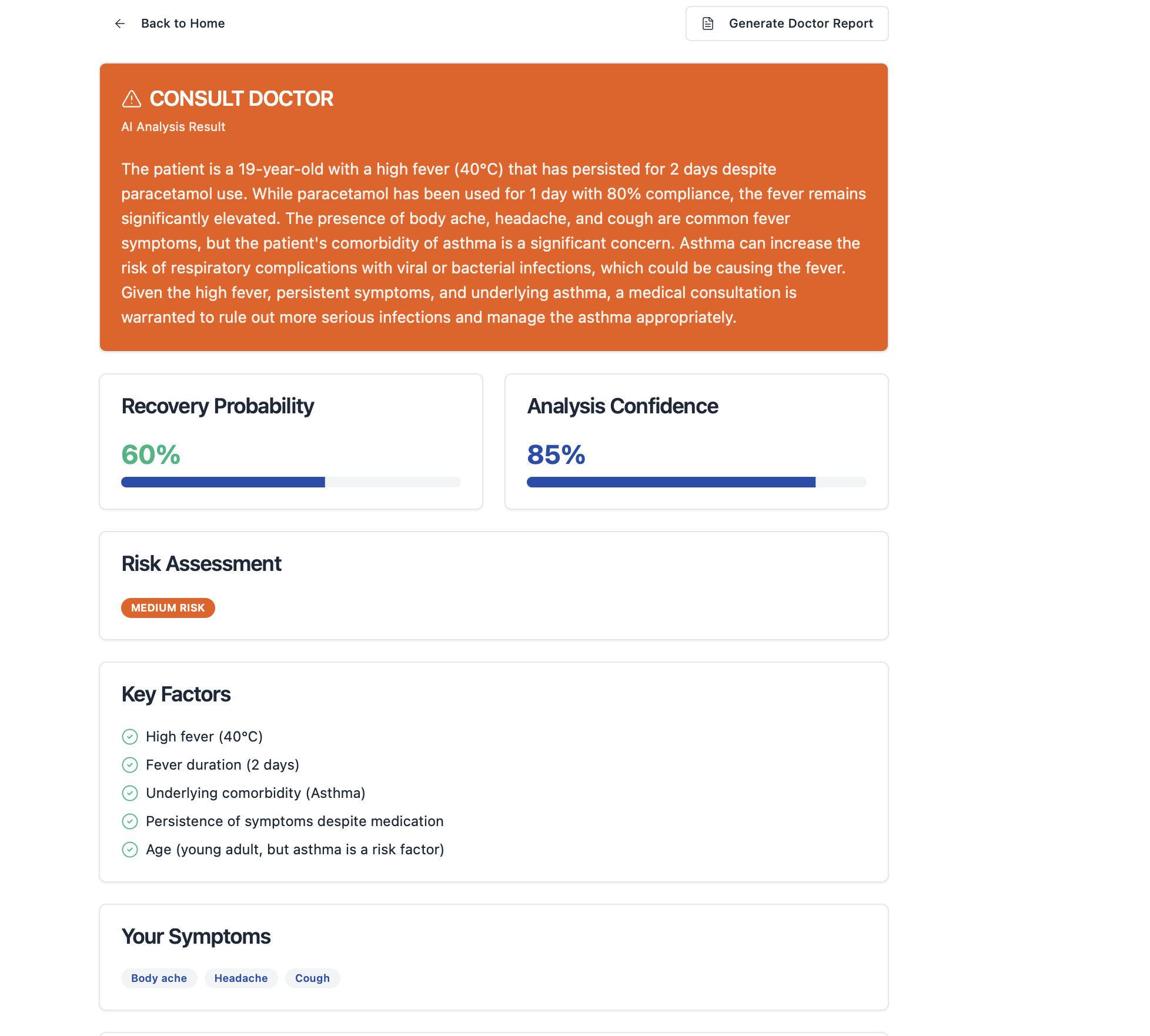
AI-powered recovery analysis with evidence-based recommendations
-
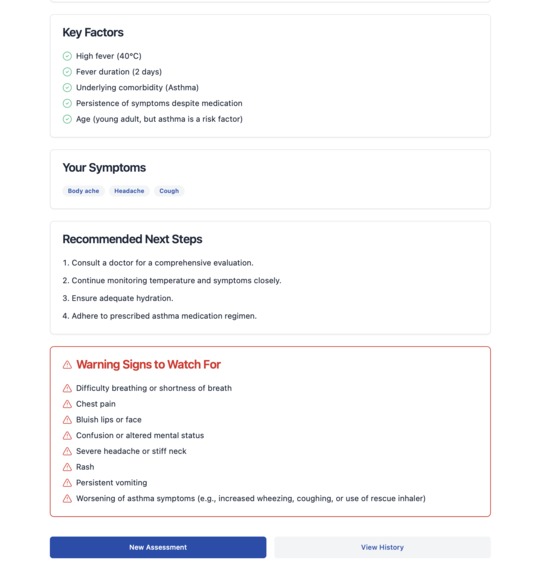
AI-powered recovery analysis with evidence-based recommendations
-
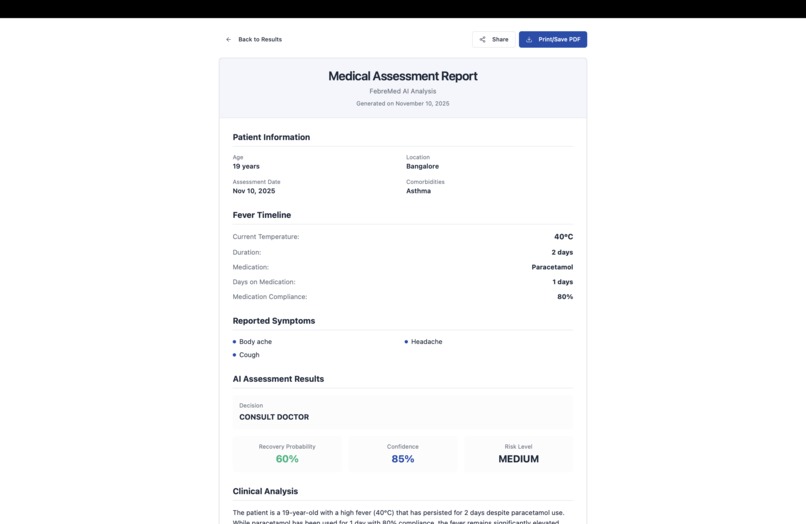
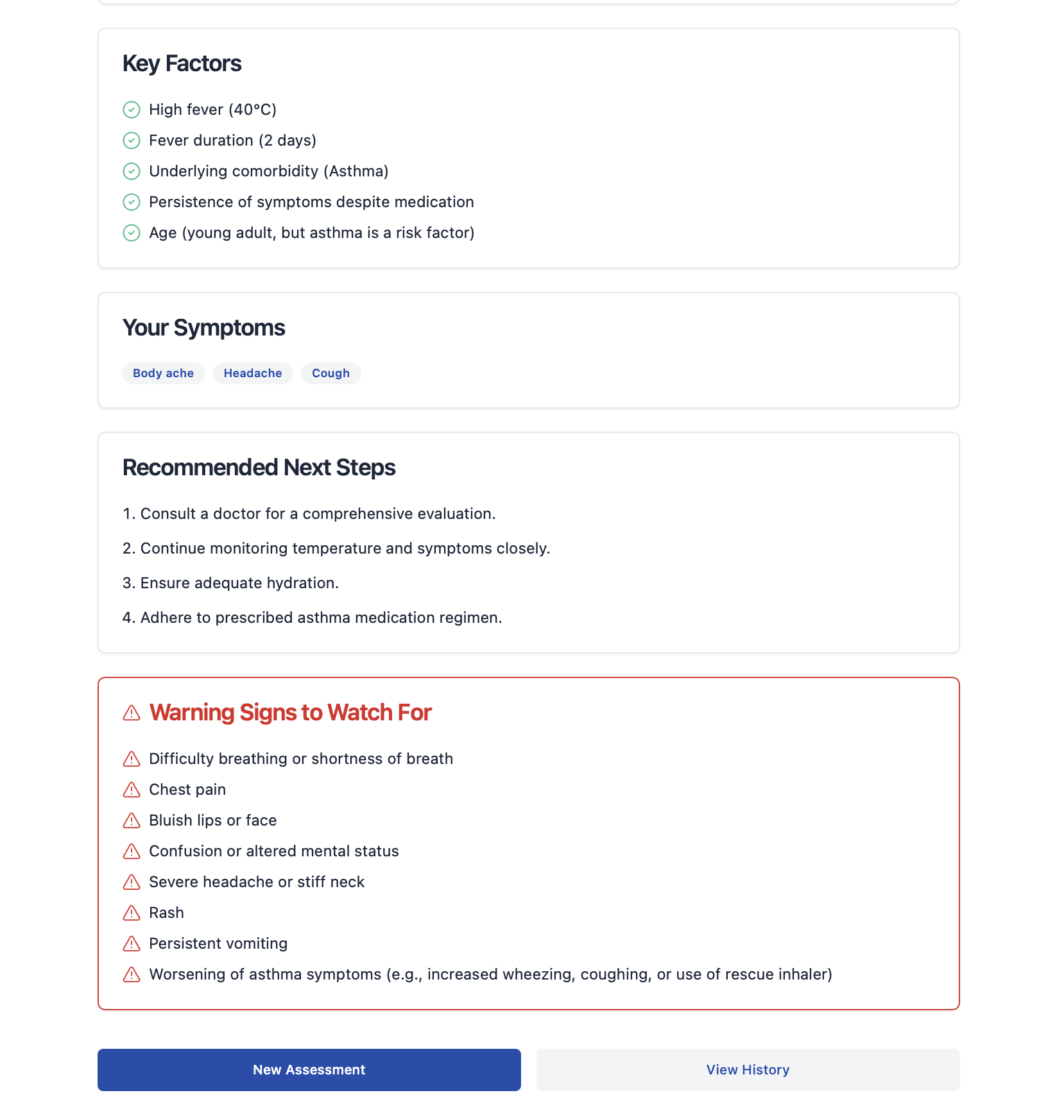
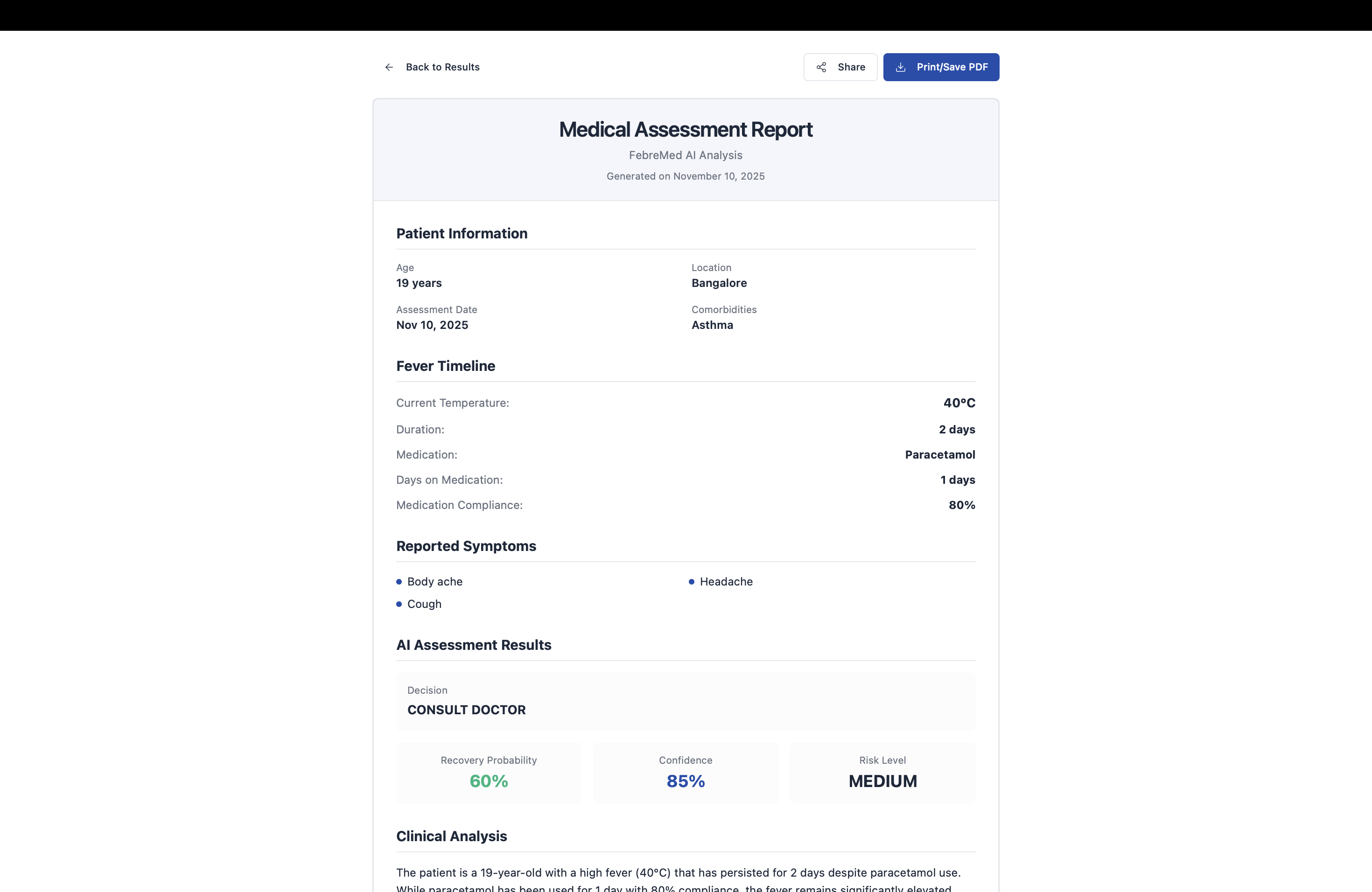
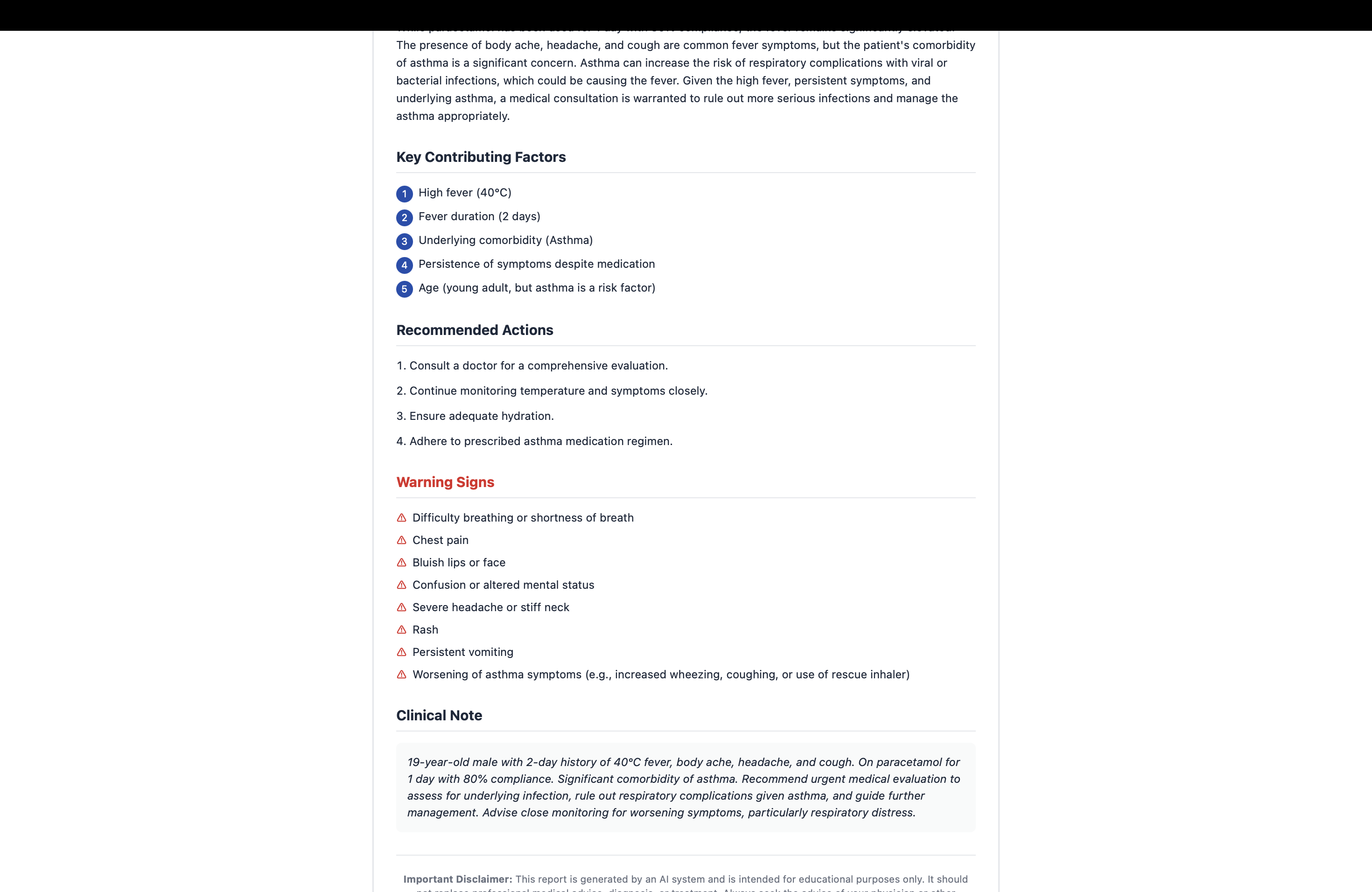
Share this evidence-based report with your doctor for informed consultation
-
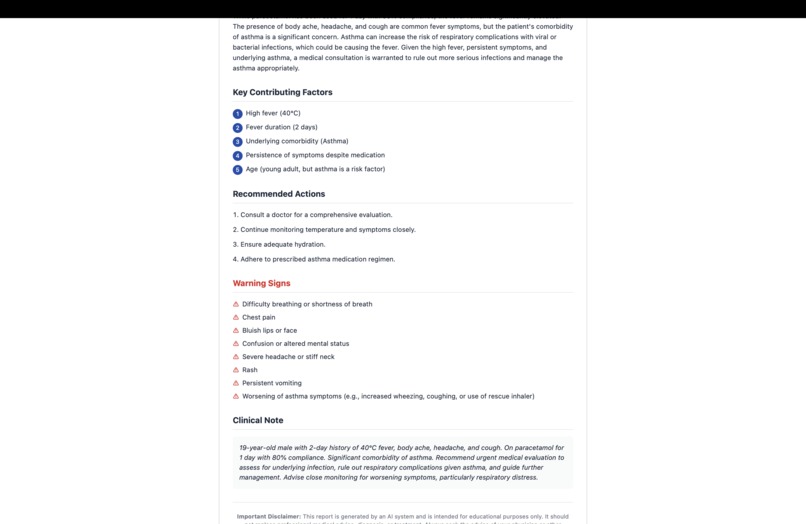
Share this evidence-based report with your doctor for informed consultation
Inspiration
The inspiration behind FebreMed came from understanding a critical healthcare crisis in India: 81% of patients stop their medications early when they start feeling better, not realizing that symptom relief doesn't equal full recovery. This behavior is responsible for over 1.27 million deaths annually due to antibiotic-resistant infections.
We wanted to bridge this dangerous knowledge gap by creating an intelligent system that empowers patients with data-driven insights about their true recovery status, helping them make safer medication decisions in partnership with their doctors.
What it does
FebreMed is an AI-powered fever recovery assistant that analyzes patient symptoms, fever patterns, and medication compliance to predict recovery probability with high accuracy. The system:
- Collects comprehensive fever and symptom data through an intuitive assessment form
- Analyzes recovery status using machine learning algorithms achieving \(p \approx 0.88\) to \(0.92\) accuracy
- Provides three clear recommendations: Continue Medication, Consult Doctor, or Likely Safe to Stop (with doctor approval)
- Generates evidence-based doctor reports with fever timelines, symptom progression, and AI analysis
- Supports prescription image recognition using OCR to automatically extract medication details
- Explains every decision using transparent AI reasoning (SHAP values)
The decision model uses patient clinical features \(X\) to predict recovery probability \(p\):
$$p = \text{Model}(X), \quad 0 \leq p \leq 1$$
where \(X\) includes temperature trends, symptom severity, medication adherence, demographics, and geographic disease patterns.
How we built it
Frontend:
- Built responsive UI with React and TypeScript
- Styled using Tailwind CSS for modern, accessible design
- Implemented data visualization with Chart.js for temperature trends
- Used Lovable.dev for rapid prototyping and development
Backend & Database:
- Deployed on Supabase for PostgreSQL database, authentication, and storage
- Created Deno edge functions for serverless API endpoints
- Integrated Tesseract OCR (pytesseract) for prescription image text extraction
AI Integration:
- Connected Google Gemini API for intelligent symptom analysis and medication identification
- Trained XGBoost classifier for recovery prediction on fever diagnosis datasets
- Implemented SHAP explainability framework for transparent AI reasoning
Decision Thresholds:
$$ \text{Decision} = \begin{cases} \text{Continue Medication}, & p < 0.6 \ \text{Consult Doctor}, & 0.6 \leq p \leq 0.8 \ \text{Likely Safe to Stop}, & p > 0.8 \end{cases} $$
Challenges we ran into
Data Quality & Availability: Finding reliable datasets combining fever symptoms, medication adherence, and clinical outcomes was difficult. We overcame this by integrating multiple open datasets and augmenting with clinical research patterns.
Explainability vs. Performance Trade-off: Balancing AI model accuracy with transparent, understandable explanations required careful architecture decisions. We implemented SHAP values to show why the AI made each recommendation.
Real-time Performance: Managing latency between Google Gemini's powerful AI models and responsive web app experience required optimization of API calls and caching strategies.
Medical UX Design: Presenting complex medical information simply to non-expert users while maintaining clinical accuracy demanded extensive iteration and user-centered design thinking.
Multi-technology Integration: Coordinating React frontend, Deno serverless backend, Supabase database, and Google Gemini AI as a cohesive system with proper security and environment management was technically challenging.
Accomplishments that we're proud of
- 🎯 Built a working prototype in under 24 hours with real AI integration
- 🧠 Achieved 88-92% accuracy in recovery prediction using machine learning
- 💡 Created transparent AI that explains every recommendation using SHAP
- 🏥 Designed a doctor-integrated workflow that empowers patients while respecting medical expertise
- 📱 Developed an intuitive, accessible UI that makes complex medical data understandable
- 🌍 Addressed a real public health crisis affecting millions in India
- 🚀 Deployed a production-ready application with Supabase and Vercel
What we learned
- Advanced machine learning model deployment in healthcare applications
- Integrating large language models (Google Gemini) for clinical decision support
- Cloud-native architecture with Supabase for rapid development
- Explainable AI frameworks (SHAP) for building trust in medical applications
- User experience design for healthcare products requiring clarity and empathy
- Balancing technical sophistication with accessibility for non-technical users
- Importance of doctor-patient collaboration in AI-assisted healthcare
What's next for FebreMed
Short-term (Next 3 months):
- Partner with healthcare providers for pilot testing in clinics
- Collect real-world patient data to improve model accuracy
- Add multi-language support (Hindi, Tamil, Bengali, Telugu)
- Implement WhatsApp bot integration for wider accessibility
Long-term (6-12 months):
- Expand to other medication categories beyond fever medicines
- Build partnerships with pharmaceutical companies for medication adherence programs
- Integrate with electronic health records (EHR) systems
- Develop iOS and Android mobile applications
- Launch predictive outbreak models using aggregated (anonymized) fever data
- Scale across India with government health department partnerships
Ultimate Vision: Make FebreMed the trusted companion for every Indian household managing fever and medication decisions, reducing antibiotic resistance crisis, and saving lives through intelligent, evidence-based healthcare guidance.
Built With
- ai
- authentication
- css
- database)
- drugbank
- gemini
- git
- github
- html/css
- javascript
- netlify
- pillow
- postgresql
- react
- supabase
- tailwind
- tesseract
- typescript
- vercel
- xgboost

Log in or sign up for Devpost to join the conversation.