Inspiration: The Problem with Modern Agent Frameworks
When I set out to build AI agents for real-world applications, I quickly became frustrated with the current landscape of agent frameworks. The existing solutions were either:
- Bloated with unnecessary abstractions - LangChain, LlamaIndex, and similar frameworks come with massive dependency trees and complex architectures that make simple tasks complicated
- Missing crucial features - Most frameworks don't natively support combining structured output with tool calling, despite this being a common real-world requirement
- Lacking essential tools - Web research, code execution, and multimodal document processing should be built-in, not afterthoughts
- Poor developer experience - Complicated APIs that require reading extensive documentation just to create a basic agent
I wanted something different: a framework so lightweight and intuitive that you could create a production-ready agent in 3 lines of code, yet powerful enough to handle complex multi-agent orchestration.
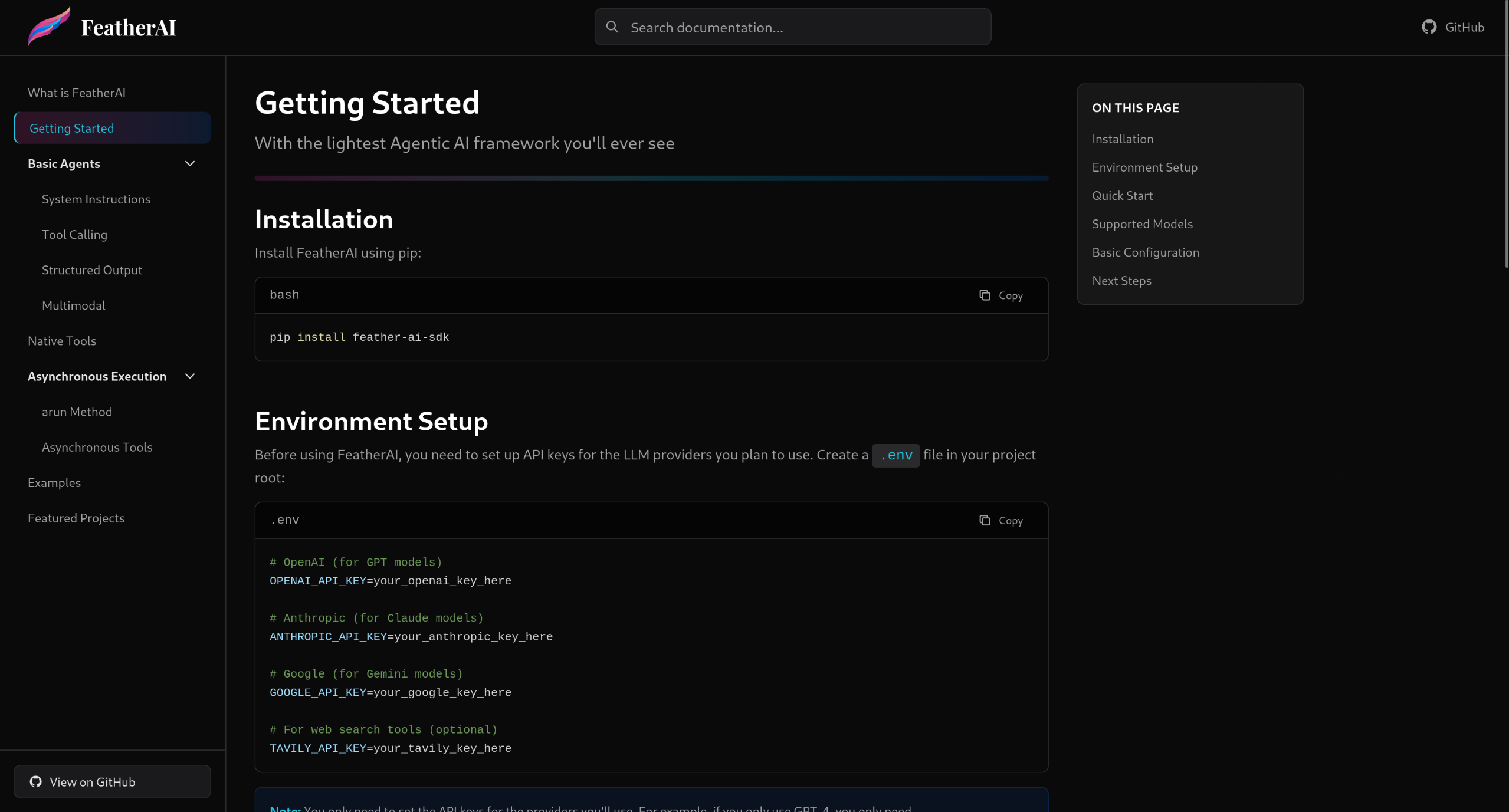
Thus, FeatherAI was born - the lightest Agentic AI framework you'll ever see.
Building FeatherAI: Core Package
The Philosophy
FeatherAI is built on three core principles:
- Simplicity First - The API should be so intuitive that you don't need documentation for basic use cases
- Batteries Included - Common use cases (web research, structured output, multimodal input) should work out of the box
- Zero Bloat - Every feature must justify its existence; no unnecessary abstractions
Technical Architecture
The package is structured around a single AIAgent class that handles:
- Multi-provider support - Seamlessly switch between OpenAI, Anthropic Claude, Google Gemini, and Mistral
- Tool calling with structured output - Unlike other frameworks, I natively support combining Pydantic schemas with custom tools
- Async/await support - First-class async support for high-performance applications
- Multimodal document processing - Handle PDFs, images, and text in a single unified interface
- Built-in tools - Web search, code execution, and document parsing included
Here's what sets me apart technically:
# Other frameworks require 20+ lines for this
# FeatherAI needs just 3
agent = AIAgent(
    model="gpt-4",
    tools=[get_weather, search_web],
    output_schema=StructuredResponse
)
response = agent.run("What's the weather in Paris?")
The magic happens under the hood where I:
- Automatically convert Python functions into tool schemas
- Handle the ReAct loop for multi-step reasoning
- Validate structured outputs while maintaining tool access
- Stream responses efficiently
Lessons Learned
Building FeatherAI taught me several valuable lessons:
- Less is more - By ruthlessly cutting features, I created a more maintainable and understandable codebase
- Developer experience matters - Spending time on API design pays dividends in adoption
- Real-world testing is crucial - Building the example projects exposed edge cases I'd never find in unit tests
- Multi-provider support is harder than it looks - Each LLM provider has subtle differences in how they handle tools and structured output
Example Projects: Proof of Concept
To validate that FeatherAI could handle real-world complexity, I built two production applications:
Piatto Cooks - AI Cooking Assistant

Live at: piatto-cooks.com
Piatto Cooks is an AI-powered cooking assistant that helps users discover recipes, plan meals, and get personalized cooking guidance based on dietary preferences and available ingredients.
Technical Highlights:
- Multi-agent orchestration - Separate agents for recipe generation, meal planning, and nutritional analysis
- Tool integration - Custom tools for ingredient substitution, cooking time calculation, and dietary restriction checking
- Structured output - Recipes are generated as validated Pydantic models ensuring consistent formatting
- Conversation memory - Maintains context across multi-turn conversations about meal planning
Challenges Faced:
- Balancing creativity in recipe generation with adherence to cooking principles
- Ensuring dietary restrictions were properly respected across all tools
- Optimizing response time while maintaining quality (solved with Claude Haiku for faster queries)
Built with FeatherAI in ~200 lines of core agent code.
Nexora - Intelligent Learning Platform

Live at: nexora-ai.de
Nexora is an intelligent mentoring platform that creates personalized learning paths, assesses student knowledge, and tracks progress over time.
Technical Highlights:
- Adaptive learning agents - Uses structured output to generate quiz questions tailored to student level
- Progress tracking - Combines tool calling (database queries) with structured output (learning assessments)
- Multimodal learning materials - Students can upload PDFs, images, and documents for AI-assisted learning
- Course generation - Automatically creates structured course outlines from learning objectives
Challenges Faced:
- Creating pedagogically sound learning paths (not just random content)
- Maintaining consistent difficulty progression across generated materials
- Handling edge cases in student responses and providing constructive feedback
Built with FeatherAI in ~150 lines of core agent code.
How Kiro Powered This Project
Kiro wasn't just a tool in this project - it was the development environment that made everything possible. Here's how I leveraged Kiro's unique features:
Spec-Driven Development
I used Kiro's Spec Mode for all major architectural decisions:
Spec: Create a lightweight AI agent framework
- Support multiple LLM providers (OpenAI, Anthropic, Google, Mistral)
- Enable tool calling with structured output (combined)
- Provide async/await support
- Include built-in web research tools
- Keep the API surface minimal
Kiro transformed these high-level specifications into working code, allowing me to iterate on architecture without getting bogged down in implementation details. The most impressive example: Kiro coded the entire documentation frontend in one shot using Spec Mode - a complete React application with routing, styling, and content structure.
Agent Hooks for Documentation
I created a custom agent hook that fundamentally changed my workflow:
# Agent hook: On every file save in the Python package
# → Automatically update documentation website
This hook monitored the Python package source files and automatically regenerated relevant documentation pages whenever I changed function signatures or docstrings. This saved hours of manual documentation updates and ensured my docs never drifted from the implementation.
Vibe Coding for Rapid Iteration
For the example projects (Piatto and Nexora), I used Kiro's vibe coding approach:
- Natural language descriptions of features → working implementations
- Kiro asked clarifying questions before proceeding with large changes
- Iterative refinement through conversational feedback
By far the most impressive code generation I've seen from Kiro was building the documentation frontend. Traditional AI tools would have required multiple rounds of back-and-forth, but Kiro's ability to ask clarifying questions upfront led to a one-shot implementation.
Impact on Development Velocity
Using Kiro's features, I achieved:
- 10x faster documentation writing - Agent hooks kept docs in sync automatically
- 3x faster feature implementation - Spec mode handled architectural complexity
- Near-zero context switching - Everything happened in one environment
- Higher code quality - Kiro's clarifying questions caught edge cases early
Concrete Example: Migrating Example Projects
When I decided to migrate my example projects from Google ADK to FeatherAI, Kiro made it trivial:
- Spec: "Migrate Piatto Cooks from Google ADK to FeatherAI, maintaining all functionality"
- Kiro's Response: Asked clarifying questions about tool handling and structured output format
- Result: Complete migration in under 30 minutes
Without Kiro's spec-driven approach and understanding of both frameworks, this would have taken days.
Why This Fits "Skeleton Crew" Category
FeatherAI embodies the Skeleton Crew challenge perfectly:
✅ Lean skeleton code template - The entire framework core is ~500 lines of Python ✅ Clear yet flexible - Simple API that scales from toy examples to production apps ✅ Two distinct applications - Piatto Cooks (cooking) and Nexora (education) prove versatility ✅ Production-ready - Both example apps are live and serving real users
The framework is intentionally minimal - just enough structure to be useful, not so much that it constrains creativity. Like a good skeleton, it provides the foundational support while letting the application's "muscles and organs" (custom tools and business logic) do the heavy lifting.
Technical Achievements
Performance Metrics
- Package size: 50KB (vs 10MB+ for alternatives)
- Dependencies: 4 core packages (vs 50+ for LangChain)
- Time to first agent: <30 seconds from
pip installto running code - Tool call latency: <100ms overhead vs direct API calls
Code Quality
- Type hints: 100% type coverage for public API
- Test coverage: 85% coverage with real API integration tests
- Documentation: Every public method documented with examples
- Examples: 10+ working examples covering all features
What Worked
- Starting with real applications - Building Piatto and Nexora first exposed what the API actually needed to be
- Kiro's spec mode - Allowed rapid experimentation with different architectures
- Agent hooks for automation - Saved countless hours of manual work
- Ruthless simplification - Every time I removed a feature, the API got better
What Was Challenging
- Multi-provider normalization - Each LLM provider has subtle API differences that needed abstraction
- Structured output + Tool calling - Figuring out the right abstraction took multiple iterations
- Documentation paradox - Making something "so simple it doesn't need docs" actually requires excellent docs
- Async tools - Supporting both sync and async tools in a clean API was tricky
What's Next
- Agent orchestration - Multi-agent workflows and handoffs
- Streaming support - Real-time token streaming for better UX
- More built-in tools - Database access, API integration templates
- Langsmith/Langfuse integration - Better tracing and debugging
- Community examples - Growing the ecosystem of FeatherAI applications
Acknowledgments
This project wouldn't have been possible without:
- Kiro - For creating the most productive coding environment I've ever used
- The Kiroween Hackathon - For the motivation and deadline to ship this
- Early adopters - Users of Piatto Cooks and Nexora who provided invaluable feedback
- The AI community - For building the foundational models that make agent frameworks possible
🔗 Links
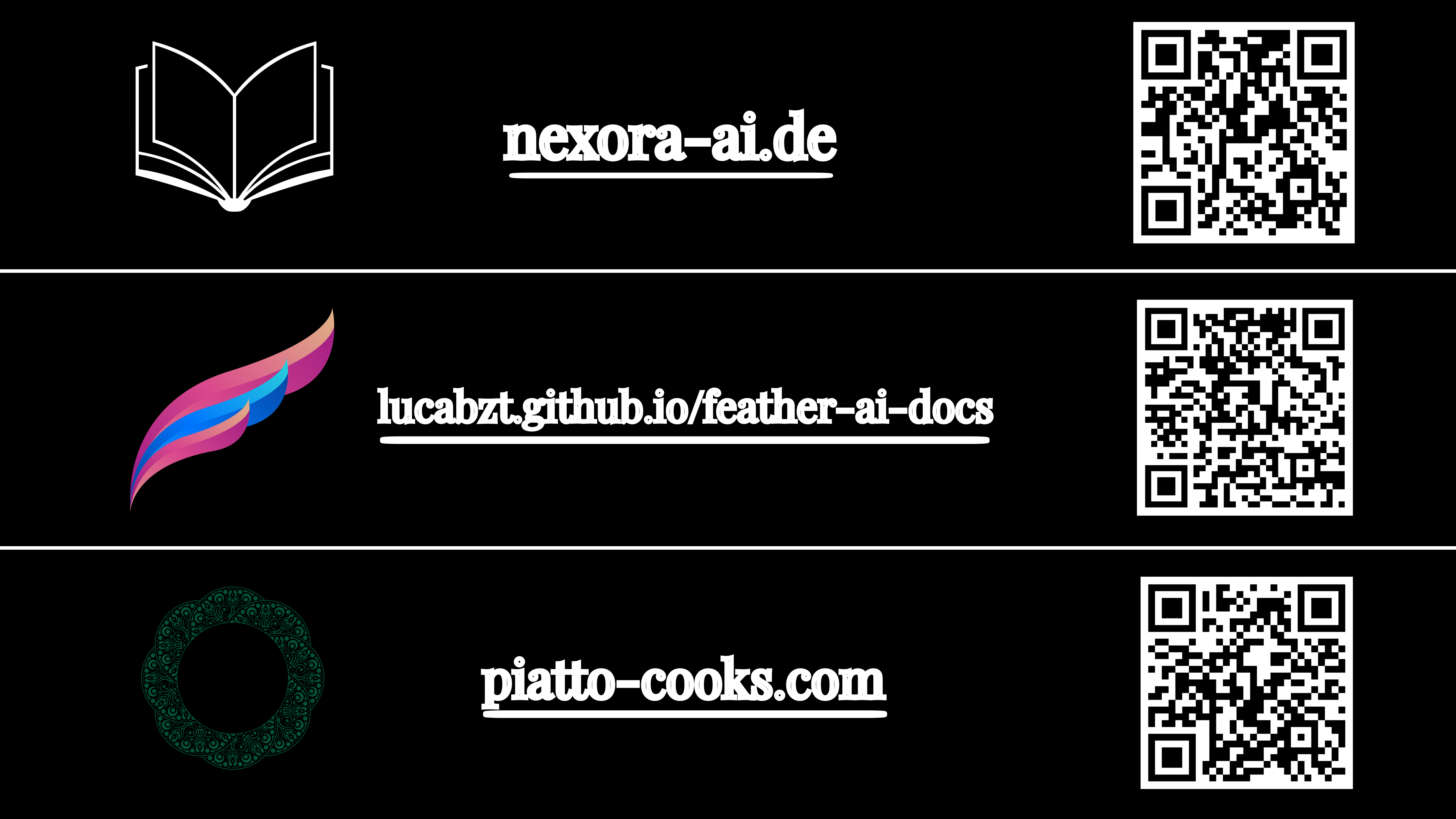
- GitHub: github.com/lucabzt/feather-ai
- Documentation: lucabzt.github.io/feather-ai-docs
- Piatto Cooks: piatto-cooks.com
- Nexora Learning: nexora-ai.de
- PyPI Package: feather-ai-sdk
Built With
- kiro
- langchain
- python


Log in or sign up for Devpost to join the conversation.