-
-
1
-
2
-
3
-
4
-
5
-
6
-
7
-
8
-
9
-
10
Inspiration
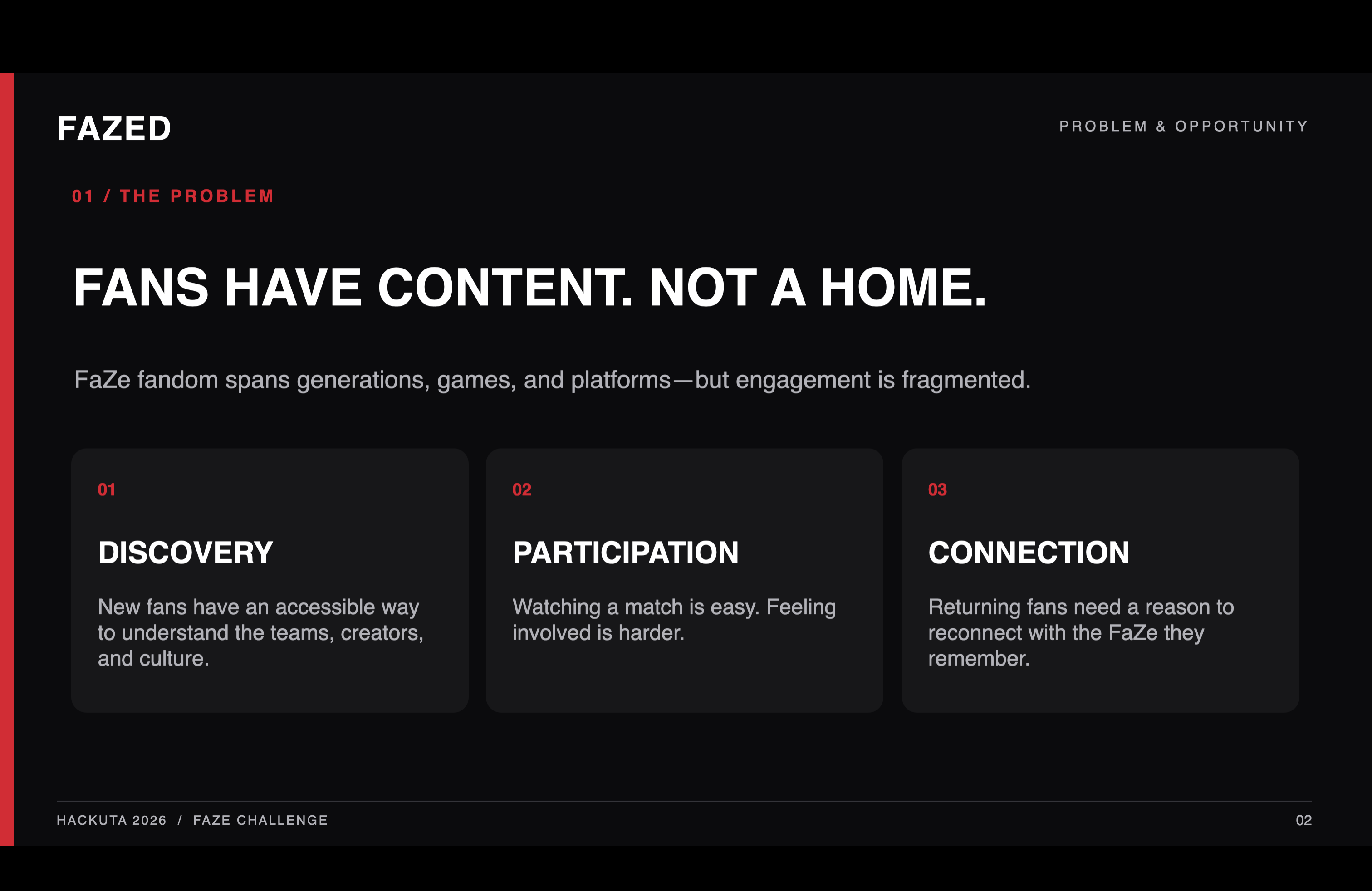
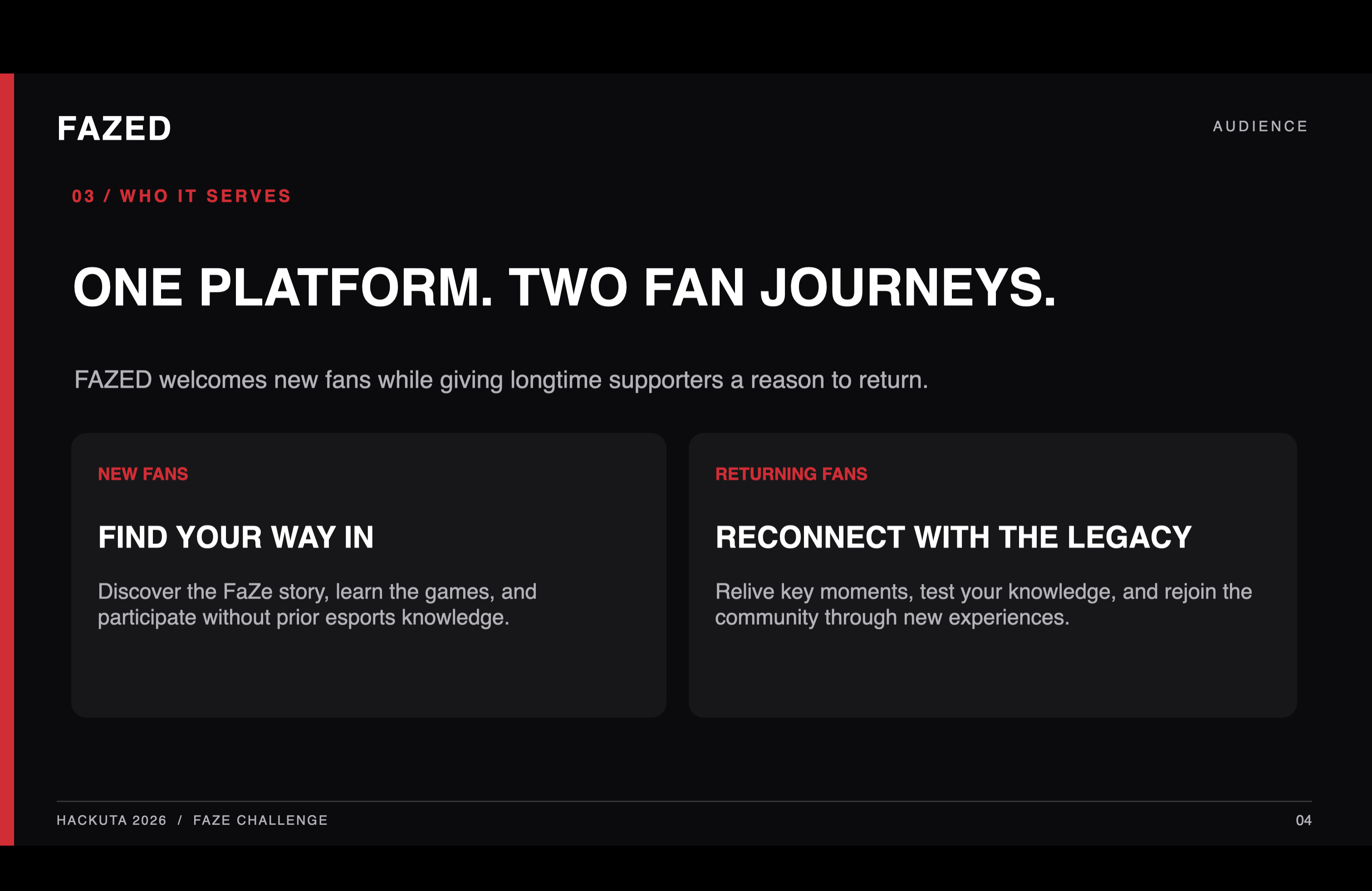
When the FaZe track was introduced at HackUTA 2026, the challenge immediately resonated with us. We're both longtime gaming enthusiasts, and we've had our fair share of fun following sports betting, especially during this year's World Cup. So when FaZe asked how they could bring back returning audiences while attracting a new generation of fans, we saw an opportunity to combine two things we're genuinely passionate about: gaming and competitive predictions.
We realized that esports engagement shouldn't end when a livestream does. Fans need a reason to come back, something that rewards their knowledge, builds anticipation, and makes every match feel personal.
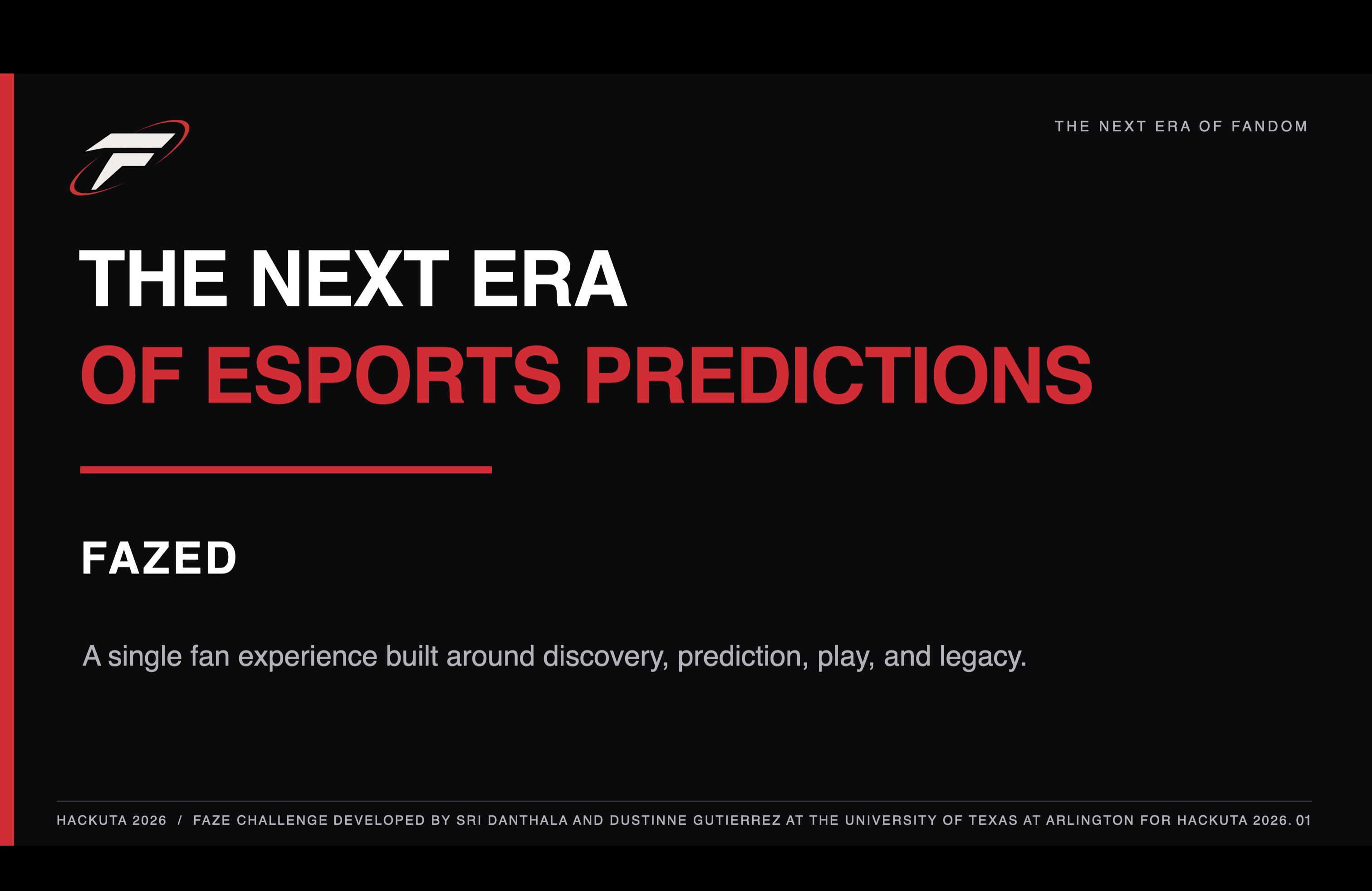
Our answer? FAZED.
We envisioned a platform where esports fans could do more than watch their favorite teams compete. They could predict outcomes, challenge themselves, earn rewards, and build a legacy of their own.
What it does
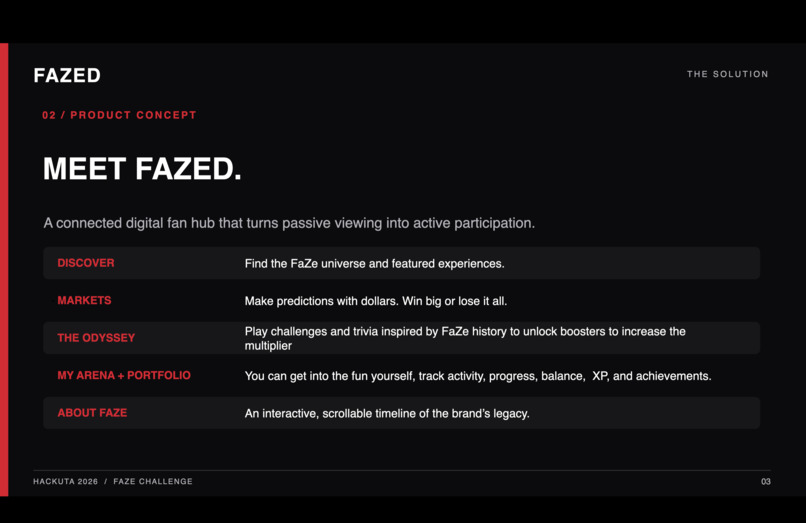
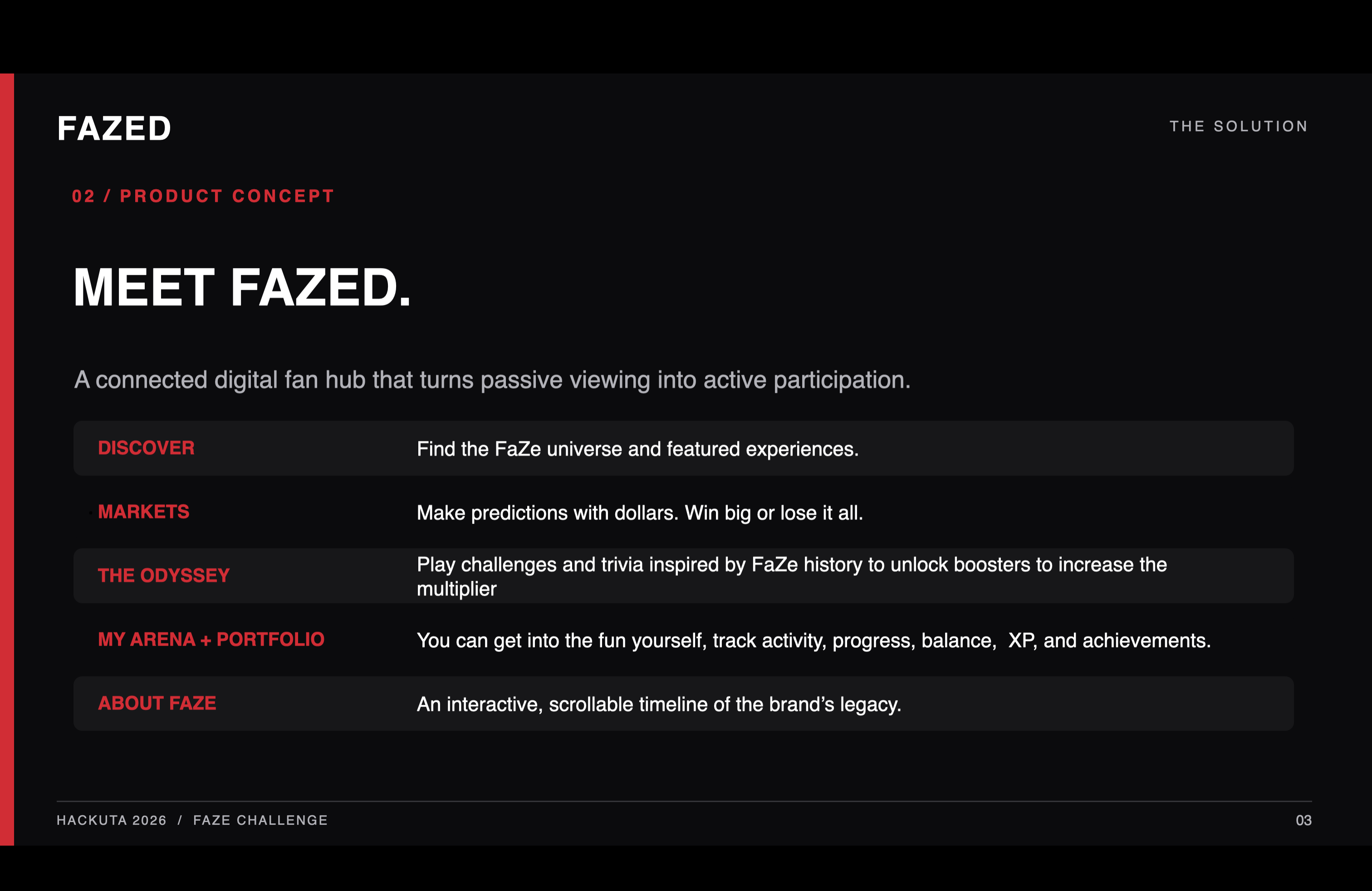
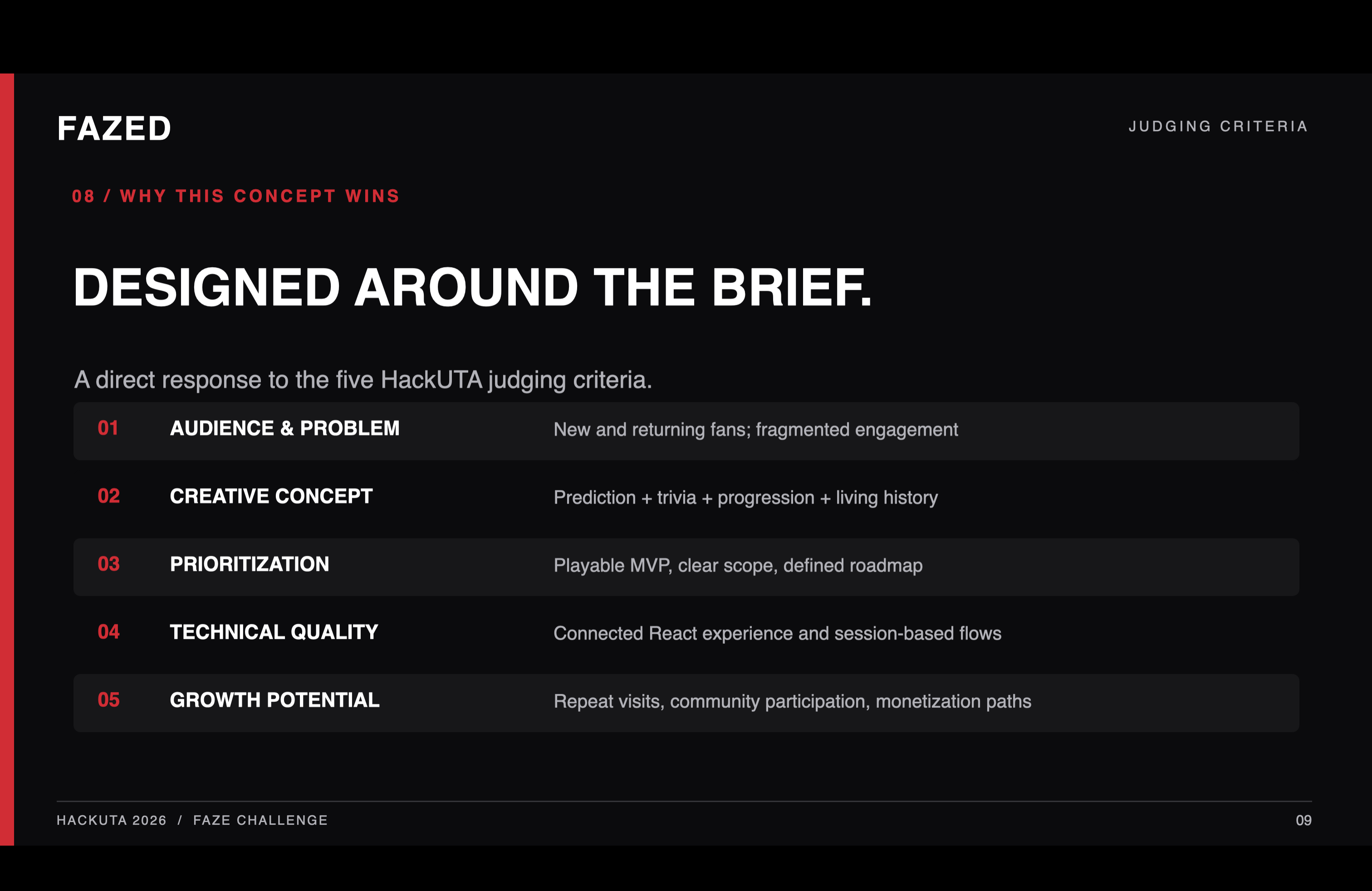
FAZED is a gamified esports betting platform that combines match predictions, competitive challenges, and an interactive progression system called The Odyssey.
Our goal is to create an experience that gives fans something to return to, whether there's a major tournament happening or not.
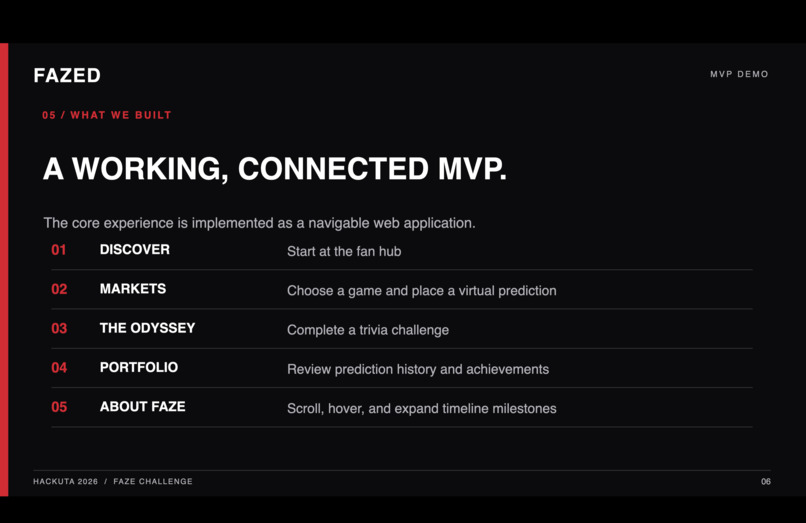
The platform features several interconnected experiences:
Prediction Markets: Explore esports markets across games like Counter-Strike 2, VALORANT, Fortnite, and Call of Duty. Make predictions, compare probabilities, and explore interactive charts that visualize simulated market trends.
My Arena: Put your gaming skills to the test through competitive, game-specific challenges. Players can select difficulty levels, stake virtual currency, track their results, and earn multiplied payouts for successful challenges.
The Odyssey: A progression-based experience that rewards players for their esports knowledge. Complete trivia quests, earn XP, and unlock boosters that can increase potential challenge rewards.
Player Portfolio: Track virtual balances, earned XP, completed challenges, and personal milestones in one place.
Player Accounts: Sign up, log in, and access a personalized experience through Supabase authentication.
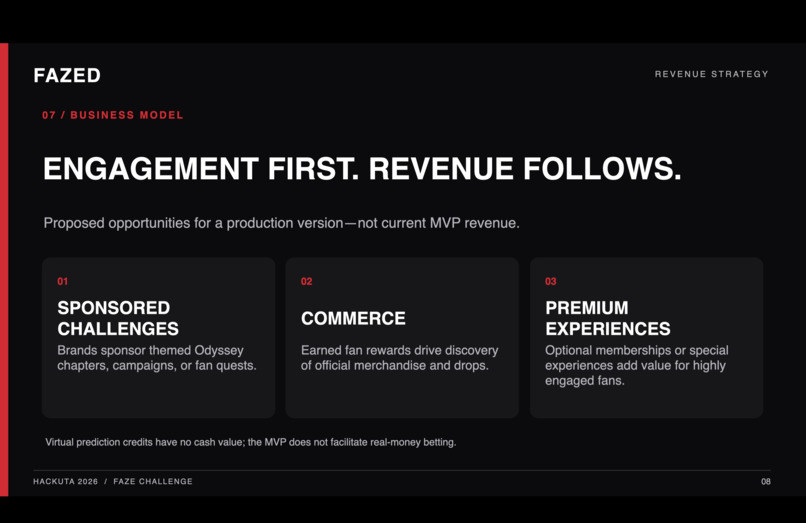
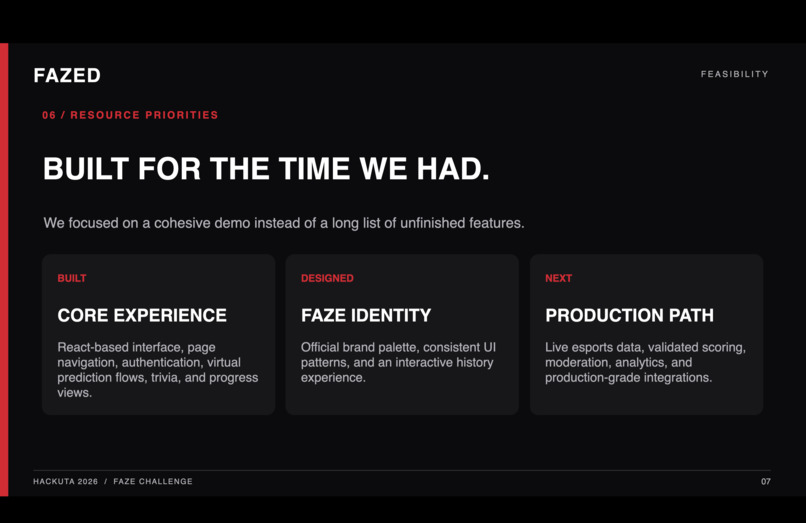
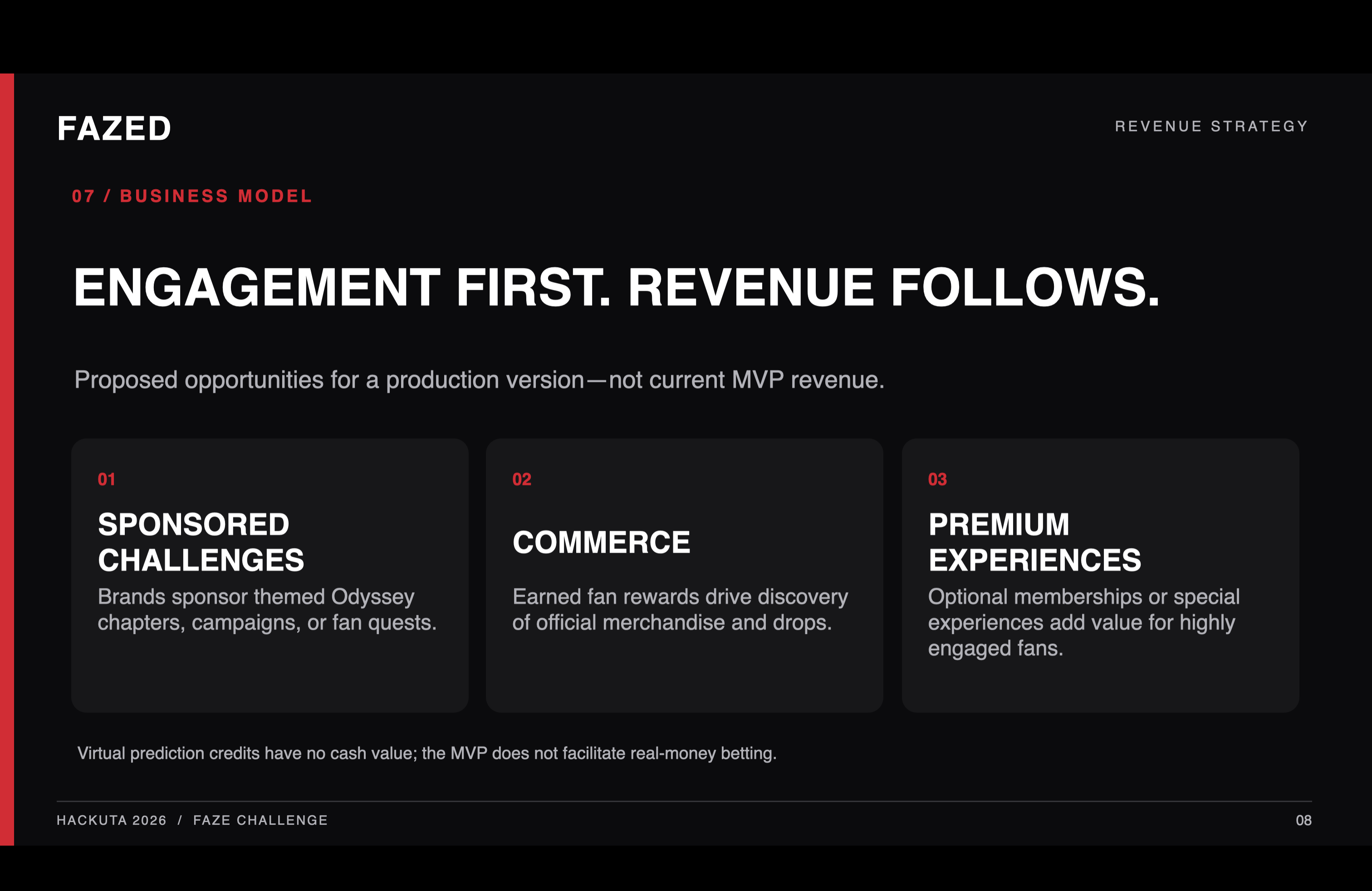
The long-term vision for FAZED includes real-money esports betting for eligible adults, while our hackathon prototype uses virtual currency and simulated markets to demonstrate the experience.
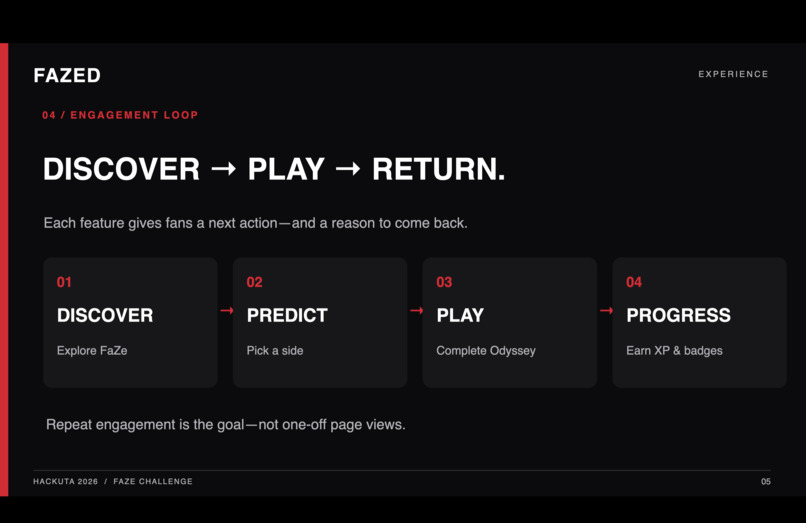
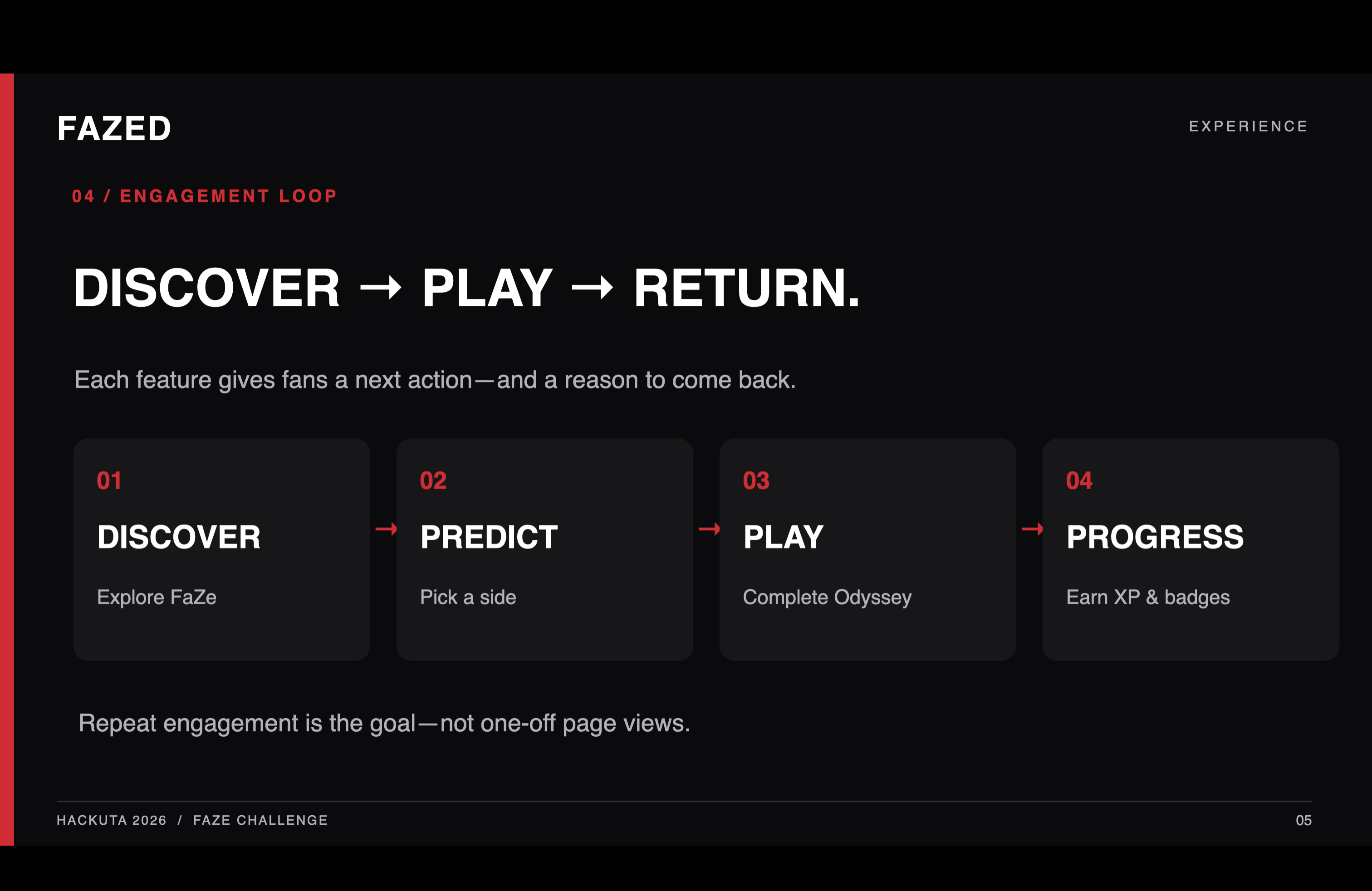
Together, these features create a continuous cycle of engagement: predict, compete, earn, and progress.
How we built it
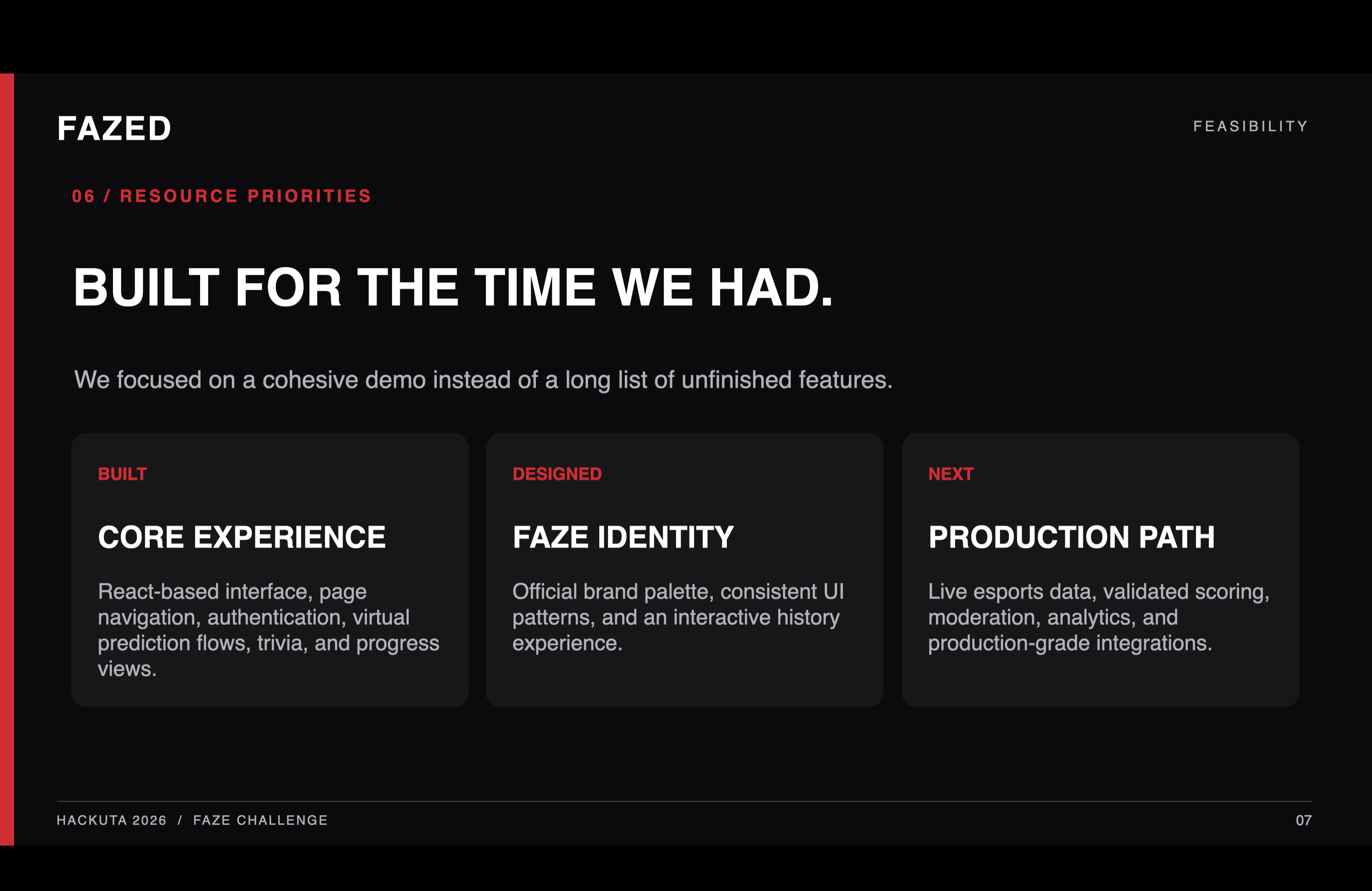
We built FAZED as a full-stack web application using React, Vite, JavaScript, Tailwind CSS, Node.js, Express.js, Supabase, Google Gemini, and Hoppscotch, with GitHub for version control and collaboration.
On the frontend, React and Vite allowed us to create a responsive, interactive experience that reflects FAZED's bold visual identity. We developed interactive probability charts, game-specific challenges, an XP-based progression system, and personalized player dashboards. We also incorporated cinematic scrolling animations and interactive elements to make the platform feel immersive and engaging.
For the backend, we used Supabase and PostgreSQL to manage player authentication and database functionality. We built a REST API with Node.js and Express to handle gameplay requests, verify authenticated users, and securely integrate Google's Gemini API.
One of our most exciting features was The Odyssey, an AI-powered esports trivia experience. Using Gemini, we dynamically generate questions about esports and FaZe history, combining AI-generated content with timed challenges, a three-strike system, and XP rewards to encourage players to return.
We used Hoppscotch to test and debug our backend API endpoints, allowing us to send HTTP requests, inspect JSON responses, and troubleshoot communication between our frontend and backend. It was especially useful for checking our Odyssey gameplay endpoints, identifying authentication issues, and verifying that our API behaved as expected during integration.
To bring FAZED online, we deployed our frontend through Vercel and hosted our Express backend on Vultr Cloud, running an Ubuntu Linux server. We configured Caddy for HTTPS and reverse proxying, connected our services through a custom domain, and used GitHub to manage branches, merge contributions, and coordinate development.
We also embraced AI-assisted development throughout the process. AI helped us troubleshoot unfamiliar concepts, navigate deployment challenges, resolve integration issues, and accelerate implementation. Rather than replacing our creativity or decision-making, it became a tool that helped us transform our ideas into a functioning product.
Challenges we ran into
Here's the plot twist: neither of us are computer science majors anymore.
We both independently changed our academic paths a couple of years ago, and while our interest in technology never disappeared, our programming skills had gotten a little rusty.
Building a full-stack application under 24 hours constraints was intimidating. We had to familiarize ourselves with tools we hadn't used in a while, troubleshoot authentication and database integration, resolve GitHub merge conflicts, and figure out how to combine our independently developed features into one cohesive platform.
One of our biggest challenges was connecting our Supabase-backed prediction markets with the frontend experience while preserving the design and functionality we'd already built.
We quickly learned that building something ambitious isn't always about knowing exactly what you're doing from the beginning. Sometimes it's about being willing to figure it out as you go.
And that's exactly what we did.
Accomplishments that we're proud of
We're especially proud of how much we accomplished in such a short period of time.
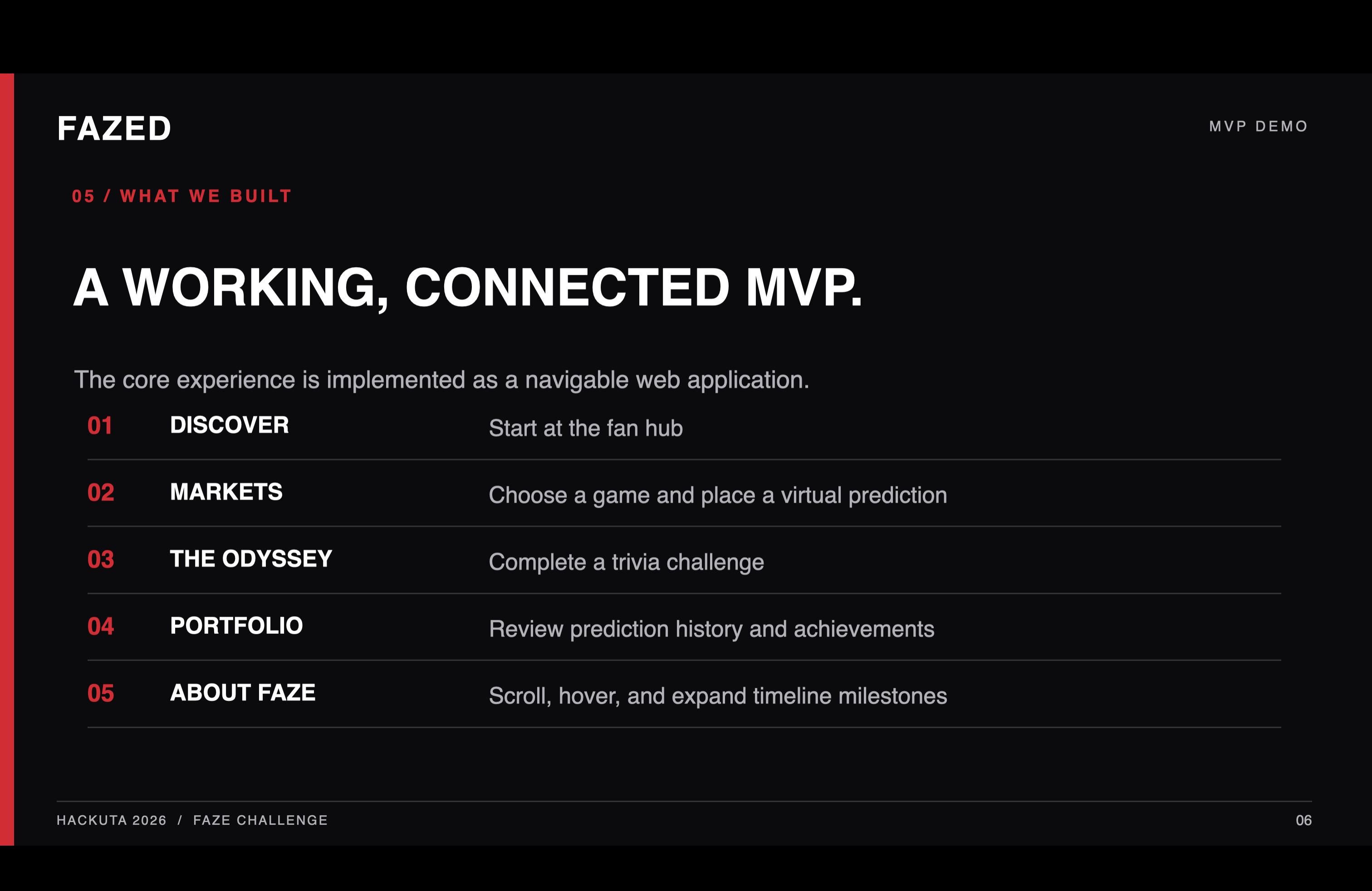
What started as an idea inspired by the opening ceremony became a working interactive prototype with user authentication, prediction markets, probability visualizations, competitive challenges, and a gamified reward system.
More importantly, we built something that reflects our interests and combines them into a product with a clear purpose.
For two students whose current fields of study aren't centered around software development, getting FAZED this far was an accomplishment in itself.
What we learned
This hackathon reminded us why we fell in love with creating in the first place.
We learned how to approach unfamiliar technical problems, collaborate through version control, integrate frontend and backend systems, and use AI effectively as a development tool.
But our biggest takeaway went beyond programming.
We learned that our academic majors don't define the limits of what we can create. With enough curiosity, persistence, caffeine, and a shared drive to win, we can turn an ambitious idea into something real.
What's next for FAZED
Our vision for FAZED extends far beyond HackUTA. While our current prototype demonstrates the foundation of an interactive esports engagement platform, we see an opportunity to develop it into a scalable ecosystem that combines real-time prediction markets, artificial intelligence, and community-driven experiences.
AI-Powered Prediction Markets
One of our biggest priorities is expanding our integration with the Google Gemini API to introduce AI-powered market analysis.
We plan to connect FAZED to dedicated esports data providers that supply verified match statistics, live results, and real-time betting odds. Gemini would then process this information to generate matchup insights, explain probability changes, and analyze relevant trends for individual prediction markets.
For example, users could explore why a particular team is favored, how recent performance influences a matchup, or what factors might contribute to changing market probabilities.
Rather than relying solely on numerical odds, we want FAZED to help users understand the data behind their predictions, making esports markets more engaging and approachable for both experienced fans and newcomers.
Building a Community Through Live Chat
Another major goal is introducing real-time community chat throughout the platform.
We envision dedicated discussion spaces for individual esports matches and prediction markets, allowing users to discuss strategies, share reactions, and interact with other fans while watching live competitions.
By integrating live chat with our existing progression system, we hope to transform FAZED from an individual experience into a community-driven platform.
Our goal is to create an environment where users return not only to make predictions or complete challenges, but also to connect with people who share their passion for esports.
Expanding Into Real-Money Markets
Although our current prototype operates using virtual currency and simulated markets, we eventually want to explore real-money transactions and regulated esports prediction markets.
This would require integrating licensed payment infrastructure, secure transaction processing, identity and age verification, and responsible-gaming safeguards.
We recognize that real-money betting introduces significant regulatory, financial, and security requirements. Our approach would be to develop these capabilities only within an appropriate legal and licensing framework.
Ultimately, we want to build a platform that balances competitive excitement with transparency, security, and user trust.
Our vision extends beyond HackUTA.
We want to connect our progression and reward systems to a unified player economy, expand the range of esports markets, introduce verified match results, and create a more personalized experience for fans.
Eventually, we'd like to explore a compliant real-money betting experience with the necessary licensing, age verification, and responsible-gaming safeguards.
But at its core, our goal stays the same: to build a platform where esports fans don't just follow the competition. They become part of it.
Bet the match. Start your Odyssey. Get FAZED.
Built With
- ai
- css
- gemini-api
- git
- github
- godaddy
- hoppscotch
- javascript
- node.js
- porkbun
- postgresql
- react
- sql
- supabase
- tailwind
- vercel
- visual-studio
- vite
- vultr
