Inspiration
Group decisions die in the group chat. Four friends, one Friday night, two restaurants, zero agreement — and the thread goes quiet until someone settles for the place nobody wanted. We wanted to settle disagreements the way they deserve to be settled: with a trial.
What it does
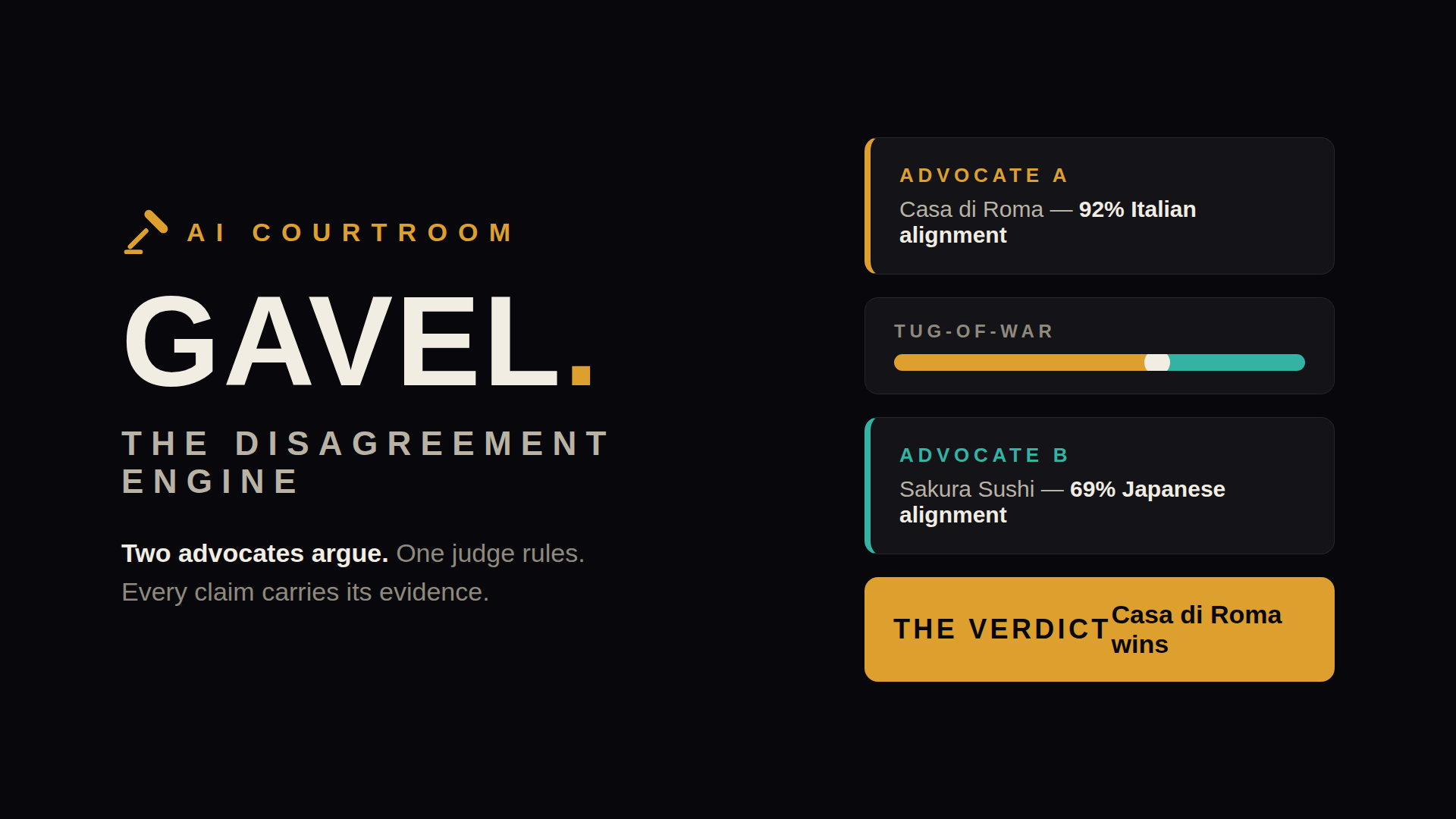
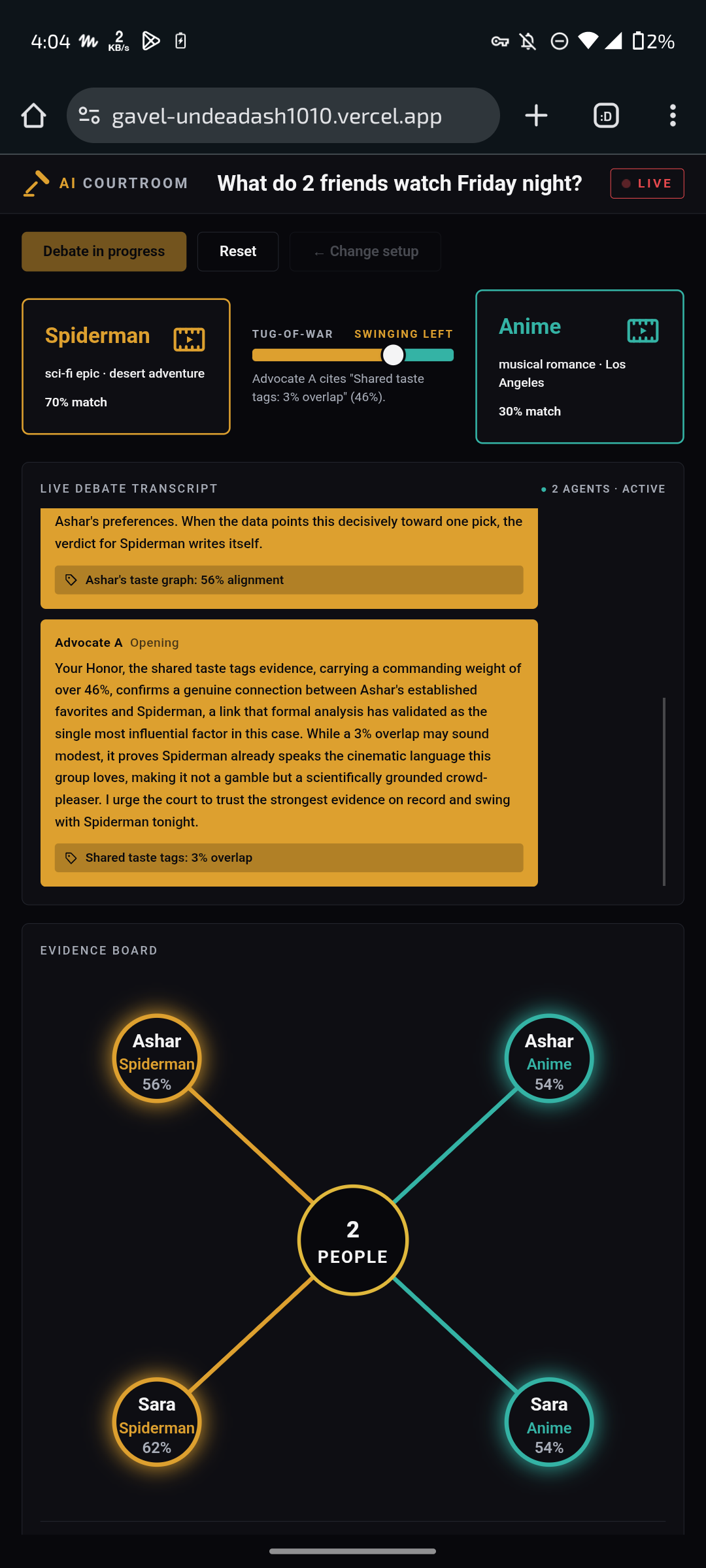
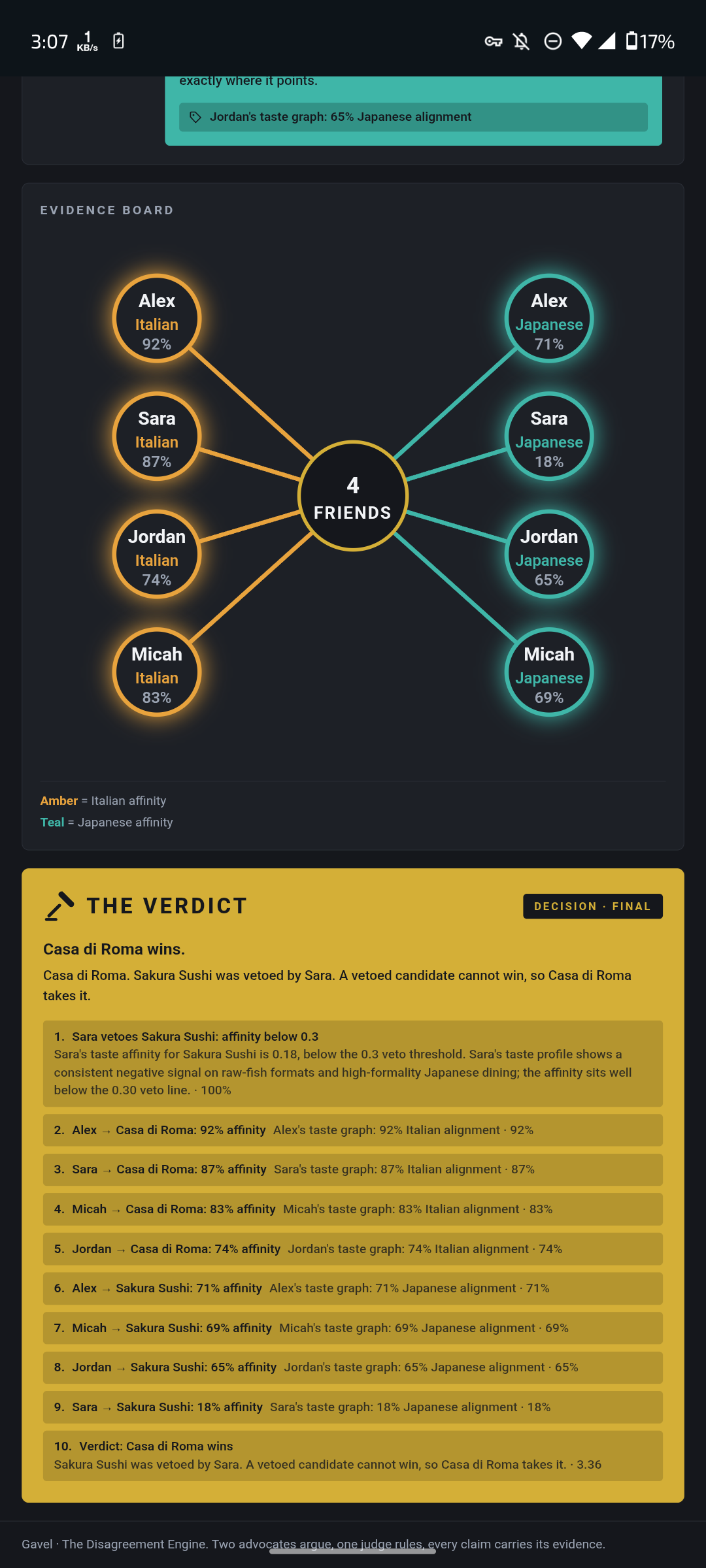
Gavel is a Disagreement Engine. Instead of asking one AI for a recommendation, it puts two advocate agents on opposite sides of your question and lets them debate using real taste-graph evidence, while a third agent — the judge — rules on the outcome. It runs as a live AI Courtroom in the browser: candidate cards, a tug-of-war score meter, a live transcript with evidence chips, an evidence board that lights up as arguments land, and a verdict banner with a full proof chain. You bring your people (2–6, each with taste keywords) and your options (2–4 restaurants, or switch to Movies mode for films). The advocates argue, the judge vetoes whatever the group cannot stand mid-debate, and the verdict arrives with receipts — plus a shareable verdict card for the group chat.
How we built it
Next.js 16, TypeScript, Tailwind CSS, deployed on Vercel. Taste evidence comes from Qloo's taste graph: every person seed and every candidate is resolved to a real Qloo entity, and affinity is computed from keyword overlap, Qloo tag similarity, and popularity. Argument wording comes from a pluggable LLM layer (NVIDIA NIM in production, local Ollama fallback, deterministic templates as final fallback). The judge is fully deterministic — vetoes and decisions are rules, not vibes. The debate streams as five stateless API stages: opening A/B, rebuttal A/B, verdict.
Challenges we ran into
Two big ones. First, voice: the advocates kept sounding identical and repeating slogans, so we gave them genuinely distinct personalities — one plain-spoken and numbers-first, one warm and people-first — and made rebuttals paraphrase instead of quoting. Second, honesty in the evidence: low affinities can't be cited as support, so anything under 0.30 is veto territory and can never argue for a candidate. Every claim on screen traces back to a real number.
Accomplishments that we're proud of
A full debate — two advocates, a live veto, a reasoned verdict with a proof chain — running end to end on real taste data with zero scripted lines. Change the taste data and the arguments change. And the verdict card: the whole trial compressed into one image worth sending to the group chat.
What we learned
Taste is data, and disagreements are computable. Once every claim has to carry its evidence, the debate gets honest fast — the loudest voice in the room stops winning by default.
What's next for Gavel
More decision domains beyond dining and movies. The engine is domain-general — the same courtroom could settle buying committees or hiring panels, any group that argues.
Built With
- next.js
- nvidia-nim
- qloo
- tailwind
- typescript
- vercel
