Inspiration
Autonomous robots are increasingly used in warehouses, factories, and other environments where reliability and safety are essential. But what happens when a robot receives corrupted sensor data, experiences communication delays, or receives an outdated AI decision?
A robot may continue moving even when its understanding of the environment is no longer accurate. This inspired us to build FaultShield, a simulation-based AI safety and recovery system for autonomous mobile robots.
Our goal is to explore how intelligent fault detection, AI-assisted decision-making, and an independent safety mechanism can work together to make autonomous systems more resilient.
What We Built
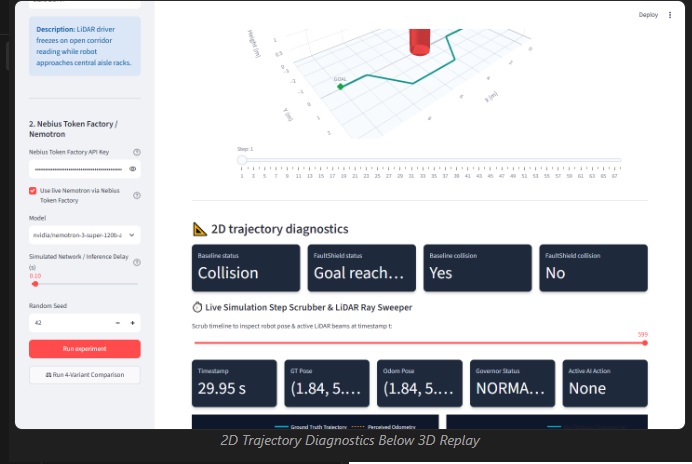
FaultShield is a simulation-based framework that demonstrates how an autonomous robot can detect faults, reason about recovery options, and verify proposed actions before execution.
The system combines:
Robot Simulation: A virtual differential-drive mobile robot operating in a simulated environment.
Fault Injection: Simulates sensor failures such as stale LiDAR readings, sensor dropouts, IMU bias, odometry drift, and communication delays.
Sensor Integrity Monitoring: Identifies potentially unreliable or outdated sensor information.
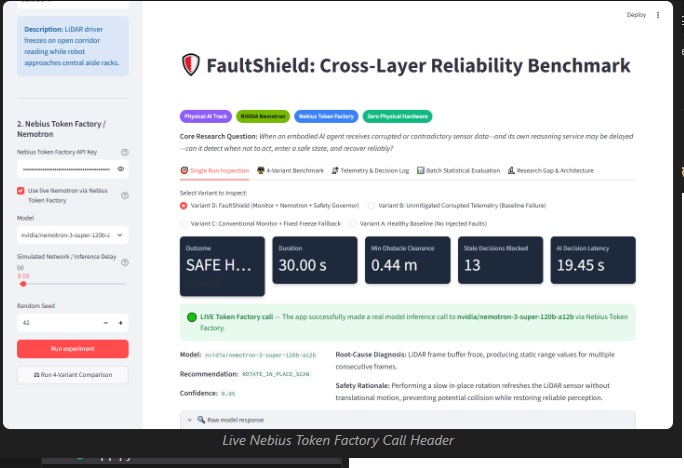
NVIDIA Nemotron: Uses Nemotron through Nebius Token Factory to analyse fault information and suggest recovery actions.
Independent Safety Governor: Checks proposed AI actions against safety constraints before allowing them.
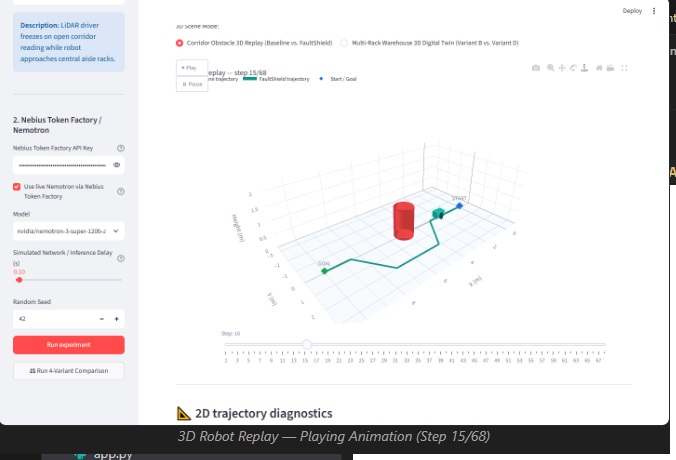
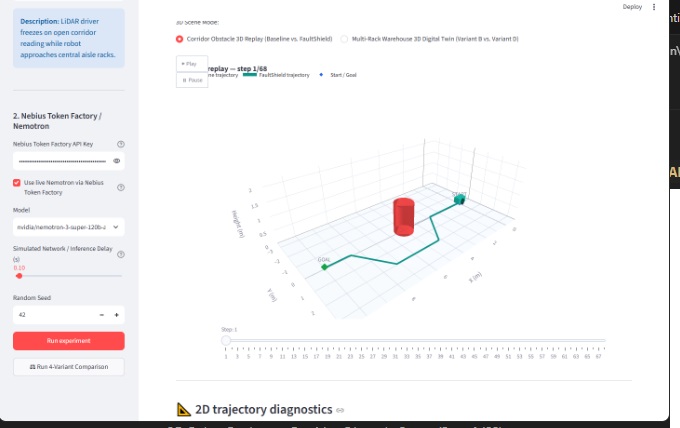
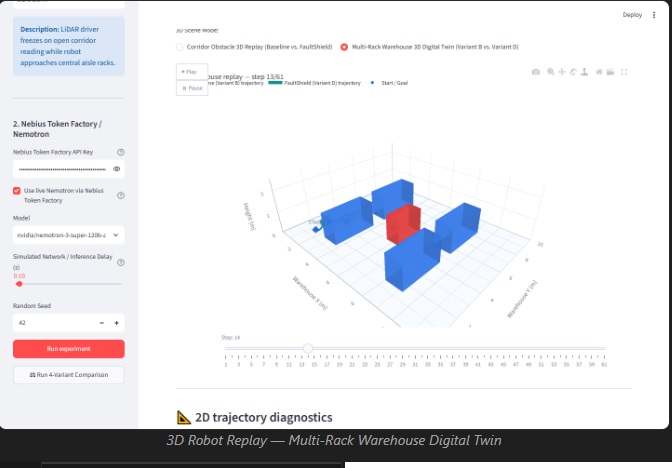
Visualization and Benchmarking: Provides interactive simulation, 3D replay, and performance comparisons between different fault-handling approaches.
How We Built It
We developed FaultShield using Python, numerical simulation, and interactive visualization tools.
The virtual robot operates in a controlled environment where different faults can be introduced and observed. Sensor information is monitored for integrity issues, and relevant fault information is passed to NVIDIA Nemotron through Nebius Token Factory.
Nemotron provides a recovery recommendation based on the available information. However, the language model does not directly control the robot. An independent safety governor evaluates the proposed action, helping prevent unsafe or outdated recommendations from being executed.
We also designed benchmark scenarios to compare baseline behaviour, conventional fault monitoring, and AI-assisted recovery. This allows us to investigate the relationship between sensor reliability, AI response latency, and safe robot operation.
Challenges We Faced
One of our biggest challenges was building a Physical AI project without access to a physical robot or robotics laboratory.
Instead of depending on expensive hardware, we created a simulation-first approach that allows us to reproduce sensor failures and evaluate recovery behaviour in a controlled environment.
Another challenge was ensuring that AI recommendations could not bypass safety constraints. We addressed this architectural challenge by separating the Nemotron reasoning component from the independent safety governor.
We also had to consider response latency and outdated information. A recovery recommendation may be reasonable when generated but unsafe if the robot's environment has changed before it is received.
Integrating a live NVIDIA Nemotron model through Nebius Token Factory while maintaining a responsive simulation was another important engineering challenge.
What We Learned
Building FaultShield taught us that adding AI to robotics is not simply about making better decisions. It is also about knowing when information is unreliable, when an AI response is outdated, and when a proposed action should be rejected.
We learned how to integrate NVIDIA Nemotron through Nebius Token Factory, design fault-injection experiments, build a simulation-based robotics environment, and separate AI reasoning from safety-critical action validation.
Most importantly, we learned that trustworthy Physical AI requires cooperation between intelligent decision-making and independent safety mechanisms.
Research Direction and Future Work
FaultShield is a simulation-based research prototype, not a physically deployed or hardware-validated robot system.
Our research direction is to investigate how sensor faults and AI response delays interact, and whether combining sensor-integrity monitoring with constrained AI-assisted recovery can improve autonomous robot resilience.
Future work includes expanding the simulation scenarios, conducting more extensive benchmark experiments, and eventually validating the framework on physical robotic platforms.
FaultShield — Detect. Decide. Recover.
Our vision is to make autonomous robots not only intelligent, but also resilient and safe when things go wrong.

Log in or sign up for Devpost to join the conversation.