-
-
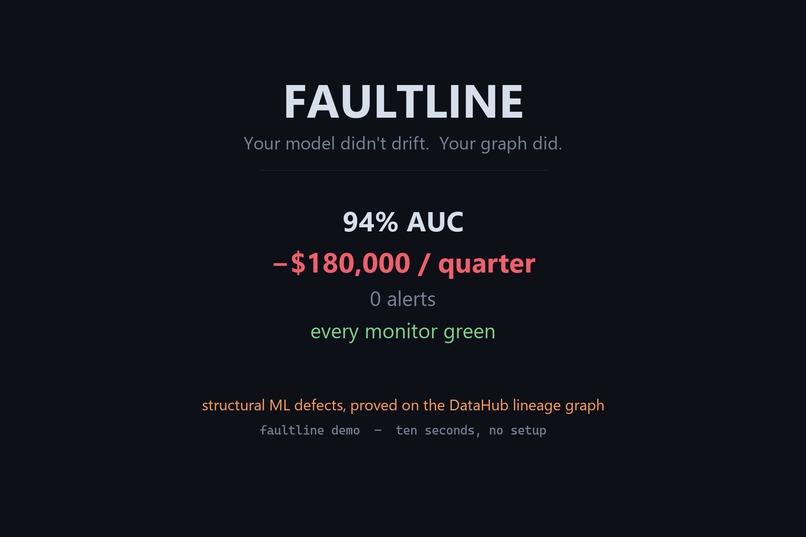
project card — the hook and tagline
-
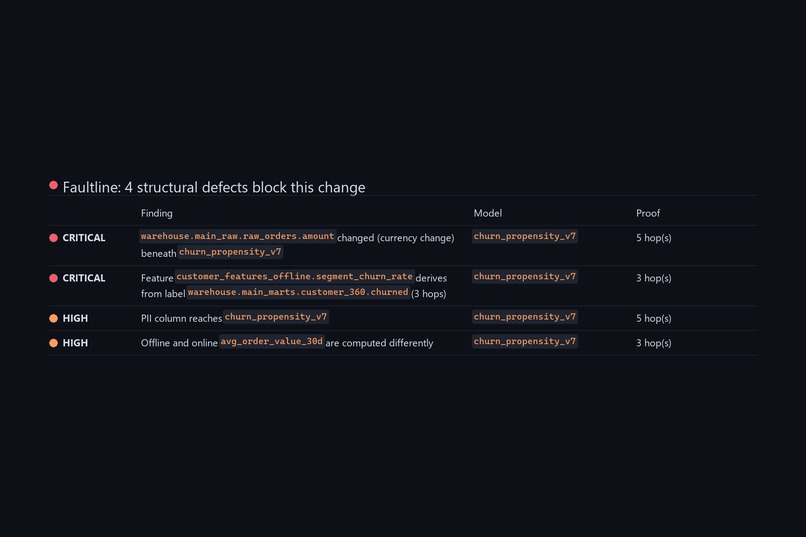
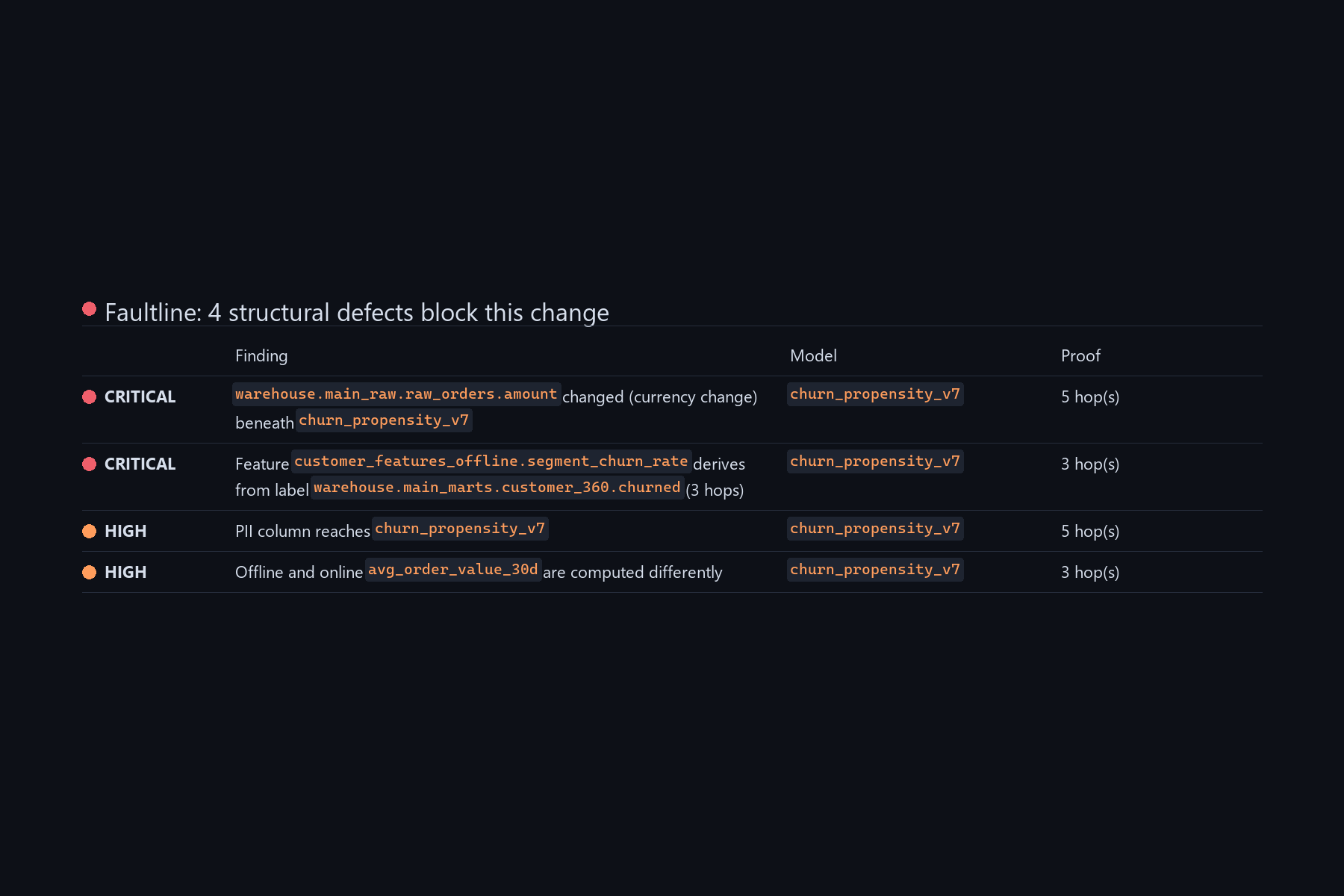
the PR comment that blocks the merge
-
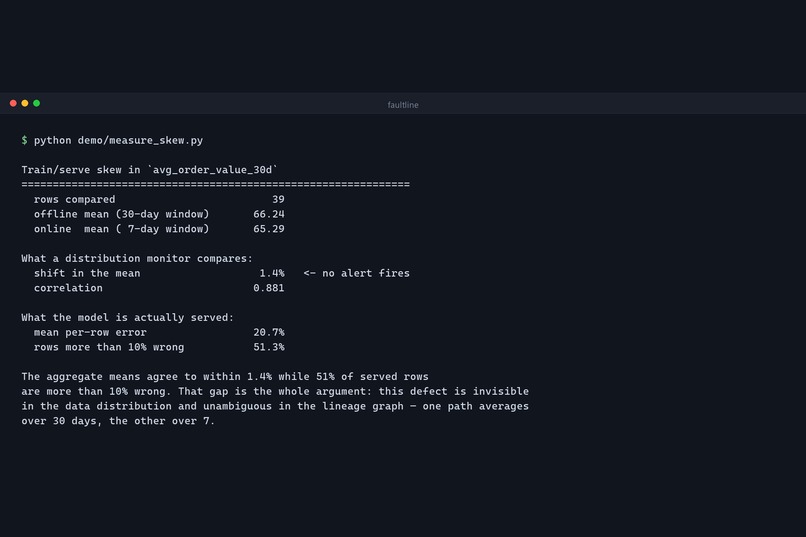
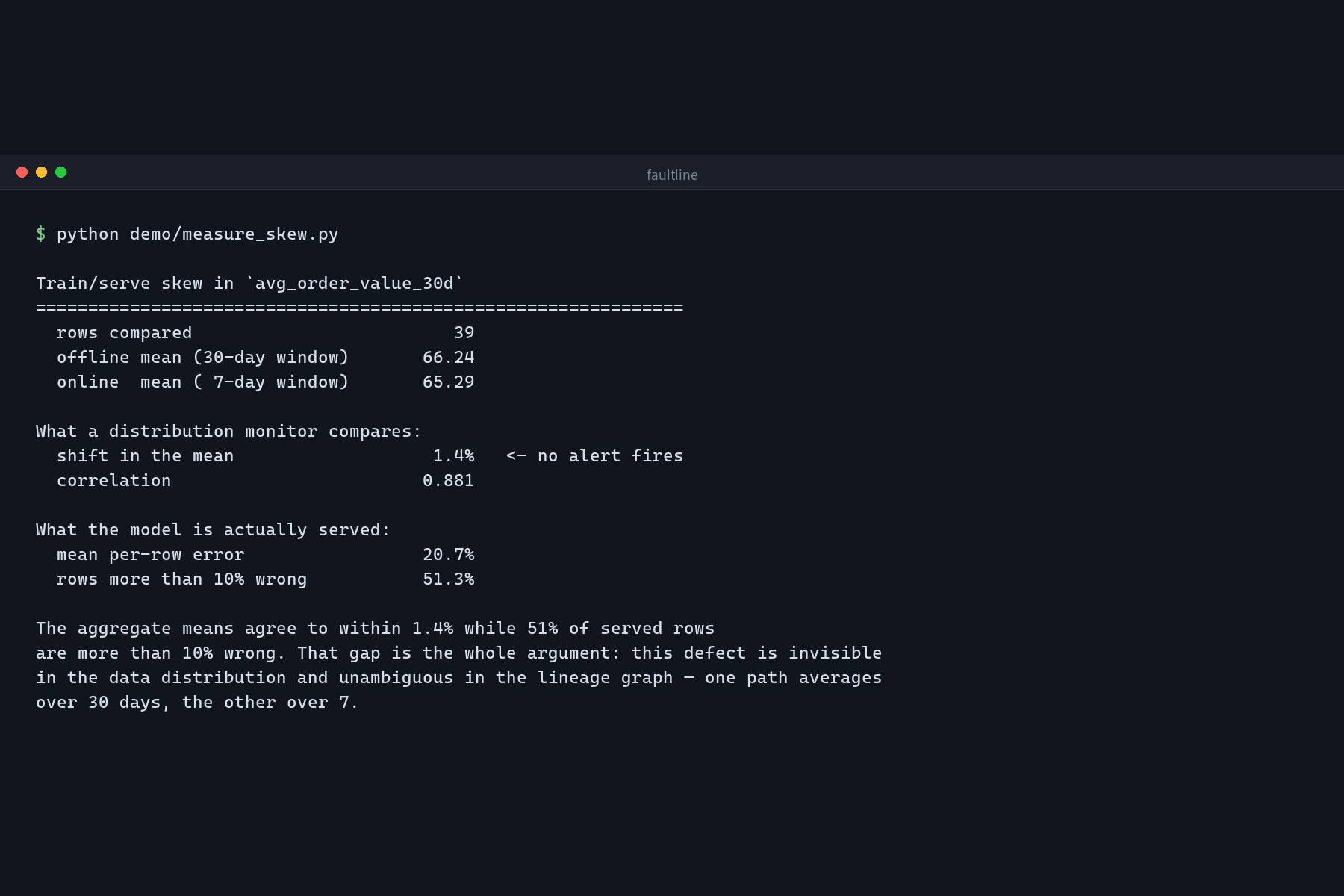
1.4% mean shift vs 51.3% of rows wrong
-
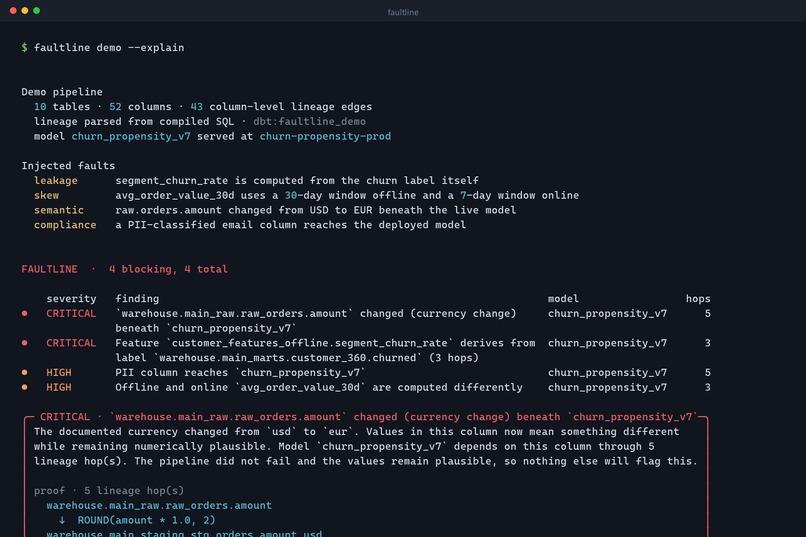
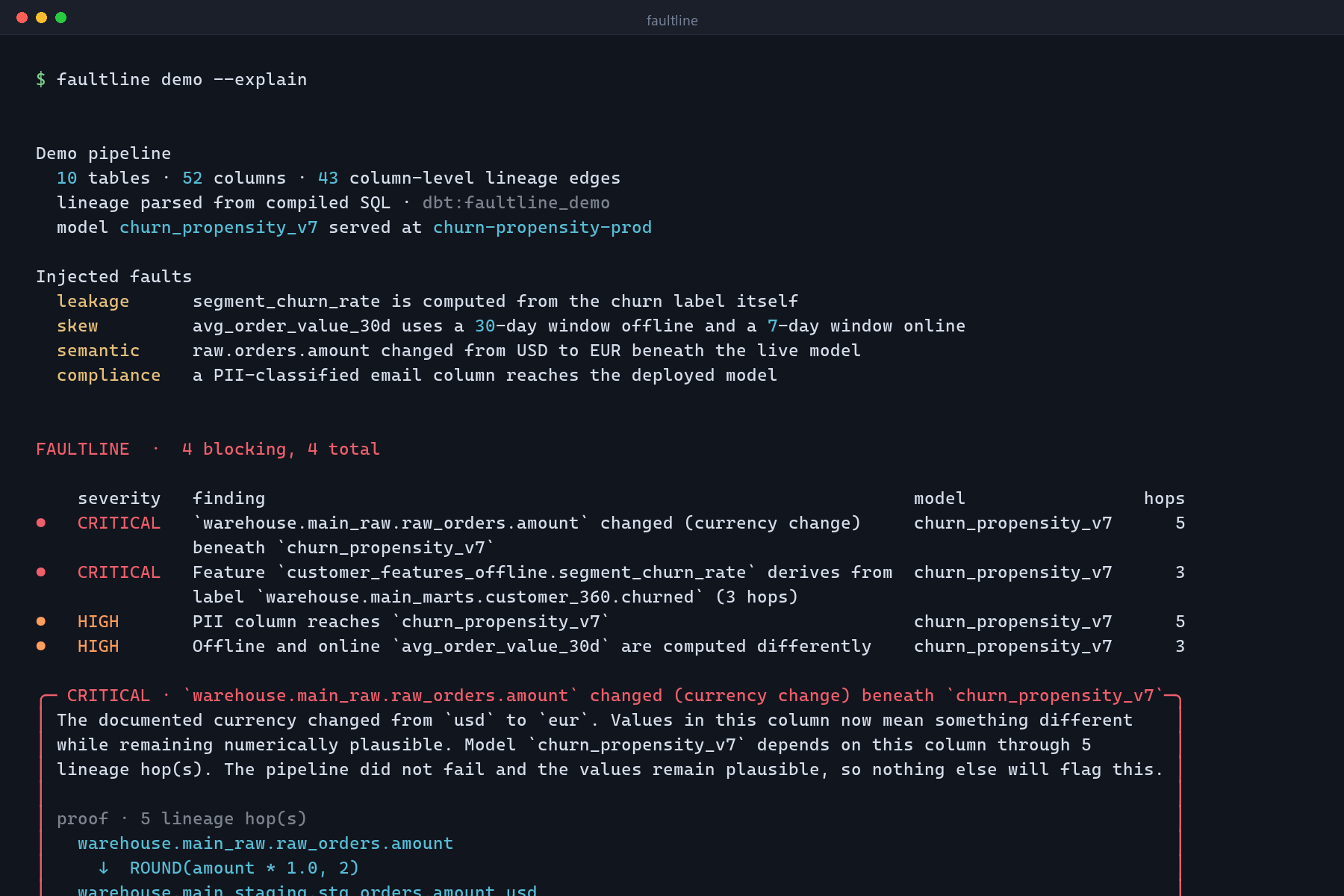
4 findings, 43 edges, parsed from compiled SQL
-
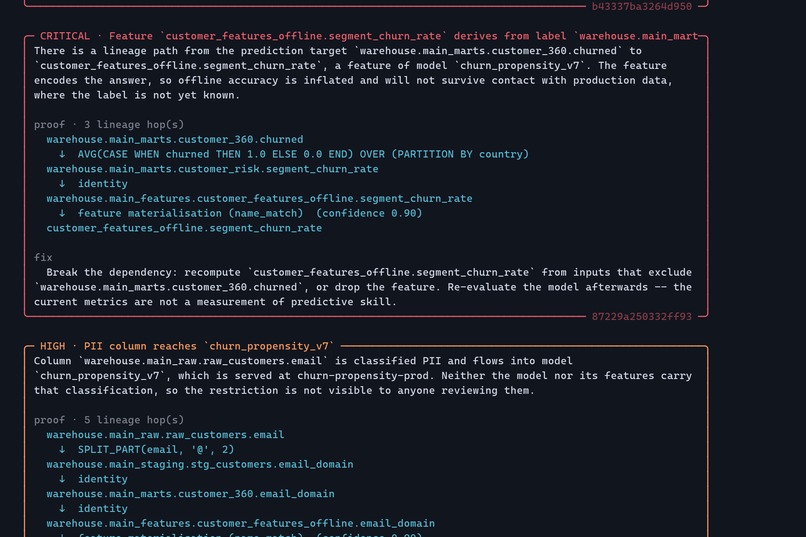
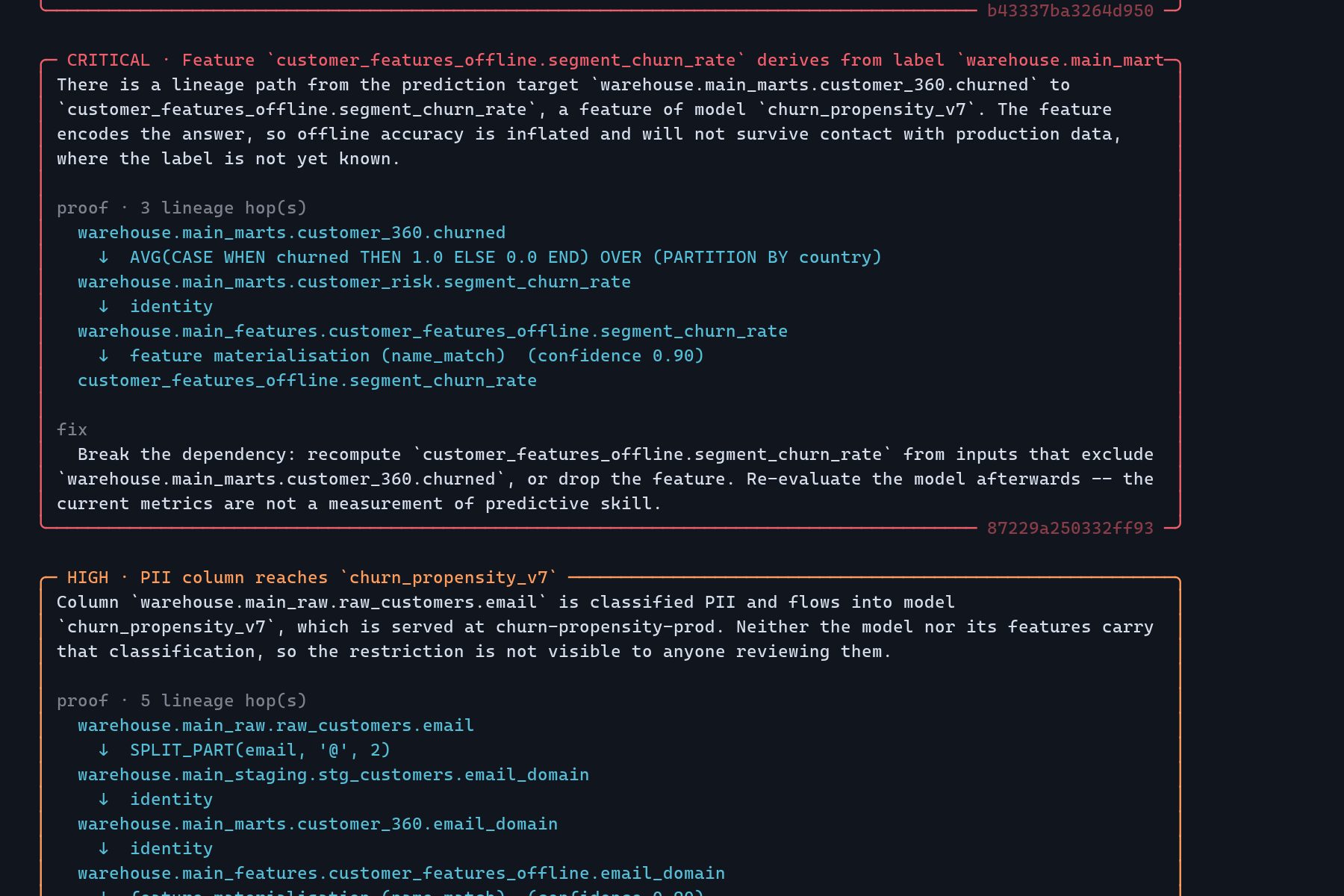
the 3-hop label→feature path
-
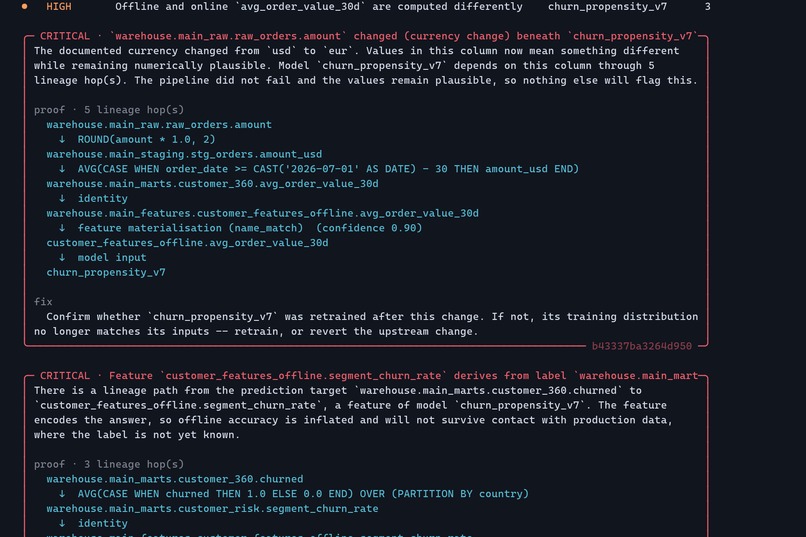
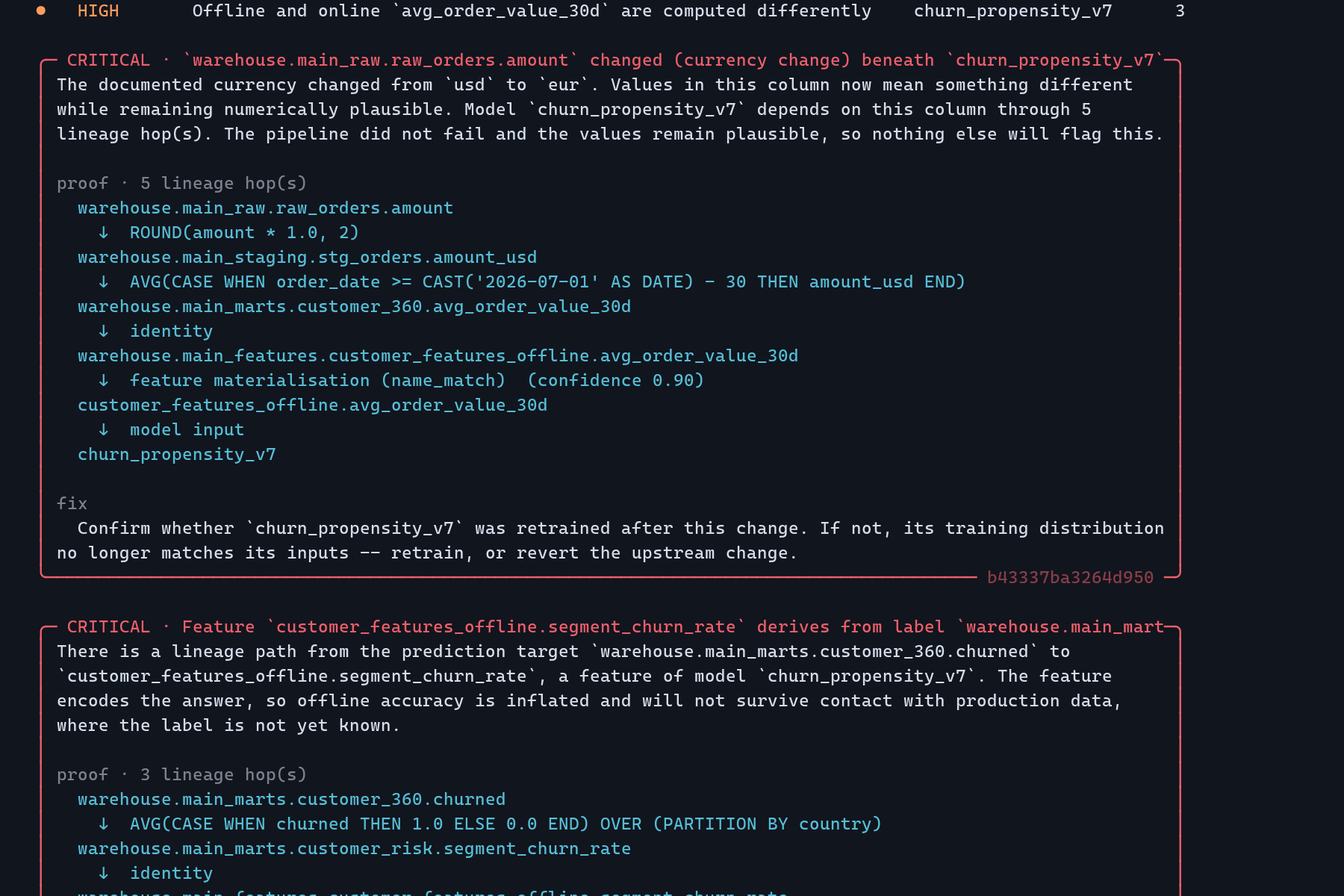
USD→EUR beneath a live model
-
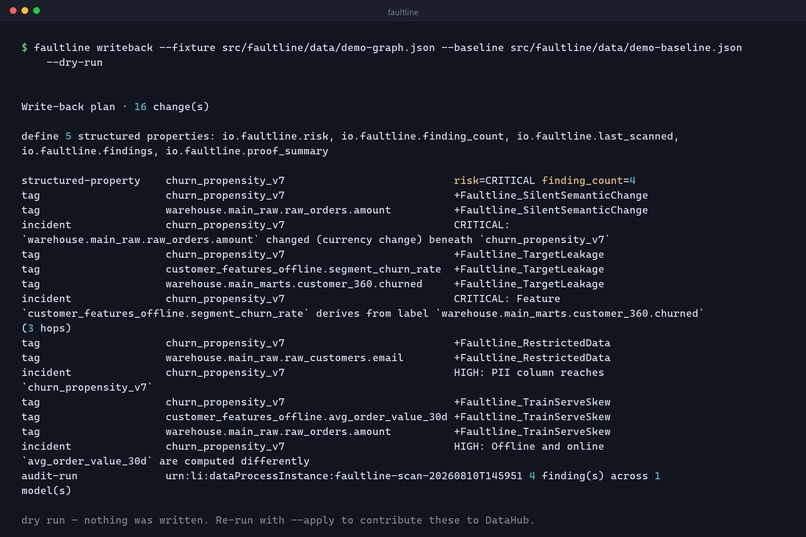
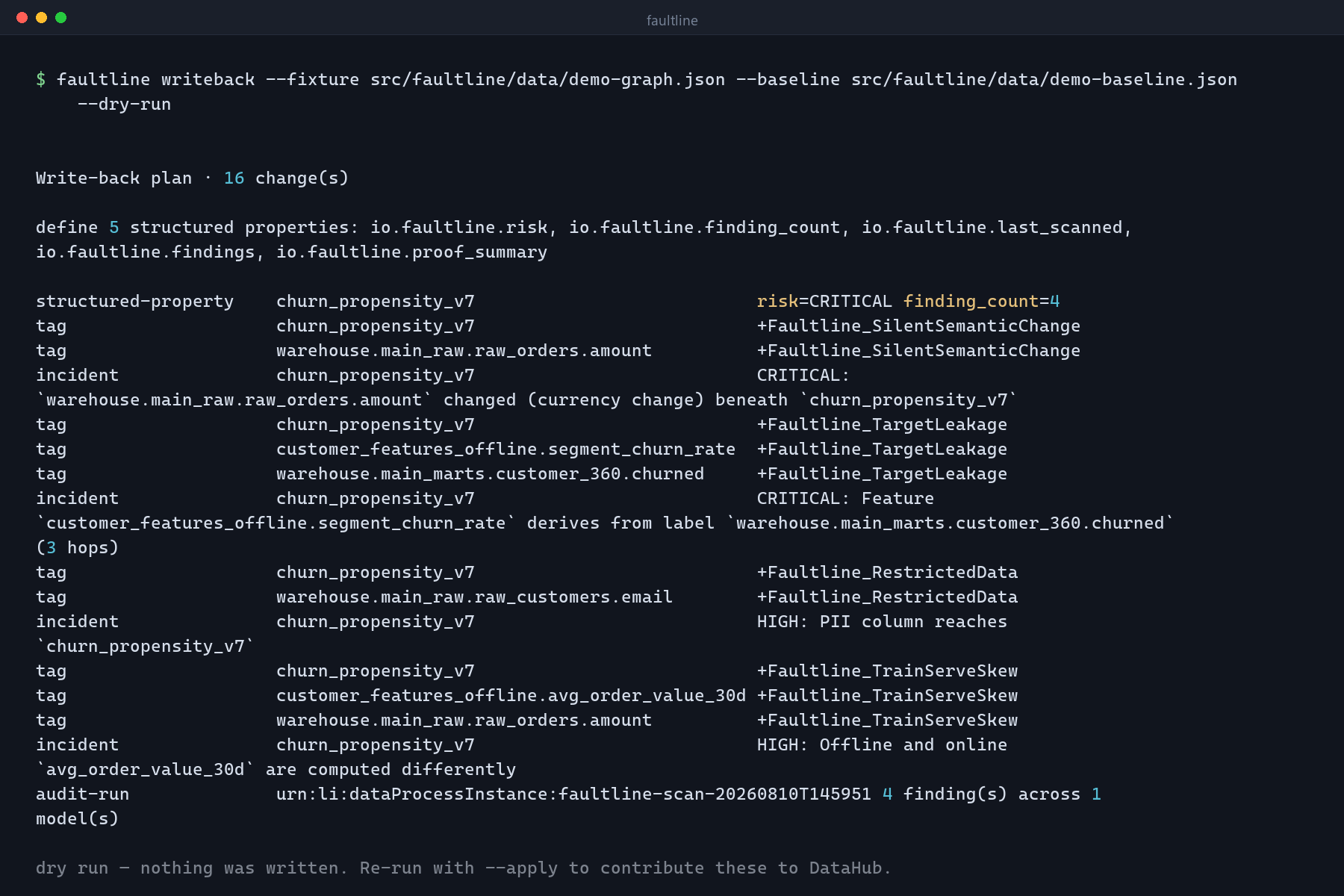
risk=CRITICAL finding_count=4, 16 changes
-
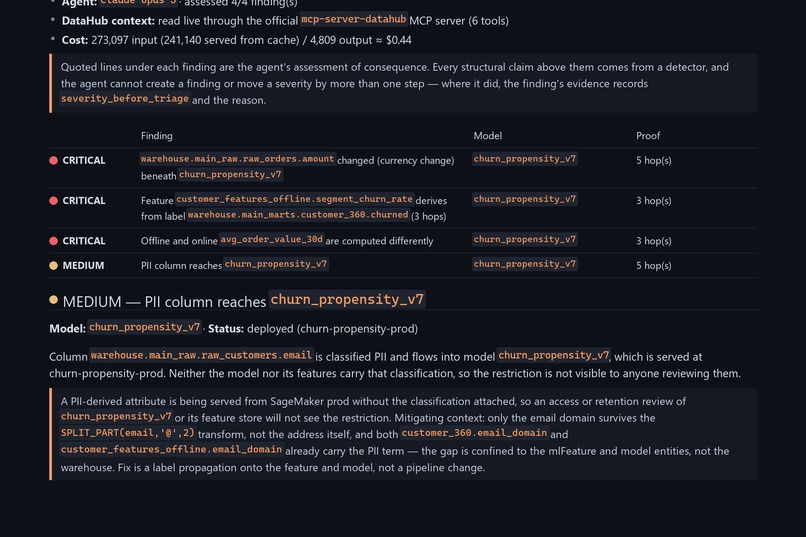
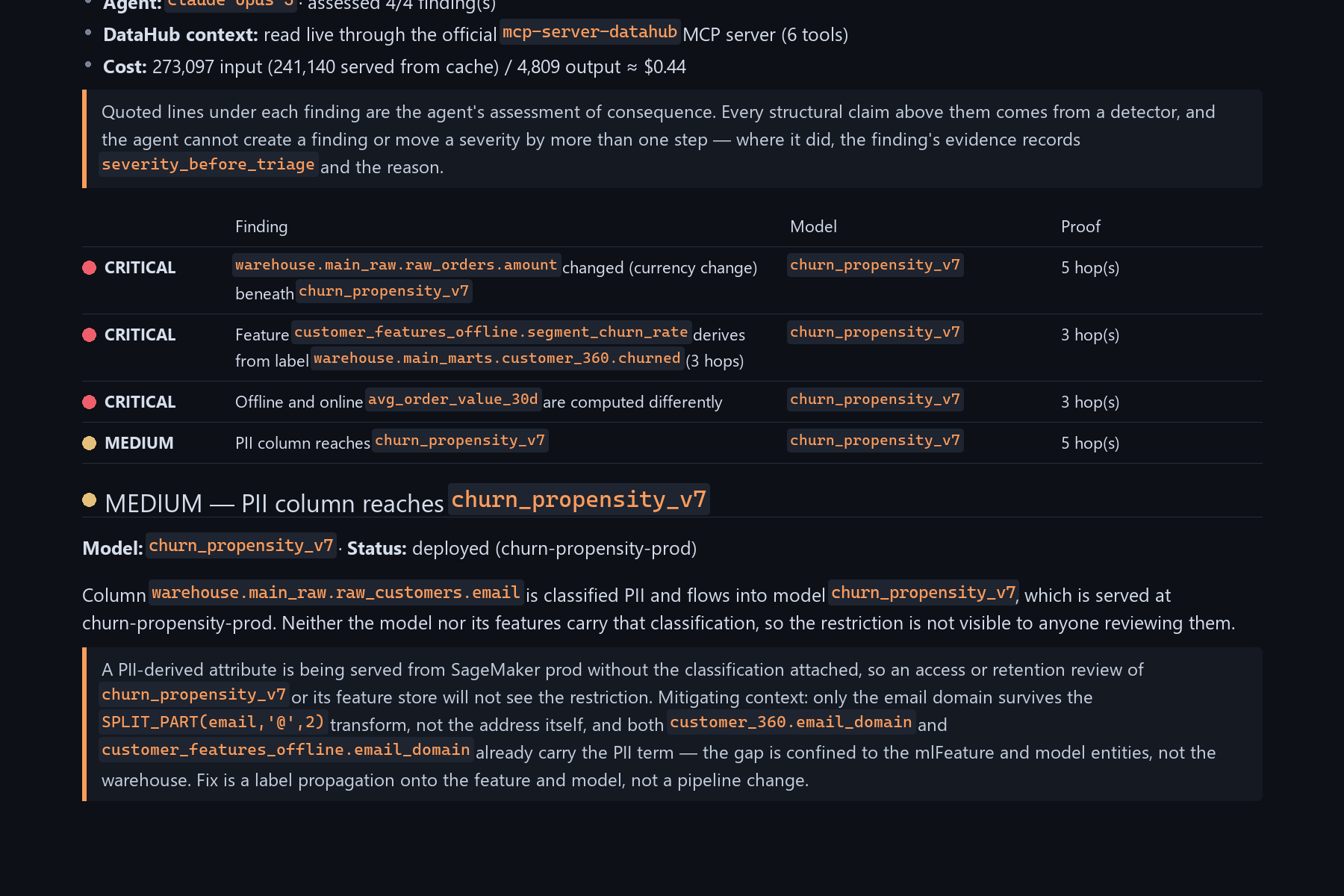
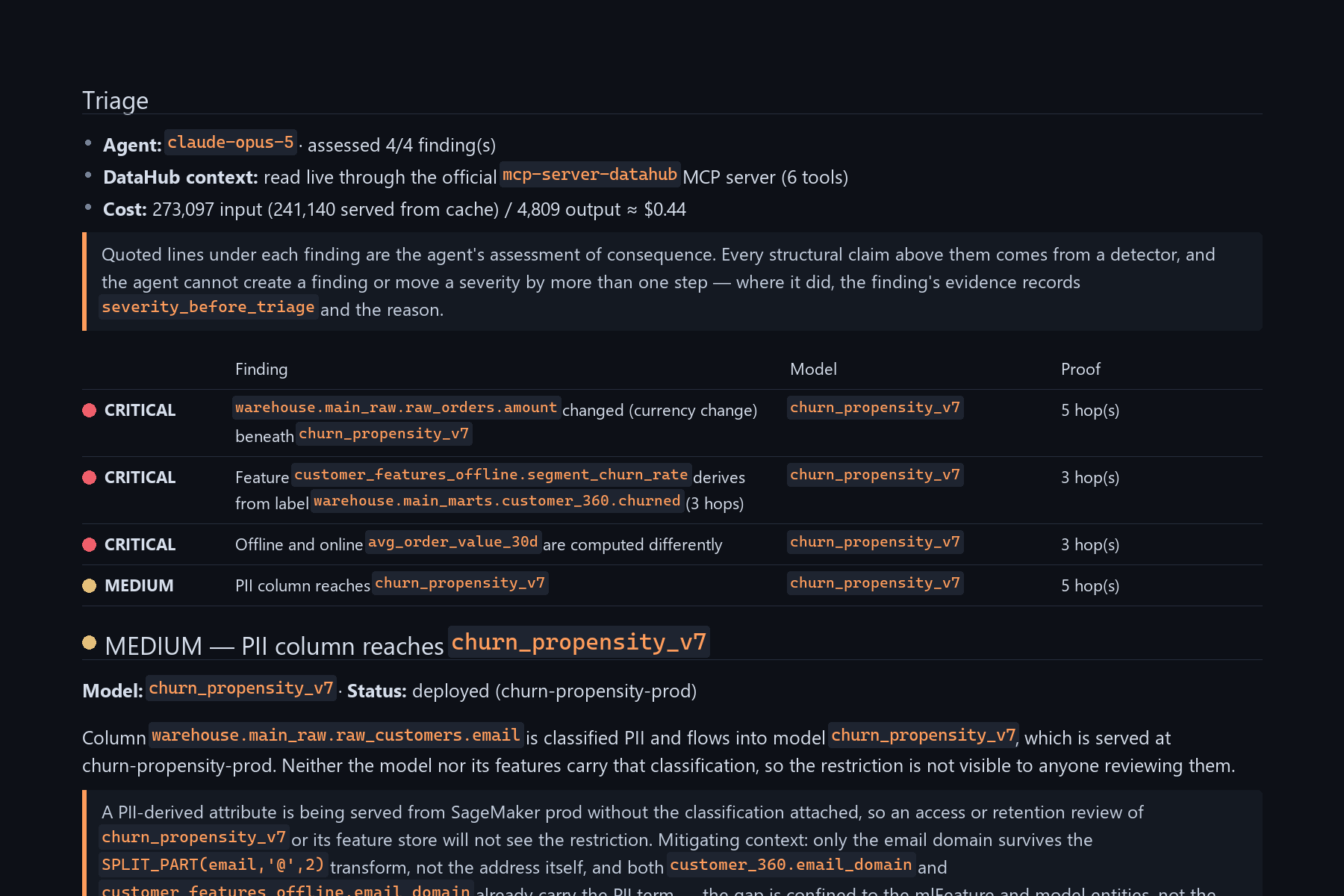
the agent's quoted assessment
-
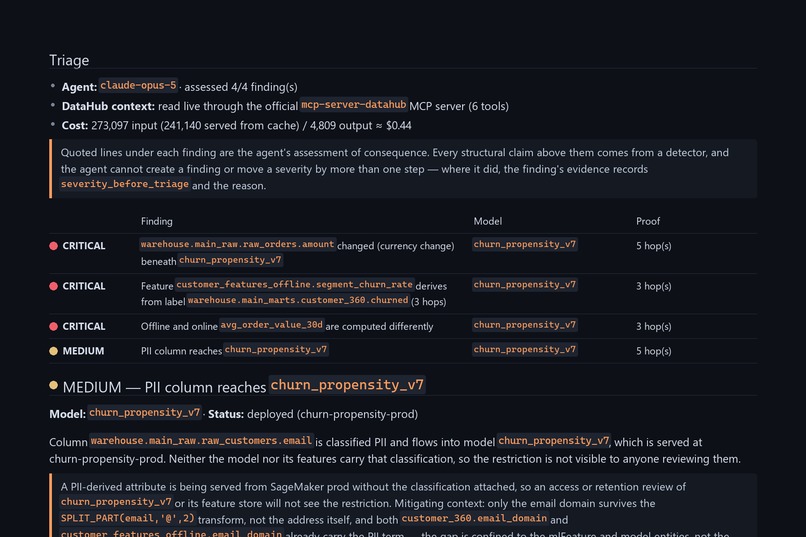
agent, MCP, Cost $0.44, PII down / skew up
Inspiration
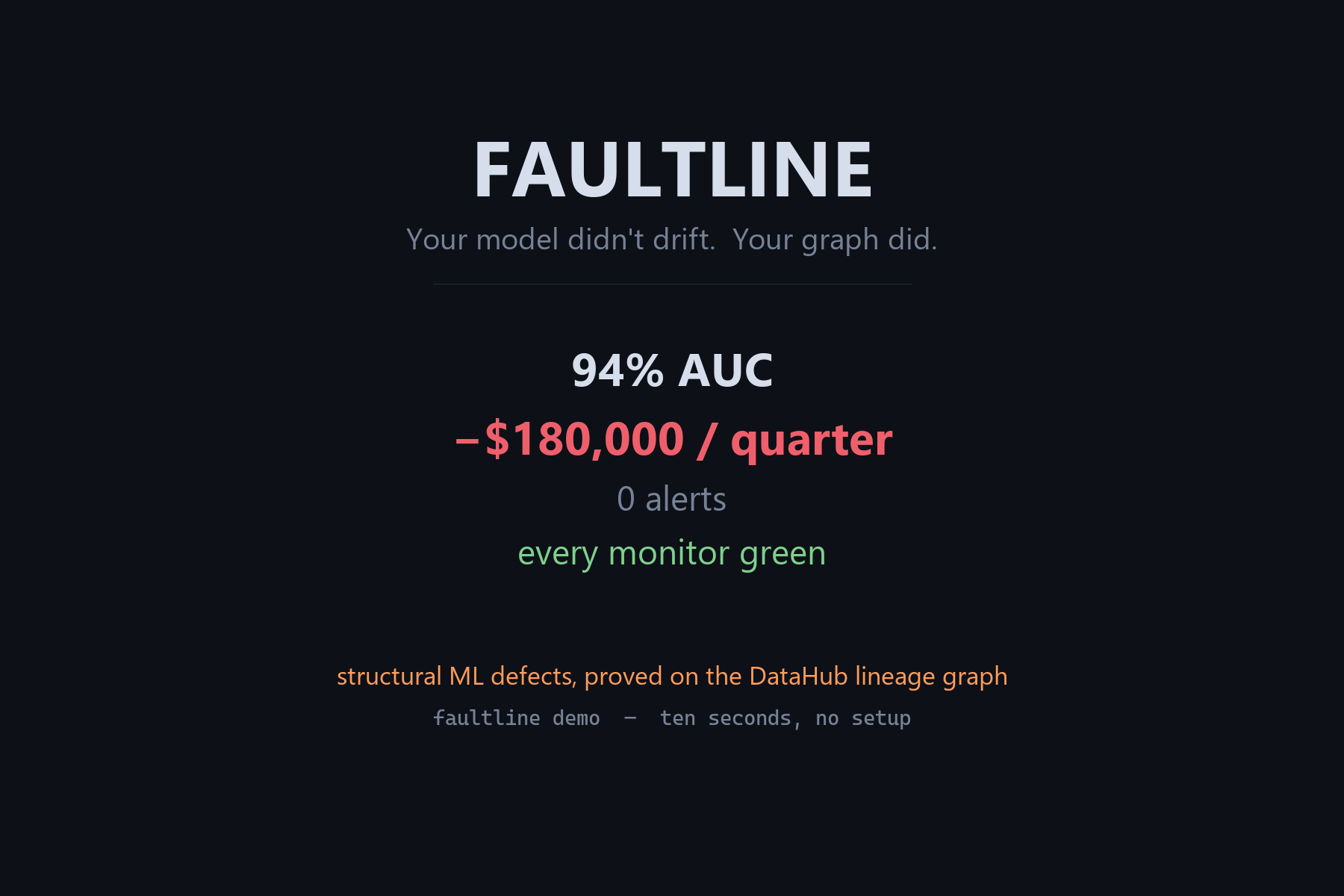
Drift monitoring watches the data. Nobody watches the shape of the pipeline — and most silent ML failures live there.
A leaked feature is not out-of-distribution. A train/serve skew keeps both copies inside their historical ranges. A currency column that switches from USD to EUR stays perfectly numeric. Nothing errors, nothing drifts, no alert fires. The model is quietly wrong and stays that way until someone reconciles the revenue.
All of those are a short walk in a lineage graph. DataHub already stores that graph. The gap was that nothing walked it looking for ML defects specifically.
We measured this on our own demo warehouse. The train/serve skew we inject — a 30-day window offline against a 7-day window online — produces:
| What a distribution monitor compares | |
|---|---|
| shift in the mean | 1.4% — no alert fires |
| correlation | 0.881 |
| What the model is actually served | |
|---|---|
| mean per-row error | 20.7% |
| rows more than 10% wrong | 51.3% |
Half the served rows are materially wrong while the aggregates agree to within a couple of percent. That gap is the whole project.
What it does
Faultline proves four classes of structural ML defect from the DataHub metadata graph:
| Detector | The defect |
|---|---|
target-leakage |
A feature is computed, however indirectly, from the label |
train-serve-skew |
A feature's offline and online derivations have diverged |
silent-semantic-change |
An upstream column changed meaning beneath a live model |
compliance-propagation |
Restricted data reaches a deployed model unlabelled |
Every finding carries a proof path — an ordered chain of lineage edges that exists in DataHub or does not. A reviewer can read it without trusting the tool:
marts.customer_360.churned                     ← the prediction target
  ↓  AVG(CASE WHEN churned THEN 1.0 ELSE 0.0 END) OVER (PARTITION BY country)
marts.customer_risk.segment_churn_rate
  ↓  identity
features.customer_features_offline.segment_churn_rate
  ↓  feature materialisation (name_match)
customer_features_offline.segment_churn_rate
  ↓  model input
churn_propensity_v7                            ← 0.94 AUC, and it was never real
The finding itself proves the first three hops, label to feature, and reports as (3 hops);
the fourth edge is the model input that makes it matter.
It then writes the finding back into DataHub — tags, structured properties, an incident
carrying the proof, an institutional-memory link, and a DataProcessInstance recording the
scan — so the next person or agent inherits the conclusion instead of rediscovering it.
How we built it
Detectors are deterministic graph algorithms. No sampling, no scoring, no inference. The engine drops any finding whose own proof does not hold together rather than report a defect it cannot substantiate.
The ML lineage bridge. DataHub's MLFeatureProperties.sources points at datasets while
FineGrainedLineage operates on columns. Nothing in the open-source model joins those two
granularities — so a naive traversal loses column precision exactly where it crosses into ML
entities, which is exactly where ML defects live. Faultline bridges it with a tiered resolver
(explicit declaration → name match → dataset-wide) that degrades confidence rather than
guessing, and caps findings that rest only on the weakest tier below blocking severity.
Lineage parsed from real SQL. The demo is a genuine dbt project on DuckDB. Column lineage
is extracted by running DataHub's own sqlglot_lineage over each compiled model, so the
edges Faultline traverses are the edges DataHub would produce from the same project. Proof
paths quote the actual expressions.
The agent reads DataHub through its own MCP server. A real MCP session against
mcp-server-datahub, converted for the Anthropic tool runner. The agent explains consequence
and may move a severity by at most one step with a recorded reason — it cannot create a
finding. examples/triage-report.md is a committed run against a live instance: it moved PII
down to MEDIUM ("a coarse domain fragment rather than an identifier") and train/serve skew up
to CRITICAL ("a 4x window mismatch on one of only ~5 inputs corrupts every production
prediction"), and it found from the catalogue that the leaked feature has no column in the
online store at all. The run cost $0.44 — 273K input tokens, 241K served from prompt cache,
against $1.49 for the same run uncached.
Challenges
Four bugs, each invisible in a demo and fatal in use:
- Path signatures included node identity. A feature's offline and online copies necessarily live in different tables, so every pair compared as divergent — skew fired on everything.
identitypass-through hops counted as divergence. One path routing through a mart while the other read from staging looked like a defect. Fixed by treating value-preserving hops as the no-ops they are.- Transform text compared with table qualifiers.
AVG("stg_tickets"."resolution_hours")versus the same aggregate over a CTE alias — same operation, different text. Three correctly-built feature pairs reported as diverged. - Cascading findings. A currency change reports at every column downstream of it. True, and useless. Findings now collapse to their root cause — the column a human would actually go and change.
The through-line: on real data, the hard part is not finding defects. It is not reporting the ones that are not there.
Accomplishments
- Exactly four findings for four injected faults — no false positives, no cascade noise, asserted directly in the test suite so it cannot silently regress.
- Live and offline runs produce identical fingerprints, verified by
demo/verify_live.py, which emits into DataHub, reads the graph back through the ordinary client, scans it, writes back, and then reads the tags, properties and incidents back out to confirm they landed. - A new skill for DataHub's skills registry, written in its format. The registry's own
datahub-lineageskill enumerates three entity types — dataset, dashboard, chart — and nothing in the registry crosses into ML entities.
What we learned
The graph is a better substrate for some questions than the data is. Structural claims are cheap to verify and impossible to fake — a path exists or it doesn't — which makes them a much better foundation for an agent than statistical inference. Letting the model explain proven facts, rather than produce them, is what makes the output trustworthy.
What's next
- Upstream the
datahub-ml-lineageskill. - Column-level lineage inside feature stores, so the bridge's weakest tier is needed less.
- A "prove it before you merge" mode that runs the proposed model against a shadow build.

Log in or sign up for Devpost to join the conversation.