Project name
FaultLine
Category / track
Developer Tools
Tagline / one-line summary
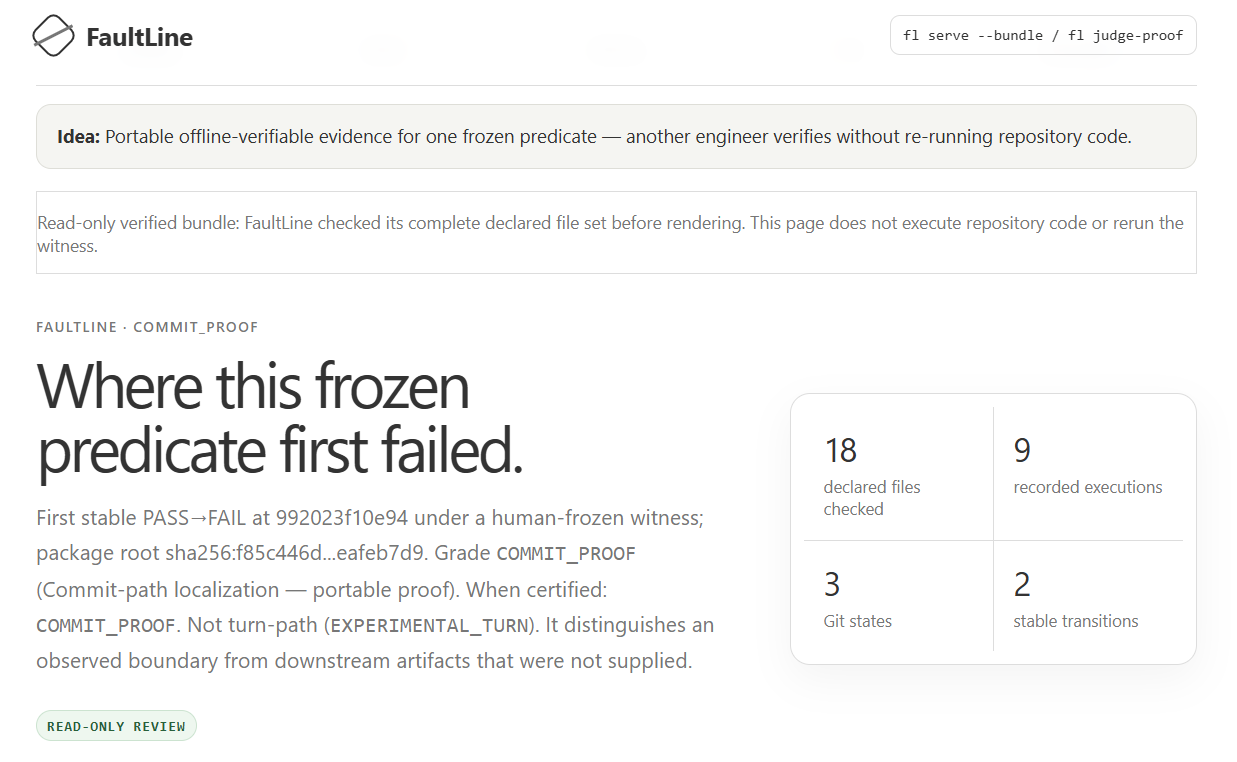
FaultLine freezes one human-reviewed test question, replays it over real Git history, and gives you a proof package another engineer can check offline; without re-running the whole repo.
Unattended agent sessions can keep moving, but nothing counts as proof until a human owned the question.
Demo video
Repository
https://github.com/Mizore66/faultline License: MIT Codex session (/feedback): 019f66bd-0ac1-78f3-8dc1-5968e4f2fa09
How to run (judges)
git clone https://github.com/Mizore66/faultline.git cd faultline git checkout v0.1.10-buildweek pnpm install --frozen-lockfile pnpm fl doctor --proof-ready pnpm fl judge-proof
Use that pin for judging. Needs Node 22+ and pnpm. No Docker and no API key for judge-proof. Optional UI after clone: open docs/self-incident-proof-preview.html GPT sample files (no API key): docs/samples/gpt-5.6/
Full description
The problem
When an agent-assisted change breaks CI, teams often have logs and a failing test, but not a portable answer to: which recorded source state first fails this exact reviewed check, and what evidence supports that?
Git history, CI logs, and repro steps help, but they don’t freeze a human-reviewed question, replay it across history under a clear rule, and hand you an offline-checkable package. FaultLine is built for that gap. It does not claim to know model intent or a single “true root cause.”
What FaultLine does
- A human reviews and freezes an executable witness (the question).
- FaultLine replays that same witness over selected Git states (Docker path when available).
- It only records PASS/FAIL when the runs actually support it, and finds the first stable fail transition.
- It writes a proof package another engineer can verify offline without re-running repository code.
- GPT-5.6 can draft a witness proposal or repair brief — it never decides PASS/FAIL.
Try it: pnpm fl judge-proof on pin v0.1.10-buildweek.
How Codex and GPT-5.6 are used
Codex helped build and harden FaultLine. Qualifying session: 019f66bd-0ac1-78f3-8dc1-5968e4f2fa09. Product rules stay human-owned: evidence labels, fail-closed sandbox, and no treating model text as a verdict.
At runtime, FaultLine can use public Codex hooks (sidecar) or a hash-chained lifecycle ledger. Non-Codex editor paths are labeled honestly — never as fake Codex hooks.
GPT-5.6 is only for blinded witness proposals and evidence-cited repair briefs. It cannot freeze the witness or create proof on its own.
Why it matters
For engineers debugging an agent-touched regression under review pressure: one frozen question + replay facts + proof boundary + clear limits.
We also ran a consented external protocol check on MUMBCS: earliest stable fail at Turn 3 under experimental turn evidence. That validates the workflow (freeze → replay → locate → verify). It is not a claim that FaultLine caught a natural production bug.
How it differs
FaultLine pairs a human-frozen executable witness, replay over recorded Git states, a portable offline-verifiable package, and honest evidence labels. It complements bisect, CI, and repro cases; it doesn’t replace them.
Built With
- cli
- codex
- docker
- git
- github-actions
- node.js
- openai-gpt-5.6
- pnpm
- typescript
- vitest
- zod


Log in or sign up for Devpost to join the conversation.