Inspiration
A robot foundation model can score well on a benchmark and still fail on one scene. What does an engineer do with that one failure? Reproduce the rollout, isolate a reproducible triggering condition, and save a regression test for future policy changes.
Faultline grew from an interest in robotics and reproducible debugging: moving beyond an average success rate to a concrete case someone can investigate. The guiding idea is to make a robot-policy failure as inspectable and replayable as a software bug.
What it does
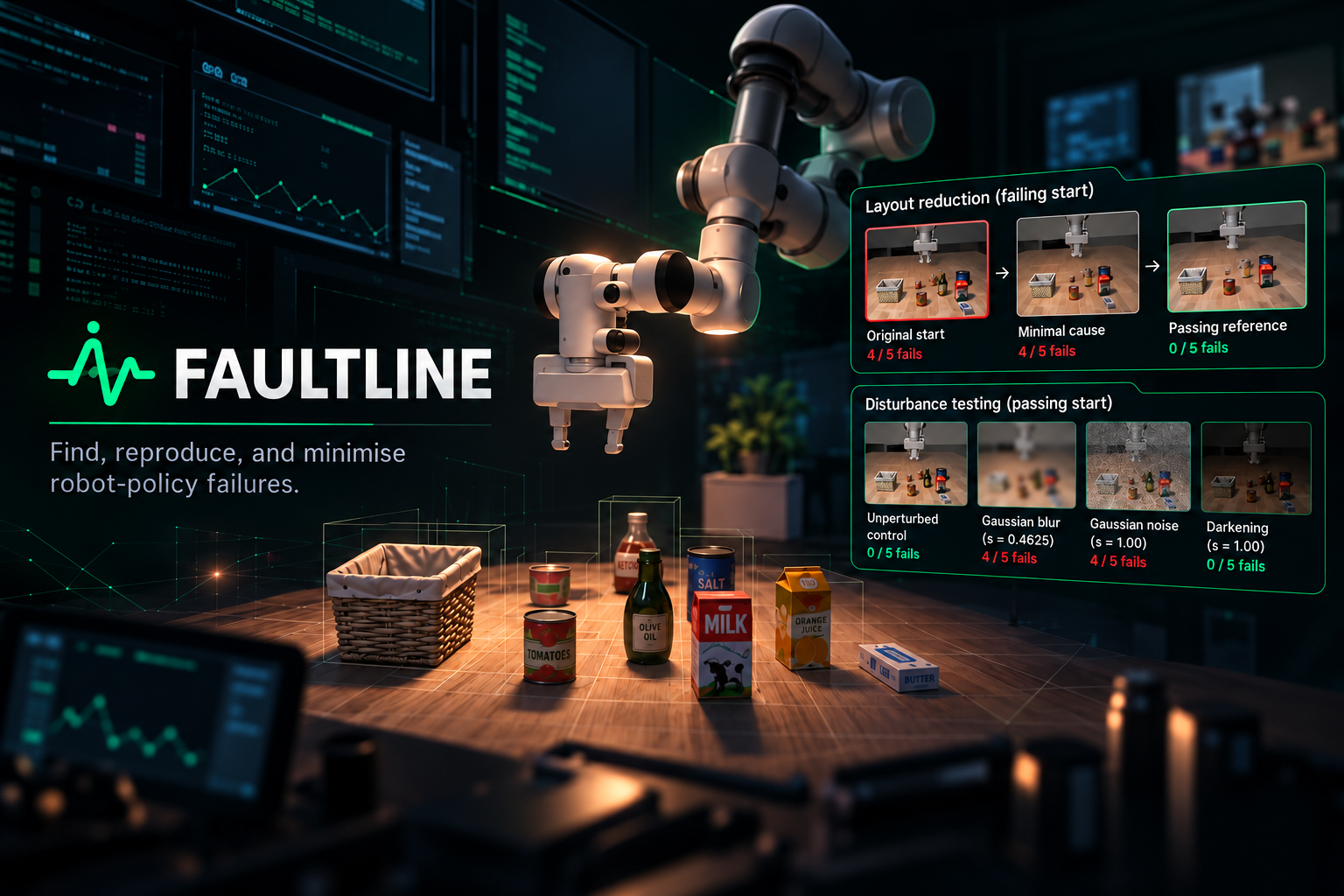
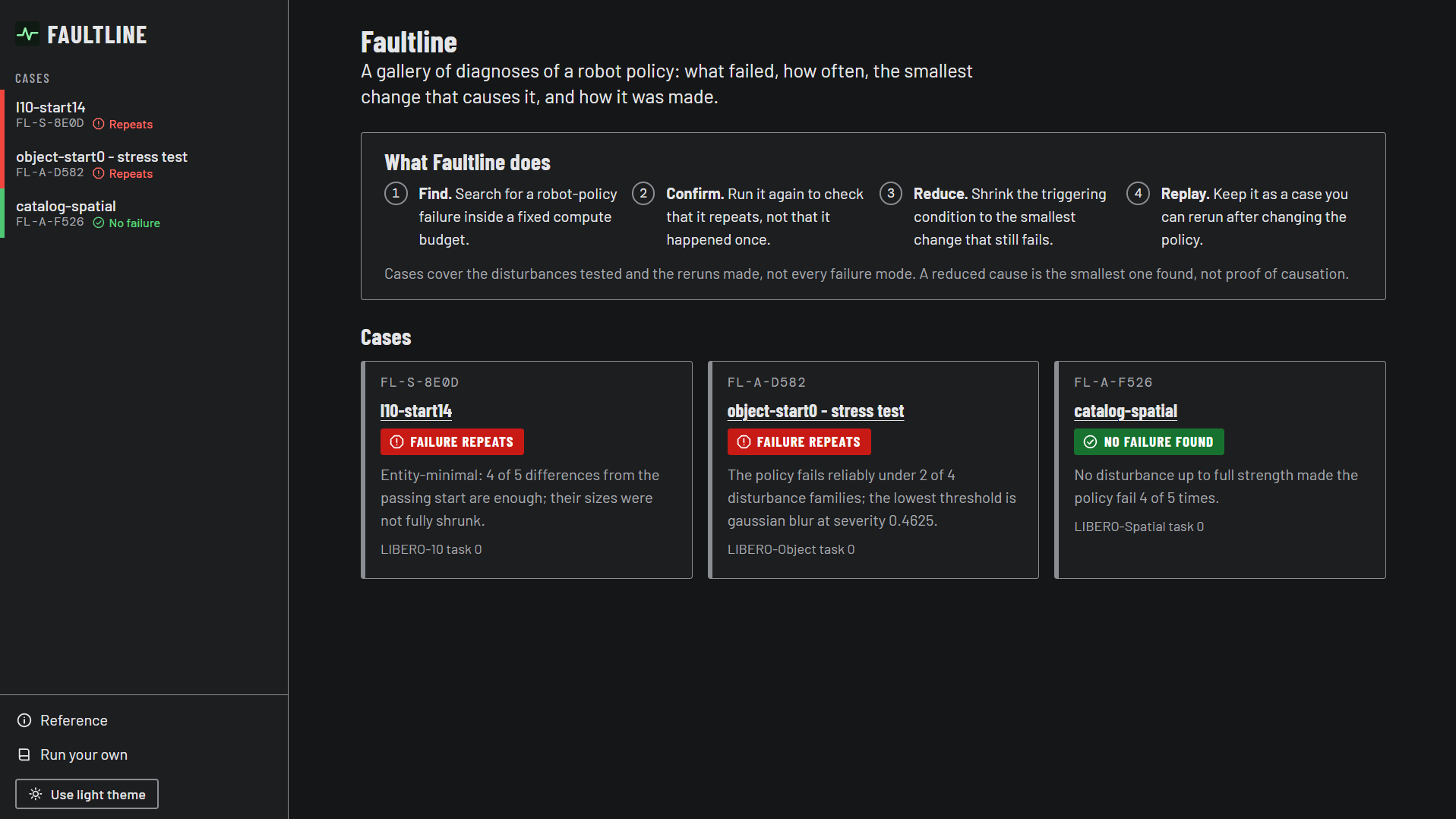
Faultline is a debugging workbench for robot foundation models. Within a configured compute budget, it checks a LIBERO start, probes selected image, scene or instruction changes when it passes, or reduces a failing scene against a passing reference. Repeated runs separate reliable findings from flaky outcomes. Confirmed cases keep inputs, evidence, and a replay path together.
The contribution is that integrated debugging workflow, not a new robot policy or reduction algorithm. It gives an evaluation engineer a concrete case to investigate and replay, rather than only an aggregate score.
What we demonstrated
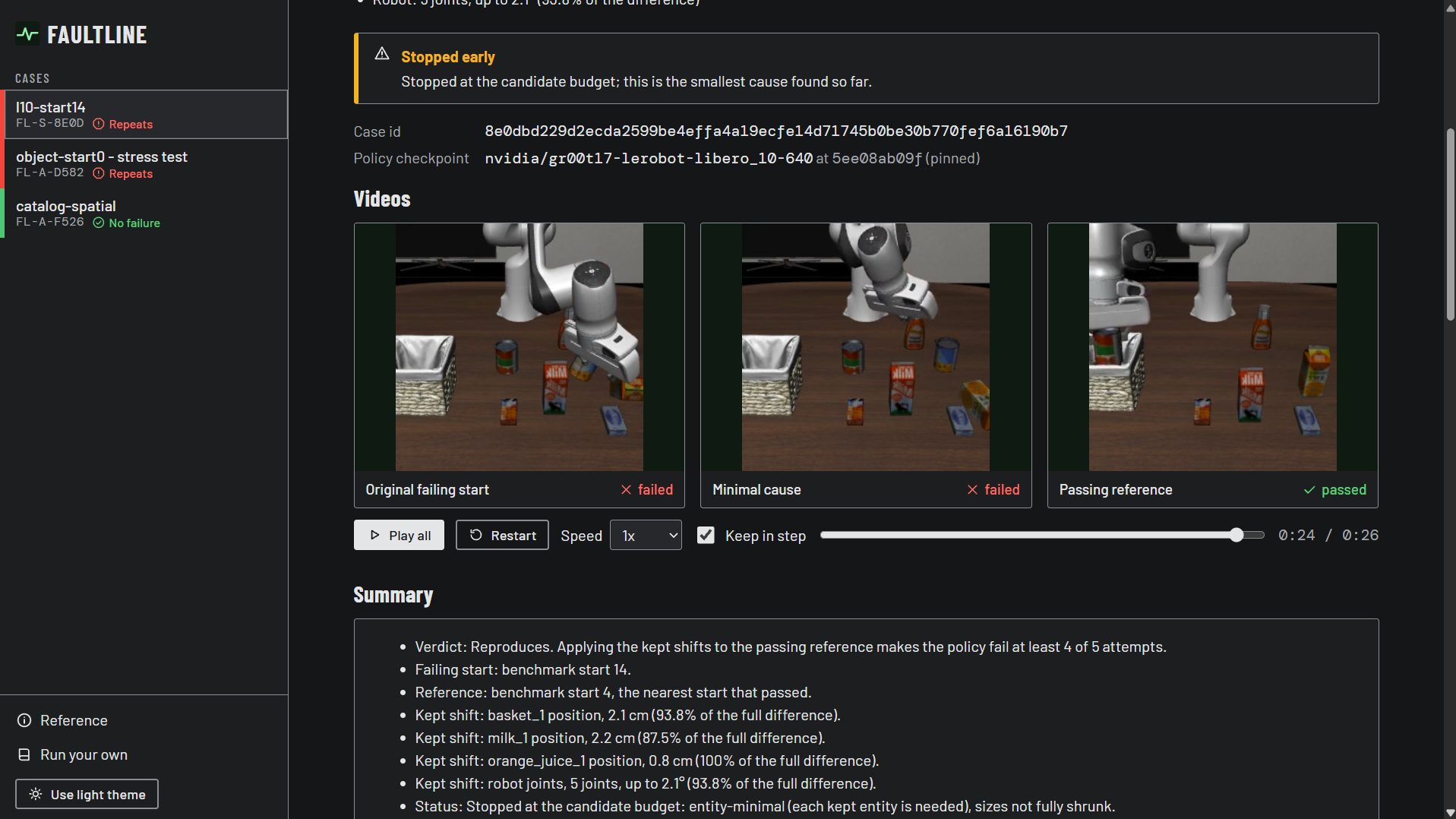
In the layout case, GR00T N1.7 failed 4 of 5 attempts on LIBERO-10 task 0, start 14. Against passing reference start 4, four shifts reproduced the failure together: basket, milk, orange juice, and robot arm. Removing any one lost the failure gate in those tests. The reduced scene failed on replay; the reference passed 5 of 5. Budget limits and non-monotone results mean these are not proven to be the smallest shift sizes.
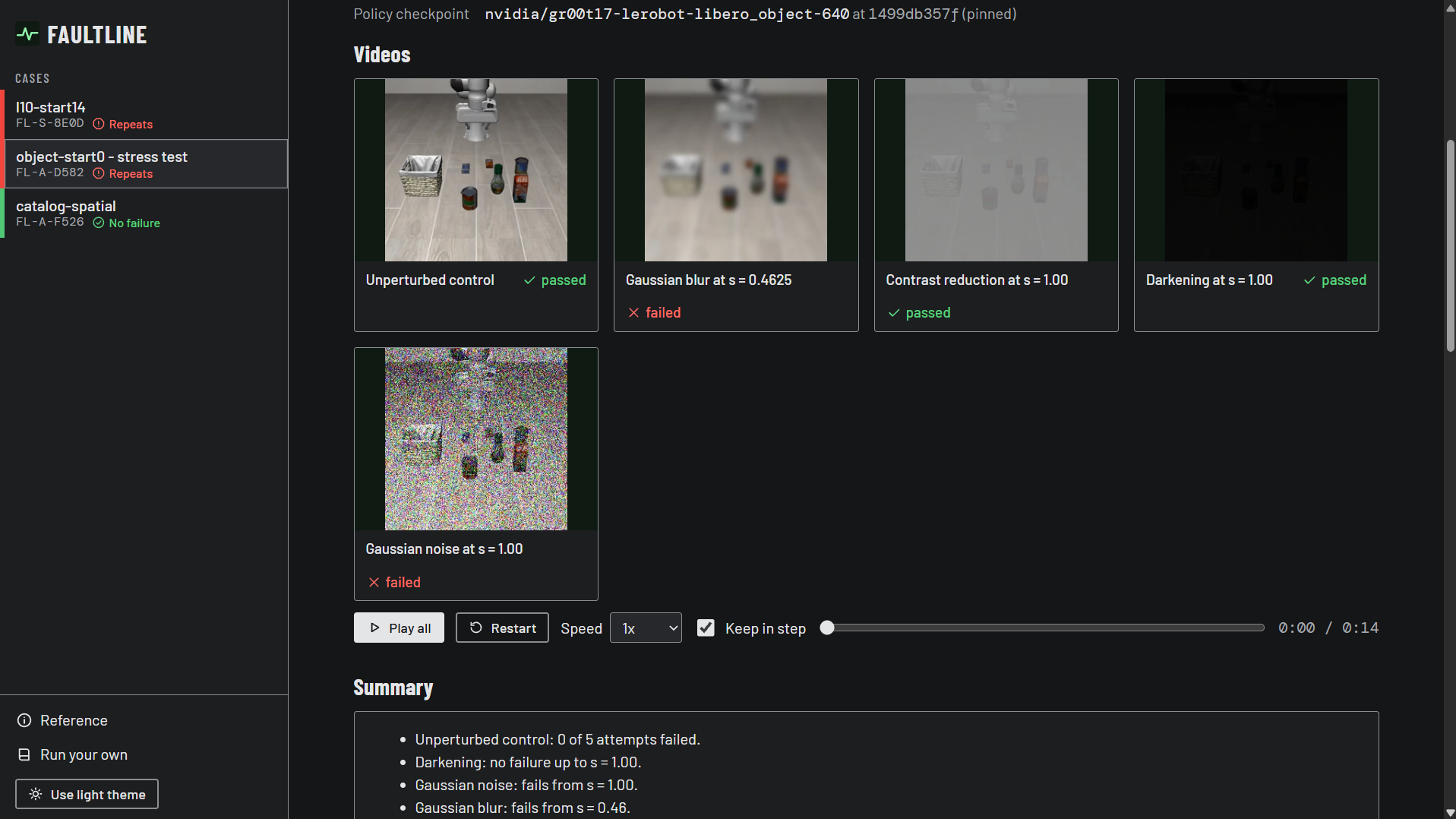
In the image-probe case, LIBERO-Object task 0, start 0 passed untouched. Gaussian blur at severity 0.4625 (sigma 3.7 pixels) failed 5 of 5 search attempts and 4 of 5 replay attempts, meeting the repeatability gate. Noise was borderline: 4 of 5 in search, 3 of 5 on replay, below the gate. Blur is confirmed; noise is not.
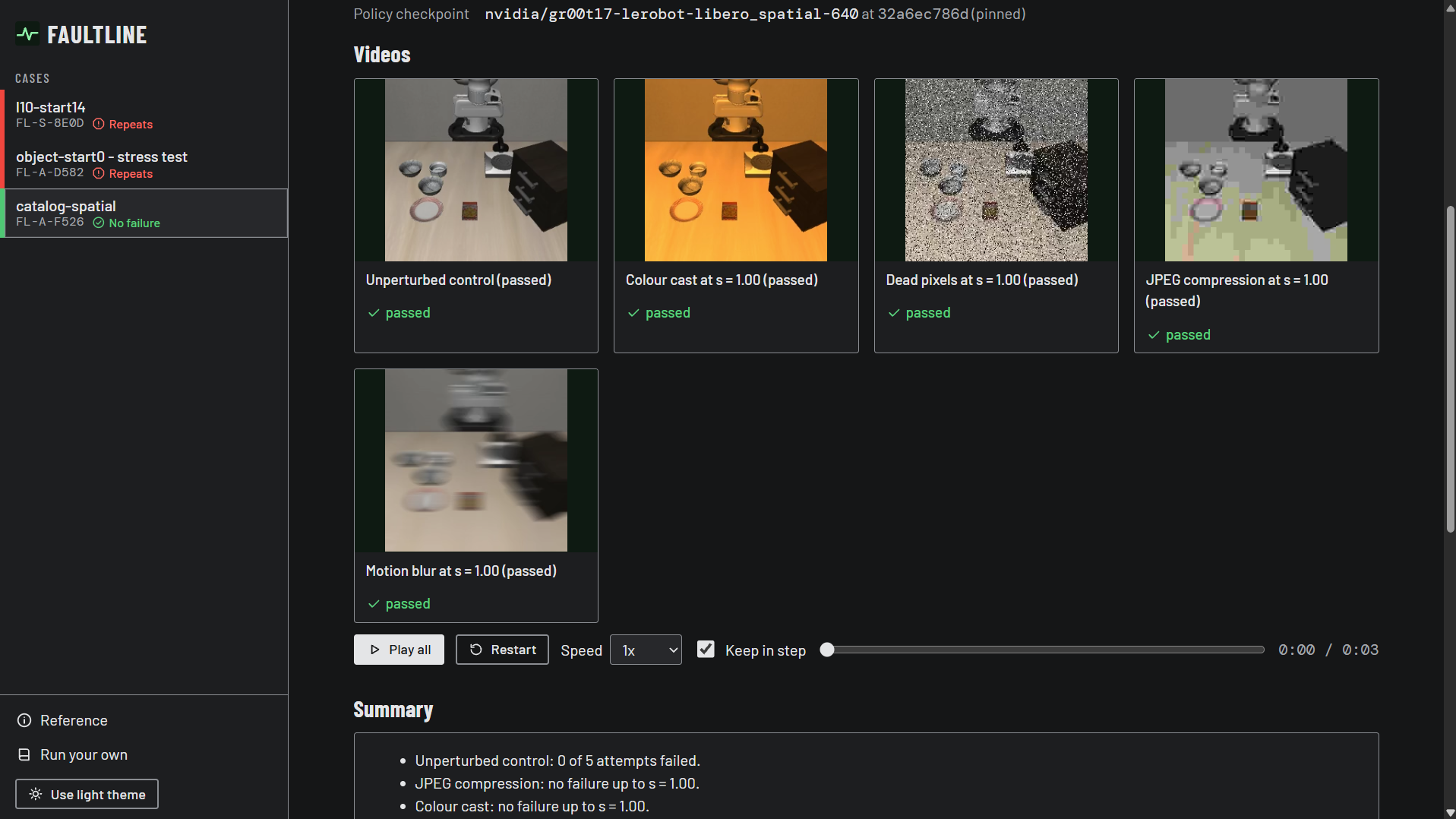
In the third case, no tested probe met the failure gate. LIBERO-Spatial task 0, start 0 passed untouched; JPEG, colour-cast and dead-pixel probes did not trigger reliable failures. Motion blur caused one failure in five attempts at maximum tested strength, below the gate. This is a bounded result, not a general robustness guarantee.
All three reports and their recordings are available in the public case gallery.
How we built it
Faultline is a Physical AI simulation and policy-evaluation tool built around LIBERO, the AllenAI VLA evaluation harness, robosuite, and MuJoCo. GR00T N1.7 is the closed-loop policy under test; diagnosis and replay jobs ran on Nebius AI Cloud Serverless Jobs, using one L40S GPU per job. Run evidence is stored in Nebius Object Storage.
NVIDIA Nemotron on Nebius Token Factory assists the workflow: Ultra ranks layout hypotheses before reruns, writes scenario explanations and suggests next steps using optional Tavily research; Super generates instruction variations. Earlier research summaries used Nano. Programmed gates and simulator reruns decide whether a failure repeats or a reduced case reproduces; generated text is not proof of cause.
A Python backend connects the experiments to a React workbench for reviewing a run, comparing videos, inspecting tested conditions, and replaying saved cases. A separate static gallery shares recorded evidence without exposing cloud controls. All four LIBERO suite paths—Object, 10, Spatial, and Goal—run end to end through faultline diagnose. That is path support, not testing all 40 tasks.
Challenges and what we learned
GPU capacity waits sometimes stretched short jobs. Two interrupted layout-evidence downloads were traced to workstation networking, then addressed with retries and resumable downloads. Recovering a run should mean retrieving the evidence, not paying to repeat an experiment that already finished.
Robotics outcomes were not always consistent. The noise result looked convincing during search, then fell below the repeatability gate on replay. That made confirmation a product requirement rather than an optional chart.
Model errors reinforced another boundary: give Nemotron computed facts to interpret, but keep outcome checks in code. Its assistance is demonstrated; an improvement in diagnostic speed or cost is not. The work also taught us that a useful robotics debugging interface must make uncertain and negative results as visible as a successful reduction.
Specific onboarding notes, strengths and friction for Nebius AI Cloud, Token Factory and the NVIDIA models are recorded in the repository's tool feedback.
What's next
With the working diagnosis, inspection and replay workflow in place, the next step is broader validation. We want to compare Faultline with simpler grid and random searches, measuring the time and compute cost needed to find a repeatable failure and reduce its triggering condition. Testing more robot tasks and starting states would also show how broadly the current findings generalize. These are future experiments.
Limitations
The demonstrated results cover specific GR00T checkpoint, simulator, task and starting-state configurations within the tested perturbation ranges. A reduced case preserves a repeatable failure, but is not necessarily the smallest possible trigger or proof of the underlying cause. We have not established the same behavior on arbitrary robot policies or physical robots. Nemotron's explanations and suggested next steps remain hypotheses, not verified fixes, and we have not yet shown that the diagnostic workflow saves time or money compared with simpler searches.
Built With
- allenai
- gr00t
- libero
- mujoco
- nebius
- nemotron
- python
- react
- robosuite
- tavily
- typescript
- vercel
