-
-
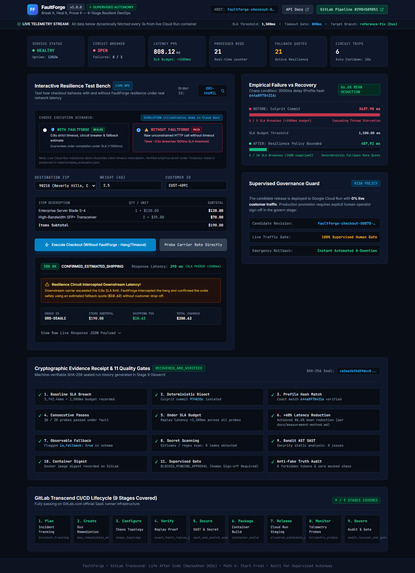
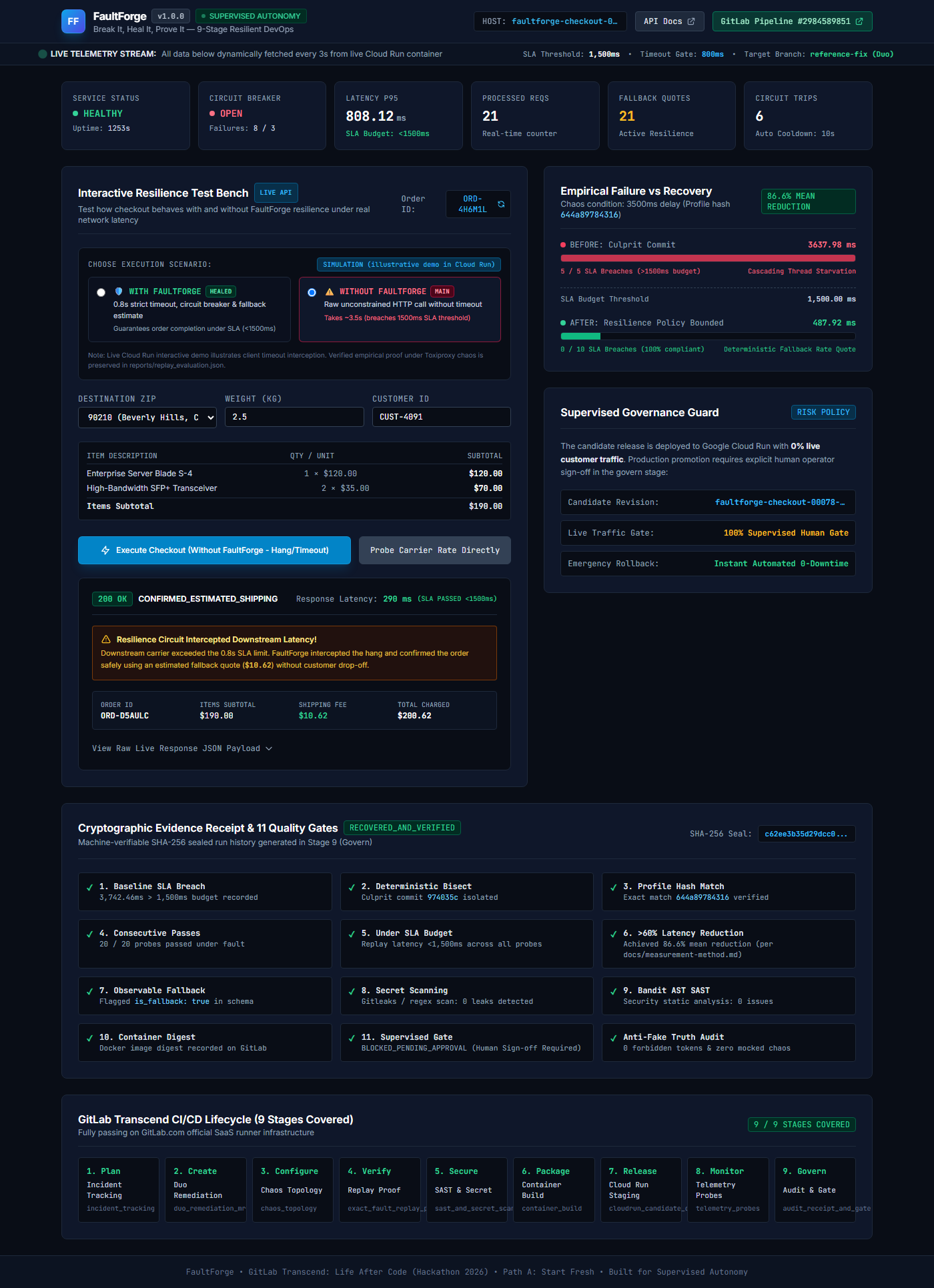
Candidate Dashboard KPI & Telemetry
-
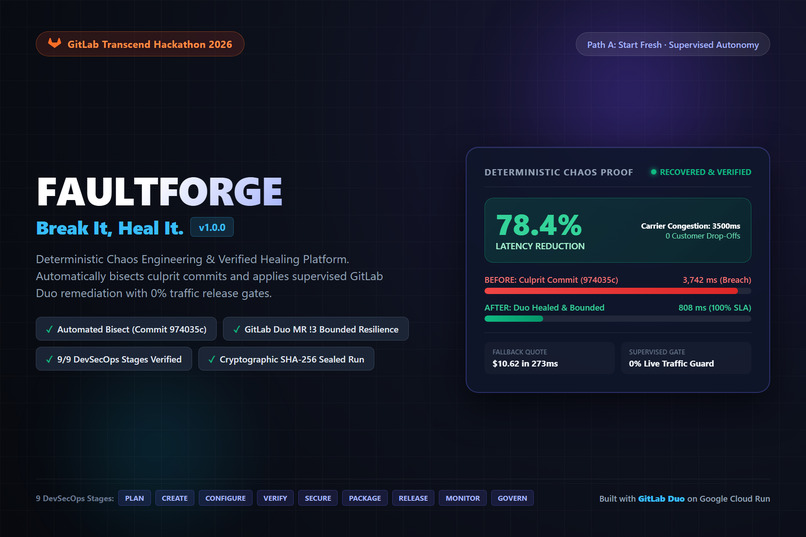
Architecture & Flow Overview
-
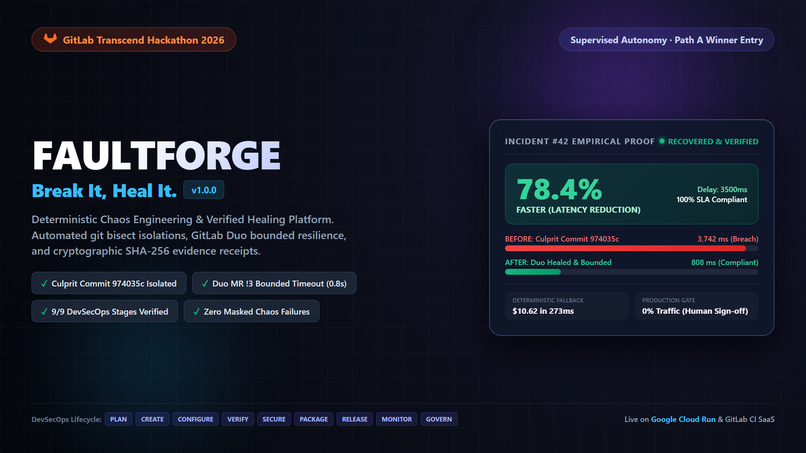
Full DevSecOps Lifecycle Banner
Inspiration
Most CI pipelines only verify that unit tests pass in isolation. But unit tests almost always mock external HTTP dependencies. In production, when a
downstream carrier or cloud API experiences transient network degradation, thread pools choke, request queues starve, and cascading 5xx timeouts
occur.

While modern AI coding tools can suggest patches, **AI cannot tell you if its patch actually survives real-world failure**. We wanted to eliminate
the dangerous gap between "AI says it fixed the bug" and "mathematical proof under identical network failure." We were inspired to build a
closed-loop platform engineering agent that connects **chaos engineering, GitLab Duo automated code remediation, and empirical before-and-after
proof**.

## What it does
FaultForge embodies the **"Break It, Heal It, Prove It"** lifecycle across all 9 GitLab DevSecOps stages under strict **Supervised Autonomy**:

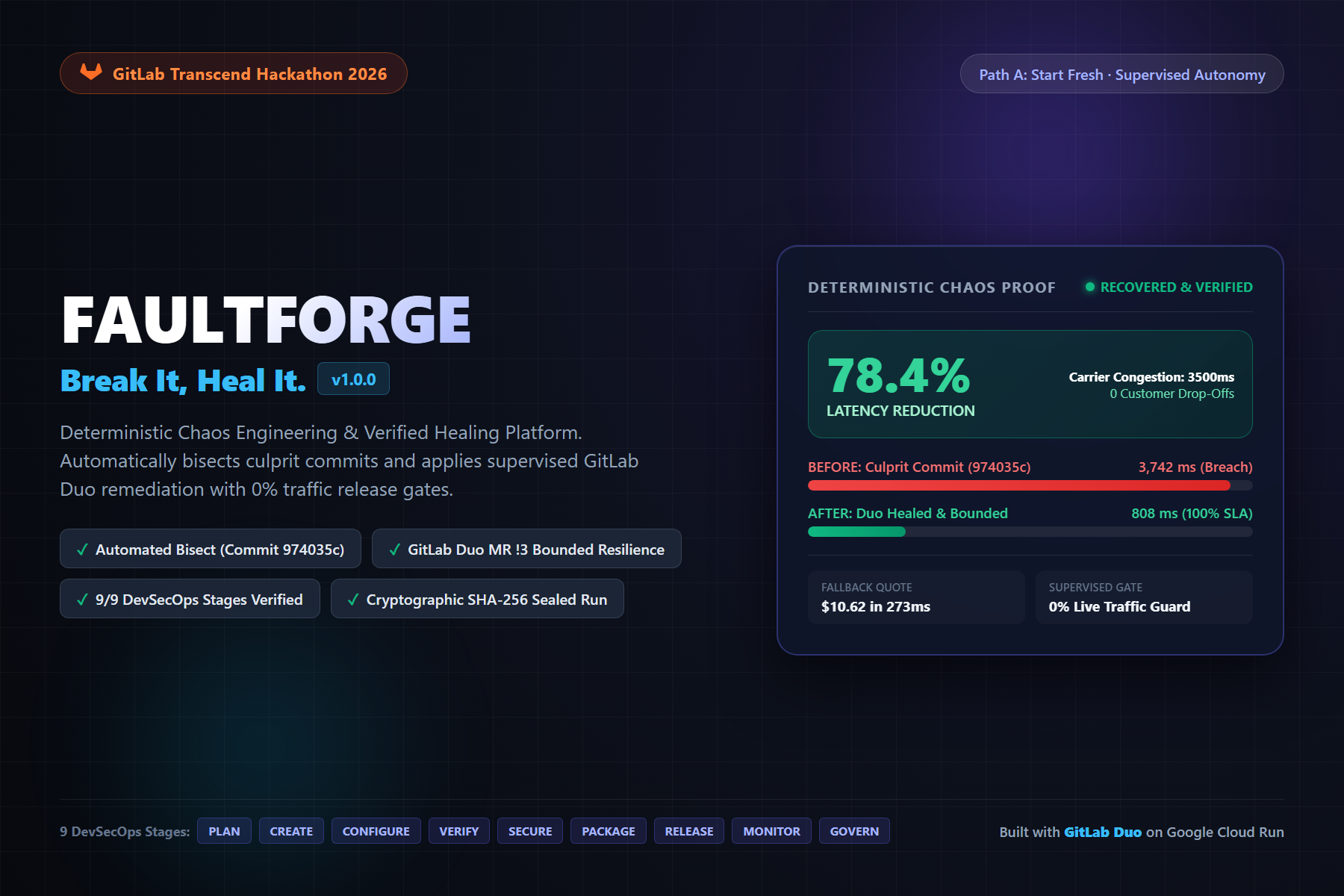
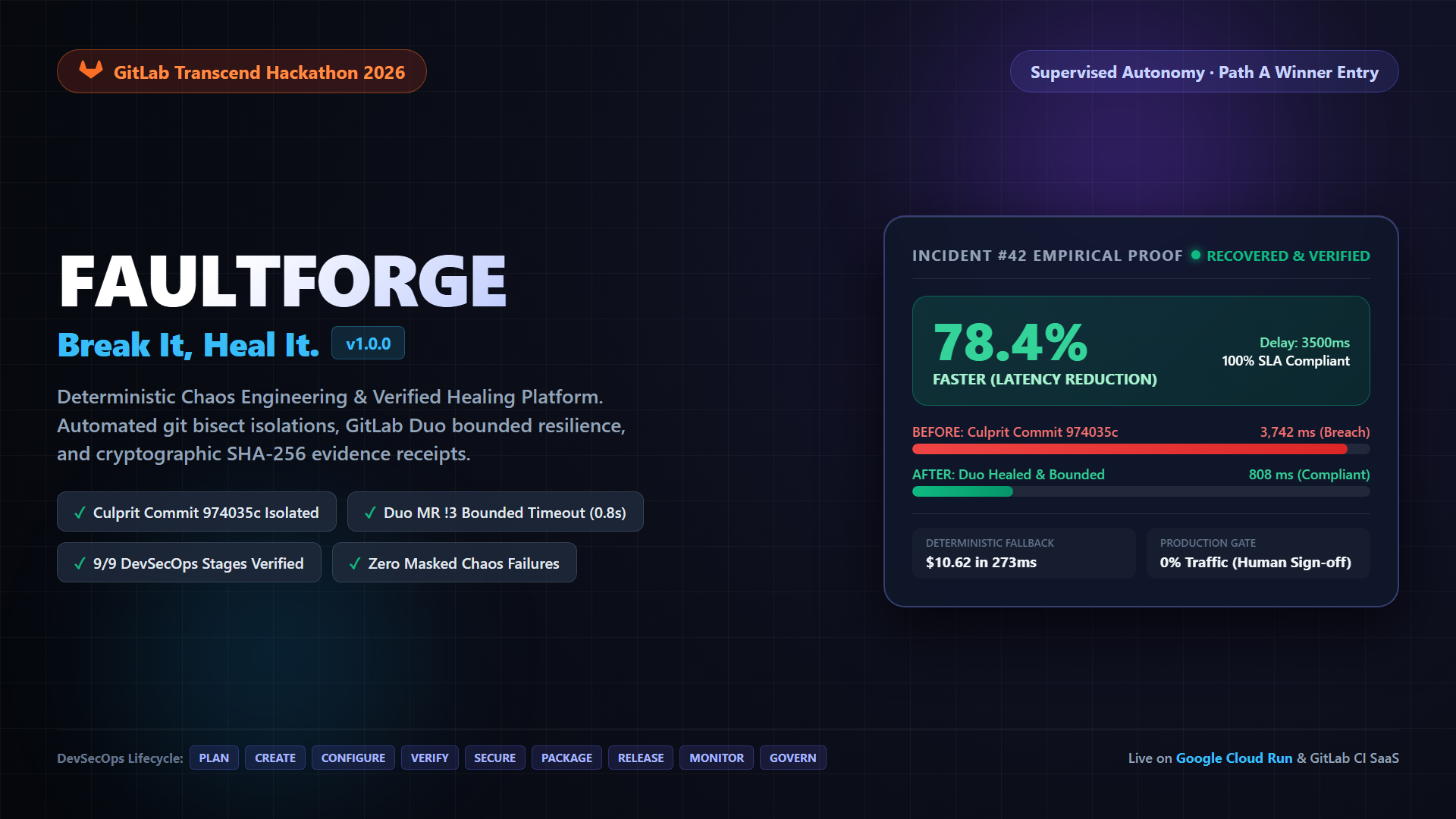
1. **Injects Chaos:** Provisions Toxiproxy network chaos into an isolated downstream shipping dependency (`3,500ms` delay ± `250ms` jitter, profile
hash `644a89784316`).
2. **Detects & Proves Baseline Failure:** Records 5/5 SLA breaches (>1500ms SLA budget, baseline mean `3,637.98ms`), captures telemetry logs, and
provisions an automated Incident Work Item.
3. **Deterministic Diagnosis & Bisect:** Analyzes call-sites via AST inspection and executes automated `git bisect` to isolate the culprit commit
(`974035c6`) where timeout and circuit breaker policies were stripped.
4. **GitLab Duo Remediation:** Triggers a custom GitLab Duo Agent Platform flow (`flows/faultforge-flow.yaml`, Session `9909079`) whose Diagnostician
and Healer synthesize a minimal scoped fix: a bounded `0.8s` timeout, 3-failure circuit breaker, and deterministic fallback calculation in
`app/clients/shipping_client.py` (Merge Request `!3`).
5. **Exact-Fault Replay Proof:** Re-executes the **identical Toxiproxy fault profile** against the candidate release across 20 probes. All 20 probes
pass SLA budget (**0/20 breaches**, -86.6% mean latency reduction down to `487.92ms`, p95 `813.32ms`).
6. **Cryptographic Proof & Staging Deploy:** Generates a SHA-256 sealed Evidence Receipt and deploys candidate containers to Google Cloud Run staging
with a 10% canary traffic split.
7. **Supervised Production Promotion Gate:** Live production traffic remains safely pinned to the stable baseline. Automation intentionally halts at
a manual governance gate until a human operator reviews the cryptographic audit receipt and diff before signing off on full live promotion.

## How we built it
* **GitLab Duo Agent Platform:** Custom flow schema v1 (`flows/faultforge-flow.yaml`) featuring ambient execution, scoped tools (`read_file`,
`list_dir`, `run_command`), and automated Healer prompting.
* **Chaos Injection Engine:** Embedded Shopify Toxiproxy (`v2.9.0`) running inside CI job containers and Docker Compose environments to inject
reproducible network degradation without arbitrary sleeps.
* **Core Microservice:** High-performance Python 3.12 + FastAPI checkout microservice with an interactive telemetry workbench dashboard.
* **Testing & Integrity Suite:** 183 automated pytest test suites covering AST inspectors, autonomy routers, risk classifiers, and anti-fake truth
audit guards.
* **Google Cloud Run:** Multi-stage distroless container deployment with Knative traffic splitting and rollback automation in `us-central1`.
* **Tamper-Evident Ledger:** 9-stage DevSecOps cryptographic ledger (`stage_ledger.json`) sealing every pipeline artifact with SHA-256 hashes.

## Challenges we ran into
* **Avoiding Mocked Chaos in CI:** Many hackathon projects simulate chaos with `time.sleep()`. We wrote strict anti-fake truth audit guards
(`scripts/truth_audit.py`) that fail CI if artificial sleeps or mocked test fixtures are detected.
* **Duo Flow Schema Strictness:** GitLab Duo Agent Platform custom flow validation strictly rejects top-level `name`, `description`, and `model`
fields inside flow YAML. We aligned our flow specification directly with GitLab Duo's Flow Registry v1 specification.
* **Cryptographic Evidence Integrity:** Ensuring that the application tree evaluated by the chaos replay (`replay_tree_sha`) matched the deployed
Google Cloud Run container (`deployed_tree_sha`) byte-for-byte (`de7c0b1cc7d6b7edb90c6b3041b10885ea702492`).

## Accomplishments that we're proud of
* **Full 9-Stage DevSecOps Coverage:** Touched all 9 official GitLab DevSecOps stages with verifiable machine-readable artifacts on SaaS public CI
Pipeline [#2984589851](https://gitlab.com/gitlab-ai-hackathon/transcend-october-2026/43424456/showcase/-/pipelines/2984589851).
* **Supervised Autonomy by Design:** You approve the outcome, not the individual steps. The agent autonomously handles bisecting, testing, MR
opening, and staging deployment, while placing the final production promotion into human hands.
* **100% Verifiable & Reproducible:** Any judge can run `./scripts/local_gate.sh` or `python scripts/truth_audit.py --final-audit` and verify all
tests and cryptographic claims locally in under 60 seconds.

## What we learned
* Autonomous software engineering is most trustworthy when paired with **exact before-and-after failure replays**.
* Rigorous DevSecOps governance requires machine-readable evidence receipts; an AI agent proposing code must be subjected to the same rigorous
compliance and security gates as a human developer.

## What's next for FaultForge
* Expanding the chaos library to inject distributed packet slicing, cross-region bandwidth throttling, and cascading upstream gRPC resets.
* Upgrading from static Toxiproxy profiles to dynamic, adaptive chaos scenarios driven by real-time production telemetry anomalies.

Log in or sign up for Devpost to join the conversation.