-
-
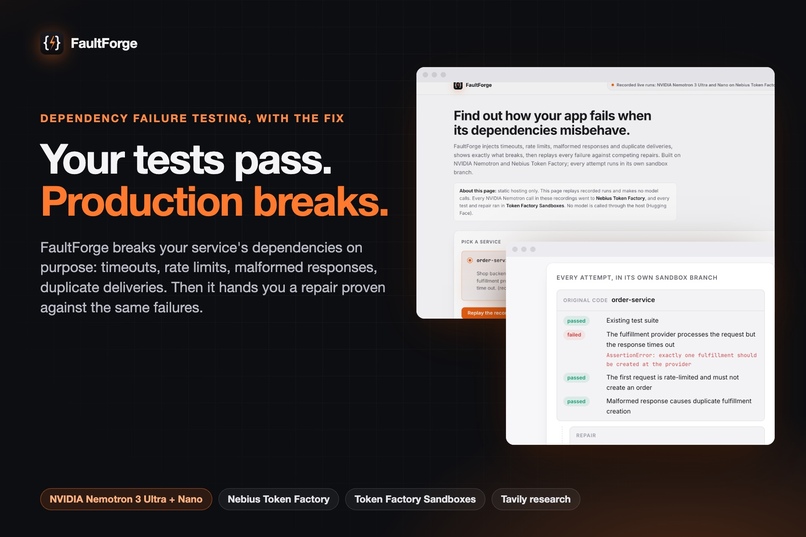
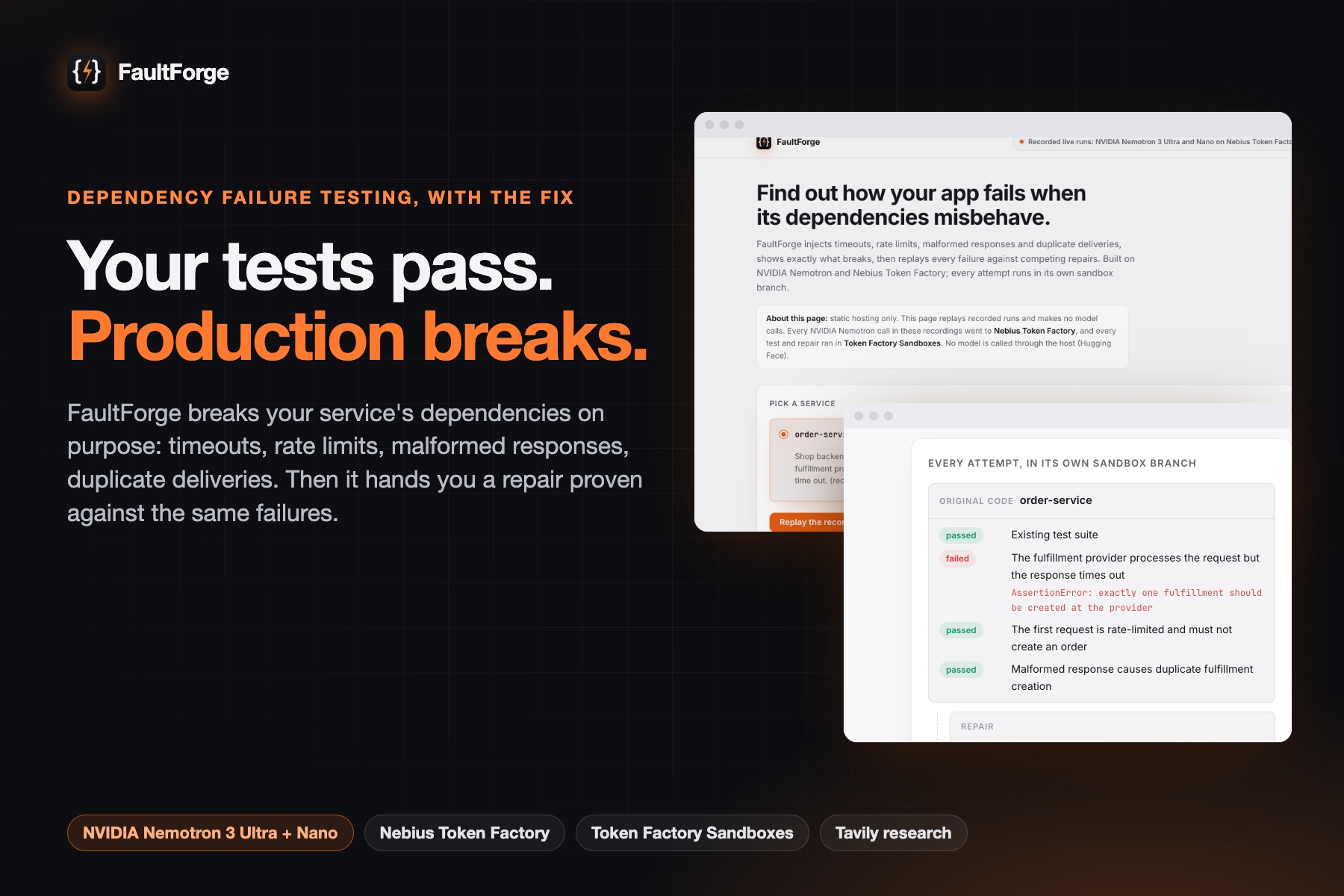
FaultForge: dependency failure testing, with the fix
-
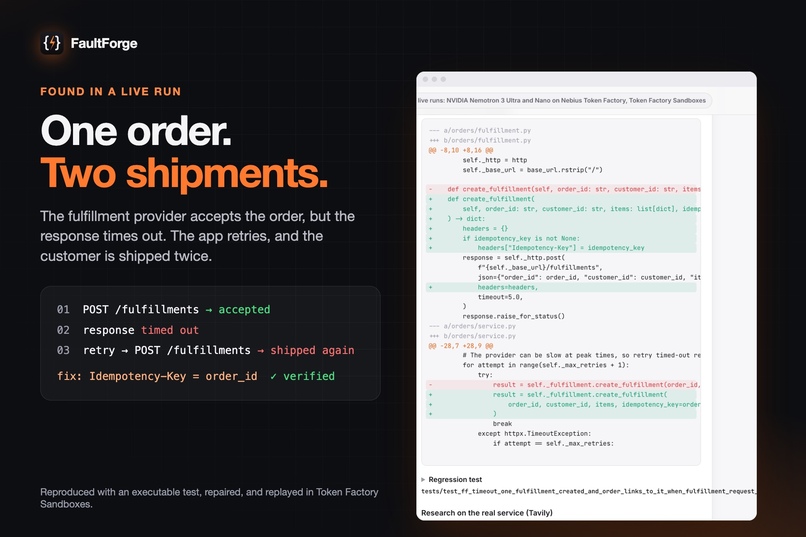
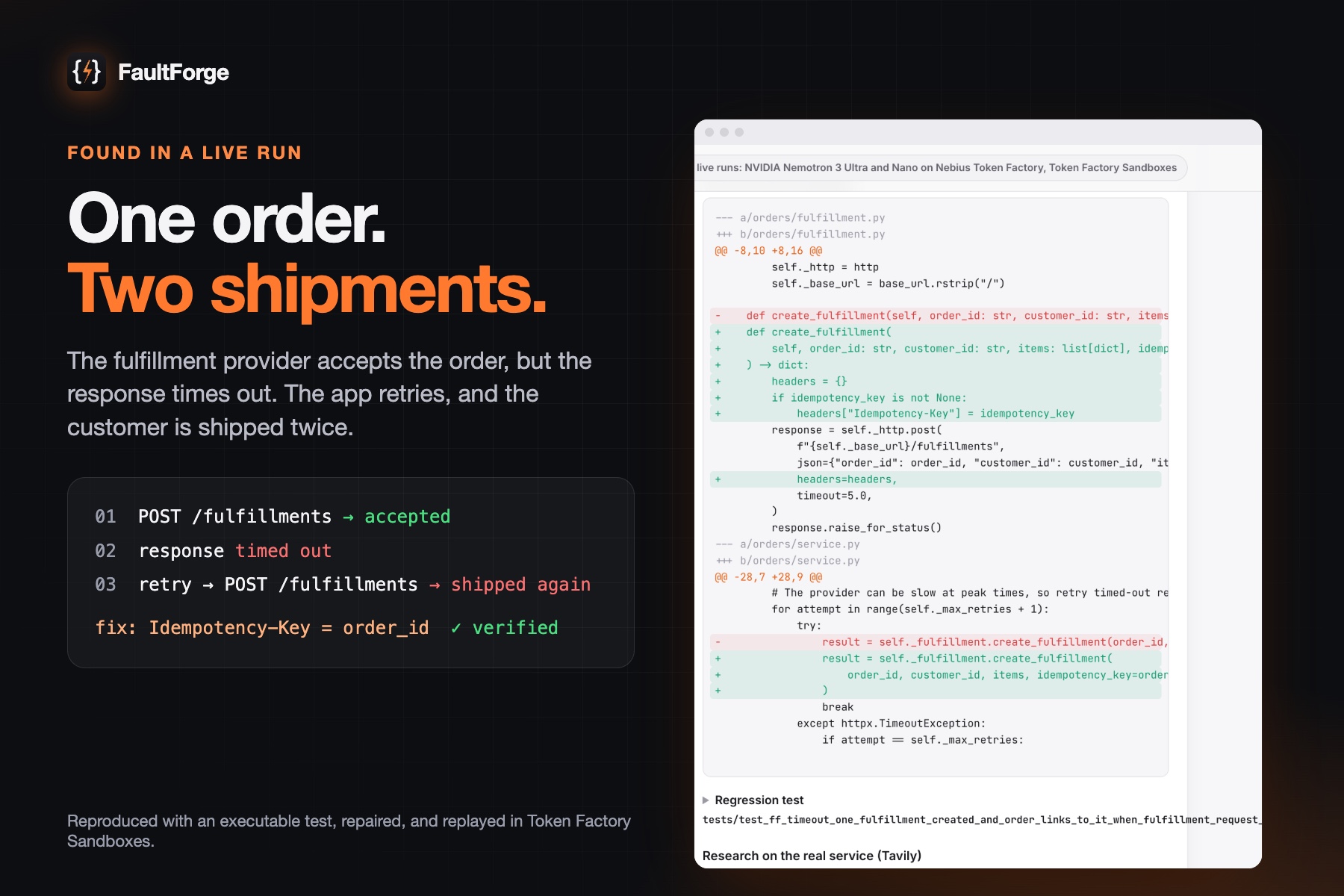
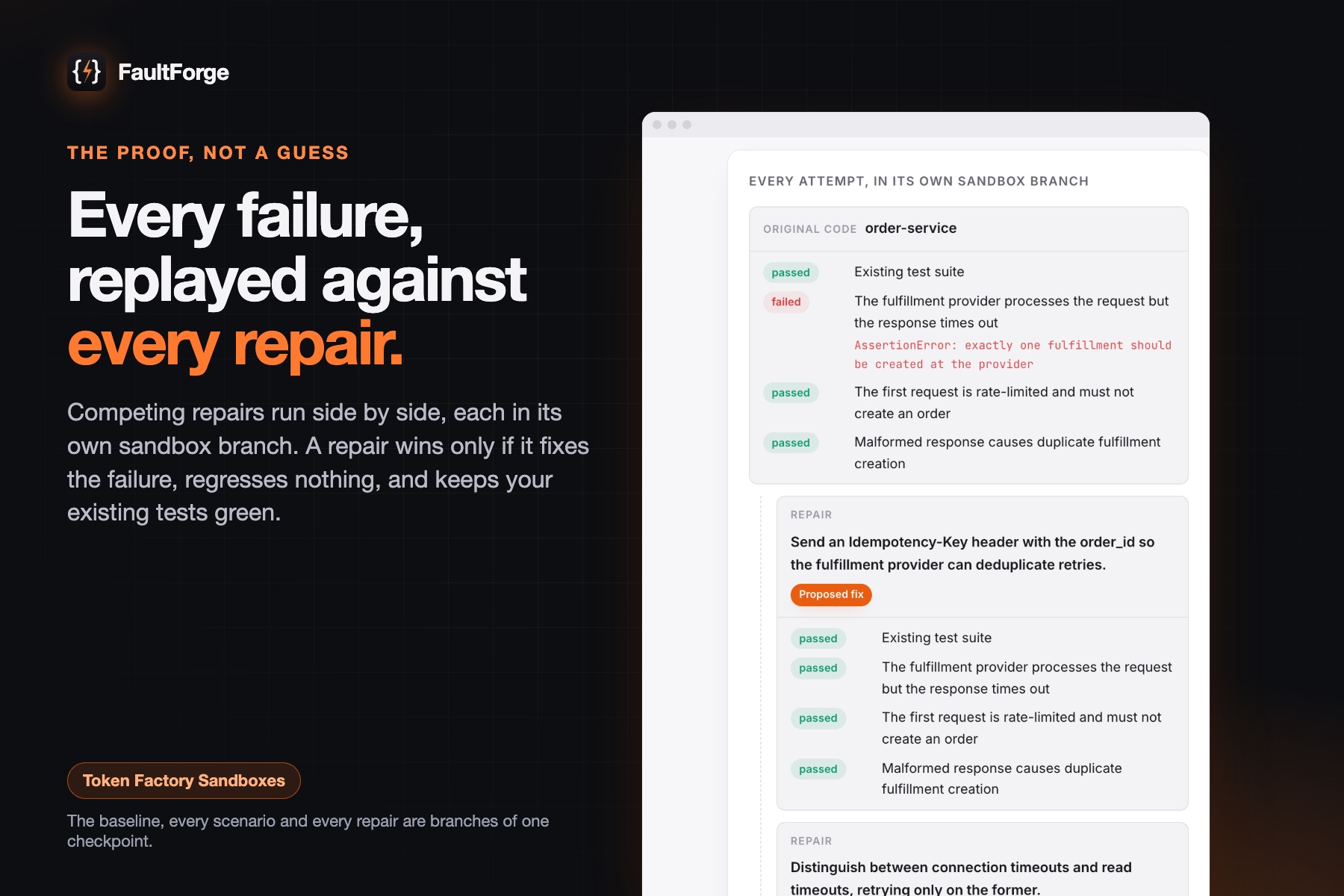
Found in a live run: a timeout after the provider accepted the order made the retry ship it twice
-
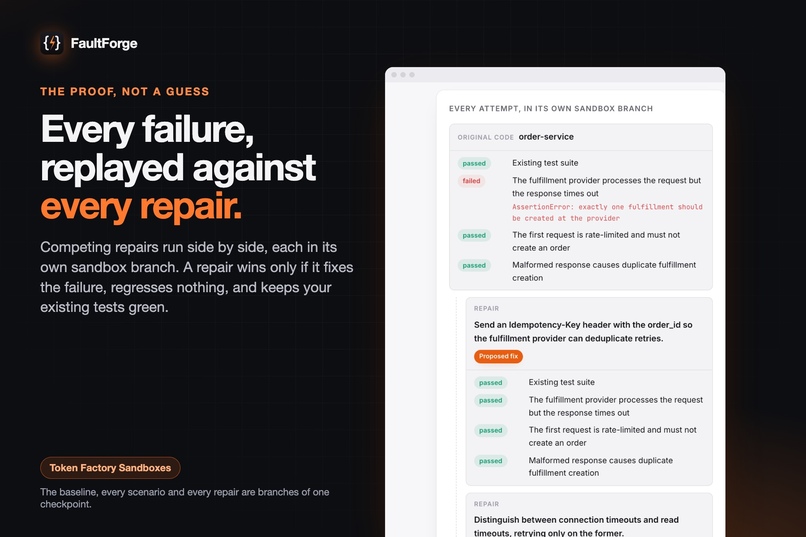
Every failure replayed against every repair, each in its own Token Factory Sandboxes branch
-
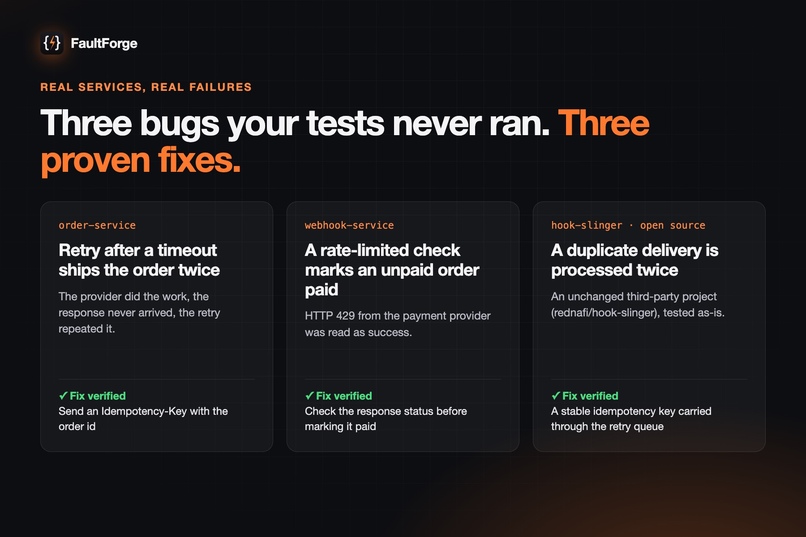
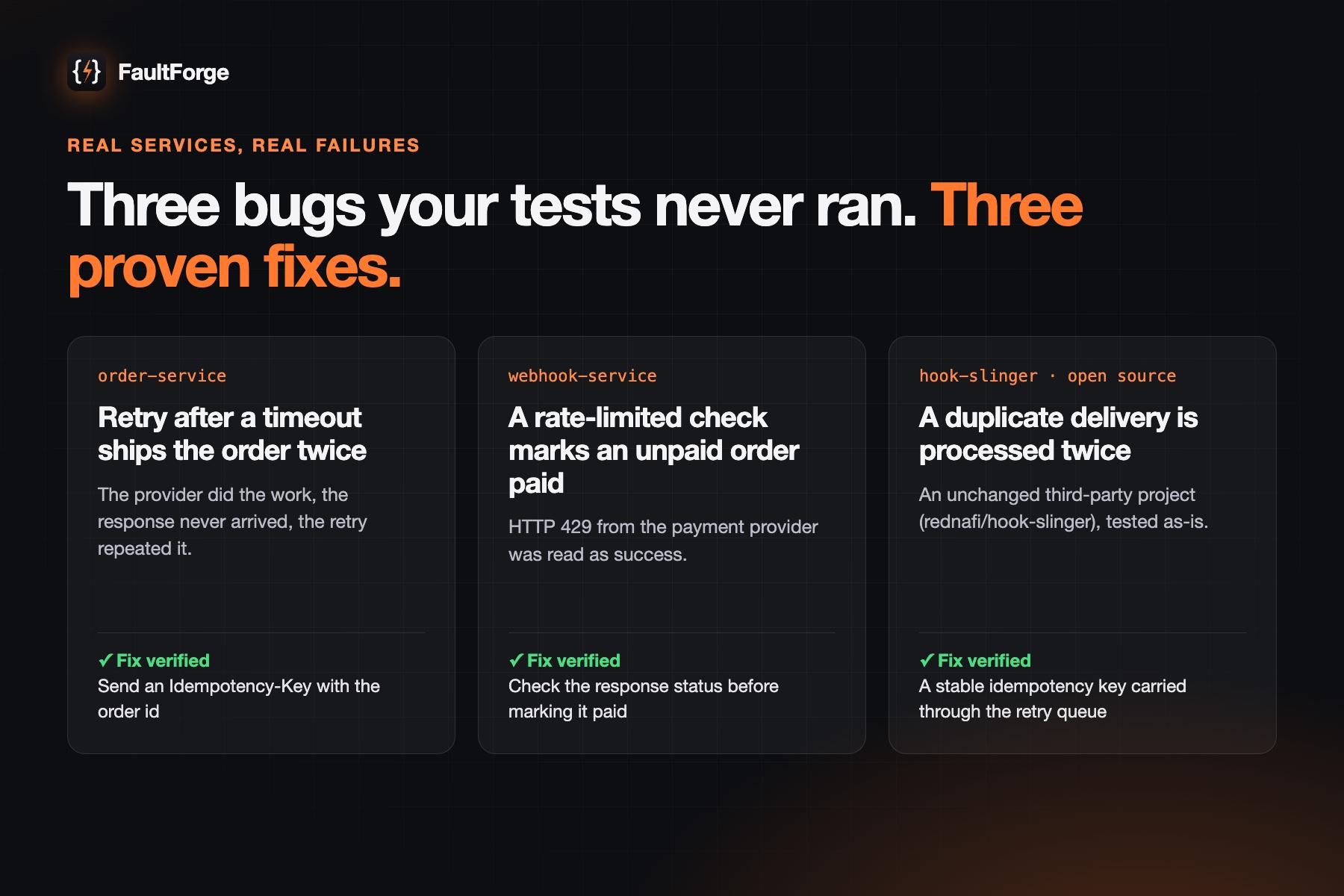
Three real services, three reproduced failures, three verified fixes
-
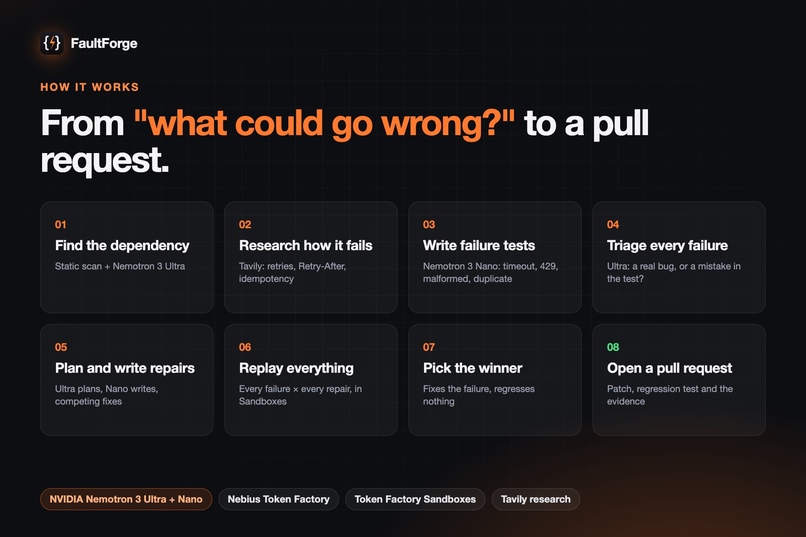
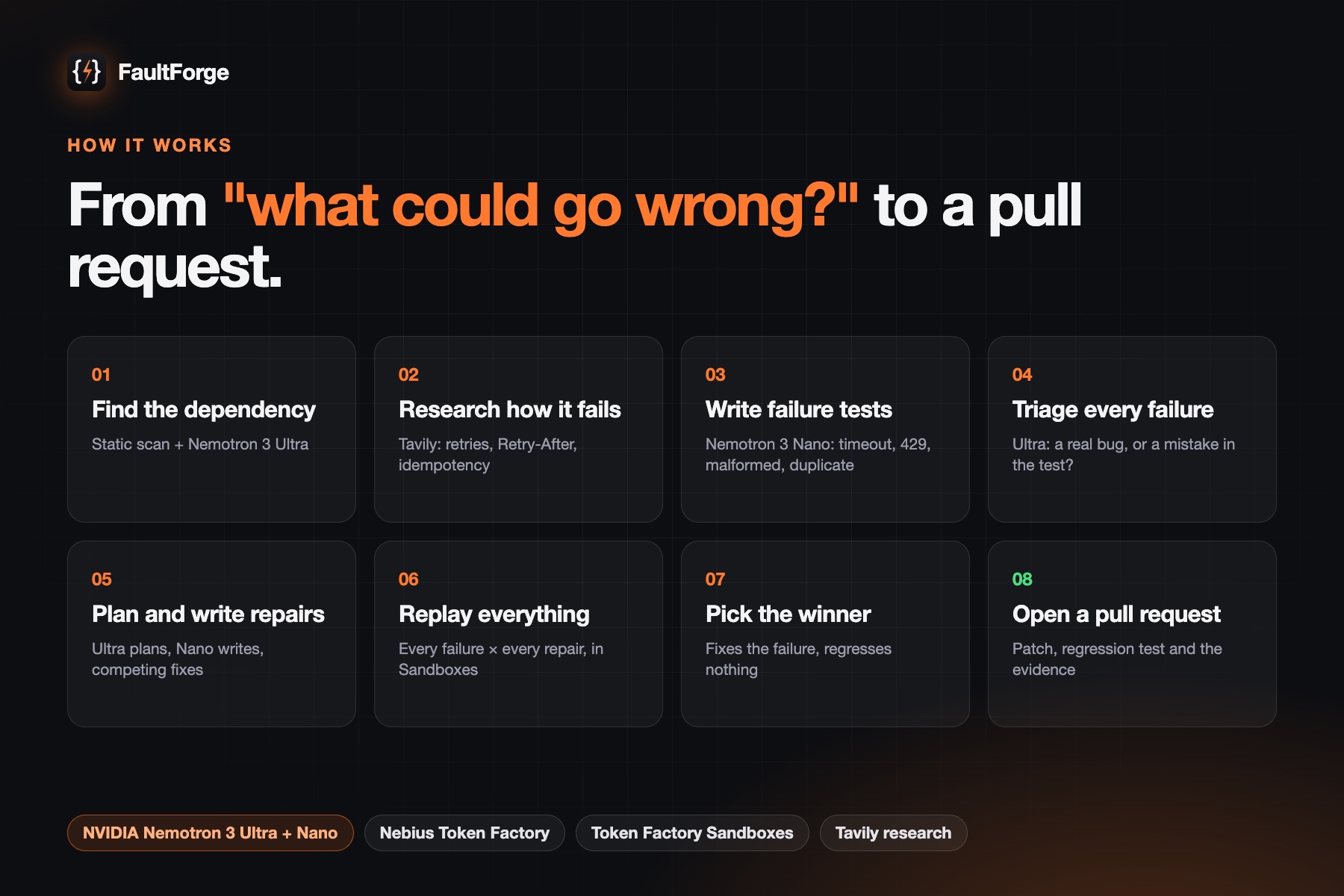
How it works: Nemotron 3 Ultra plans and triages, Nano writes, Sandboxes replay
-
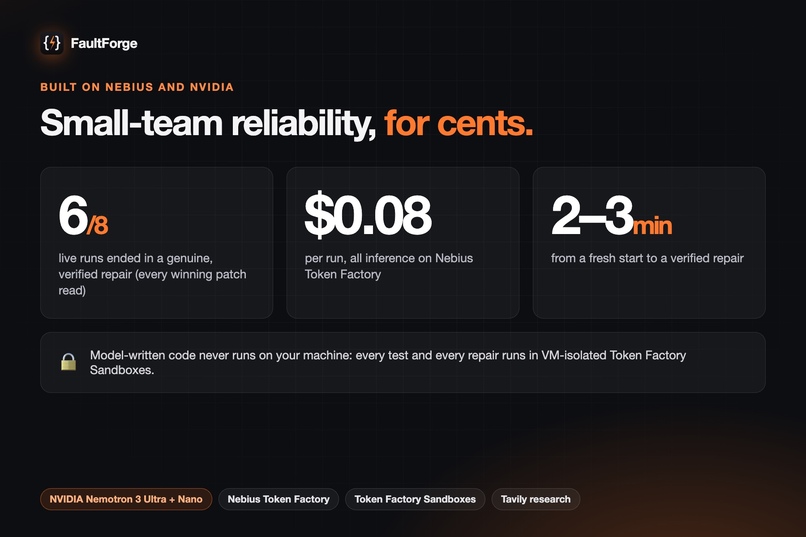
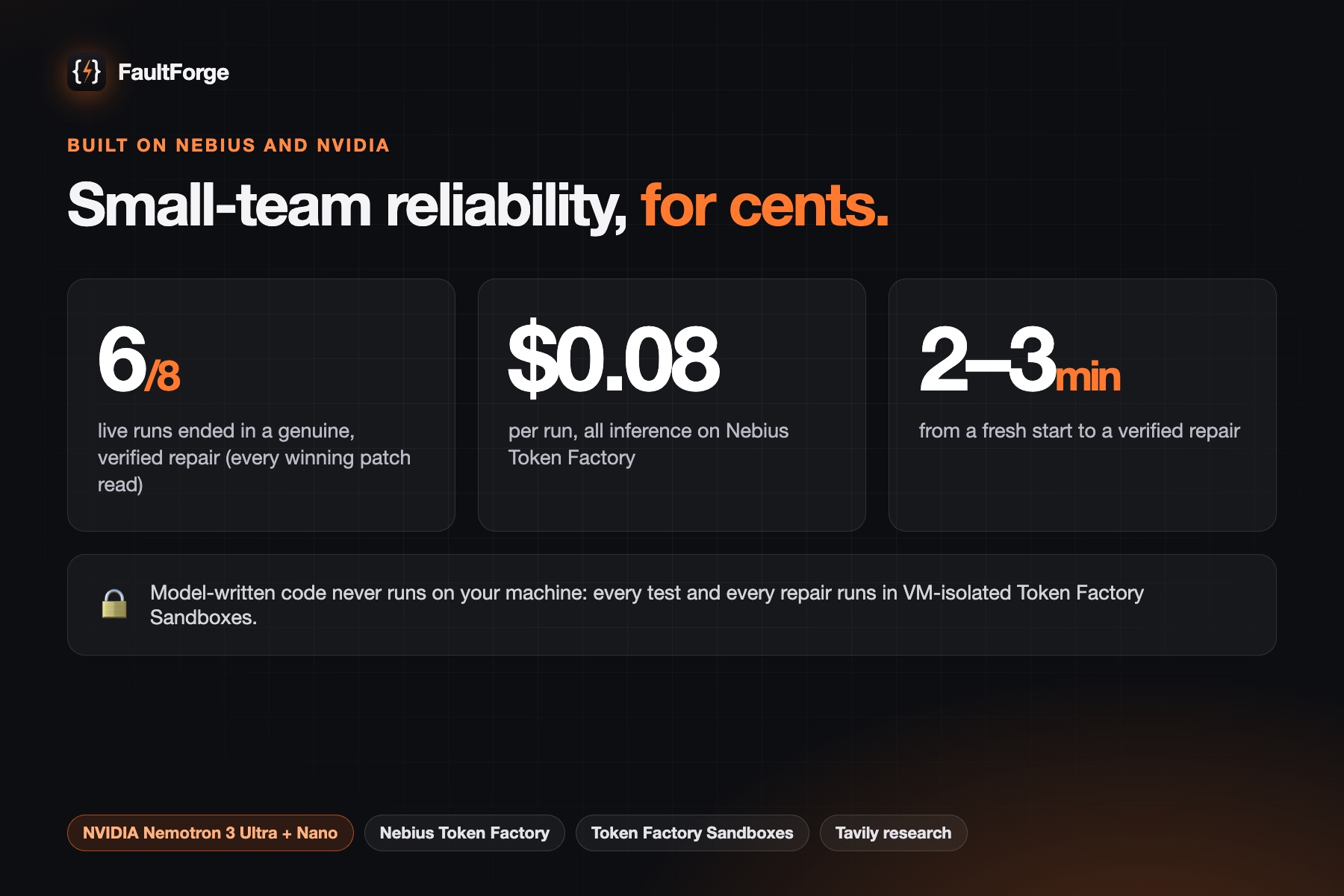
6 of 8 live runs ended in a genuine verified repair, about $0.08 a run
Inspiration
Most outages in small backends don't come from the code everyone reads. They come from the code that runs when a dependency misbehaves: a payment provider that rate-limits you, a fulfillment API whose response times out after it already did the work, a webhook delivered twice. Those paths almost never run in tests. Chaos-engineering tools can inject the failure, but a small team still has to work out what broke, write the fix, and prove the fix doesn't break something else. We wanted an agent that does the whole loop.
What it does
Point FaultForge at a small Python service. It:
- Finds the outbound HTTP dependency (static scan plus Nemotron 3 Ultra naming the dependency and the operation at risk).
- Researches how that kind of service really fails with Tavily: retries,
Retry-After, idempotency keys. - Writes executable failure tests for timeouts, rate limits, malformed responses and duplicate delivery. Faults are injected inside the HTTP client, so they are instant and repeatable.
- Reviews each reproduced failure with Ultra: a real application bug, or a mistake in the generated test? Test mistakes go back to the writer with the reason. Tests are checked again after repair: if only patches that changed code off the dependency path could make a test pass, it goes back to the writer and the run is repeated once with the corrected test.
- Plans distinct repairs (Ultra) and writes them (Nemotron 3 Nano).
- Replays every failure against every repair in Token Factory Sandboxes, each as a branch of one checkpoint. A repair wins only if it fixes a reproduced failure, breaks no existing test, regresses nothing and changes no existing code off the dependency path (so a patch that only bends the app to fit a mistaken test loses, even with every check green); a failed attempt gets one revision from Ultra, told exactly what verification found.
- Proposes a pull request with the patch, the regression tests and an evidence report.
What it found in live runs:
- Order service: a timeout after the provider accepted the order → retry → one order, two shipments. Fix found: a one-line
Idempotency-Keyheader. - Payment webhook service: a rate-limited charge check (HTTP 429) is read as success → an unpaid order is marked paid. Fix found: check the response status.
- hook-slinger (rednafi/hook-slinger, an unchanged open-source project): a duplicate delivery makes the receiver process the same webhook twice. Fix found: a stable idempotency key carried through its retry queue.
How we built it
- Nemotron 3 Ultra on Token Factory handles reasoning: dependency analysis, scenario planning, triage, repair strategy, and second attempts with reasoning on.
- Nemotron 3 Nano on Token Factory handles fast generation of failure tests and patches, with thinking switched off (it cut runs from ~15 minutes to ~1).
- Token Factory Sandboxes: each run of an image yields a new image, so the baseline, every scenario and every repair are parallel branches of one checkpoint. That's the exact shape of "replay every failure against every repair". Model-written code never runs on our machine or the demo server.
- Tavily grounds the failure tests in how real services behave. Once Ultra has named the dependency, FaultForge runs one Tavily search on how that kind of API handles timeouts, rate limits,
Retry-After, retries and idempotency keys. It passes Tavily's answer and the top five sources to the test writer as research notes. These notes are why the tests assert what the app promised, such as "one order is one shipment" or "a 429 is not a payment", rather than counting HTTP calls. Each live run surfaced the conventions the eventual fix followed: Stripe, Shopify and Adyen's idempotency-key docs for the order and payment services, and webhook-retry guides for hook-slinger. Every source is listed with its link in the run's preparation feed and in the evidence report. If Tavily is unavailable, the run continues without the notes, and the preparation feed shows that the research was skipped. - Python, FastAPI and React: the pipeline, an API with a live event stream, and a UI that shows the attempt tree, preparation feed, and before/after evidence.
- Engineering discipline: test-first throughout (180+ tests), a code review that found 15 issues (all fixed), and a two-model security review of the public surface (findings fixed). Live runs are capped per day so a public demo can't drain credit.
Challenges we ran into
- Code inside JSON fails for every model size. Escaping and indentation broke most early patches. Switching to fenced code blocks, with a worked example, fixed it. Super and Ultra as writers did no better than Nano until validation and feedback existed.
- Generated tests are often wrong in subtle ways. We learned to tell a broken test from a real bug by where the error is raised: inside the test file means a test bug, inside application code means a real failure. An idea that sounded right, "a valid failure test must pass with the fault switched off", turned out wrong: many correct tests describe what must happen during the fault. Live data showed it, so we reverted it.
- Reading verdicts isn't enough; read the patches. Some early "repairs" made the app tolerate a mistake in the test. Adding Ultra's triage step fixed that, and we now check every winning diff.
- Our own fake dependency misled the models. Its
.acceptedlist held request bodies, but tests read IDs from it, and the bug only appeared after a correct repair. Adding.createdand documenting the difference took the order service from 2/4 to 2/2.
Accomplishments that we're proud of
- Six genuine repairs in eight live runs after triage, and every winning patch read and confirmed to change the dependency handling.
- Fully on Nebius: Nemotron for every model call, Sandboxes for every execution, about $0.08 per run.
- A real open-source project repaired without modifying its code.
- Honest evidence: every run shows what broke, what each repair tried, and why it was accepted or rejected.
What we learned
- Small models write good code when the format is simple (fenced code) and the feedback loop is tight; bigger writers mostly add cost.
- A reasoning model is most valuable as a reviewer: triaging failures and revising failed attempts with the concrete error.
- Sandboxes' branching is a natural fit for agents that compare alternatives.
What's next for FaultForge
- More fault types (partial responses, slow streams, connection resets) and dependencies beyond HTTP (queues, databases).
- A GitHub App that runs FaultForge on pull requests touching dependency code.
- Repairs that keep idempotency keys unique per destination by default (a caveat from the hook-slinger run).
Built With
- fastapi
- httpx
- nebius-sandboxes
- nebius-token-factory
- nvidia-nemotron
- pytest
- python
- react
- tavily
- typescript

Log in or sign up for Devpost to join the conversation.