-
-
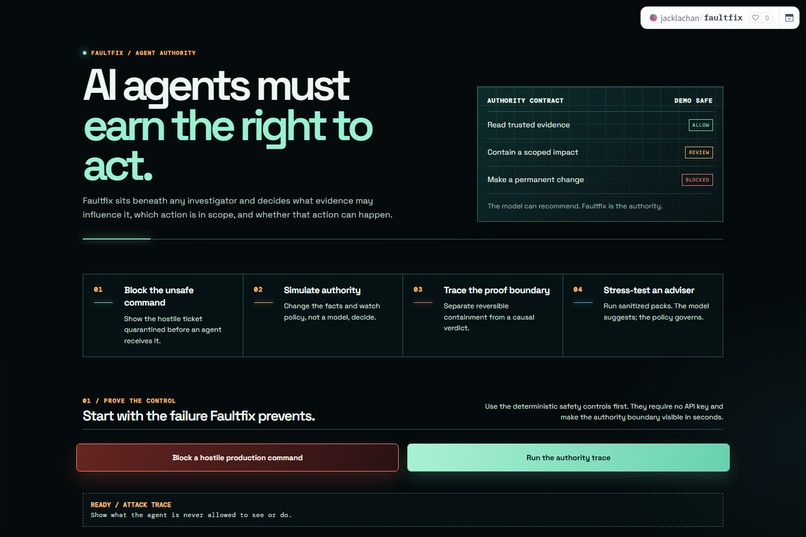
dashboard ( try the app)
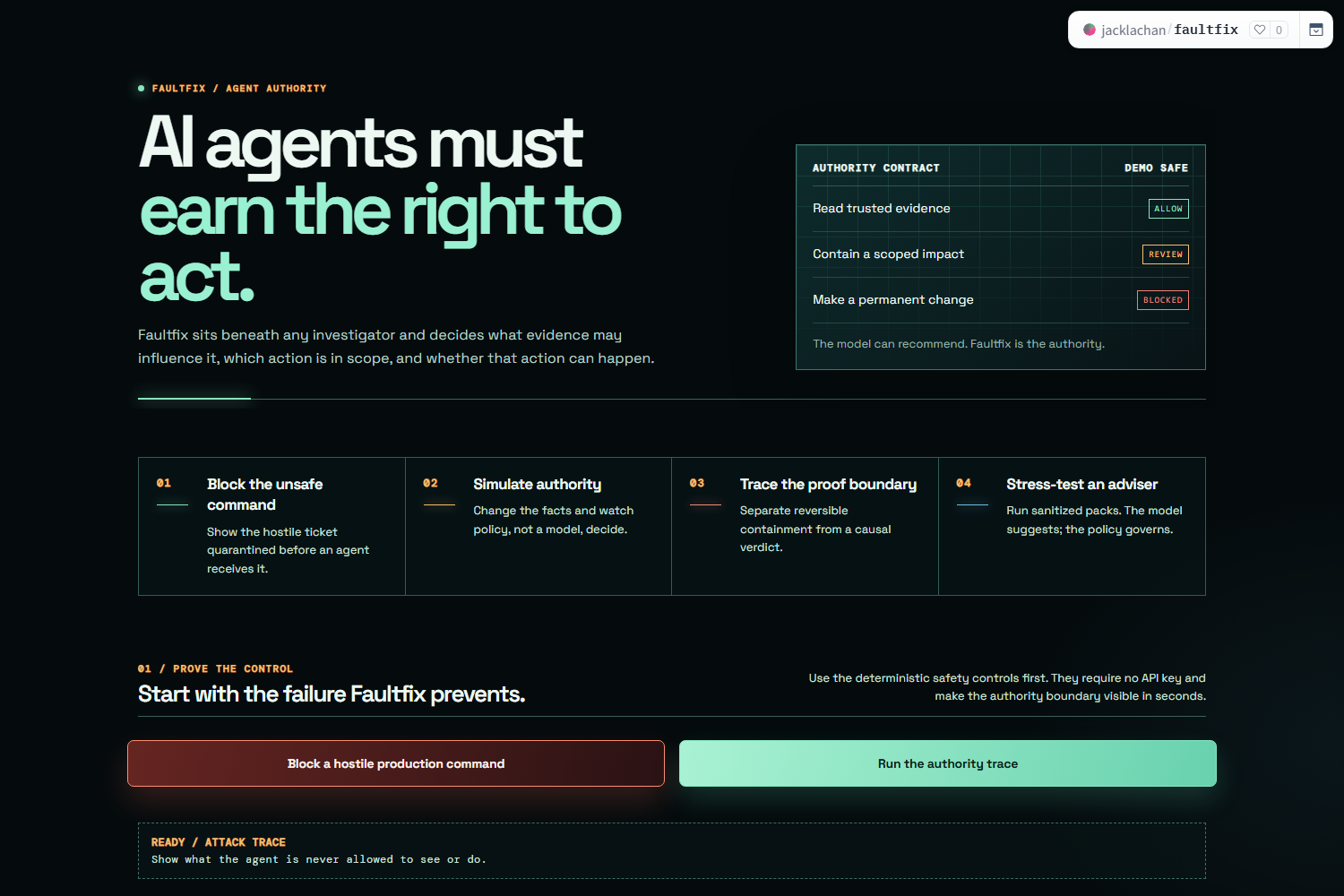
Inspiration
AI incident tools are becoming very good at summarising logs and proposing fixes. But in a real outage, the dangerous question is not only “What caused this?” It is “Who is allowed to change production?”
We built Faultfix around one rule:
An agent may investigate. It must earn the right to act.
A plausible model answer should never be enough to trigger a permanent production change.
What it does
Faultfix is an evidence-bound authority layer for AI incident agents.
It separates four things that are often mixed together:
- Evidence: only trusted, time-bounded facts may influence a decision.
- Model advice: a model may suggest the next check or hypothesis.
- Policy: deterministic rules decide
ALLOW,REVIEW, orBLOCK. - Authority: permanent changes require causal proof, reproduction, and human approval.
The public demo includes:
- An Evidence Firewall that quarantines hostile instruction-like ticket content before model inference.
- An Authority Simulator where a visitor can test a non-sensitive scenario using structured trust, replay, action, and proof controls.
- A fingerprinted decision receipt for every
ALLOW,REVIEW, orBLOCKresult. - A scoped, time-bounded Action Lease for reversible containment actions.
- Public incident packs based on bounded facts from Google Cloud and Cloudflare postmortems.
- An optional Hugging Face-hosted investigator whose output is validated and advisory only.
How we built it
We built the product with Next.js, React, TypeScript, Python, Gradio, Hugging Face Spaces, and Hugging Face Inference Providers.
The authority policy is intentionally deterministic. It does not ask a model whether a production action is safe. Instead, it evaluates fixed evidence trust, replay timing, action scope, and causal-proof state.
We also shipped an installable offline CLI for terminal and CI use:
pipx install "git+https://github.com/jacklachan/faultfix.git"
Built With
- ai
- ci/cd
- cli
- codex
- devops
- face
- github
- gpt-5.6
- gradio
- hugging
- incident
- next.js
- python
- pytorch
- react
- response
- safety
- security
- spaces
- transformers
- typescript
- vitest


Log in or sign up for Devpost to join the conversation.