Inspiration
I started building Fathom because I kept running into the same problem: important information rarely exists as isolated facts. The meaning is usually in the relationships—what supports a claim, what depends on something else, what changed over time, and how different pieces of evidence fit together.
Most research tools still present information as lists, documents, search results, or dashboards. Those formats are useful, but they make it difficult to hold a large relational picture in mind.
Fathom began as a broader relational research environment for exploring scientific and conceptual collections. For OpenAI Build Week, I wanted to see whether the same architecture could become useful for market intelligence.
What Fathom does
This submission is an offline Market Intelligence edition of Fathom built around evidence from SEC filings.
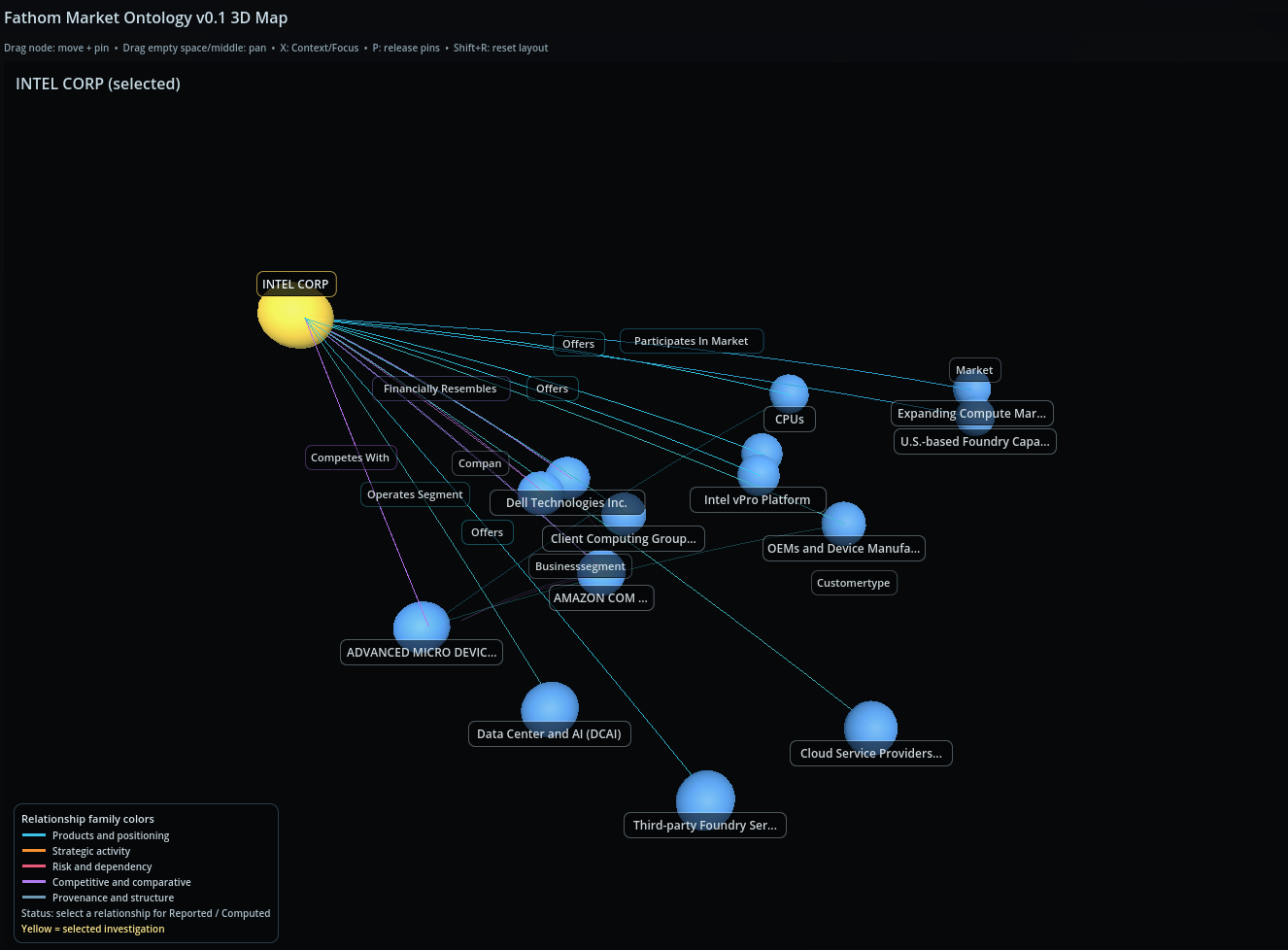
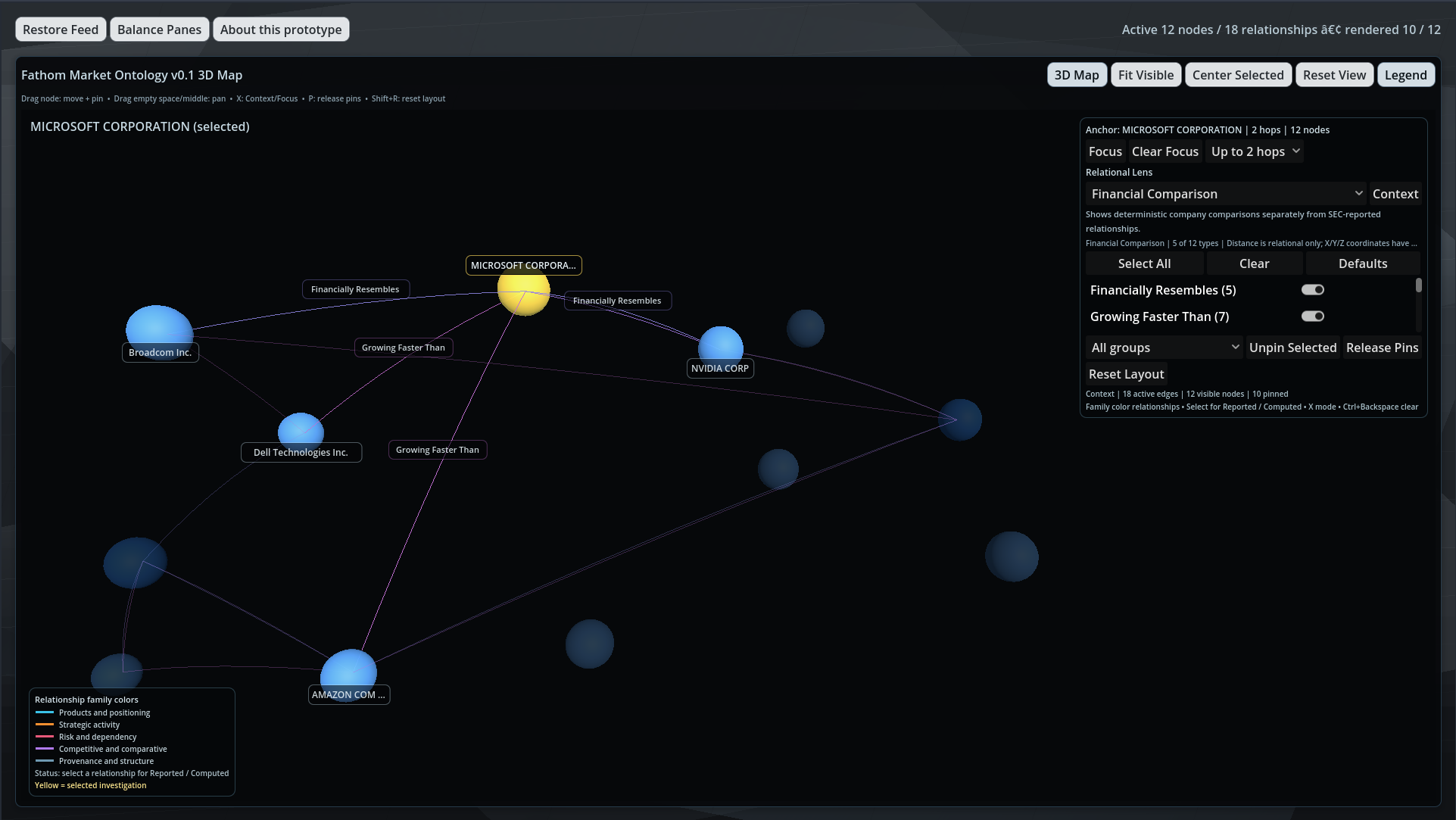
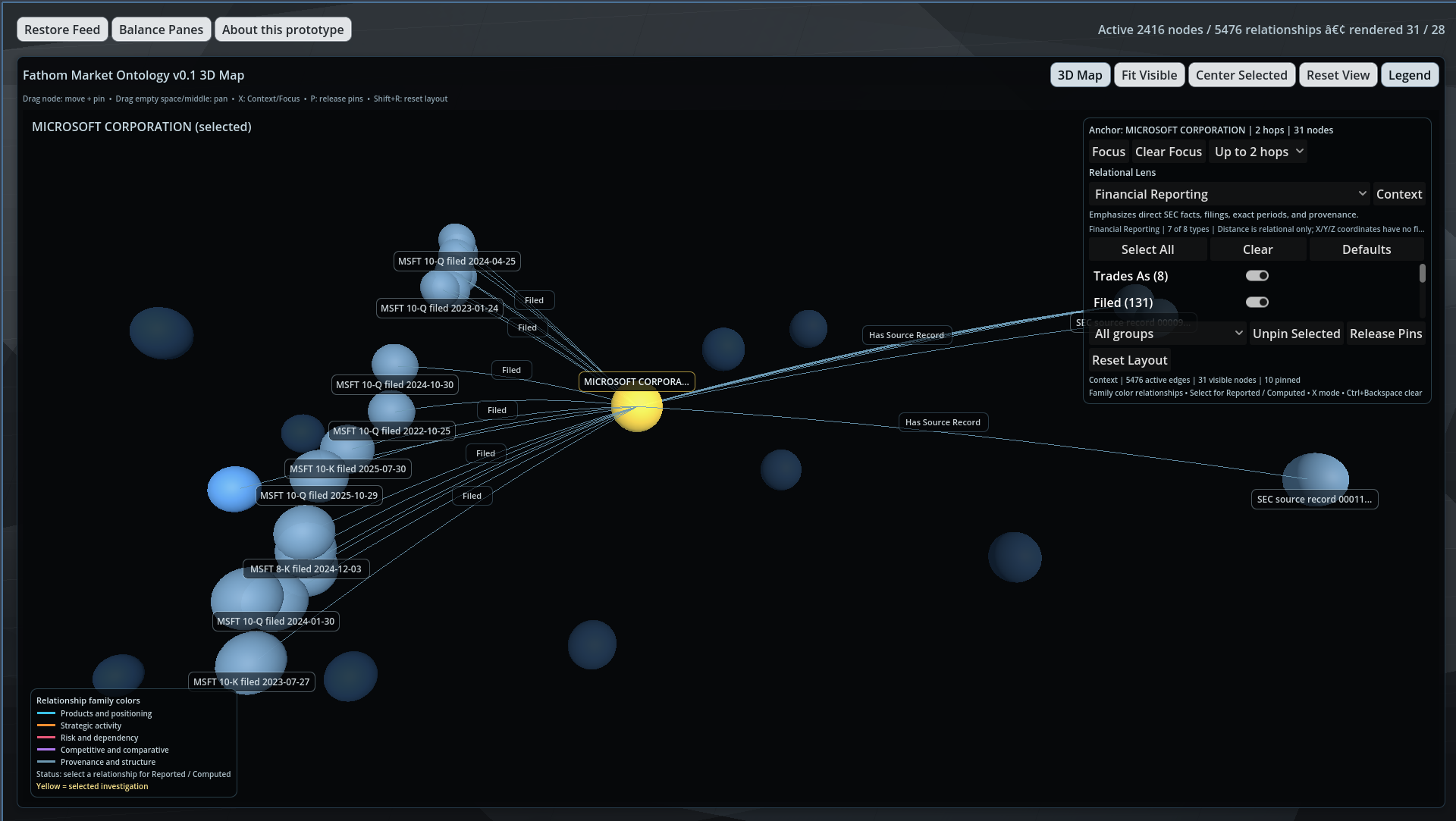
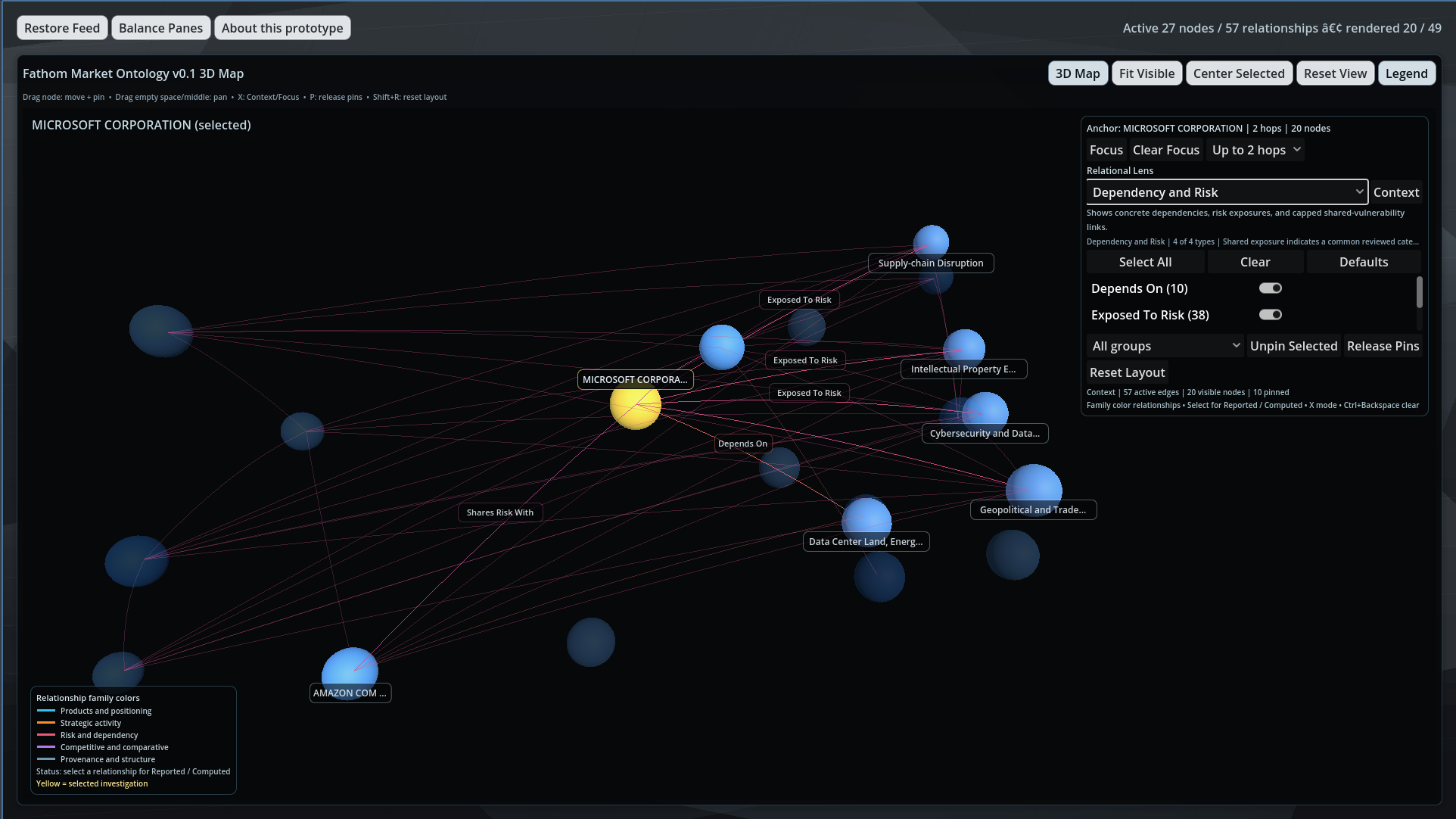
It organizes financial facts, companies, products, markets, dependencies, risks, strategic events, filings, and derived indicators into an interactive relational map.
The bundled collection covers eight major technology companies and contains:
- 2,504 nodes
- 8,397 relationships
- 82 explanatory cards
- 137 SEC source records
- Seven relational lenses for exploring different questions
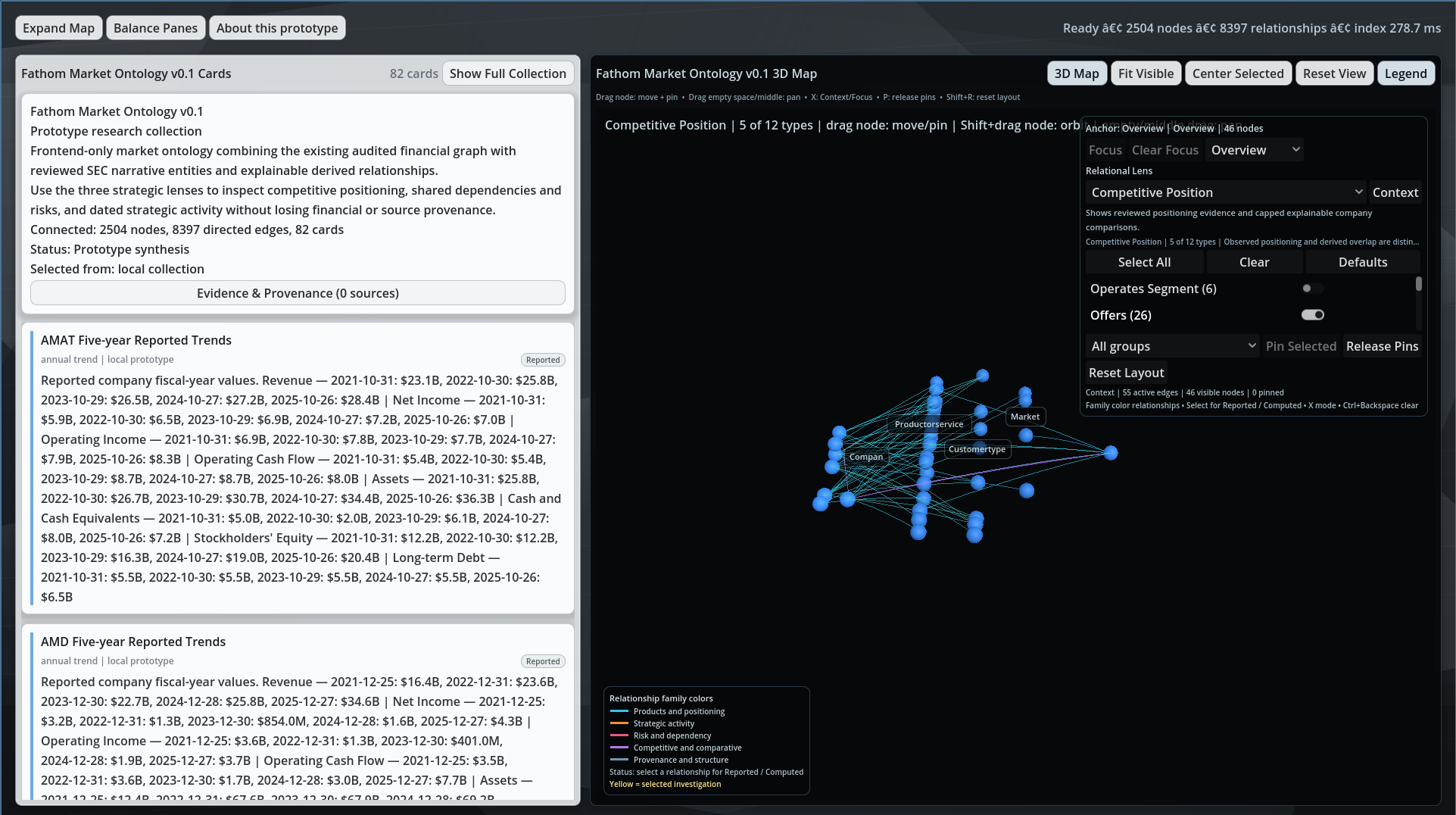
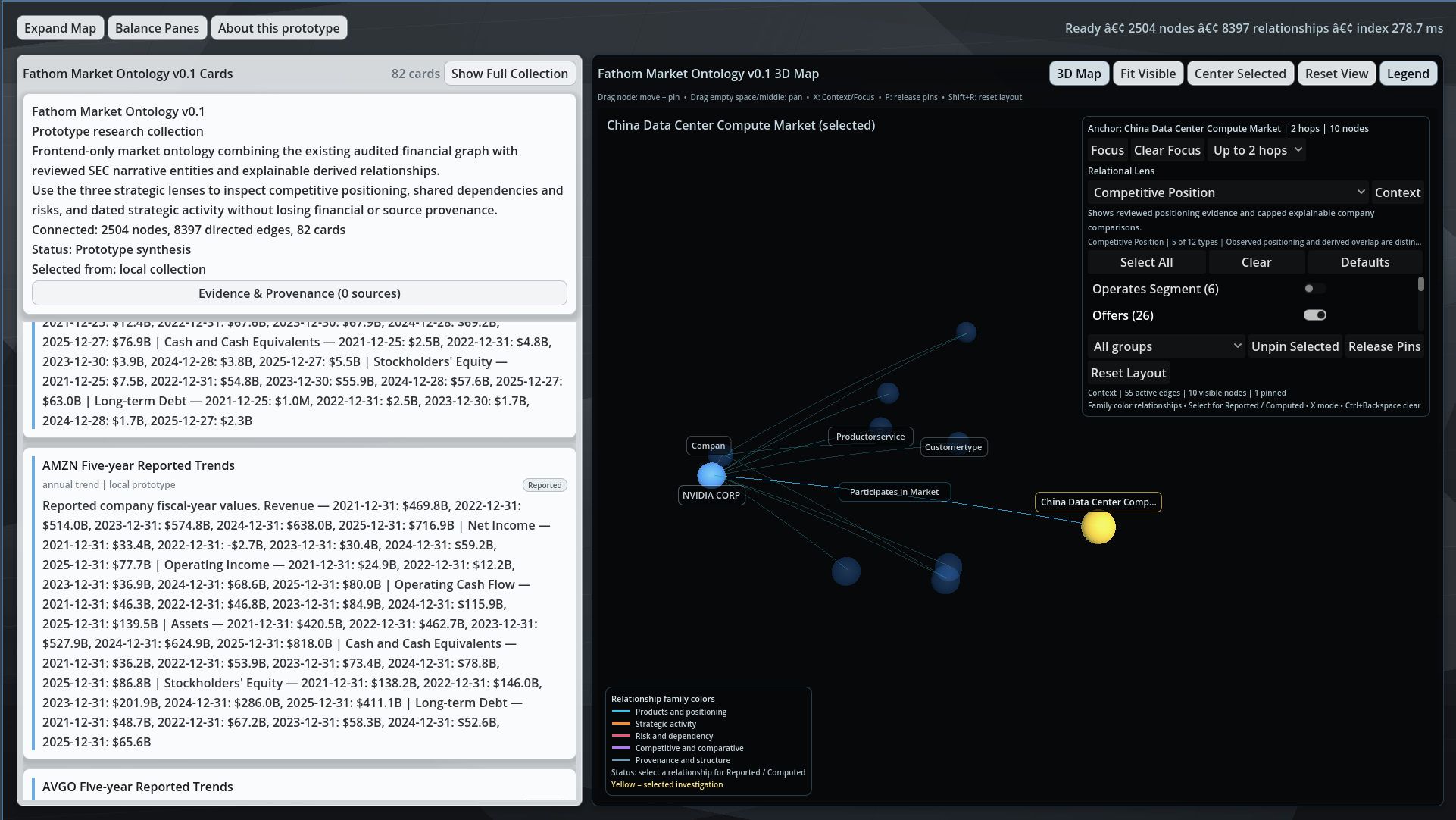
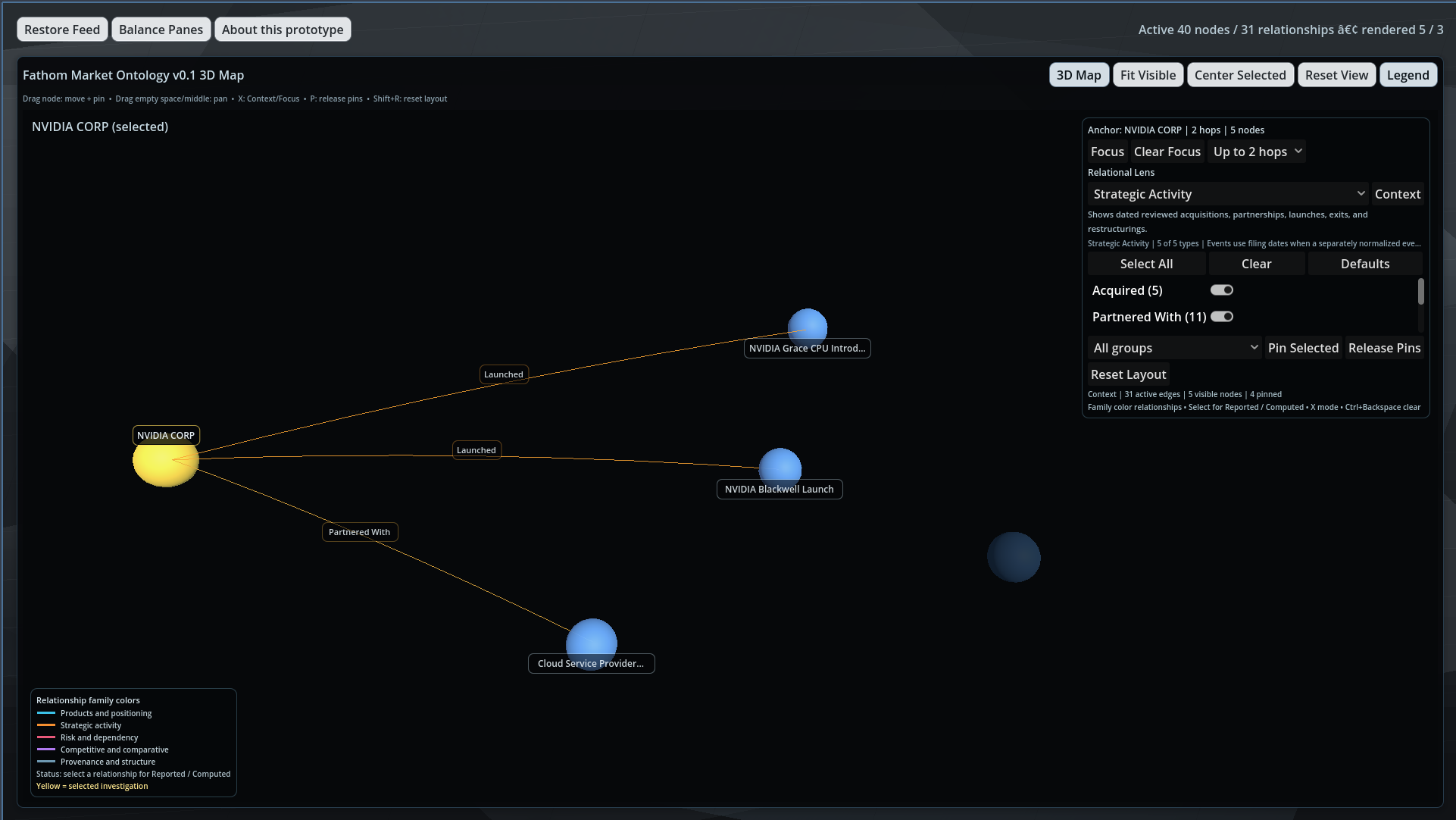
A user can begin with a company, choose a lens such as Financial Reporting, Competitive Position, Dependency and Risk, or Strategic Activity, and narrow the graph around the question being investigated.
The map, cards, and detail panel remain synchronized. Selecting an item brings forward its related evidence, while selecting a card returns the investigation to the relevant node or relationship.
Fathom also distinguishes between information directly reported in source material and relationships or indicators that were computed or derived. Derived results retain explanations and links to their supporting observations.
The Evidence and Provenance panel exposes filing metadata, evidence excerpts, review status, limitations, and optional links to the original SEC documents. The goal is not to produce a black-box recommendation, but to make the structure of the evidence inspectable.
How I built it
Fathom uses a Godot desktop frontend with reusable graph, card, provenance, and investigation-state systems.
During Build Week, I used Codex with GPT-5.6 as a coding and analysis assistant to:
- Audit SEC Company Facts and filing narratives
- Build deterministic Python data pipelines
- Normalize financial and narrative observations
- Construct the Market Ontology
- Implement decision-oriented relational lenses
- Add support tracing for derived relationships
- Improve graph rendering and navigation performance
- Refine the 3D investigation interface
- Add responsive layout behavior
- Create automated validation and clean-clone tests
- Package a completely offline judging build
The submitted application launches directly into the bundled Market Ontology and does not require a backend, API key, database, raw SEC cache, or network connection.
The generated collection is produced by checked-in deterministic pipelines. It is not presented as a set of unsupported model-generated facts.
Challenges
One of the largest challenges was turning a large amount of heterogeneous filing information into a graph that remained understandable.
The system needed to preserve the difference between reported observations, normalized entities, deterministic calculations, and higher-level relationships without making the interface visually overwhelming.
Performance was another challenge. The collection contains thousands of nodes and relationships, so the map needed graph indexing, bounded rendering, filtering, neighborhood scopes, and persistent investigation state.
Preparing the project for judging uncovered additional practical issues. The original version started through a live backend, contained several unrelated research collections, and depended on files available only in my development environment.
I created a dedicated submission branch that launches directly into the Market Intelligence experience, disables backend initialization, hides unrelated interfaces, validates the bundled artifact, and runs successfully from a clean clone.
A final responsive-layout pass was also necessary after discovering that the lens and investigation controls could extend beyond the usable window area at common screen sizes.
What I learned
The project reinforced my belief that provenance should not be treated as an appendix. It can be part of the primary interaction model.
I also learned that relational interfaces become much more useful when users can change the question being asked without changing the underlying evidence. The lenses do not create different datasets; they apply different investigative priorities to the same graph.
Codex with GPT-5.6 was especially helpful for working across a large existing codebase. It helped inspect architecture, trace reference contracts, implement focused changes, construct tests, and identify clean-clone and repository issues that would have been easy to overlook.
The most effective workflow was iterative: I supplied the product direction and evaluated the interface, while Codex handled increasingly precise implementation and verification passes.
What’s next
The current collection is a static eight-company calibration dataset rather than a complete or live market-intelligence platform.
Future work could include:
- Additional industries and company cohorts
- Updated filing ingestion
- User-supplied research collections
- Saved investigations and comparative views
- More sophisticated temporal relationships
- Collaborative annotation and review
- Natural-language assistance that remains grounded in the visible evidence graph
The broader goal of Fathom is to help people move beyond collecting isolated facts and begin exploring the larger structures those facts create together.
Built With
- 3d-visualization
- automated-testing
- data-engineering
- data-visualization
- desktop-application
- fastapi
- gdscript
- git
- github
- godot-engine
- gpt-5.6
- information-retrieval
- json
- knowledge-graphs
- openai
- postgresql
- provenance
- python
- railway
- restapi
- sec-edgar


Log in or sign up for Devpost to join the conversation.