-
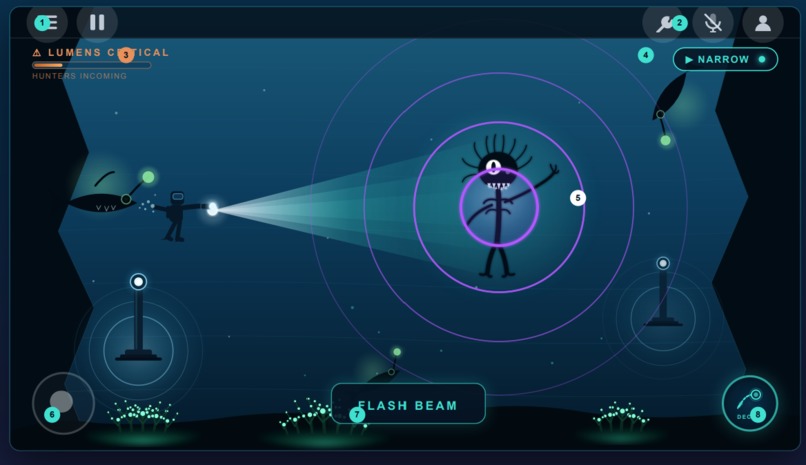
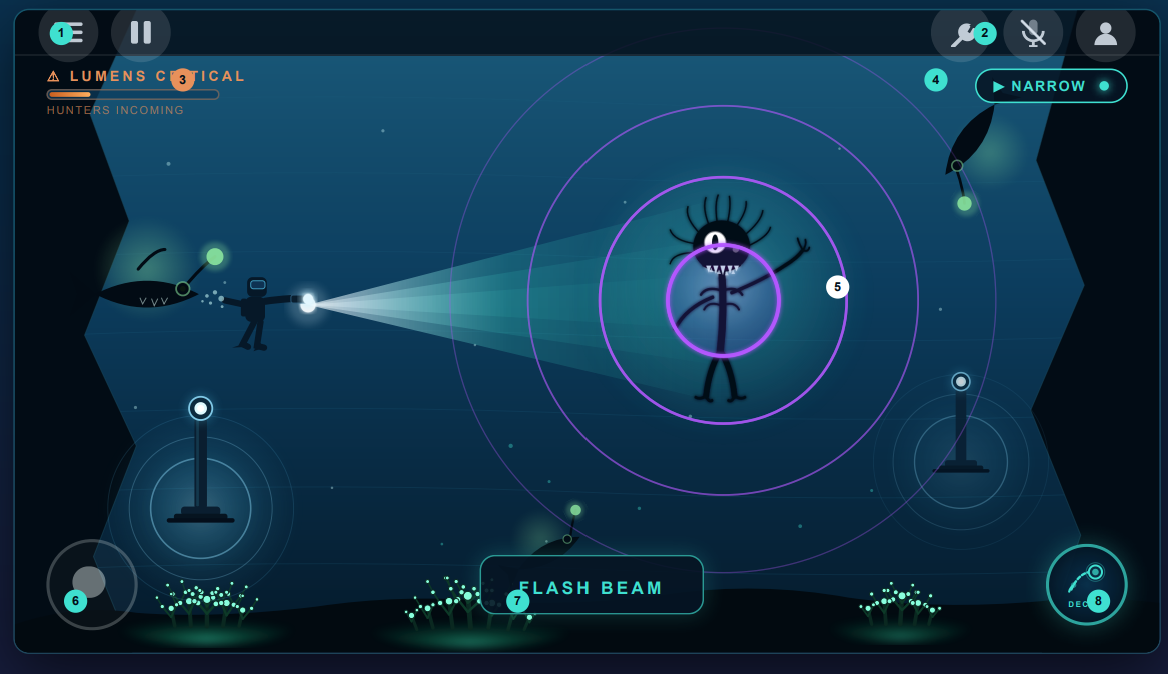
Mid-dive: hunter illuminated, violet shockwave rings expanding, lumens critical, cone toggle top-right, flash beam bottom-center.
-
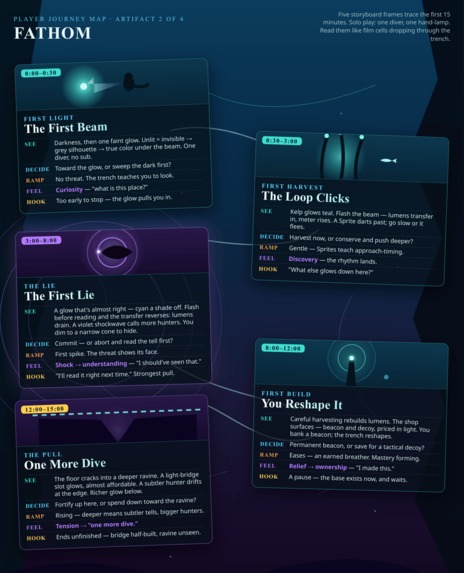
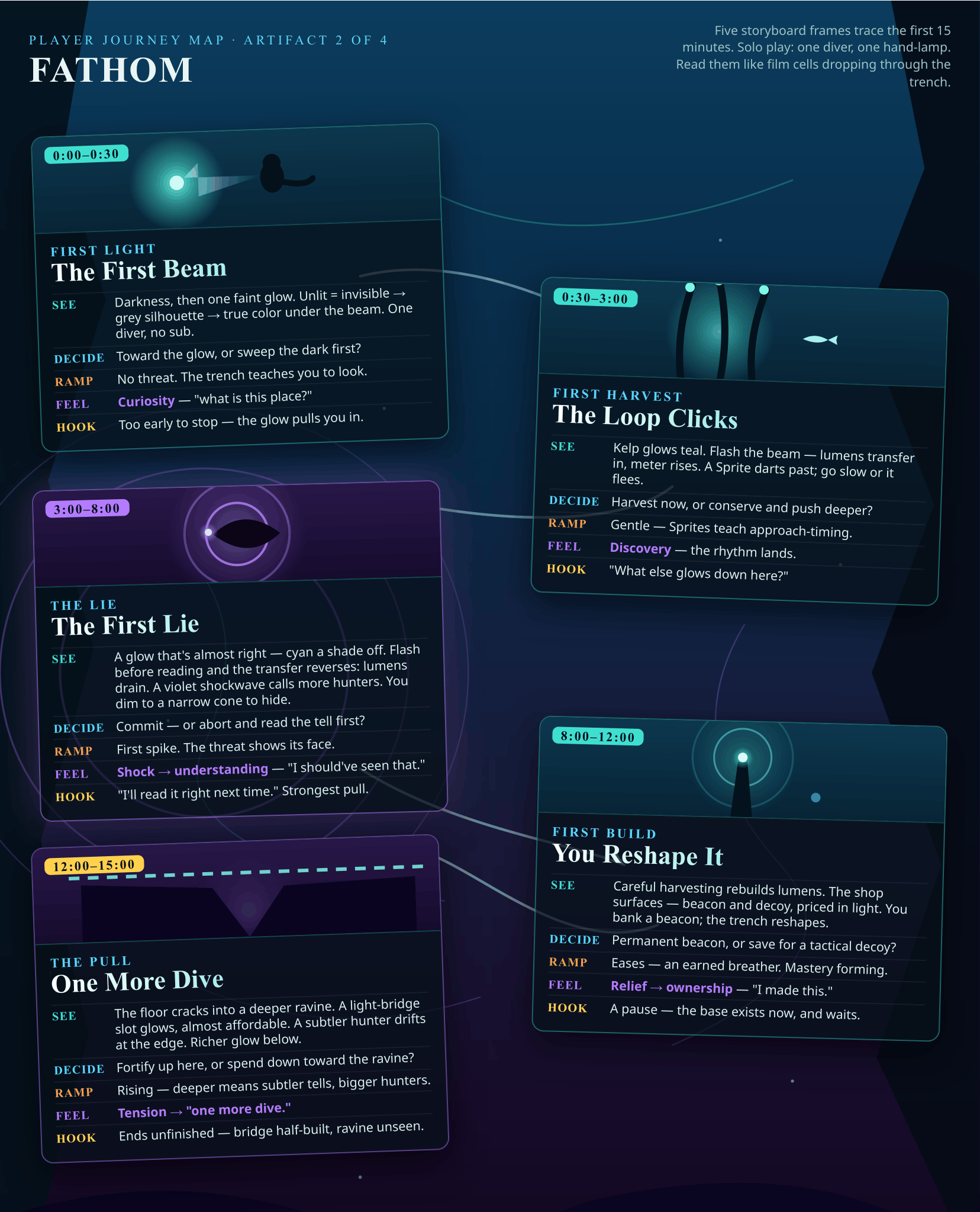
Five storyboard beats trace the first 15 minutes: curiosity, discovery, the first lie, ownership, and the pull to go deeper.
-
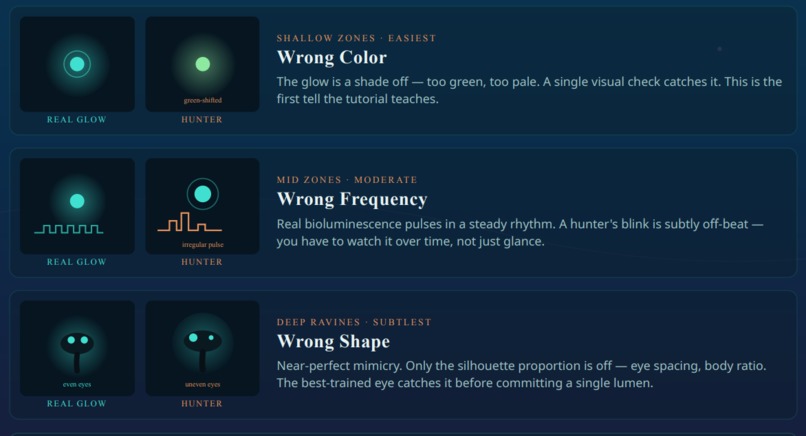
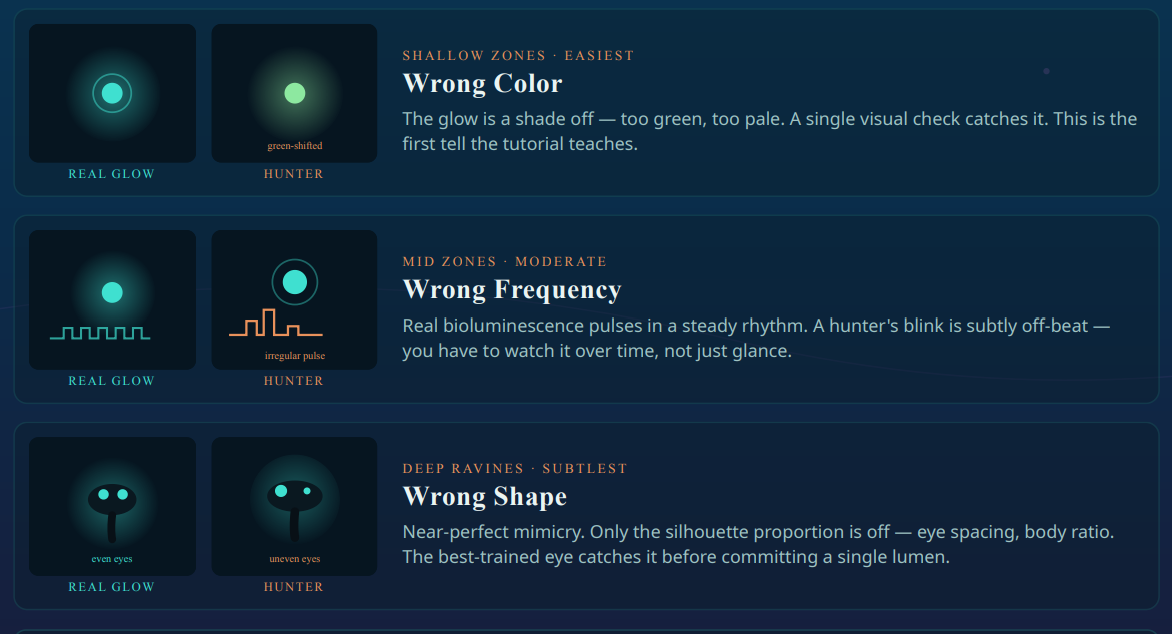
Three tell tiers — wrong colour, wrong frequency, wrong shape — escalating from shallow zones to deep ravines. Always fair, never random.
-
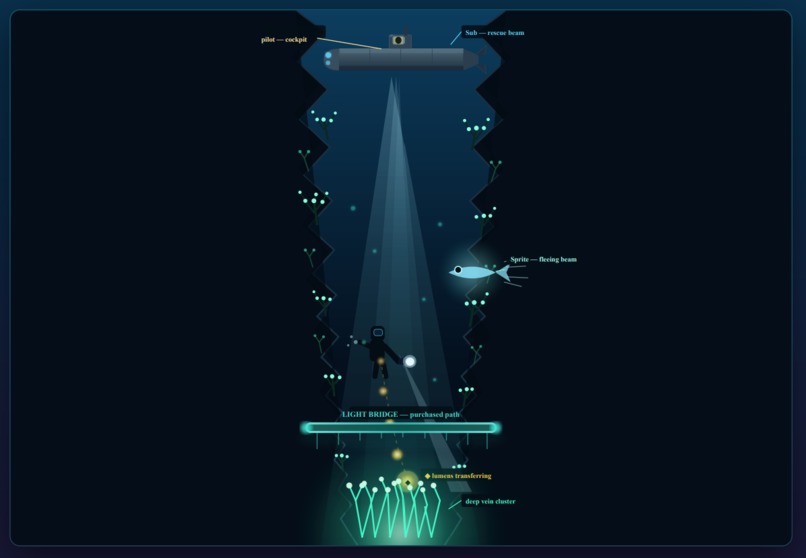
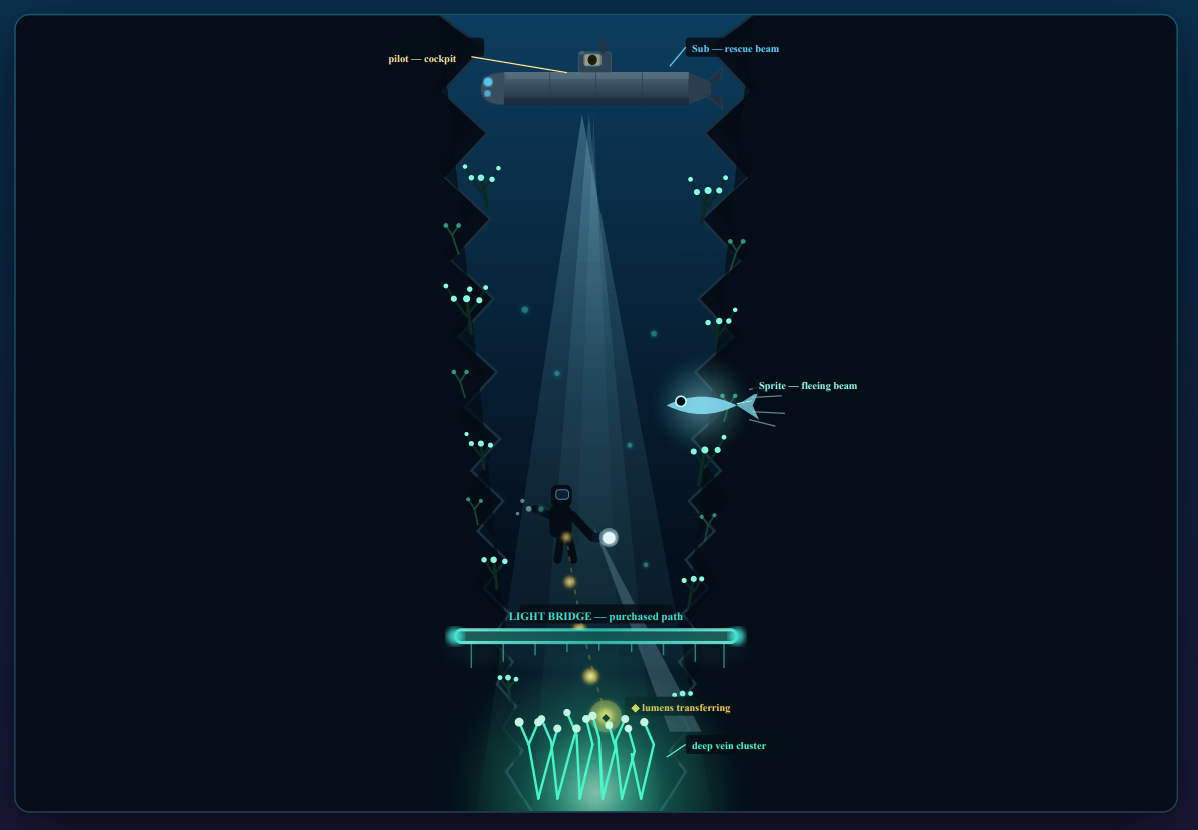
Sub too wide to enter, diver alone, sprite fleeing, light-bridge purchased, deep vein cluster glowing below. Richest and most dangerous.
-
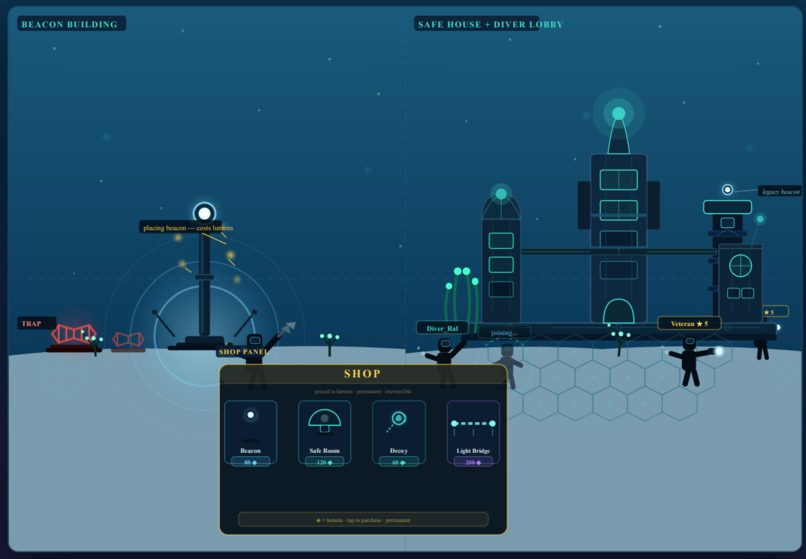
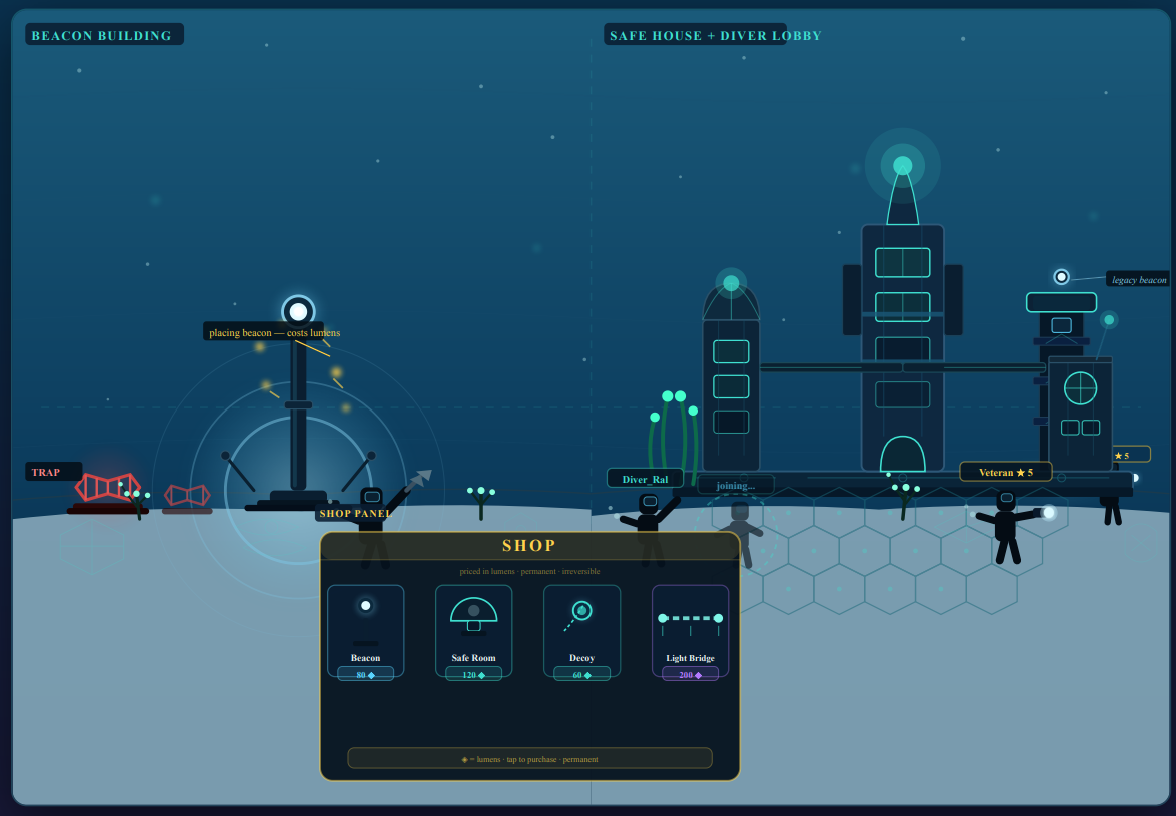
Persistent builds between dives: beacon, safe house palace, trap, decoy. Shop priced in lumens. Hex-patterned ground, divers arriving.
Inspiration
Most survival games give you multiple meters to manage. We kept asking: what if everything routed through one? Light in the deep ocean does three things simultaneously — it reveals what's around you, it sustains you, and it tells predators exactly where you are. That triple role became the entire design. The anglerfish's lure was the other spark: a creature that weaponizes the thing its prey needs most. Fathom is built around that idea.
What it does
Fathom is a deep-sea survival game for Meta Horizon Worlds mobile. Players dive into a lightless trench with a single resource — lumens — that drains while your beam is on. Bioluminescent sources replenish it, but apex predators mimic that same glow. The core skill is reading the tell: a wrong shade, an off-beat pulse, a silhouette proportion that doesn't sit right. Miss it and a violet shockwave cascade draws more hunters in. Builds like beacons, safe rooms, and light-bridges persist across sessions, reshaping the trench over time. In asymmetric co-op, one player pilots the sub while others dive — the rescue beam decision is the social heartbeat of the game.
How we built it
The design started with the single-resource constraint and worked outward. Every system — the three-tier visibility model, the deception tells, the shockwave cascade, the strategic base split — was stress-tested against one question: does this deepen the light mechanic or just widen it? Anything that widened got cut. The visual language was designed the same way: teal-cyan does the work of marking every glow source and every hunter lure simultaneously, so colour is the ruleset, not decoration. Violet is reserved exclusively for the cascade — it appears nowhere else in the trench palette, so when it fires the eye goes to it immediately. The 2.5D side-on camera keeps creature silhouettes readable in profile, which is the entire deception system's foundation.
Challenges we ran into
The hardest design problem was fairness. A deception mechanic only works if the player feels the outcome was their read, not random luck. Every hunter tell had to be always perceivable given enough light and attention — spotted by a skilled player, missed by a rushed one — with no randomness involved. Getting the three tell tiers (wrong colour, wrong frequency, wrong shape) to escalate in difficulty without ever feeling unfair took significant iteration. The second challenge was the social layer: making the sub pilot role feel active rather than passive, and ensuring the rescue beam decision had genuine consequence for both players rather than being an obvious choice.
Accomplishments that we're proud of
Collapsing an entire survival game's resource economy into a single meter without losing strategic depth. The moment where a player realizes the harvesting gesture and the death gesture are identical — that the only variable is whether they read the tell — is the design insight we're most proud of. The violet shockwave cascade that follows a wrong read is also a designed moment rather than a punishment: survivable once, potentially catastrophic if it summons more hunters into a bad position. The asymmetric co-op architecture — one pilot with macro vision, multiple divers living the deception up close — came together as a genuinely distinct social experience rather than just "same game with more players."
What we learned
Constraints are generative. Starting with "one resource" and refusing to add a second forced every system to earn its place through the light mechanic rather than alongside it. We also learned that the visual language has to carry mechanical meaning — colour as ruleset, not atmosphere — or the deception system doesn't land. And platform research matters early: understanding Horizon's 20 dynamic light limit shaped the entire rendering approach (bioluminescence as emissive materials, the player beam as the single dynamic spotlight) before a line of scripting was written.
What's next for Fathom
The solo loop comes first — validate that reading light is a skill worth practicing before layering anything on top. From there: the submarine and asymmetric co-op pilot role, second and third hunter tell tiers for deeper ravine zones, light-bridge unlocks, and eventually procedural glow placement once hand-placed sources have proven the first-session design. The deeper the trench goes, the better the lies get.
Built With
- blender
- claude-code
- figma
- meta-horizon-worlds


Log in or sign up for Devpost to join the conversation.