Short description
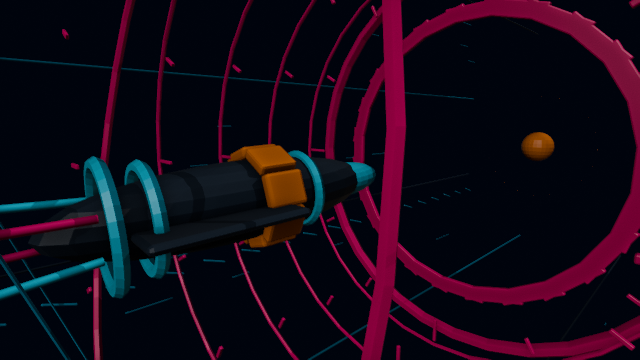
FASTER THAN NOW is a nine-second procedural Blender animation about a photon courier racing through a tunnel made from collapsing clock rings. The courier breaks through a red deadline barrier and releases its payload as a kinetic sun. The film interprets speed not only as velocity, but as the power to escape a closing moment and create the next one.
Inspiration
Most speed animations focus on vehicles, motion blur, or a stopwatch. I wanted time itself to become the obstacle. Each clock ring represents a disappearing second, so the environment reacts to the courier rather than merely passing by. The final transformation from a mechanical chase into a warm sunrise gives the sequence a narrative payoff: all that speed was carrying something meaningful.
What it does
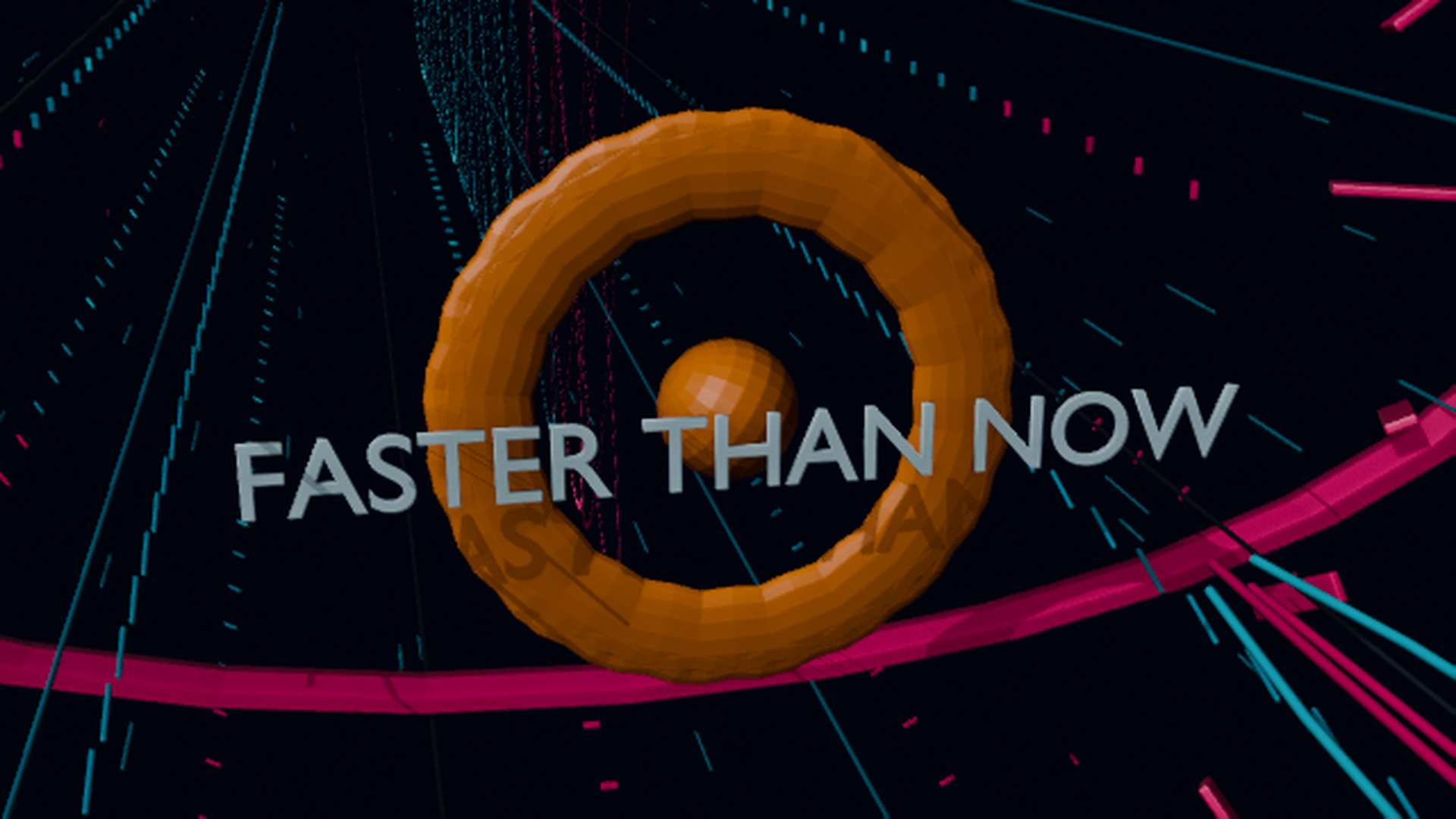
The film opens on a mechanical photon courier preparing to launch. It accelerates through a cyan clock tunnel while completed seconds collapse and scatter behind it. The palette changes to warning magenta as the courier approaches a deadline membrane. It breaks through the barrier and releases a procedural golden bloom, ending on the title FASTER THAN NOW.
How we built it
The complete scene was constructed procedurally with Blender Python (bpy). A
deterministic generator creates the courier, 30 clock rings, 360 clock marks,
guide rails, speed-particle field, energy trails, deadline fragments, kinetic
bloom, materials, lighting, compositor, and four-camera edit.
The animation system links the collapse of every clock ring to the courier's progress through the tunnel. Clock marks burst outward after the courier passes, the deadline fragments respond at the climax, and the final bloom unfolds in a timed radial pattern. A separate procedural audio generator creates the turbine rise, air rush, impacts, and harmonic finale without stock samples.
Challenges we ran into
The main challenge was communicating speed without relying only on motion blur. The solution was to make time physically react: rings compress, clock marks scatter, particles create parallax, the color language changes, and camera cuts become progressively more aggressive.
Another challenge was designing a scene that remained renderable on modest hardware. Repeated elements use low-complexity geometry, deterministic placement, and Eevee-compatible materials while still producing a dense cinematic tunnel.
Accomplishments that we're proud of
- A complete original nine-second story with a clear beginning, escalation, climax, and visual payoff.
- 748 scene objects generated and animated from one reproducible Blender script.
- A collapse system in which each ring responds to the courier's timing.
- Four distinct camera compositions and a cyan-to-magenta-to-gold color arc.
- Original synchronized stereo sound created without third-party samples.
- A self-contained
.blendmaster with no external visual dependencies.
What we learned
Speed reads most clearly when several visual cues agree: parallax, shrinking distance, environmental reaction, changing shot scale, rhythm, and sound. We also learned that procedural construction is most useful when it controls storytelling and timing, rather than simply generating more geometry.
What's next
The next iteration would add higher-sample cloud rendering, more refined material surfaces, and a subtle volumetric wake around the courier while preserving the same procedural timing system.

Log in or sign up for Devpost to join the conversation.