-
-
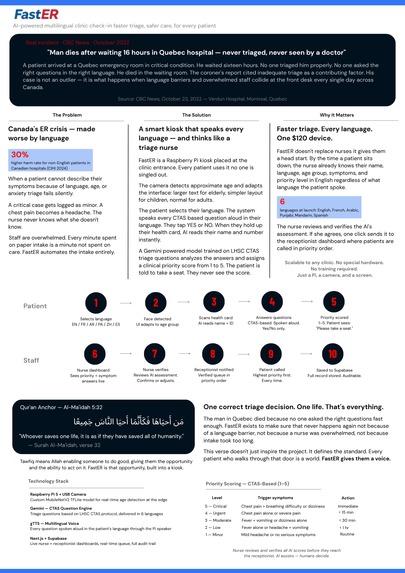
One Pager - FastER
Inspiration
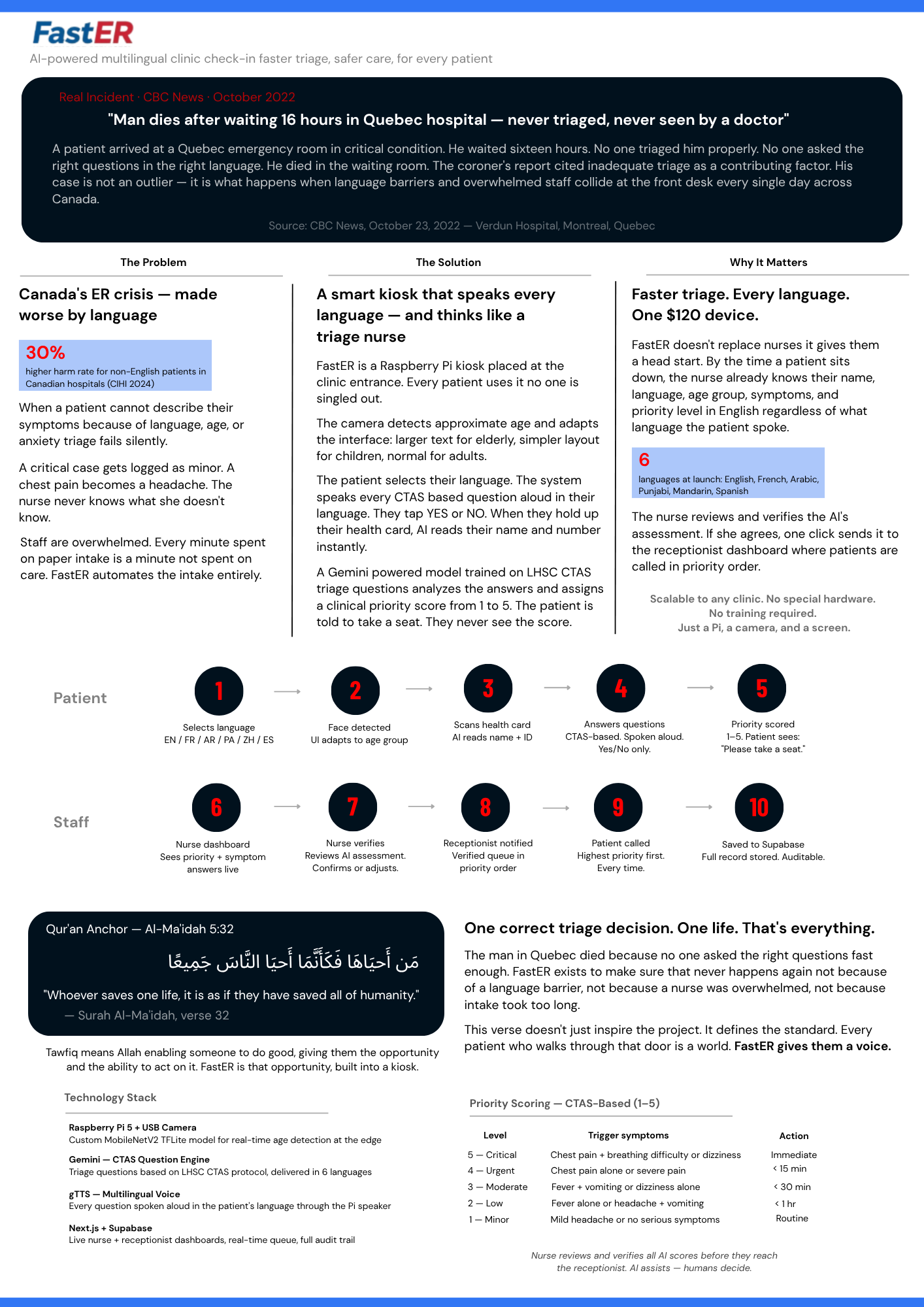
In October 2022, a man walked into a Quebec hospital in critical condition. He waited sixteen hours. No one triaged him properly. No one asked the right questions in the right language. He died in the waiting room. His story is not an exception it is the system. The Canadian Institute for Health Information found that patients who speak neither English nor French face a 30% higher rate of harmful events in Canadian hospitals. Not because the care isn't there. Because the intake isn't. The moment a patient walks through the door and can't communicate their symptoms, the clock starts ticking and the system has already failed them.
We built FastER because of a verse that stopped us in our tracks: مَن أَحيَاهَا فَكَأَنَّمَا أَحيَا النَّاسَ جَمِيعًا "Whoever saves one life, it is as if they have saved all of humanity." — Al-Ma'idah 5:32
What it does
FastER is an AI-powered patient check-in kiosk that sits at the entrance of any walk-in clinic or emergency department. Every patient uses it/
Here is the full patient journey:
Language selection: the patient taps their language from 6 options: English, French, Arabic, Punjabi, Mandarin, or Spanish.
Age detection: the Raspberry Pi camera captures their face. A custom MobileNetV2 TFLite model estimates whether they are a child, adult, or elderly patient. The UI adapts automatically — larger text and higher contrast for elderly patients, a simplified layout for children.
Health card scan: the patient holds up their health card. Google Gemini Vision reads the card and extracts their name and health number in under 2 seconds.
Symptom questions: FastER asks CTAS-based triage questions one at a time. Each question is displayed on screen AND spoken aloud in the patient's language using Google Text-to-Speech. The patient taps YES or NO nothing else required.
Priority scoring: the system analyzes the answers and assigns a clinical priority score from one (minor) to five (critical) based on LHSC CTAS triage protocol. The patient sees: "Thank you. Please take a seat you will be called shortly." They never see their score.
Nurse dashboard : the nurse sees a live queue with every patient's name, language, age group, symptoms, and AI-assigned priority. She reviews the AI's assessment and verifies it or adjusts it based on her clinical judgment.
Receptionist dashboard : once the nurse verifies, the patient appears on the receptionist's screen in priority order. The receptionist calls patients accordingly.
Hardware Layer : Raspberry Pi 5
AI Layer : Google Gemini + gTTS
Frontend + Backend Layer
Next.js kiosk interface : fullscreen, touch-friendly, adapts to age group via CSS class switching Next.js nurse dashboard : live queue, symptom tags, verify button, auto-refreshes every 4 seconds Next.js receptionist dashboard : shows verified patients in priority order Flask server : on the Pi handles all routes: age detection, health card scan, check-in, queue, and verify
Challenges we ran into
Working across different locations. We were not all in the same room. Coordinating three separate codebases Pi hardware, AI server, and frontend without being able to physically test together required extremely clear API contracts agreed on before anyone wrote a line of code.
Accomplishments that we're proud of
- Built by a team of 3 in 24 hours, working remotely, across a full hardware + AI + frontend stack
- A patient can walk up speaking zero English, have their health card, answer questions by tapping YES or NO, and be correctly triaged all in matter of minutes
What we learned
Integration is everything. You can have three perfectly working pieces the Pi, the AI server, the frontend and when you try to connect them, nothing works the way you expected. We learned that the hard way.
What's next for FastER:
- using scanning for different documents like health card, driving liscence and do image to text with documents
- Expand to more languages
Built With
- database
- flask
- gemini
- gtts
- next.js
- python
- typescript

Log in or sign up for Devpost to join the conversation.