-
-
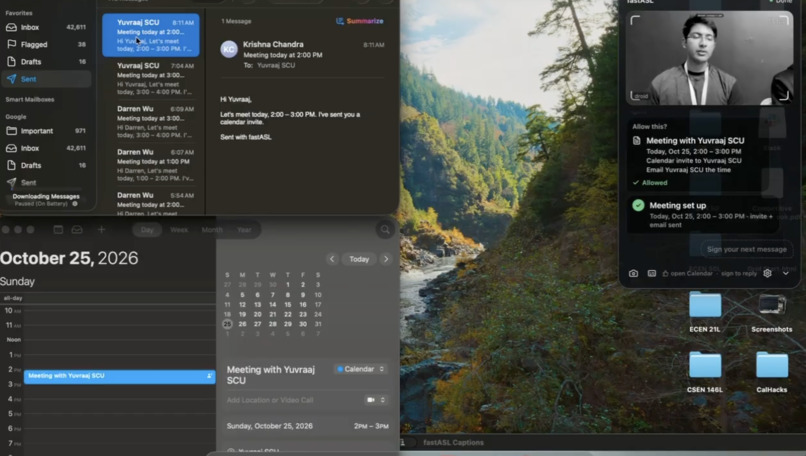
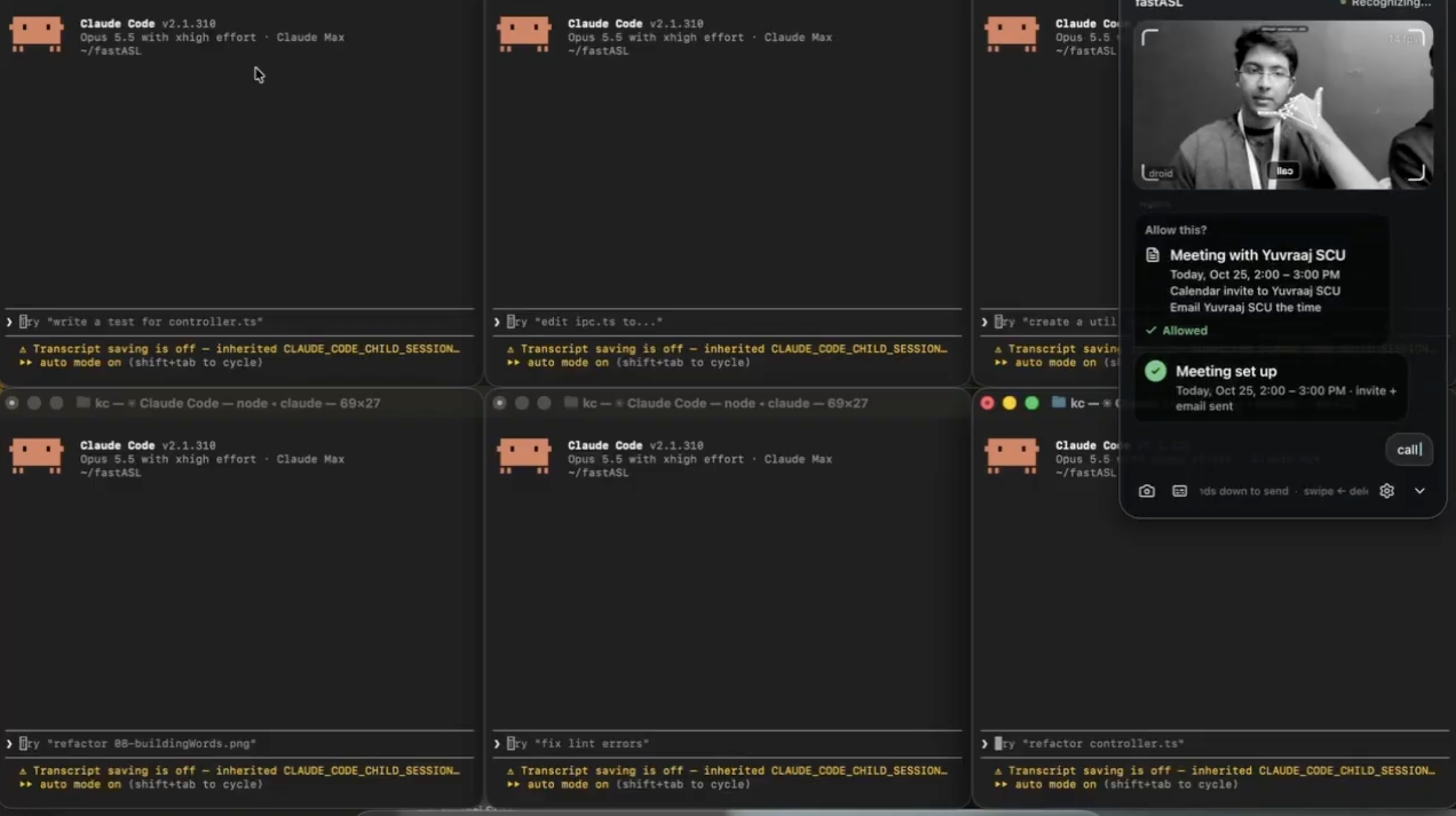
One sign sets up the meeting: invite, email, time, done.
-
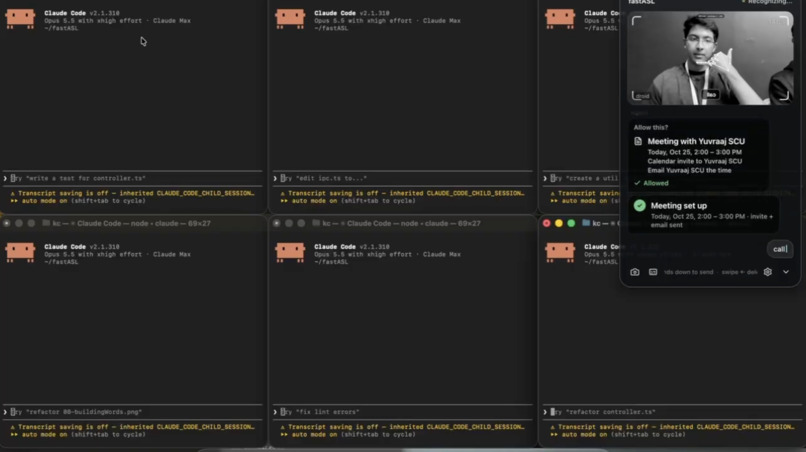
Custom gestures so you can work "fast as hell"
-
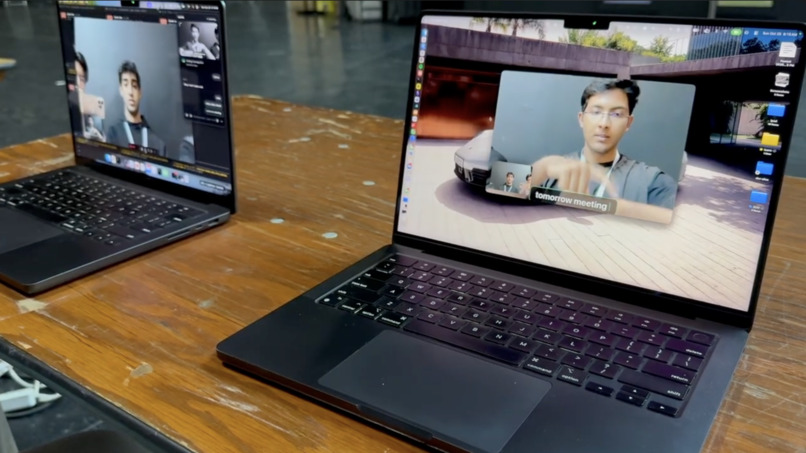
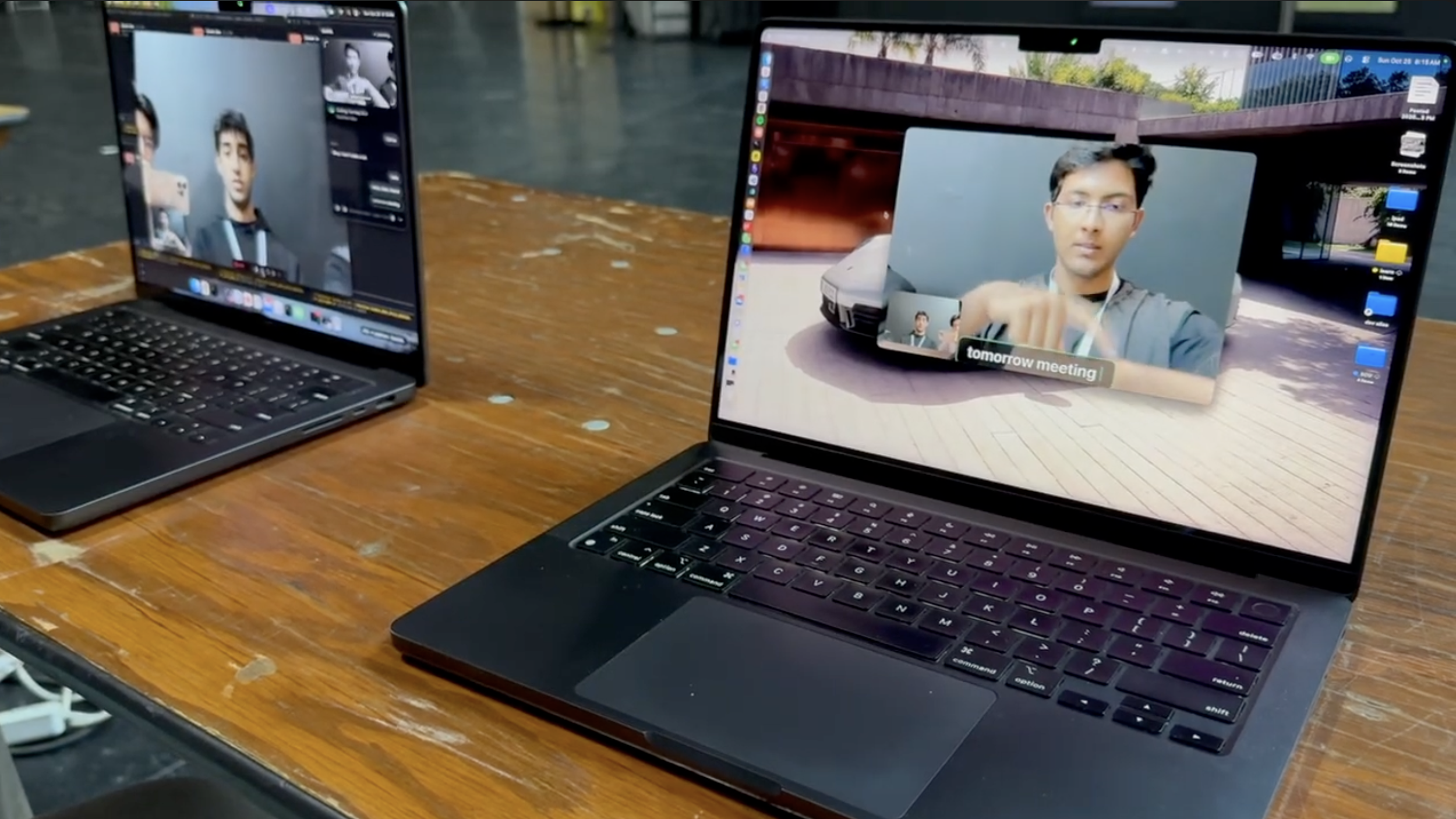
Real time captions
FastASL
Run your Mac in American Sign Language.
FastASL is an always-on overlay that reads signs from your webcam, turns them into real actions (email, calendar, FaceTime, apps), and burns live English captions into your FaceTime video — so a Deaf user can drive their Mac entirely in ASL.
Built for Cal Hacks 13.0 · Electron + MediaPipe + Factory Droid + Ollama
Inspiration
A Deaf user shouldn't need a keyboard, a voice, or a hearing intermediary to run their own computer. FastASL started from a simple question: what if signing to your Mac just... worked? — always available, on top of everything, reading ASL and acting on it directly.
We also wanted captions that travel with the person, not just on their own screen: what you sign should show up as English inside the FaceTime video your caller receives.
What it does
- Always-on overlay. A small card floats over every app with a live camera view and a chat. One click hides it; an open palm held up brings it back.
- Signs stream into sentences. Words appear the moment each sign lands (
TOMORROW,MEETING,WHAT,TIME...), building a sentence you send by lowering your hands. - Signs become actions. An agent (Factory Droid) reads the signed sentence and uses real Mac tools: Calendar, Mail, Messages, Contacts, Notes, Spotify, FaceTime, apps, web search, screenshots.
- Safe by default. Anything that sends, creates or calls shows a Confirm card first — a thumbs up runs it, a fist cancels.
- MEETING FRIEND. Two signs, then hold up 1–4 fingers for a time: Mail and Calendar open side by side, the invite and the email go out, and both apps show what was sent.
- CALL FRIEND. One confirmation and FaceTime calls the contact, pressing Call by itself.
- Live captions on FaceTime. What you sign is captioned into the video your caller receives, rewritten from ASL word order into English (
TOMORROW MEETING WHAT TIME→ "What time is the meeting tomorrow?"). - Custom gestures. Record any hand shape and bind it to a task — e.g. one gesture opens six Claude Code terminals tiled across the screen.
- Contact nicknames by sign or initials.
FRIEND, or fingerspelled initials likeD W, stand for a saved contact. - Gesture controls. Thumbs up for a quick menu, swipes to switch modes, finger counts to pick options, swipe up for Settings.
How we built it
Signs are read on the Mac; only the agent's task goes to the cloud.
| Layer | What we used |
|---|---|
| App shell | Electron 39, electron-vite, React 19, TypeScript; transparent always-on-top overlay window |
| Hand, face & body tracking | Google MediaPipe Tasks Vision (Hand, Face, Pose Landmarkers), GPU, alternating frames to hold ~30 fps |
| Streaming sign recognition | Our own rules over the landmarks (handshape, location relative to the face, movement): a dictionary of signs plus per-word rules, firing mid-movement so words stream in |
| Pretrained sign models | 1st-place model from Google's Kaggle Isolated Sign Language Recognition competition, ported to ONNX (11 MB, fp16), run with onnxruntime-web in a worker; Microsoft's ASL Citizen pose model (ST-GCN) for a larger vocabulary |
| Control gestures | Our gesture engine: open palm, fist, thumbs up, swipes, finger counts, plus custom hand shapes |
| Agent | Factory Droid SDK (@factory/droid-sdk, the droid CLI), one persistent session; Droid's own tools disabled, ours exposed via an MCP server |
| Mac actions | 19 tools in AppleScript / JXA: Calendar, Contacts, Mail, Messages, Notes, Spotify, media keys, FaceTime, open app, web search, type text, screenshot, Claude Code terminals, meeting invite |
| Fast paths | CALL / MEETING + nickname and custom gestures run fixed tool calls with no model — about a second |
| Live captions | 1280×720 caption window (camera + captions) → OBS Window Capture → OBS Virtual Camera → FaceTime |
| ASL → English | Local Ollama llama3.2 (3B) rewrites signs into one sentence in 0.2–0.9 s; used only if every signed word survives |
We built it in phases, each tested before the next — and rebuilt recognition twice when live signing showed where it broke:
- Overlay and controls — floating card, MediaPipe pipeline, gesture engine, Settings, and a test suite that grew past 1,300 tests.
- First recognition: teach your own signs — users recorded each sign; an LLM turned words into intent. Live, teaching was slow and unreliable.
- Pretrained sign models — switched to models trained on thousands of signers (Kaggle ISLR winner ported to ONNX, Microsoft ASL Citizen), so no teaching is needed.
- Real actions — Factory Droid SDK with our own Mac tools, a conversational chat, and Confirm cards for anything that sends.
- Streaming recognition — rules that recognize demo words mid-movement and build the sentence live, checked against ASL Citizen clips.
- Live captions for FaceTime — caption camera window routed through OBS virtual camera, plus a local model that fixes ASL word order.
- Fast paths for the demo — CALL FRIEND / MEETING FRIEND skip the model; initials name a contact; a custom gesture opens six Claude Code terminals.
Challenges
Most of our time went into making recognition hold up on a real person in a busy hackathon hall.
| Problem | What we did |
|---|---|
| Teaching signs per user was slow and unreliable | Moved to pretrained models (Kaggle ISLR, ASL Citizen) plus hand-written streaming rules |
| The body tracker locked onto people behind the signer; face and pose dropped out between frames | Track several people, keep the closest; hold the last face and pose across gaps |
| Recognition waited for a whole movement | Streaming rules fire mid-sign, so the sentence builds as you sign |
| FRIEND's two hooks also read as TIME ("time friend time friend") | A FRIEND right after a TIME replaces it; a TIME right after FRIEND is dropped; fingerspelled initials as fallback |
| A resting fist hid the card and stopped recognition (and the captions) | The fist no longer hides the card while signing words; the card has a button instead |
| "Listening" flickered off and on between tries | It stays up 2.5 s for the next try |
| Loosening MEETING's handshape check fires on WHAT and EMAIL | Measured both on recorded clips; kept the stricter check |
| Gemini's quota ran out mid-hackathon, then its model was withdrawn | Factory Droid reads the signs itself; English captions run on a local model |
| Droid wouldn't call our tools | It calls MCP tools through its Script tool, so our permission check now reads the calls inside a script |
| FaceTime stops at "Click to call" | After the user confirms, fastASL presses Call through macOS accessibility |
| FaceTime has no caption API | Captions drawn into a window that OBS publishes as a virtual camera |
| Once OBS's virtual camera existed, fastASL picked it as its own camera and filmed itself (a black loop) | Default to the built-in camera, never a virtual one |
| A hidden second copy of the overlay in the caption window declined every Confirm | The caption window loads only its own code |
| At 3% battery macOS throttled the GPU; tracking fell to 3–9 fps | Plug in for demos; it recovered to ~30 fps |
| A small model guessed (YES became "I'm okay") | An English caption is used only if every signed word is in it |
Accomplishments
Everything below was measured — on recorded ASL clips, or live on our laptop.
| Measure | Result |
|---|---|
| FRIEND recognized, ASL Citizen signers (videos run through our tracker) | 25 of 29, ~0.6 s after the hands appear |
| FRIEND firing on other signs | 1 of 895 clips |
| TIME firing on FRIEND clips (before → after fix) | 8 of 58 → 2 of 58 |
| MEETING recognized on recorded clips | 9 of 12 and 26 of 29 (two clip sets) |
| MEETING firing on other signs | 0.2% and 1.4% |
| ASL → English captions on 16 demo phrases | 15 correct, 0.2–0.9 s each; the 16th fell back to the signs |
| Hand tracking on an M-series MacBook | ~6 ms/frame at ~30 fps |
| CALL FRIEND / MEETING FRIEND before the Confirm card | ~1 s, no model involved |
| Automated tests | 1,325 passing |
What we learned
- Recorded datasets flatter a recognizer. A live signer in a busy room, a hand resting in a fist, a dying battery — that's what breaks it. We tested every fix on the real laptop.
- ASL is not English in signs. Word order differs and one handshape starts many signs, so sequence rules (FRIEND over TIME) mattered as much as per-sign rules.
- For a Deaf user, speed and trust beat cleverness. Fixed fast paths for common commands, and one clear Confirm before anything reaches another person.
What's next
- More streaming signs, trained on more signers, and the full fingerspelling alphabet without teaching.
- Captions in Zoom, Meet and Teams the same way, plus a voice-to-text return channel for the hearing caller.
- A signed app instead of a dev build, and a native camera extension instead of OBS.
Built With
- accessibility
- applescript
- asl
- electron
- factory-droid
- factory-droid-sdk
- jxa
- kaggle
- macos
- mcp
- mediapipe
- mediapipe-tasks-vision
- node.js
- onnx-runtime
- react
- slack-api
- typescript
- vite
- vitest
- zod
- zustand


Log in or sign up for Devpost to join the conversation.