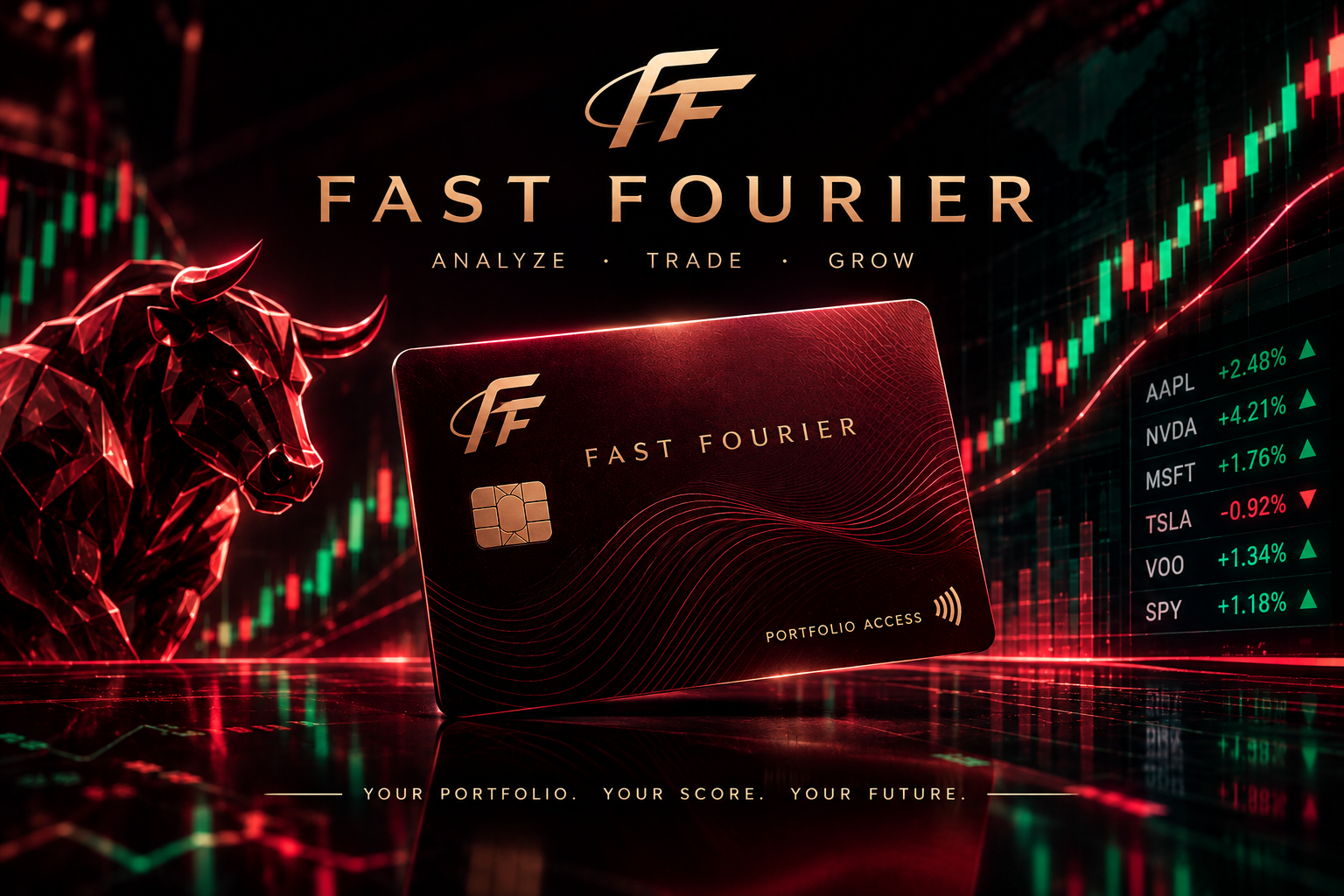
Inspiration
Traditional personal finance relies heavily on credit scores, which primarily measure a person's borrowing and repayment history rather than their overall financial health or investment performance. We wanted to explore a modern alternative: a Stock Portfolio Score that evaluates financial health through portfolio diversification, risk adjusted performance, drawdown resilience, liquidity, and real time market data. Our vision with Fast Fourier is to create a financial identity that connects a persons investment portfolio, financial performance, and digital identity into one dynamic score.
What it does
Fast Fourier combines AI-powered market analysis, algorithmic trading, and physical RFID authentication into a unified investment platform. The system analyzes market trends to generate targeted stock recommendations and identify potential buy/sell opportunities. It connects Trading API for paper trading and market data. Our key feature is the Stock Portfolio Score, a dynamic 300-850 score inspired by traditional credit scores. Instead of focusing on debt history, the score evaluates factors such as:
- Portfolio diversification
- Risk-adjusted returns
- Drawdown resilience
- Liquidity
- Overall portfolio performance
Fast Fourier also has Autopilot built in, an AI that suggests which stocks to buy and sell. Every few minutes it analyzes a 15-stock watchlist and explains each suggestion in plain English, for example: "57% chance of rising over 5 days; 21-day cycle near its low; sized for 23% volatility." In Dry Run mode it only shows suggestions; in Live mode it places the paper trades itself, within safety limits such as a 5% stop-loss, a 10% cap per stock and a 10% cash buffer.
Users can authenticate their investment identity simply by tapping an RFID card connecting their physical card to their digital portfolio.
How we built it
- Alpaca Trading API: Used for paper trading, market data, and trade execution signaling.
- Arduino & RFID Hardware: Integrated an Arduino board with an RC522 RFID reader to connect physical RFID cards to digital investment accounts.
- Arduino IDE: Programmed the microcontroller to read RFID card serial numbers and transmit them to our application.
- Python: Built the portfolio scoring engine, market-data analysis, NFC communication bridge, and dashboard.
- PySide6: Used to build the interactive desktop dashboard displaying the user's portfolio, score, holdings, and market metrics.
- API Integration: Connected the investment dashboard to our trading platform so portfolio and market information can be synchronized dynamically.
- Autopilot (NumPy): A Fast Fourier Transform finds each stock's price cycle and filters out noise, a logistic regression model trained on about 2 years of price history estimates the chance each stock rises, and a GARCH volatility model decides how many shares to suggest.
Challenges we ran into
One of our biggest hardware challenges was getting the Arduino UNO Q to connect reliably to our university Wi-Fi network. We also encountered issues with the RFID reader's positioning. The RC522 required precise alignment and positioning with the RFID card for consistent reads. We ultimately worked through these hardware limitations and successfully established communication between the RFID reader, Arduino, and our software.
Accomplishments that we're proud of
We successfully got the RFID system working and were able to read and capture the unique serial number of an RFID card. We then connected that physical card authentication to our Fast Fourier software, allowing a card tap to identify and load a digital investment portfolio. We are especially proud of turning what started as an idea for a financial scoring system into a working physical + software prototype.
What we learned
We learned how to:
- Integrate and program RFID hardware
- Communicate between Arduino and Python
- Build an API-connected financial application
- Work with real-time market data
- Develop portfolio scoring algorithms
- Integrate physical authentication with a digital financial platform
- Build an interactive financial dashboard Most importantly, we learned how to combine hardware, software, APIs, and financial data into one working system.
What's next for Fast Fourier
Our next step is to improve the accuracy of Autopilot's recommendations by adding more time-series and signal-processing features beyond our current Fourier analysis, and by testing stronger machine-learning models against the one we have today. We also want to expand the Stock Portfolio Score into a more comprehensive financial identity that can continuously adapt to a user's portfolio and financial behavior. Our long-term vision is to make Fast Fourier a new layer of financial identity—where your portfolio isn't just something you own, but something that dynamically represents your financial health.
Built With
- alpaca
- api
- arduino
- nfc
- pyside
- python
- rc522
- rfid
- sdk
- stock-market-data

Log in or sign up for Devpost to join the conversation.