Inspiration
Deciding what to wear is a small decision we make every day, and it takes longer than it should. Before work, before a dinner, before a trip, the routine is the same: put something on, check the mirror, take it off, try the next thing, and end up with a pile of clothes on the bed. Sometimes imagining yourself in the clothes is just not enough.
I did a bit of research and found that retailer surveys put choosing an outfit at 12 to 17 minutes a morning, and that about a quarter of the clothes in UK wardrobes have not been worn for a year (WRAP, 2022). We spend time deciding, and we still forget what we own.
The mirror at home is where all of this happens, and it has done the same job for generations: it shows you, and nothing more. Smart mirrors have been tried, but they are dedicated hardware costing from over a thousand to tens of thousands of dollars, and most were discontinued or never left a few store pilots. Fashion Glass takes a different path: it turns the mirror you already own into a smart outfit planner, with the headset you already have.
How it works
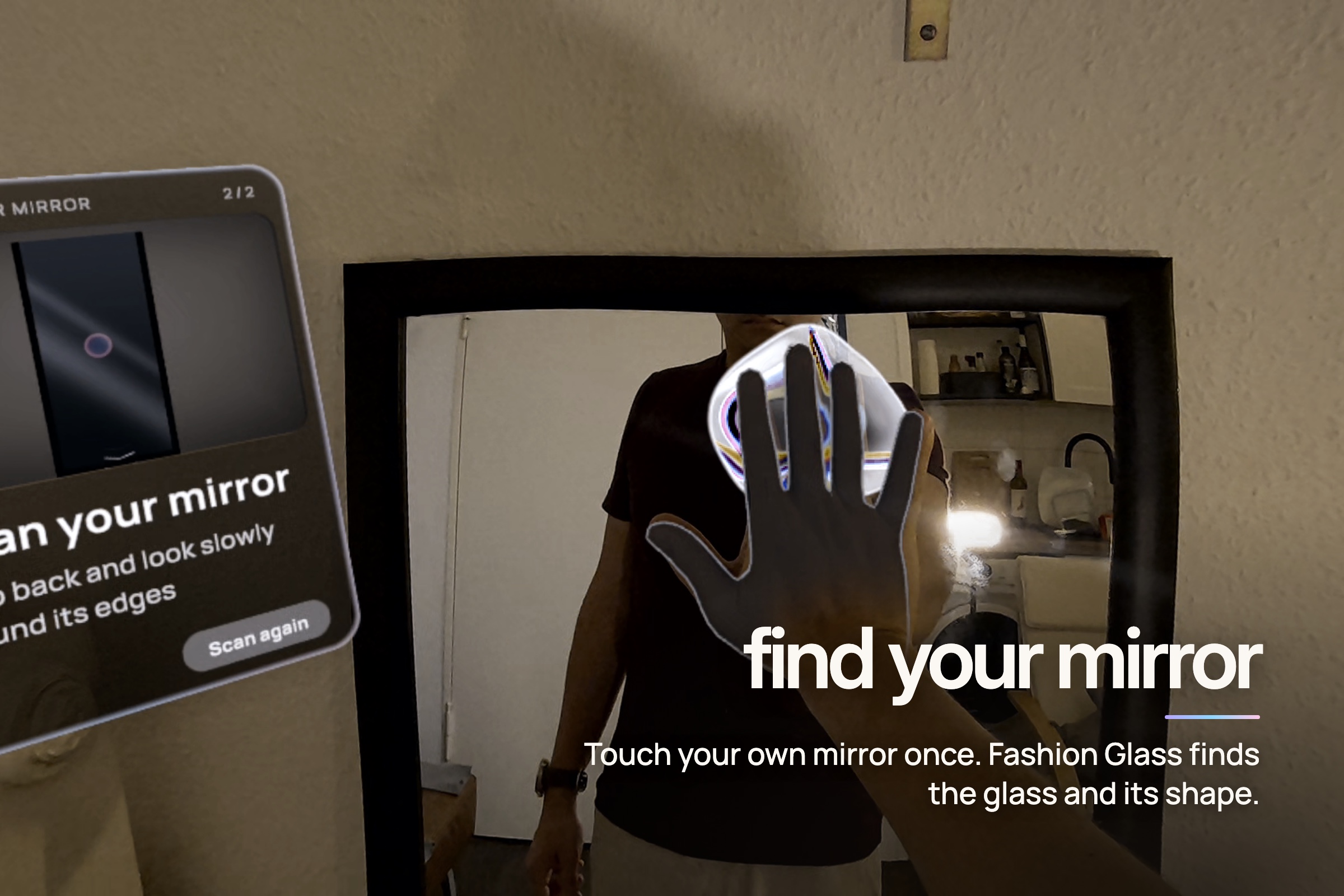
- Scan your mirror. Put your hand on the mirror once and the app starts scanning it: its position, its shape and its size. The mirror is stored, so you only do this once.
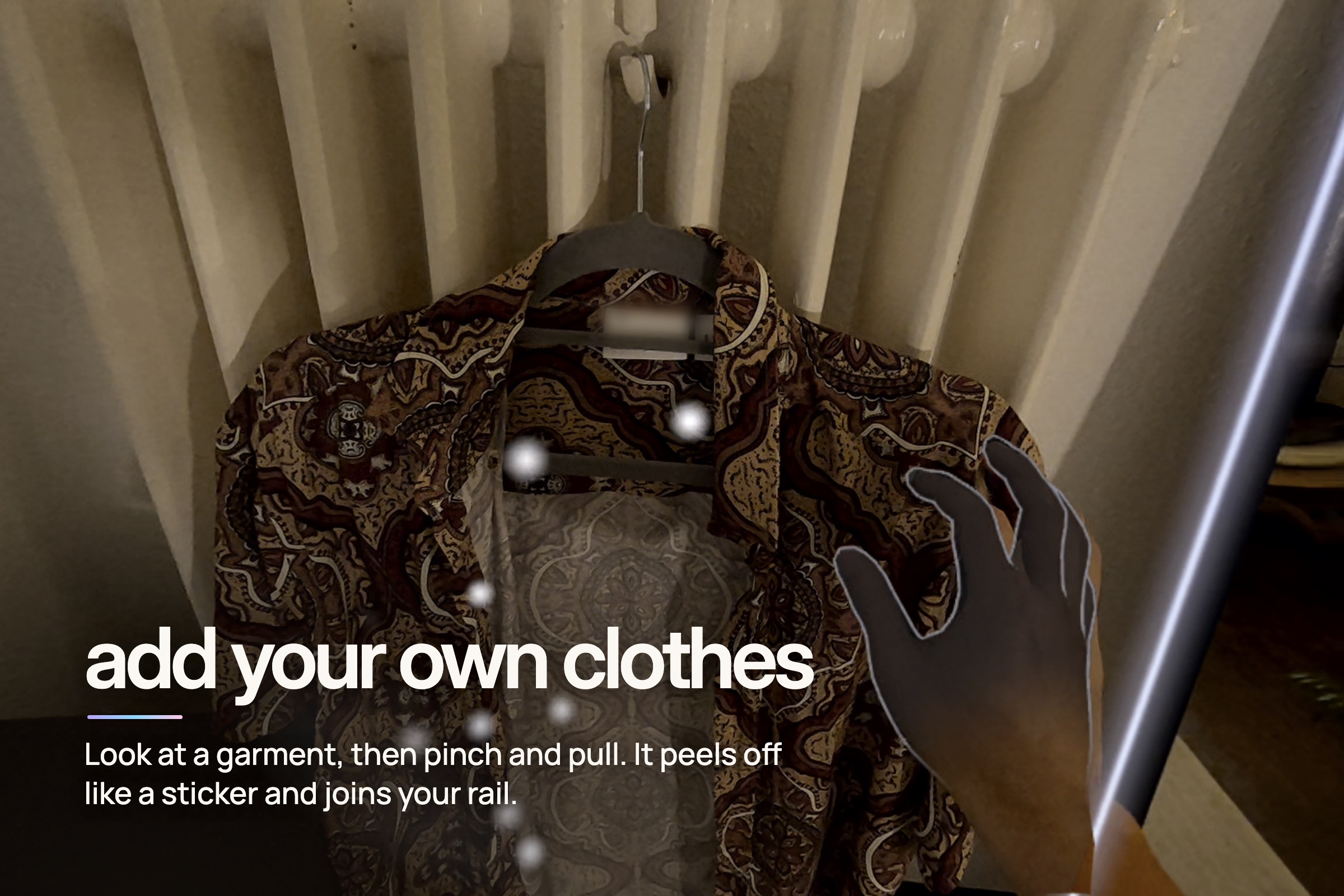
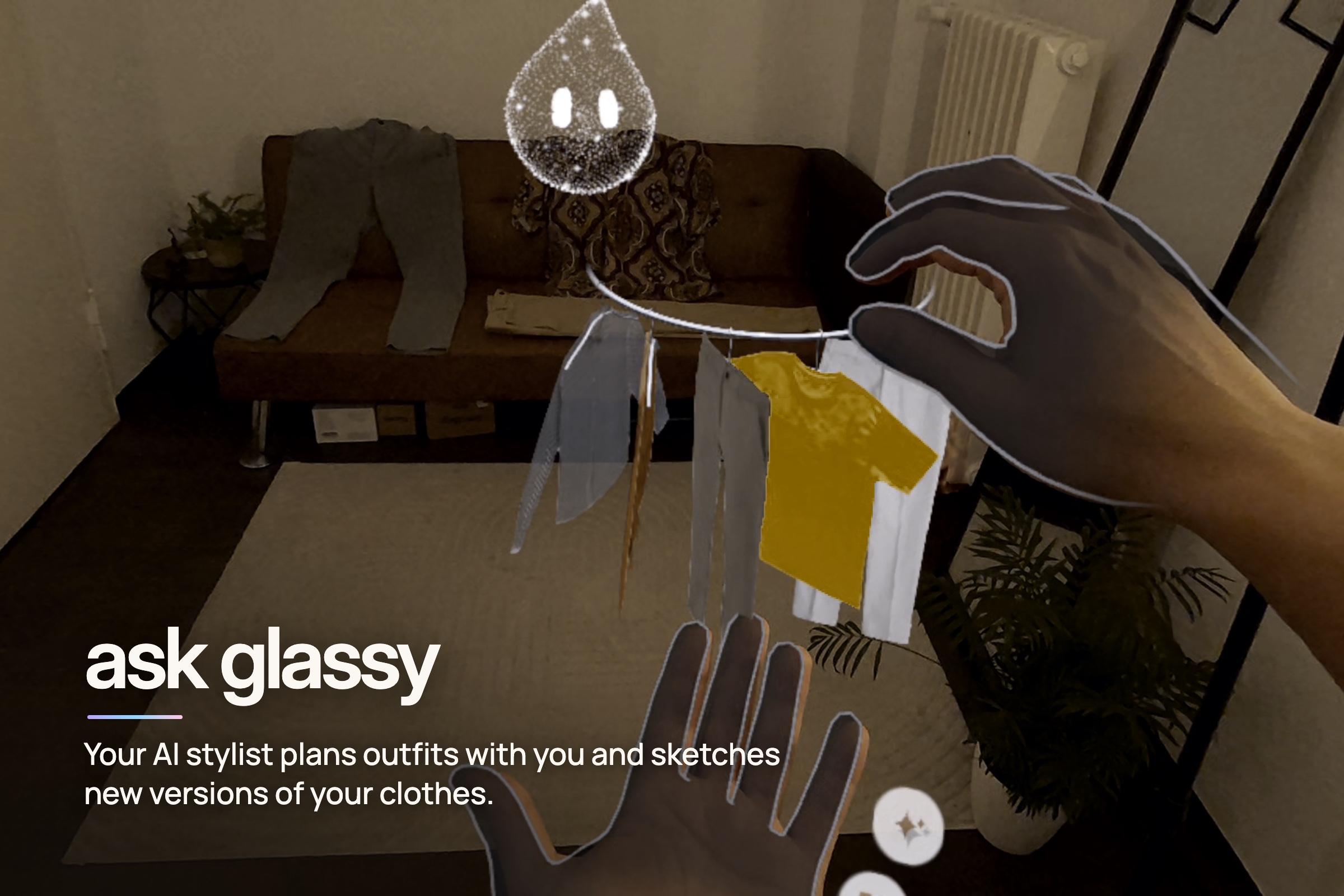
- Build your spatial wardrobe. Bring your garments from your real wardrobe into your spatial one. Look around and the app recognises the clothes on your bed, in your wardrobe or anywhere in your room, and they start to sparkle. Pinch one and pull: the real world stretches with your fingers until the garment detaches and becomes a digital copy in your hand, ready to hang in your spatial wardrobe.
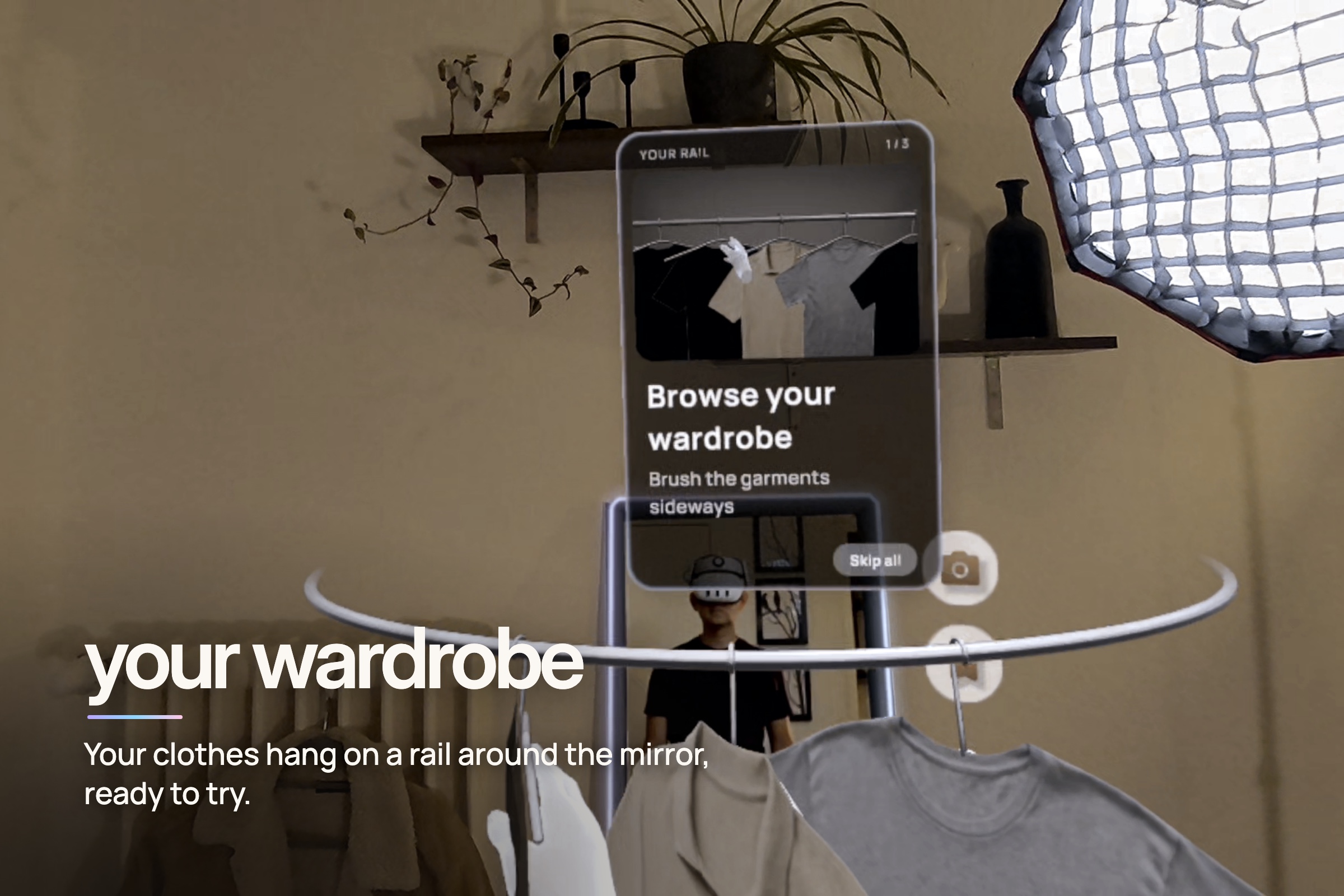
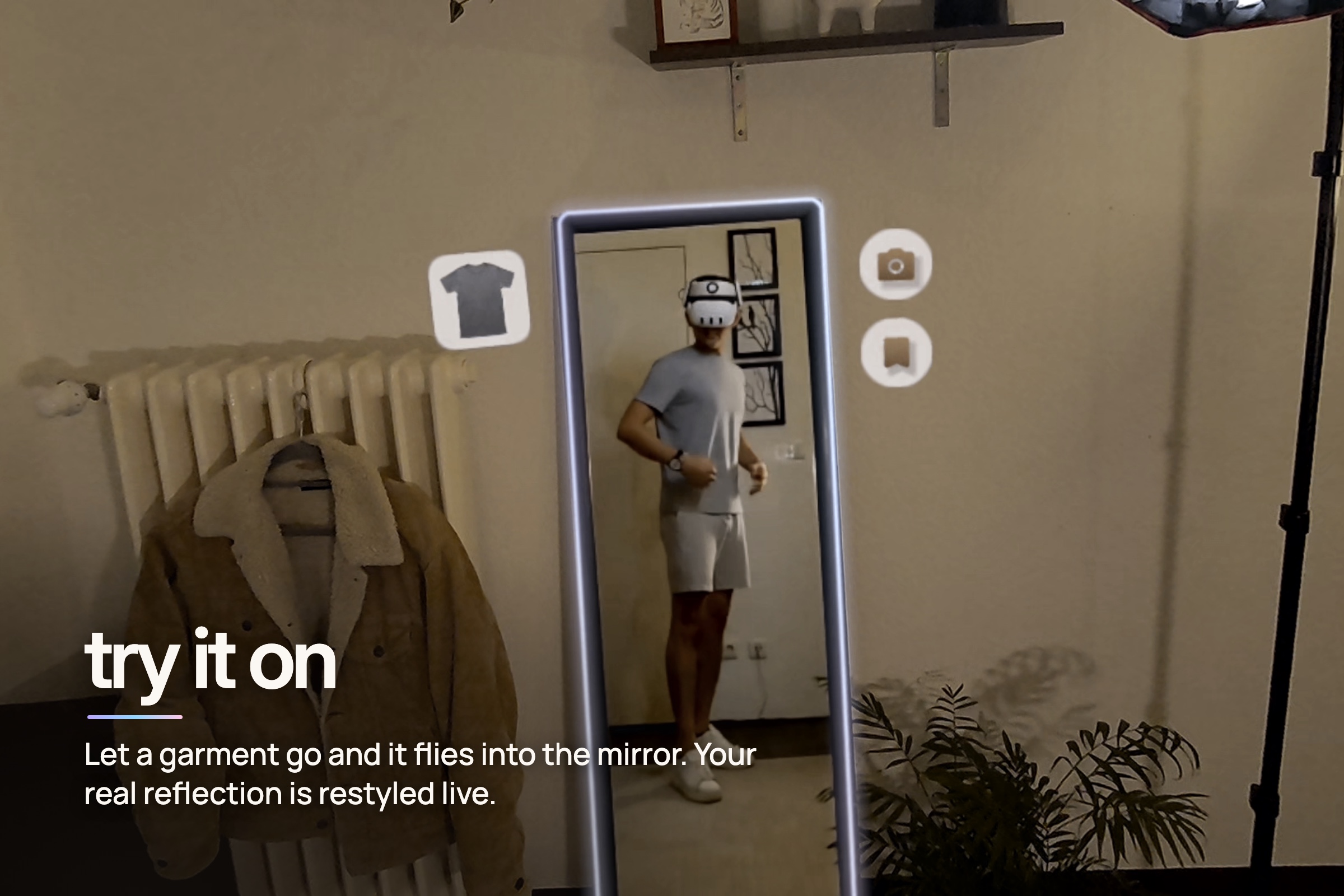
- Try them on. Step in front of the mirror and your spatial wardrobe shows up around it. Pick a garment, throw it into the mirror, and see yourself wearing it in real time. Keep browsing and adding pieces (new shirts, trousers, jackets) to explore different combinations. When you like an outfit, take a picture and it is saved with all its pieces, ready to wear again.
- Ask Glassy. Glassy is your fashion assistant. Say "Hey Glassy" and ask for a recommendation. Glassy asks about the occasion, then decides with you based on the time, the weather, the occasion and what you own. It knows your spatial context too: where your mirror is, what you are wearing right now, and how much of you the mirror can show. When you say yes, it dresses your reflection. If a piece is missing, Glassy can sketch one for you to try on: designs are digital only, a way to see an idea on yourself before you decide whether it is worth buying.
- Away from the mirror? Your wardrobe is right on your hand. Browse your garments, keep adding new ones from the room, or explore them with Glassy.
Why come back
Getting dressed happens every day, and every day the question is new: a different occasion, different weather, a different mood. Fashion Glass remembers everything between sessions: your mirror is ready the moment you put the headset on, your spatial wardrobe grows with every garment you add, your saved outfits are one pinch away, and Glassy remembers what you like and what you wore. The more you use it, the faster deciding becomes.
How I built it
Fashion Glass is built in Unity 6 with Meta's XR SDK v207 for Quest 3 and 3S, and it is hands-only: no controller is needed anywhere.
Finding the mirror. Depth sensors can't reliably detect a mirror's surface, because they read the reflected room behind it. So the app finds the mirror from your own reflection instead:
- When you touch the glass, hand tracking gives the first point that lies on the mirror.
- Passthrough Camera Access (PCA) gives the app the camera picture, and MediaPipe (Google's on-device pose and hand landmark models) finds your reflected head and hand joints in it.
- The headset already knows where your real head and hands are. A mirror maps every real point to its reflection, so the app solves for the one plane that maps the real points onto where their reflections are seen. It is a least-squares fit on the pixel error, held at the touched point.
- This gives the mirror's position and its inclination: a leaning mirror measured within about a degree of a spirit level placed on the glass.
- Mirrors come in every shape and size, so the outline comes from SAM 3.1, Meta's segmentation model, asked for "mirror". Each mask is projected onto the solved plane and voted on a 1 cm grid, so a hand or the reflected body in one picture is outvoted by the others. The result is a rectangle, or any free shape.
- The mirror is saved as a spatial anchor with its shape, so on the next launch it is found again without scanning, and it stays in place when the headset is taken off and put back on.
Your real reflection, not an avatar. Once the app knows where the mirror is, it uses the camera's position and lens from PCA to work out which part of the camera picture shows the reflection inside the glass. It reprojects that onto the mirror's plane (a homography) so it looks like a real mirror reflection. It also has to be corrected: the cameras sit 6.4 cm in front of and 3.2 cm beside your eyes, and the reflection doubles that offset, so without correction the picture would be off by about a hand's width. Where the camera can't see part of the glass, the picture fades into the real reflection in passthrough.
Capturing clothes. I didn't want this to be "take a picture and recognise the garments". Inspired by Inkphony, one of the 2025 winners, I built a garment capture that blends with the world:
- SAM 3.1 finds the garments in the camera picture, and depth raycasts place each one in the room.
- When you pinch one, its picture is lifted off the real garment onto a mesh that stretches toward your fingers like rubber, while its base stays where it was. The mesh moves on damped springs: stiff near your fingers, softer far away.
- Pull past a point and it snaps back onto the real garment as a cut-out sticker pops into your hand. You choose exactly the garments you want, and the real one stays where it is.
- Finally, Meta's Muse image model makes a polished version: the complete garment laid flat, respecting its design and colours.
The spatial wardrobe. I wanted garments to feel like real clothes while you hold them, not only when you wear them. Each garment is a cloth simulation (position-based dynamics) on background threads:
- It is a grid of particles every 2 cm, cut to the garment's shape and pinned along the hanger's shoulders.
- Stretch, shear and bend constraints keep it from stretching, and it collides with your hands, the bar and its neighbours.
- It hangs at its real length: a coat is longer than a t-shirt.
So garments swing as you turn the wardrobe, fall into folds, and move out of the way when your hand brushes them.
Realtime try-on. The mirror's area (not the whole room) is streamed to Decart's real-time virtual try-on model together with the garment's picture. The restyled video comes back at up to 1080p and is blended onto the glass, with your real reflection at its edges. The stream only runs while you are trying something on and stops when you take it off. Because this is live video of real people, Decart checks the stream with its own content moderation and ends a session that breaks its rules: we saw it do this in our own tests.
Glassy, built agent-first. Glassy is not a chatbot added on top: the app was built so an AI can use it.
- Everything the app can do is a tool with a clear description: wear an outfit, take a piece off, show a garment, open the wardrobe, scan the room, take a picture, save or wear an outfit, design a piece, remember a preference. Your hands and Glassy call exactly the same actions.
- With every request, Glassy receives the spatial context: your wardrobe with descriptions, the weather where you are, whether you are at the mirror, whether the wardrobe is hiding your reflection, whether a try-on is live, how much of your body the mirror can show from where you stand, your saved outfits, and what it remembers about you across sessions.
- It can look at your restyled reflection to give an honest opinion, and it never dresses you without a yes.
- Your voice goes straight to Meta's Ember model, with no separate transcription step. Its answer is spoken with Fish Audio's streaming voice, which carries emotion tags for more natural expression.
ML on the device. Some of the work has to run on the headset itself, for speed and privacy:
- "Hey Glassy" is detected on the device by a keyword-spotting model (sherpa-onnx on ONNX Runtime), so no audio leaves the headset until you call Glassy.
- MediaPipe, which finds your reflection while the mirror is scanned, and OpenCV, which looks for the mirror's frame as a fallback, also run on the device.
- Both run in native Kotlin plugins I wrote, on their own threads, so the app keeps its frame rate.
The heavier models (SAM 3.1, Muse, Ember and the try-on) run in the cloud.
Challenges
- Mirrors fool the headset. Before the reflection-based approach, I tried the classic image techniques: separating the mirror by colour regions, by how the image moves as you move, and with a small on-device segmentation model. All of them failed on real mirrors.
- Streaming video needed its own plugin. The usual WebRTC libraries for Unity did not work alongside Meta's passthrough and depth stack: the official Unity package connected, but never received a single video frame. So I wrote a native Kotlin plugin on LiveKit's Android library.
- Keeping the try-on smooth. The first stream encoded video in software and dropped to 14 frames per second while the headset was busy. Moving to the headset's hardware video encoder brought it to a steady 24, while the app itself stays at 72 fps.
- Cloth that feels like cloth. The first versions looked like jelly. It took many rounds on the headset with damping, shape holding and hand friction to get fabric that swings and settles.
What I learned
- How to build native Kotlin plugins for Quest, especially for AI: running OpenCV, MediaPipe and ONNX Runtime inside a Unity app without dropping frames. One lesson: passing camera frames to Kotlin the obvious way copied them byte by byte and dropped the app to 30-45 fps; sharing the memory directly fixed it.
- Onboarding is a balance: it has to teach without distracting. Short looping videos, one step per card, and moving on as soon as the user has done it worked much better than text.
- Depth makes spatial apps feel immersive: icons that stand off their buttons, videos set back behind their cards, and a welcome logo floating in front of a curved panel feel like part of the room instead of a flat screen.
What's next
- Accessories: bags, hats and glasses, which the try-on model can already restyle.
- Size and fit: showing how a garment would fit your body, not only how it looks. Almost 1 in 4 clothes bought online are sent back, and poor fit is the top reason (Coresight Research, 2023).
- Every mirror in the home: bedroom, bathroom and living room mirrors anchored at once, each knowing whether it shows a full outfit or only the upper body.
- Shared mirror: the mirror as a portal, so friends can see your outfit live and discuss it with you.
- Try and buy in stores: a point of sale where you try clothes on in seconds and buy them right away; at home, designs made with Glassy could turn into a search for real pieces to buy.
I believe in a future where every home has a pair of MR glasses, like it has a phone today. Mirrors are not going to disappear, so let's make sure they make our lives better.


