Inspiration
We had heard about the impact of clothing on the environment. Companies that deal in fast fashion basically flood the market with cheaply made clothes, without any sort of accountability for sustainability. However, as students, we found it extremely hard to find ethical clothing at affordable prices.
What it does
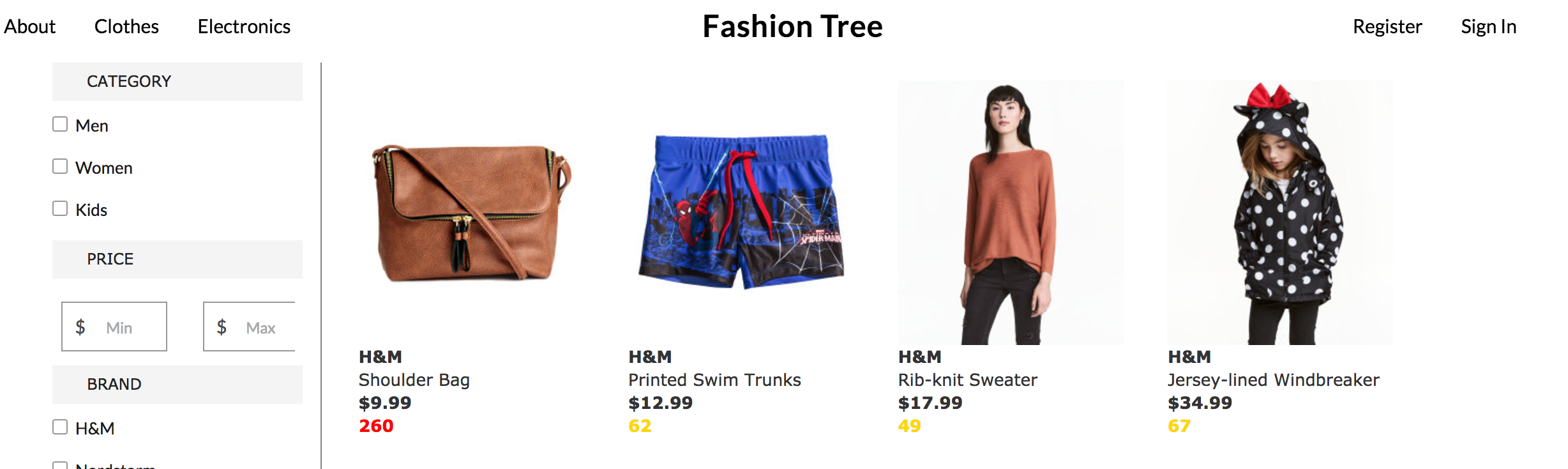
Fashion Tree scrapes various websites such as Nordstrom, Uniqlo, etc. for data about clothing items. It analyzes clothing composition, price, and other factors, then returns a sustainability score. Furthermore, it allows the user to filter according to these data points, making for a faster, brand independent shopping experience.
How we built it
We started with some basic Python web scrapers. Each of us chose a specific website and designed the scraper accordingly. We used regular expressions as well as Beautiful Soup to parse and scrape the information. However, we soon realized that the robustness of the Ruby on Rails model view controller paradigm allowed us to quickly set up a minimum viable product. From there, Rails tools such as Capistrano allowed us to continuously integrate our code into production. We set up a production server for the website, storing most of our data in a Postgresql database.
Challenges we ran into
As each website was different, we had to tailor the scrapers accordingly. Additionally, some websites have included anti bot software, which forced us to abandon some potential sources of data. Not to mention, with data being in multiple different formats, designing our business logic required some finesse. We had to carefully construct an algorithm that would keep a consistent scale at both extremes, while still being accurate enough to express the sustainability of a given product
Accomplishments that we're proud of
The final algorithm is both intuitive and powerful in its use. It models the material composition of the product as a vector in R^n Hilbert space. This vector is then multiplied using the inner product of the space, by the linear combination of the energy consumption and the water consumption. This algorithm is then scaled to make it intuitive and easy to understand. Combined with a distinctive color coded user interface, the environmental impact of a product can be ascertained with only a quick glance. Our website was deployed within the first five minute of entering the hackathon
What we learned
We learned about the importance of ecologically friendly material in both clothing and electronics. Producing textiles like cotton and polyesther consumes our natures resources, an accumulating cost that we often overlook. It is surprising to see how much energy and water is required to produce a piece of clothing.
What's next for Fashion Tree
Some additional features we would like to implement:
- deploying a mobile app
- having camera capturing ability, allowing user to take a picture of clothing tag
- vertical integration to encompass more everyday items/necessities
- horizontal integration to scrap data from more sources
- subscription service allowing readers to track the best deals
- design a more accurate algorithm using linear algebra and complex calculus
- using Machine Learning to recognize patterns in user preferences and environmental variables


Log in or sign up for Devpost to join the conversation.