-
-
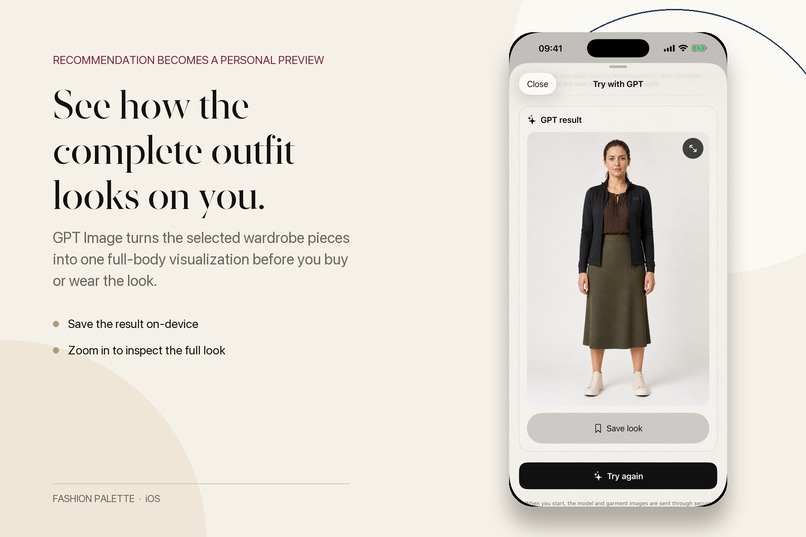
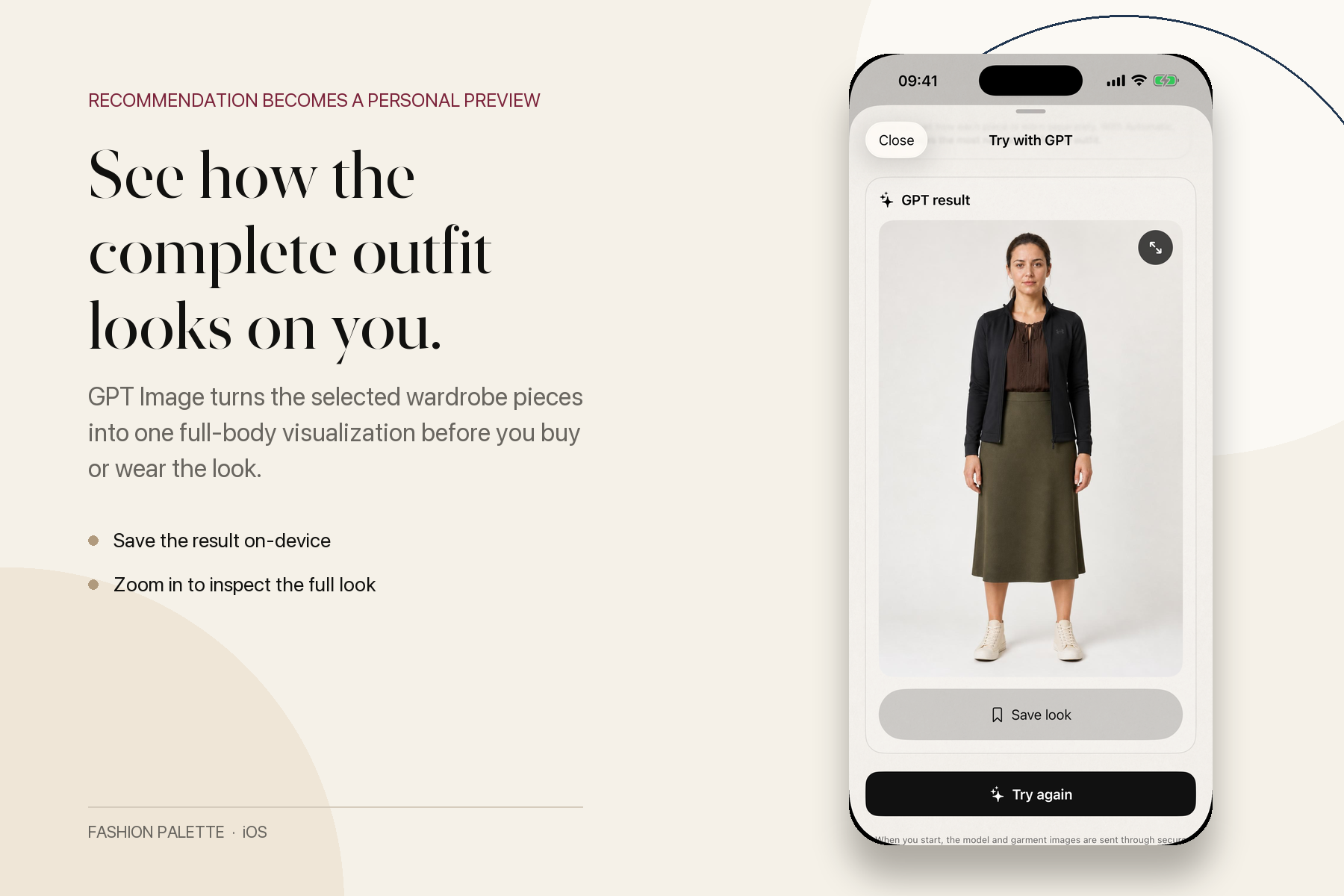
GPT Image visualizes the complete selected outfit on the user in one full-body result.
-
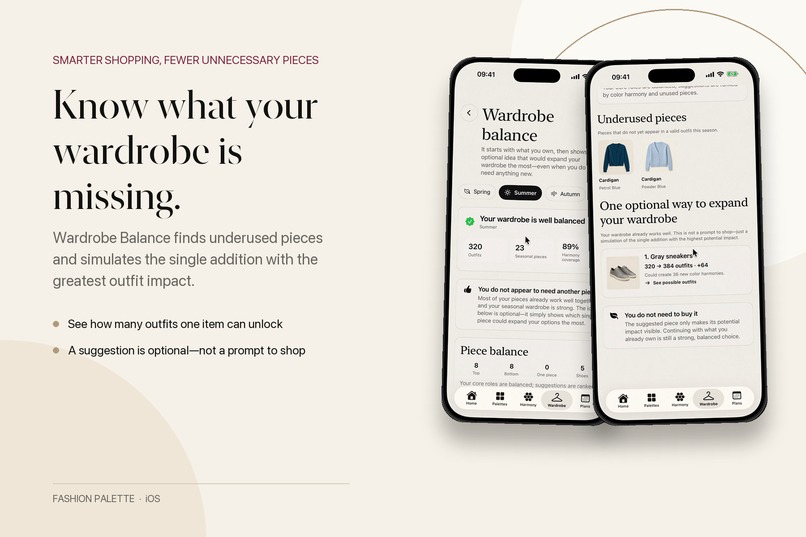
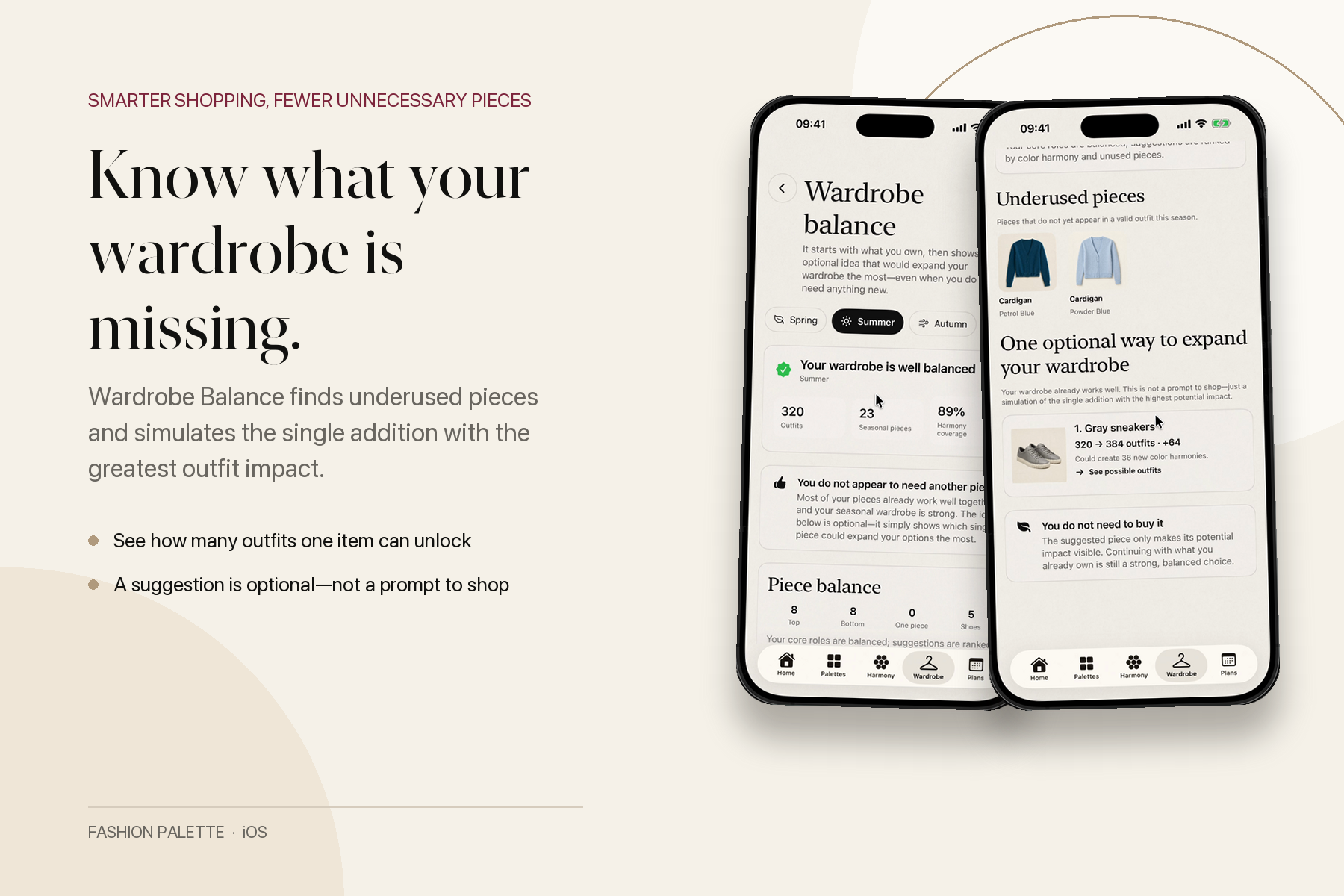
Wardrobe Balance reveals underused pieces and simulates the single addition with the greatest outfit impact.
-
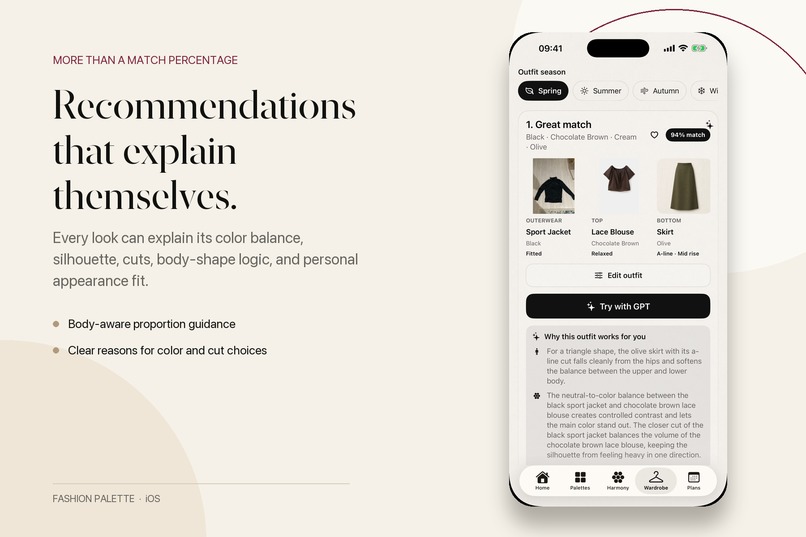
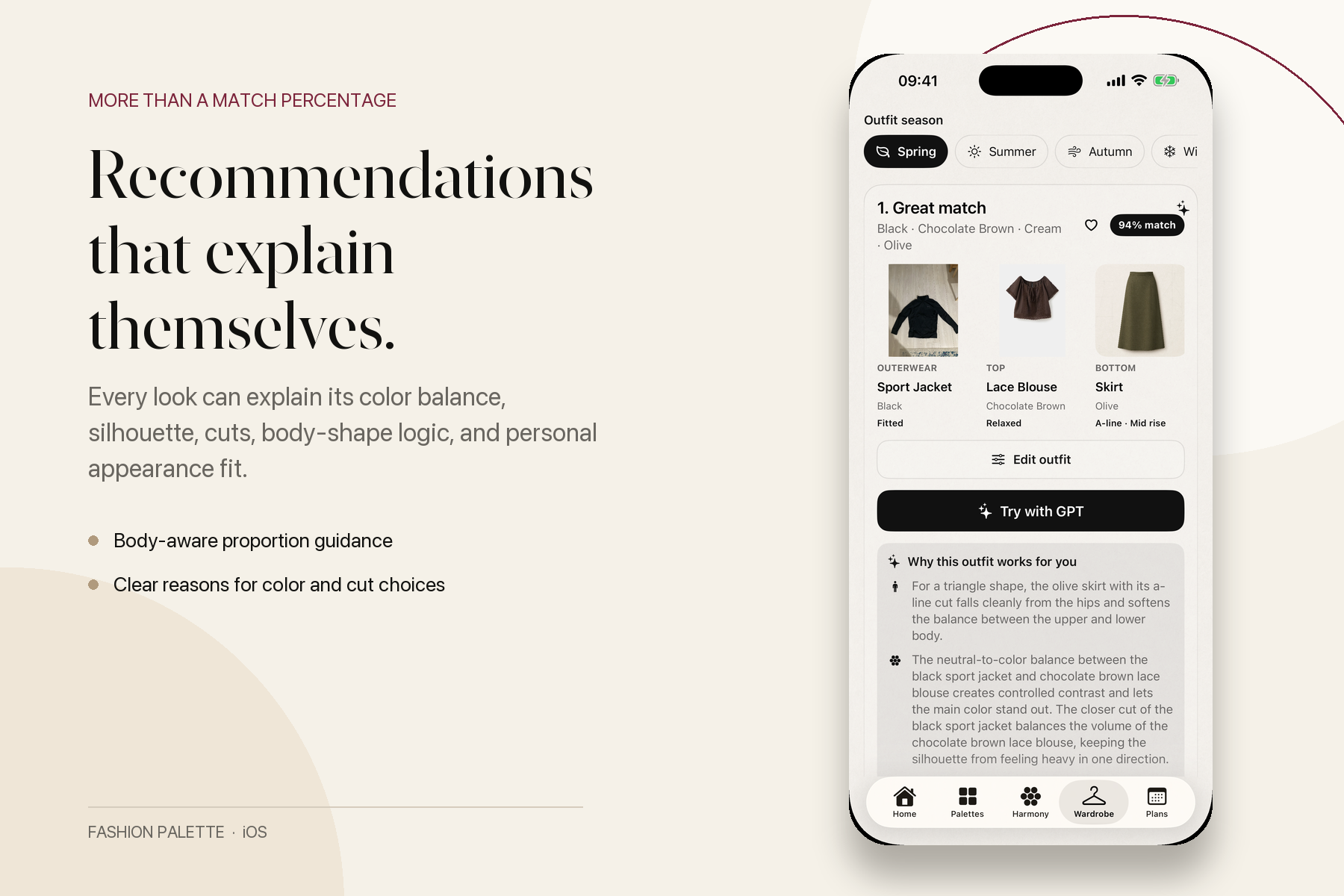
Each recommendation explains its color, cut, silhouette, body-shape, and personal appearance logic.
-
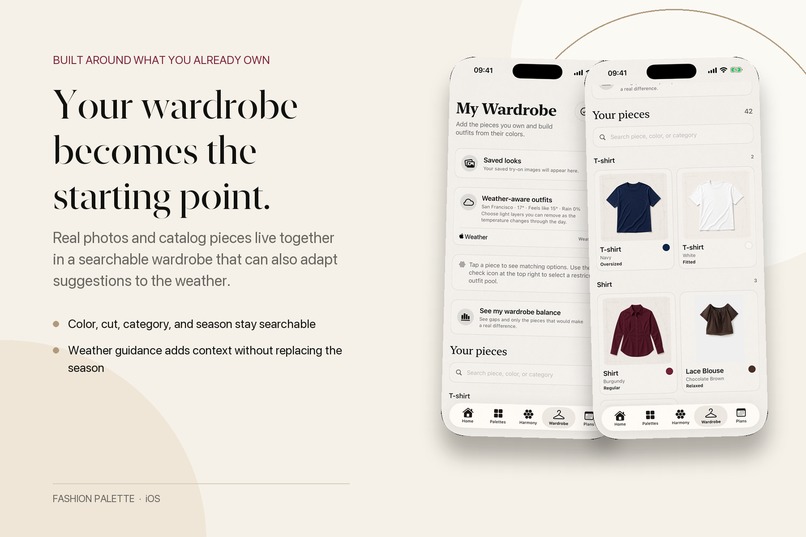
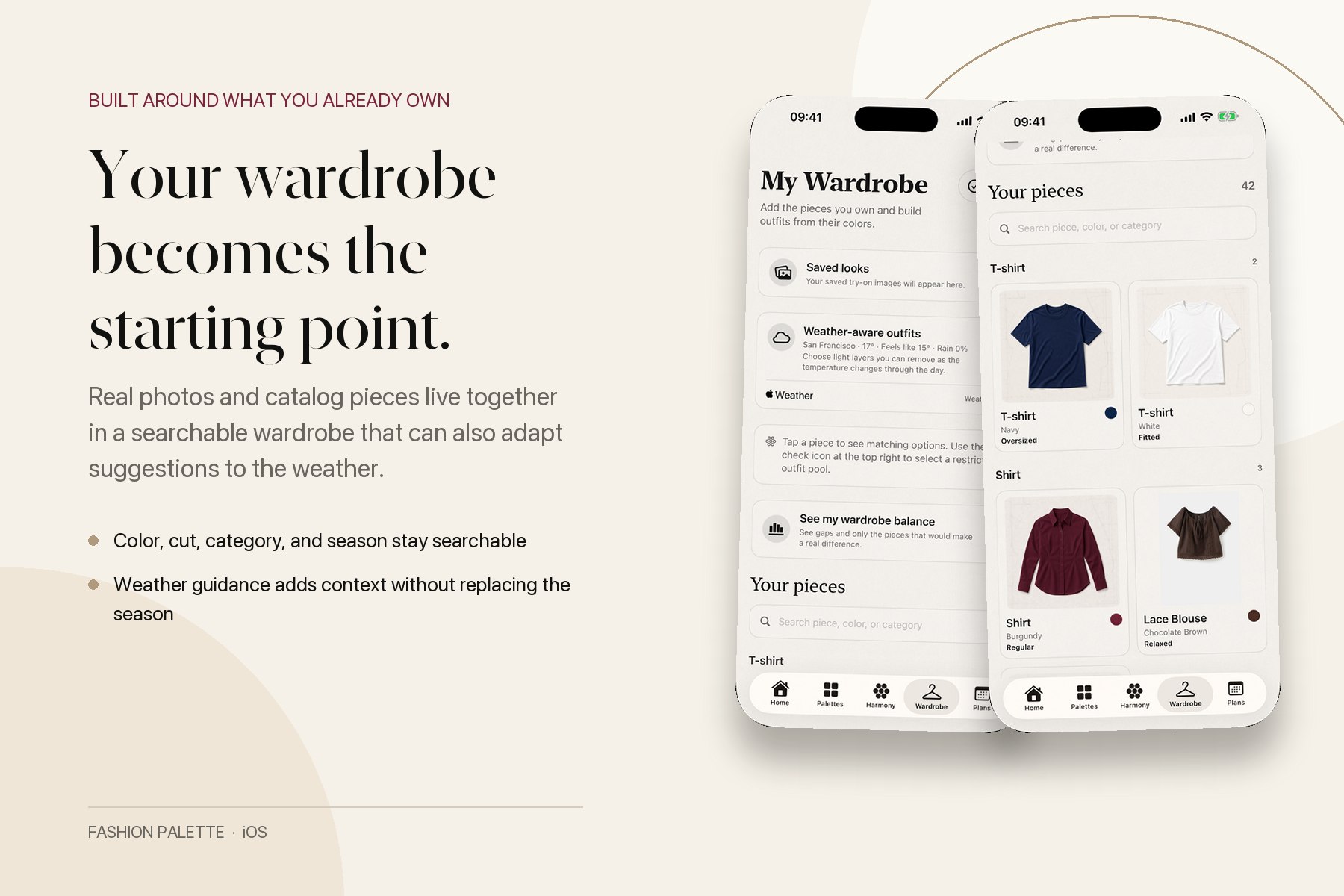
A searchable digital wardrobe combines real photos, catalog pieces, cuts, colors, seasons, and weather context.
-
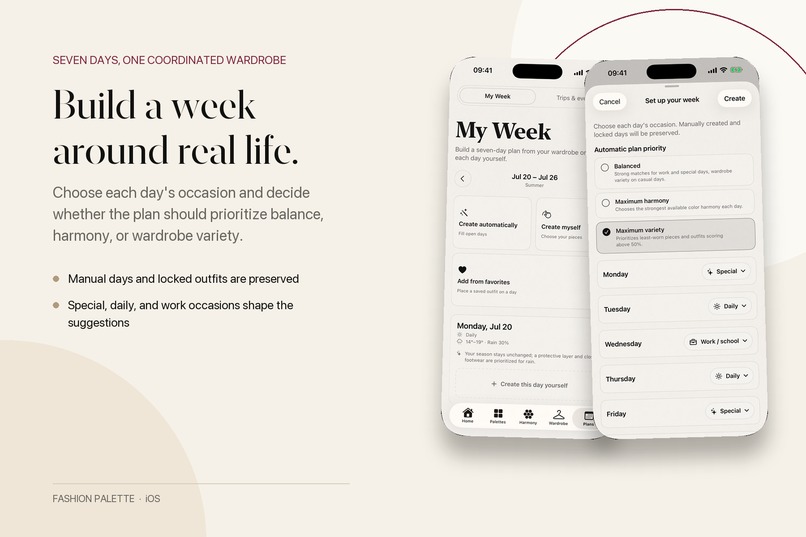
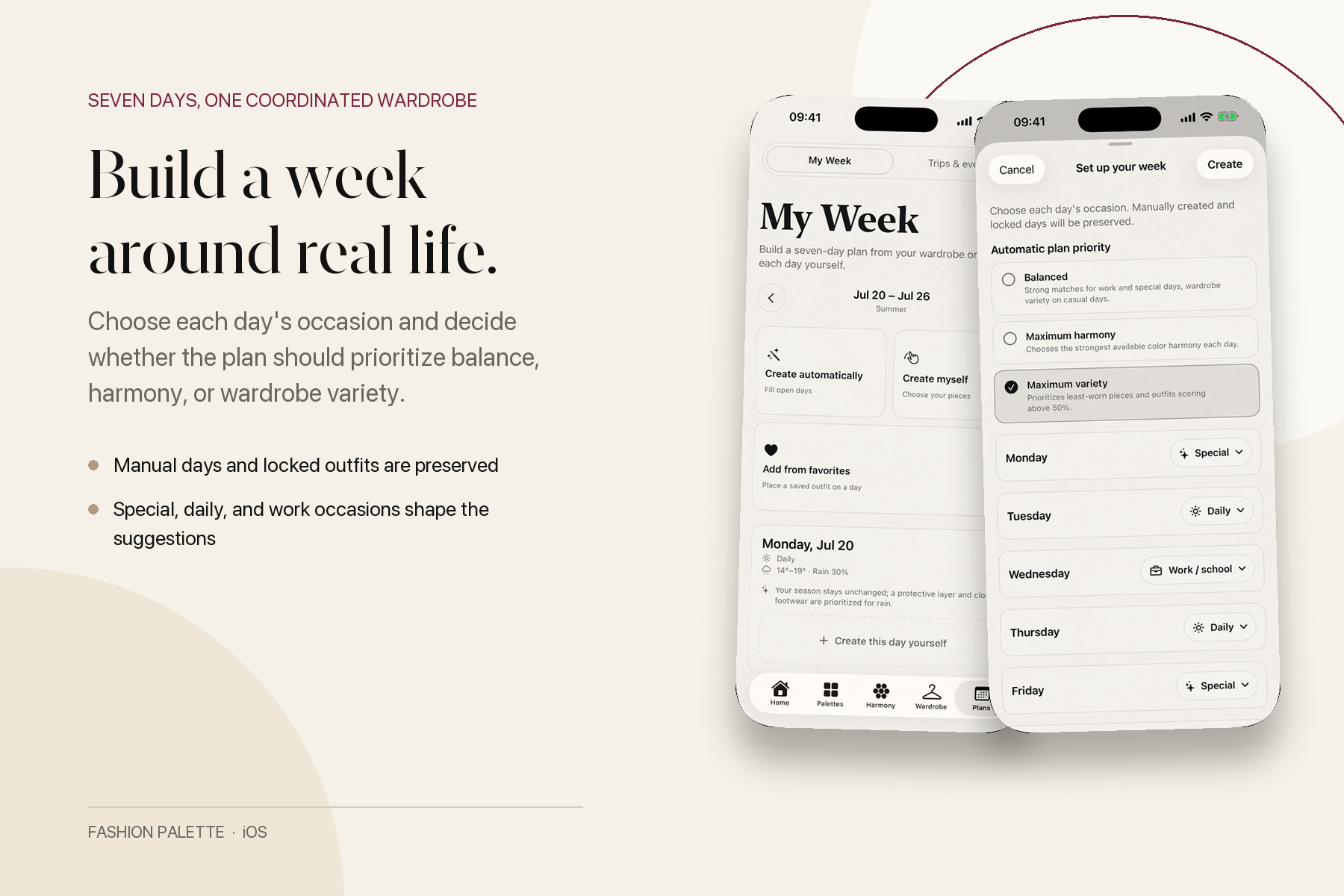
Build a seven-day wardrobe plan around each day's occasion, with balance, harmony, or variety priorities.
-
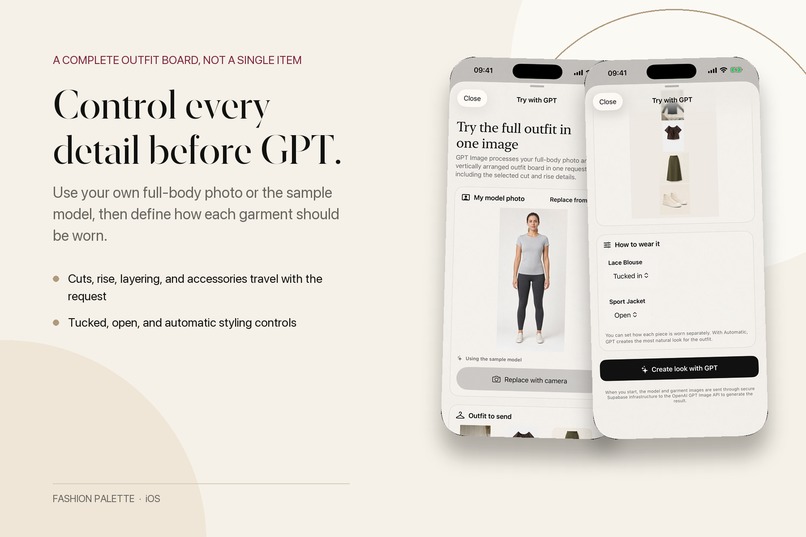
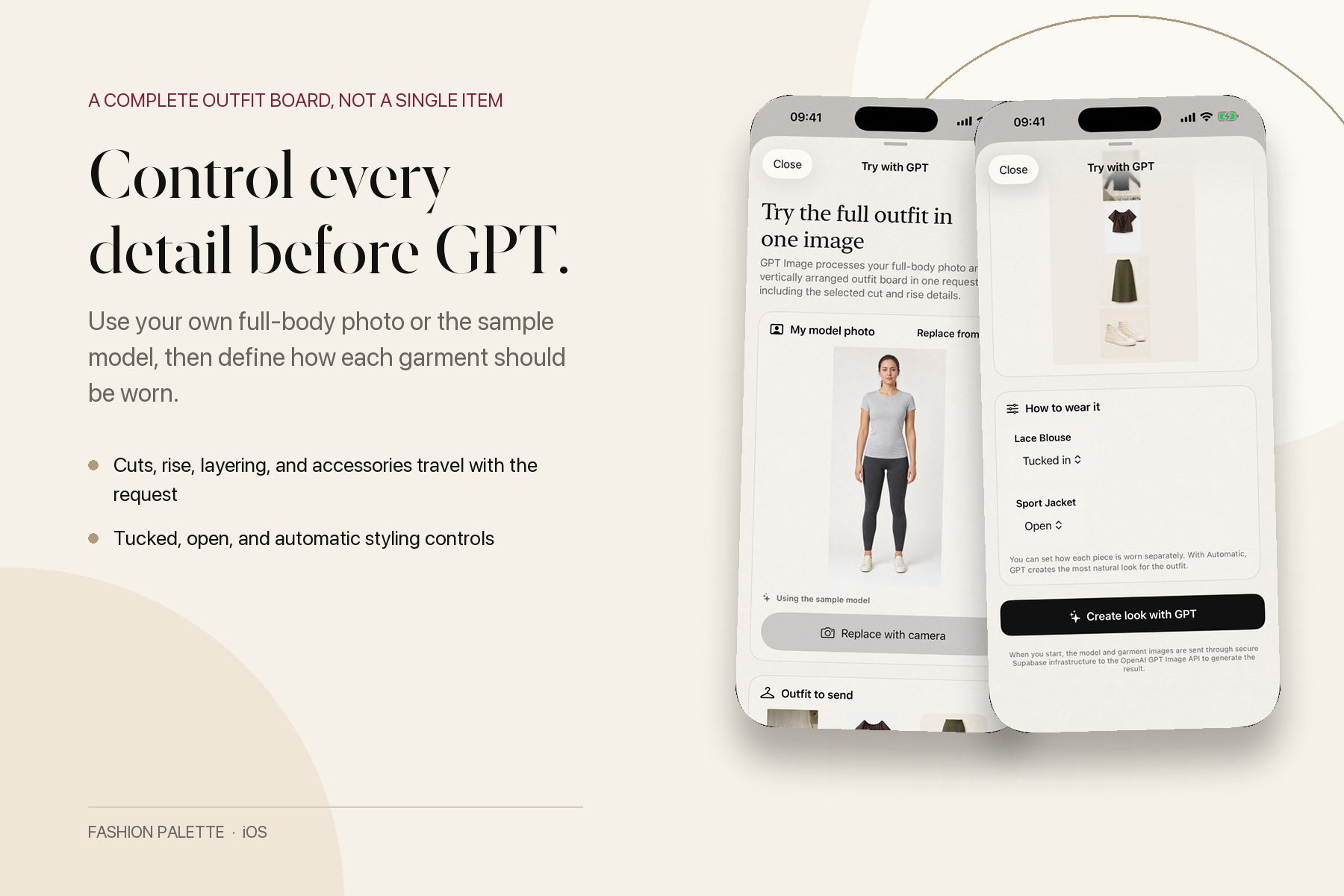
Choose a model photo and control layering, tucking, and how each garment should be worn before sending it to GPT.
-
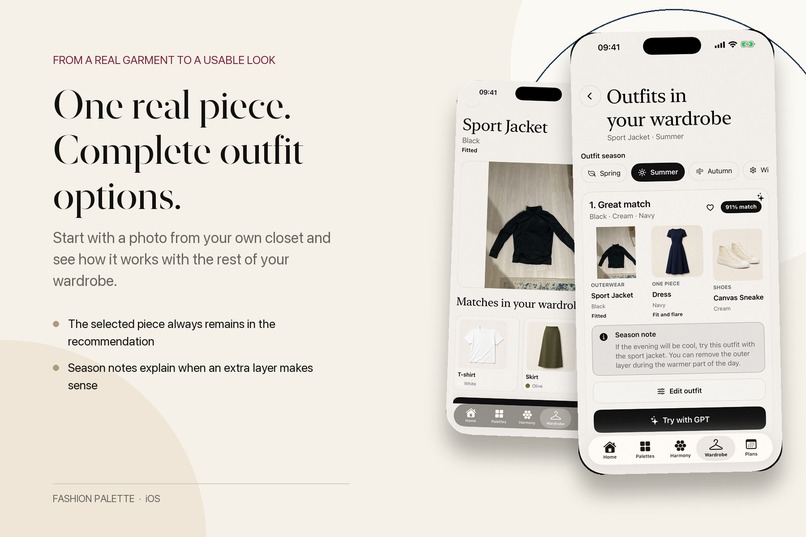
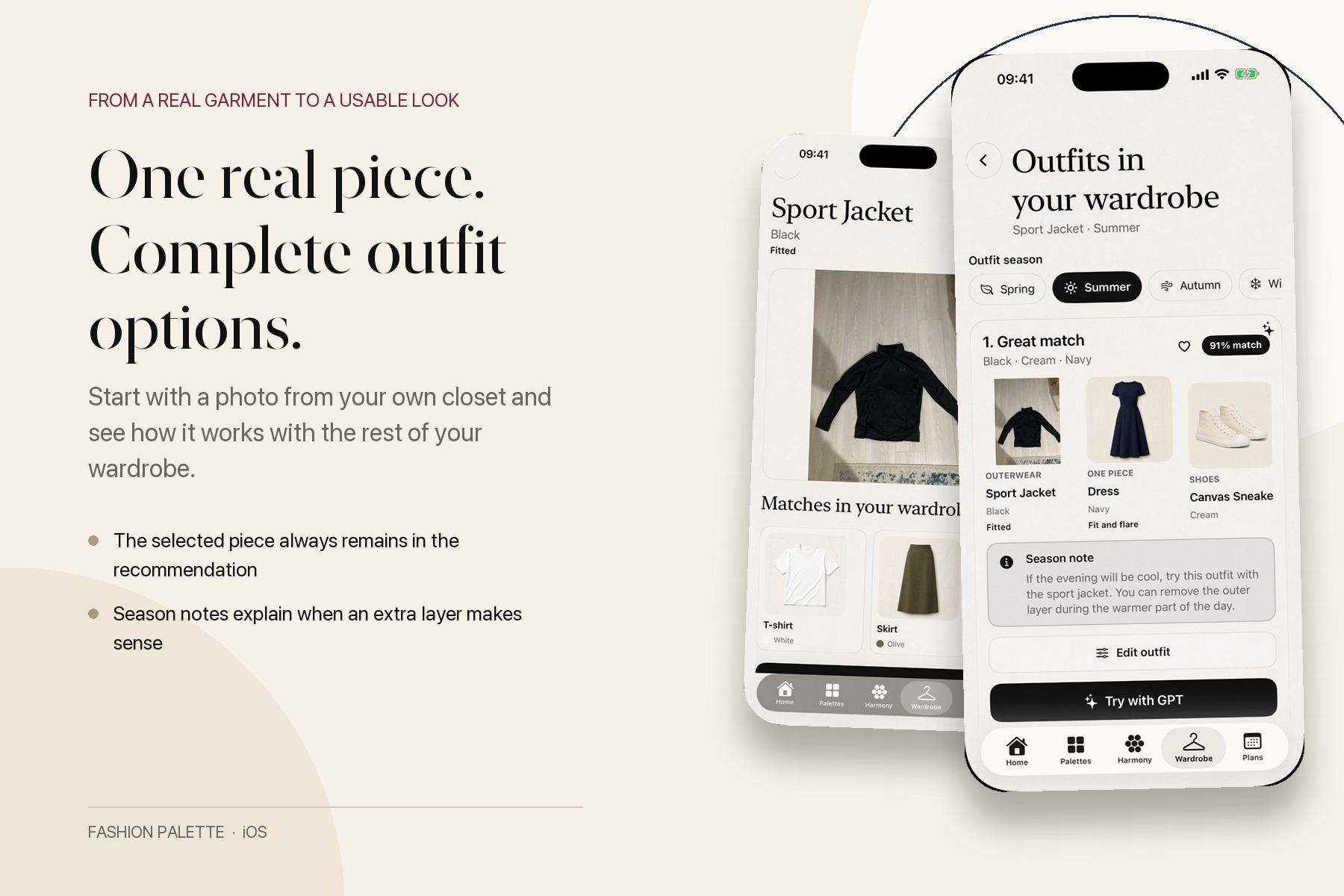
Start with one real garment and see complete outfit options built around that exact piece.
-
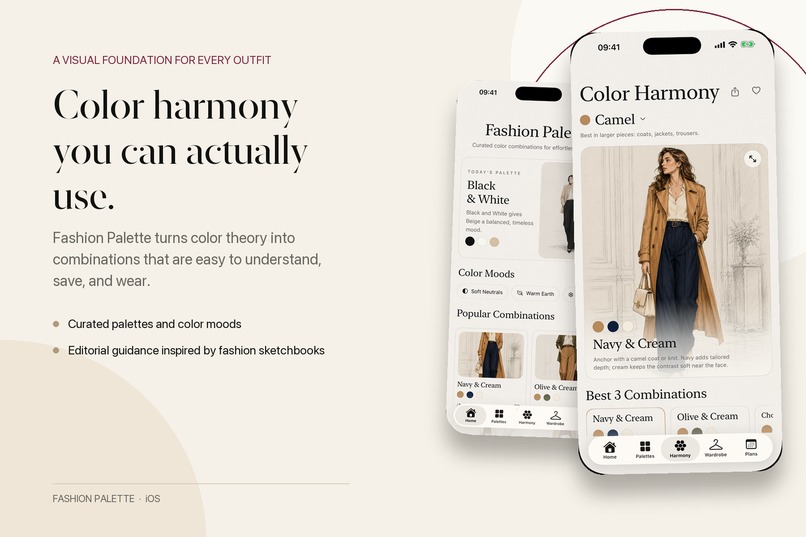
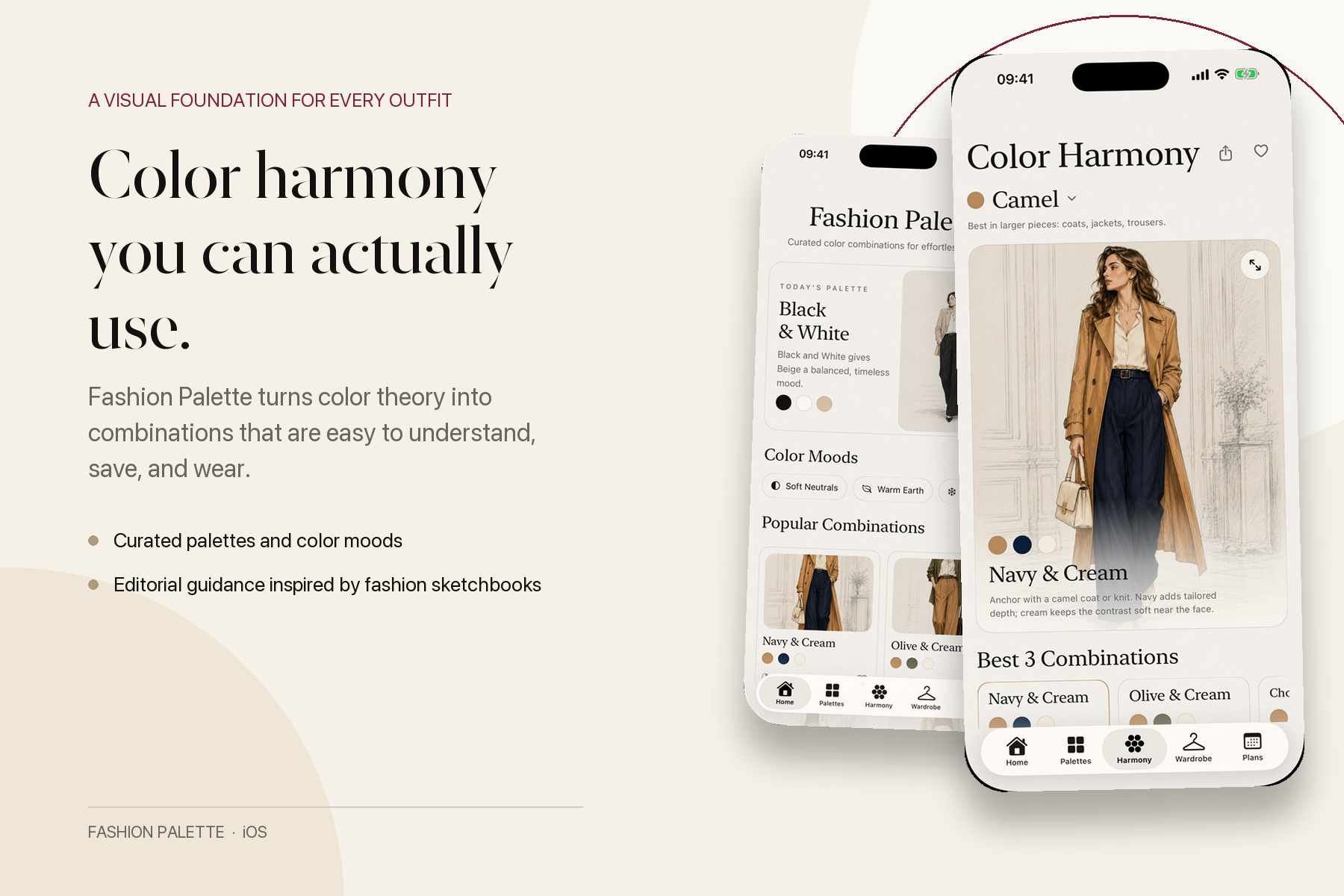
Color harmony made practical: curated palettes turn color theory into wearable combinations.
-
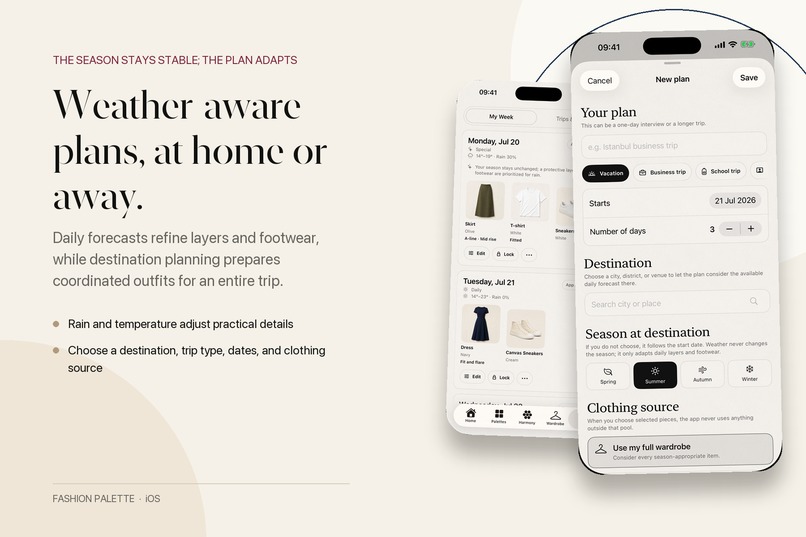
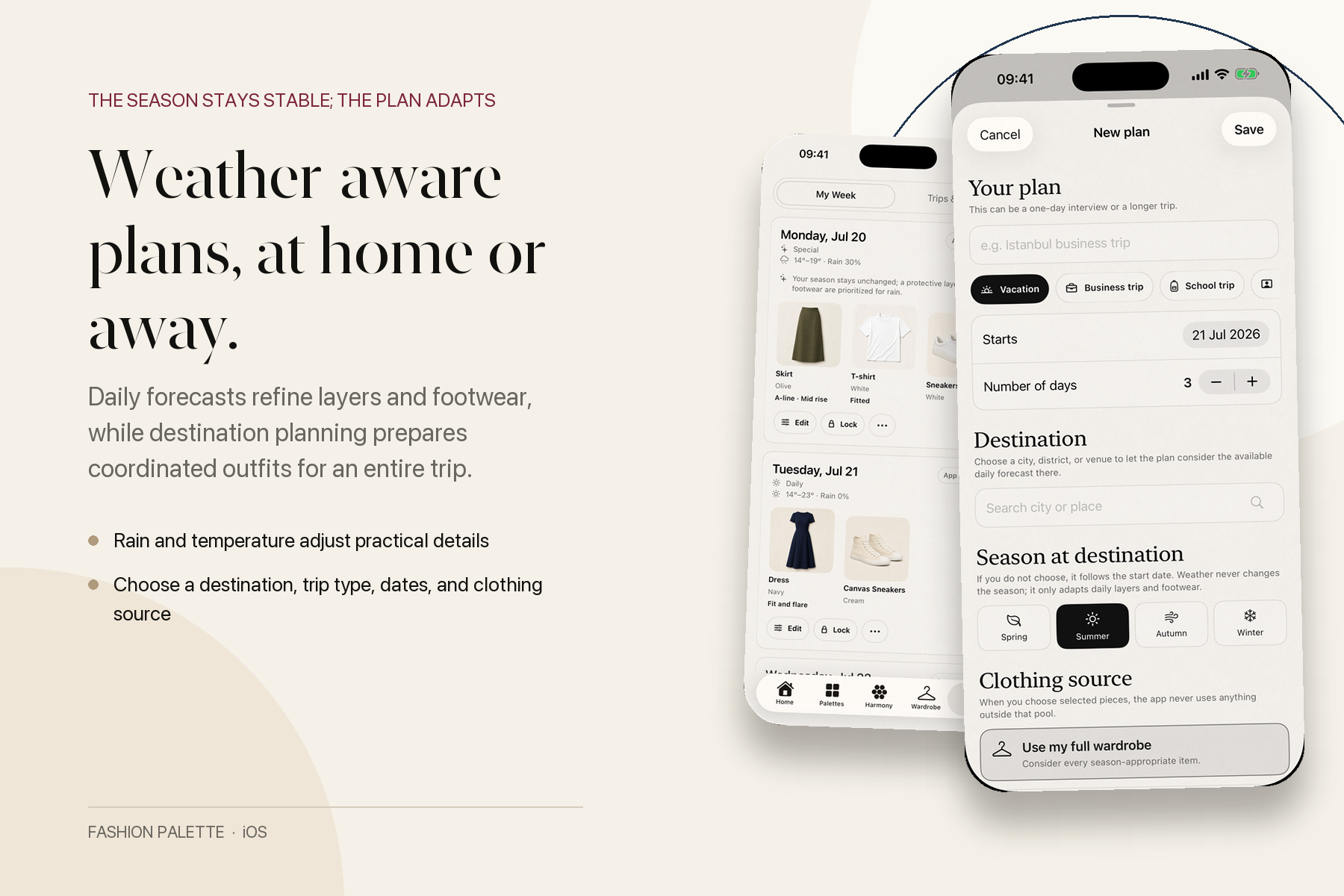
Weather refines daily layers and footwear, while destination planning prepares coordinated outfits for travel.
Inspiration
Fashion Palette began with a simple but recurring question that almost everyone faces: “What should I wear today?”
Even when people own plenty of clothes, deciding which pieces work together, creating an outfit that suits the season, and finding alternatives beyond the same few combinations can take a surprising amount of time.
The same uncertainty appears while shopping online. When we find a product we like, we usually cannot tell whether it will work with what we already own, how many new outfits it could create, or how the product and a complete outfit might look on us before buying it.
I created Fashion Palette to make these decisions clearer, more personal, and more practical.
For the visual direction, I drew inspiration from the hand-drawn pencil and charcoal sketches created by iconic fashion designers and ateliers before a garment becomes real. I wanted the app to feel like a living fashion sketchbook rather than a conventional technology product.
That idea shaped the warm paper texture, restrained color palette, editorial typography, and pencil-and-charcoal garment illustrations used throughout the app. I defined this creative direction; ChatGPT Web helped develop the visual language and illustrations, while Codex helped turn it into a consistent design system across the entire application.
Before Build Week, Fashion Palette was primarily a smaller color-harmony and visual gallery app. During Build Week, I used GPT-5.6 and Codex to transform that foundation into a complete personal wardrobe assistant.
What it does
Users can add pieces from Fashion Palette’s built-in garment catalog, photograph an item from their own wardrobe, or save a product image from an online store and add it to their digital wardrobe.
Fashion Palette evaluates those pieces using color, category, cut, season, body profile, skin tone, hair color, and eye color.
The app can:
- Show which pieces in the wardrobe work well together.
- Produce explainable compatibility scores for complete outfits.
- Prioritize seasonally appropriate combinations.
- Adapt suggestions using optional Apple Weather data such as temperature, rain, and wind.
- Continue using the selected season and the complete outfit engine when location or weather access is disabled.
- Evaluate garment cuts in relation to the user’s body profile.
- Introduce colors that complement the user’s skin tone, hair color, and eye color.
- Explain why a specific combination may suit the user.
- Estimate how many additional outfits a new product could create with the existing wardrobe.
- Prepare outfits for weekly schedules, trips, and events.
- Let users edit a suggested outfit without being restricted by its compatibility score.
- Use GPT Image to preview a complete selected outfit on the user’s own full-body photograph.
One of its most important use cases is online shopping. A user can save a product image from a retailer’s website, add it to Fashion Palette, evaluate how it fits into the existing wardrobe, and preview it as part of a complete outfit before making a purchase.
The recommendation engine itself does not ask an AI model to invent outfits at runtime. Outfit selection is handled by a deterministic rule-and-score engine so that results remain fast, consistent, explainable, and reproducible. GPT Image is used only when the user explicitly chooses to visualize the completed outfit on a model photograph.
How we built it
I am a non-technical builder and product creator. I defined the problem, product purpose, user flows, feature decisions, recommendation behavior, and visual direction, but I did not manually write a single line of code.
The SwiftUI application, data models, wardrobe engine, weather integration, background preparation system, GPT Image connection, performance improvements, privacy disclosures, and visual assets were created through an iterative workflow using ChatGPT Web, GPT-5.6, and Codex.
This was not a one-prompt process.
For each feature, I first described the user problem and the behavior I wanted in natural language. Codex inspected the existing project, analyzed how the current system worked, proposed an implementation, and translated the chosen direction into code.
I then tested the application on simulators and real iPhones. When I found slow interactions, incorrect seasonal suggestions, unsuitable combinations, layout issues, or unclear explanations, I described the exact behavior and provided screenshots. Codex traced the related code paths and refined the system. Many features went through several product and engineering iterations before reaching their current form.
ChatGPT Web was especially useful for exploring product ideas, refining the visual direction, preparing natural interface language, and creating visual assets. GPT-5.6 inside Codex helped analyze the growing codebase, design data structures, implement recommendation logic, debug complex interactions, improve performance, and maintain a consistent architecture.
The app’s optional virtual outfit preview sends the selected full-body model image and a reference board made from the actual selected garments through a Supabase Edge Function to the OpenAI Images API. This separation keeps image generation outside the deterministic recommendation engine and makes the data flow easier to explain and control.
Challenges we ran into
The first major challenge was preventing the recommendation engine from behaving like a superficial color matcher.
A T-shirt and a pair of trousers may be visually compatible, but they are not necessarily a complete outdoor outfit for winter. The system needed to understand this distinction. Instead of hiding every incomplete combination, it can still show a visually compatible outfit while clearly explaining that an outer layer, such as a coat or jacket, may be needed.
This led to a layered recommendation engine that considers color harmony, garment category, cut, season, body profile, personal coloring, and outfit completeness separately.
Another challenge was separating season from weather. A cold day should not automatically change summer into winter. If the user selects summer, the engine continues working with the summer wardrobe. Weather data only makes smaller practical adjustments, such as suggesting a light jacket for a cool evening or advising the user to take an umbrella when rain is expected.
Seasonally unusual pieces are not always completely removed. A leather jacket, for example, may appear later in summer results with an explanation such as: “Try this if the evening will be cool.” This makes the system feel aware of real life rather than blindly following rigid rules.
We also had to handle multiple garments with similar properties. A person may own several black T-shirts or multiple navy shirts. Treating a product only as a category-and-color combination caused distinct items to collapse into one result. The wardrobe system was redesigned so every piece retains its own identity, source, image, cut, and attributes.
Performance became another major challenge as the wardrobe and result count grew. Recalculating every possible outfit whenever the user opened a garment caused visible delays, especially on older devices.
To solve this, recommendations are prepared in the background and stored in a persistent local cache. When the wardrobe changes, only affected calculations are invalidated. If a user opens an item that has not been prepared yet, background work is interrupted and that specific item receives immediate priority. Afterward, the preparation queue resumes.
Weekly and travel plans introduced similar challenges. Instead of rebuilding the entire outfit system separately, they were connected to the same wardrobe recommendation engine. Weather can then make small day-specific adjustments without regenerating every combination from the beginning.
GPT Image visualization required another level of precision. The generated result needed to preserve the user’s general appearance and body proportions while respecting the real colors, cuts, and garment details selected from the wardrobe. The final flow uses one full-body model image and a structured reference board containing the actual outfit pieces in a single controlled request.
Privacy also had to remain understandable. Location and weather are optional. Outfit images are sent for generation only after the user explicitly starts the process, and the privacy policy explains which services participate in that request.
Accomplishments that we're proud of
I am most proud that Fashion Palette evolved from a small color-harmony experience into a working personal wardrobe assistant during Build Week.
As a non-technical creator who did not manually write code, I was able to use GPT-5.6, Codex, and ChatGPT Web to create:
- A complete native iOS application.
- An explainable outfit recommendation engine.
- Seasonal and optional weather-aware outfit ordering.
- Body-profile and personal-color considerations.
- A digital wardrobe containing catalog, photographed, and online products.
- Weekly, travel, and event outfit planning.
- A GPT Image experience that previews complete outfits on the user.
- Persistent background preparation and caching designed to remain usable on older iPhones.
- A consistent fashion-sketch-inspired visual language across the entire product.
I am also proud that the application does not use AI merely as a decorative label. Codex and GPT-5.6 were central to how the product was designed and built, while GPT Image provides a clear user-facing capability that would otherwise be extremely difficult for a non-technical creator to implement.
What we learned
This project taught me that manually writing code is not the only path to creating a serious digital product. It also taught me that simply stating an idea is not enough.
Working effectively with Codex requires clearly defining the problem, providing realistic examples, testing the result, and explaining incorrect behavior precisely. The strongest results came from an ongoing collaboration in which I made the product and user-experience decisions while Codex analyzed and implemented those decisions technically.
I learned to think more carefully about edge cases that initially appeared simple: whether weather should change a season, how winter outfits differ across climates, how to treat duplicate garments, when an incomplete outfit should still be shown, and how background preparation affects real-device usability.
Fashion Palette became more than a fashion application for me. It became proof that a non-technical person can use ChatGPT, GPT-5.6, and Codex to move from an idea to a coherent, working product that runs on a real device.
What's next for Fashion Palette
The next step is to test Fashion Palette with real users and prepare it for release on the App Store.
I want to continue improving the recommendation engine, personal-color explanations, body-profile guidance, and GPT Image fidelity based on real feedback.
Future plans also include making it easier to send a product directly from a retailer’s website into the wardrobe, improving the speed of outfit visualization, and supporting additional languages.
In the long term, I want Fashion Palette to become more than an answer to “What should I wear today?” I want it to help people use more of what they already own, make more informed shopping decisions, and reduce unnecessary purchases.
Built With
- apple-weatherkit
- chatgpt
- core-location
- gpt-5.6
- gpt-image-2
- ios
- mapkit
- openai-codex
- openai-images-api
- supabase
- supabase-edge-functions
- swift
- swiftui
- xcode

Log in or sign up for Devpost to join the conversation.