-
-
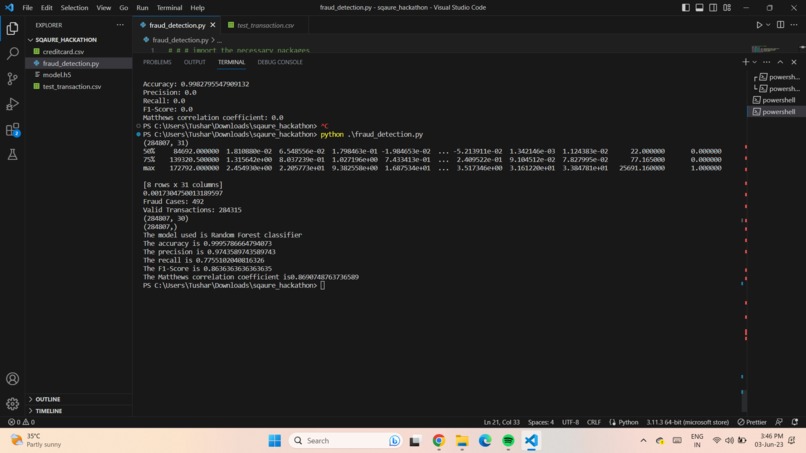
results in the terminal
-

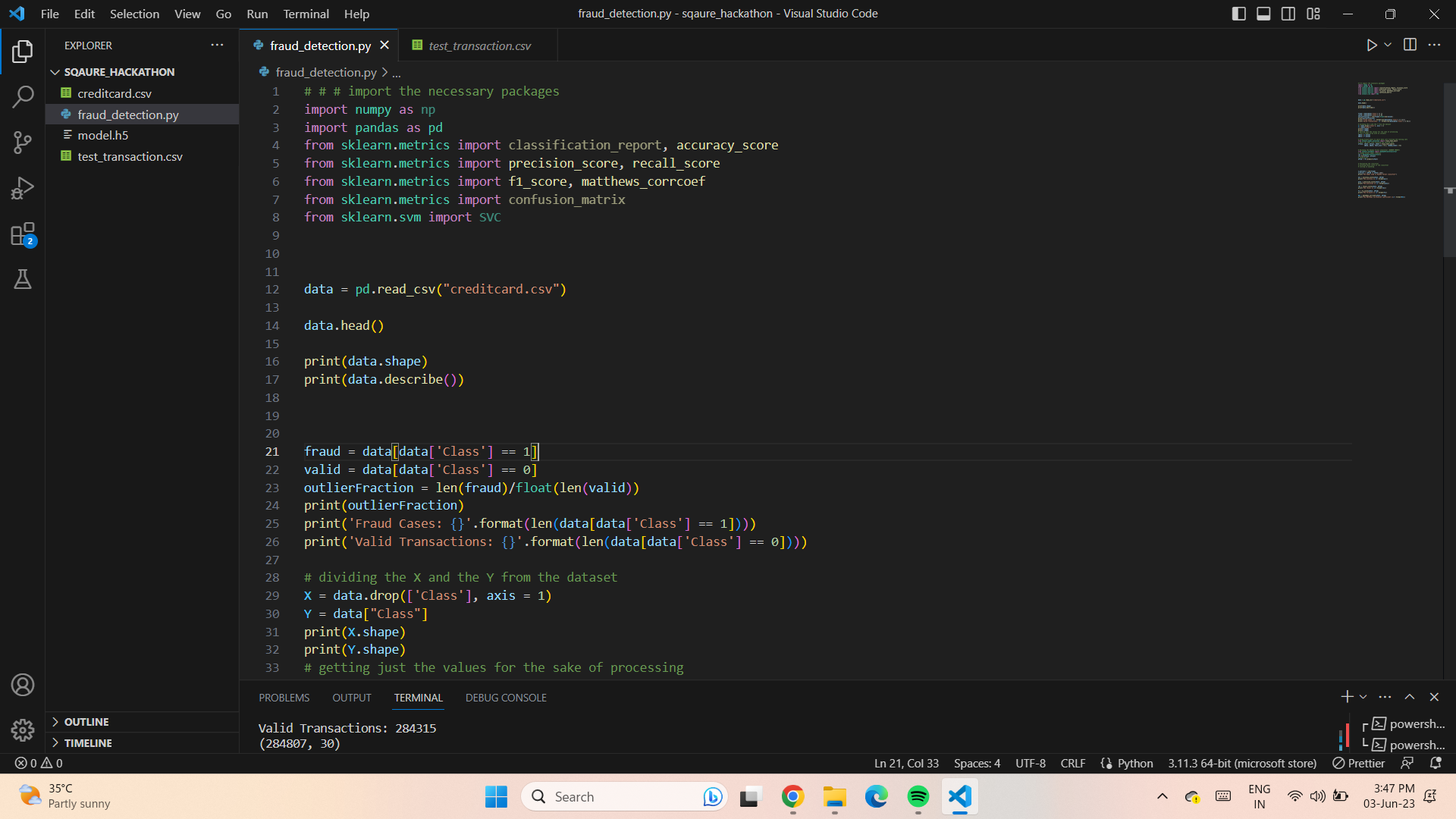
code in vscode

Inspiration
The inspiration behind the fraud transaction detection AI model is the need to combat the increasing sophistication of fraudulent activities in financial transactions. By leveraging advanced algorithms and machine learning techniques, the model aims to provide businesses with a powerful tool to detect and prevent fraudulent transactions, safeguarding their financial systems and protecting their customers.
What it does
The AI model utilizes the Random Forest Classifier algorithm to analyze transaction data and classify them as either fraudulent or valid. By training on a dataset of known fraudulent and valid transactions, the model learns patterns and anomalies associated with fraudulent behavior. It then applies this knowledge to predict the likelihood of fraud in real-time transactions.
How we built it
The model is built using Python and various libraries such as NumPy, Pandas, and scikit-learn. The dataset of credit card transactions is loaded, preprocessed, and divided into training and testing sets. The Random Forest Classifier is employed to train the model on the training data and make predictions on the testing data. Performance metrics such as accuracy, precision, recall, F1-score, and the Matthews correlation coefficient are calculated to evaluate the model's effectiveness.
Challenges we ran into
During the development process, several challenges may have been encountered. These could include handling imbalanced datasets, optimizing model performance, and fine-tuning hyperparameters. Additionally, ensuring the model's ability to generalize to new and unseen data is crucial for real-world application.
Accomplishments that we're proud of
Some accomplishments to be proud of include successfully implementing the fraud transaction detection AI model, achieving high accuracy in classifying fraudulent and valid transactions, and obtaining valuable performance metrics. Additionally, the model's integration with existing financial systems and its potential to save time and resources for fraud investigation teams are notable achievements.
What we learned
During the development of the AI model, valuable insights and knowledge were gained regarding the use of machine learning algorithms for fraud detection. The process involved data preprocessing, feature selection, model training, and evaluation. Understanding the importance of choosing the right performance metrics and addressing challenges specific to fraud detection contributed to a deeper understanding of this domain.
What's next for farud_transaction_detection_ai_model
Moving forward, there are several potential avenues for improvement and expansion. This includes exploring other advanced machine learning algorithms, such as Support Vector Machines (SVM), Neural Networks, or Gradient Boosting, to further enhance the model's accuracy and fraud detection capabilities. Additionally, incorporating real-time data feeds, implementing anomaly detection techniques, and integrating the model into a production environment are all valuable steps towards deploying the model for practical use in real-world scenarios.
Built With
- numpy
- pandas
- python
- randomforestclassifier
- scikit-learn


Log in or sign up for Devpost to join the conversation.