Inspiration
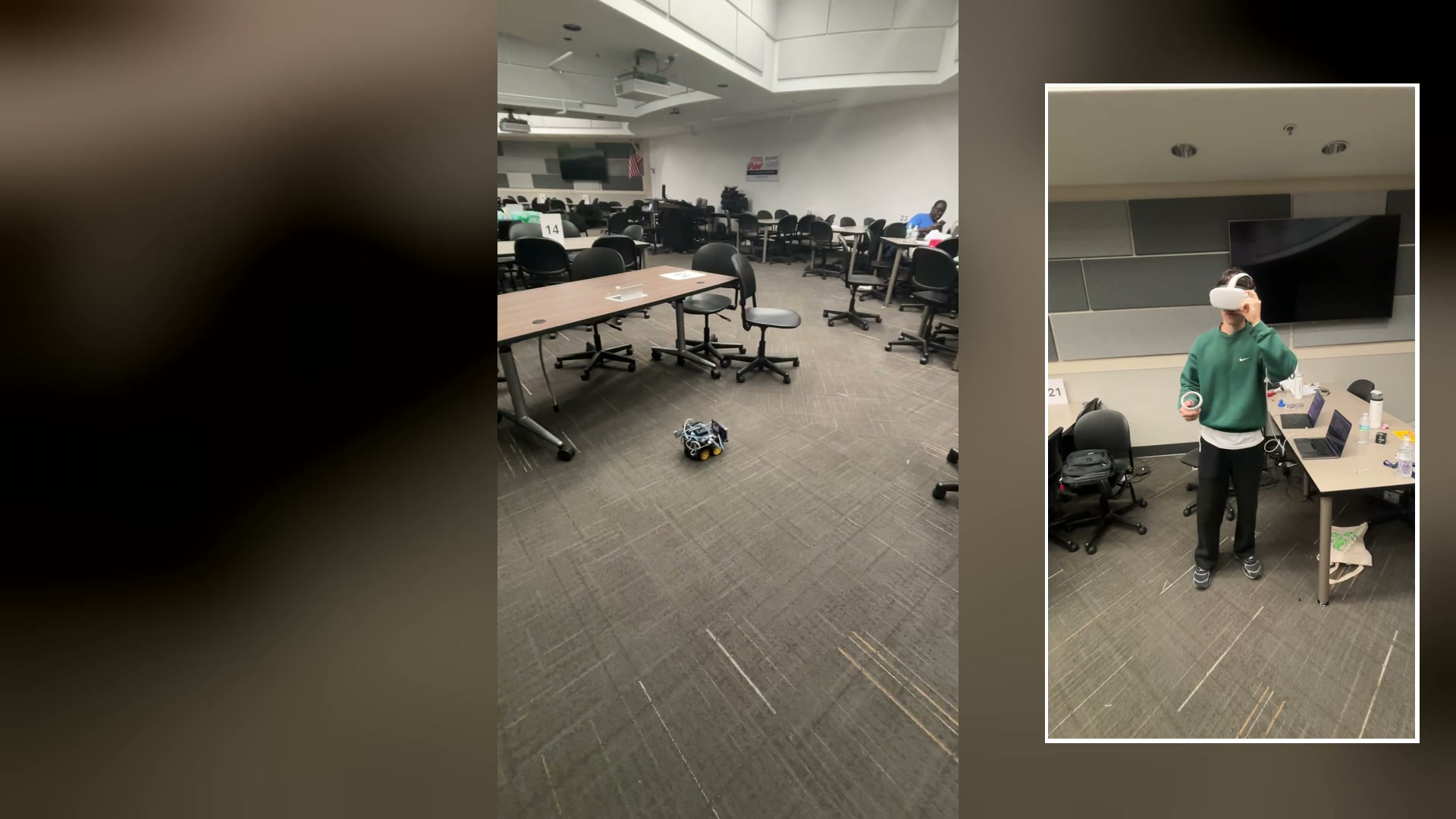
A responder should be able to inspect an unfamiliar room before entering it. We wanted more than remote steering on a small screen: a live view of the rover's surroundings, help finding people, and spatial context that stays available as the rover moves. VR telepresence and a measured room map bring those views together. Our demonstration is a controlled indoor rescue scenario.
What it does
Farsight lets a responder explore a room from a Meta Quest instead of entering it first. An ELEGOO rover carries a LiDAR iPhone and an NVIDIA Jetson Orin Nano. The headset shows the live camera: move the right joystick to drive, press A for autonomous Explore, and press B to stop and return to MANUAL. In AUTO, the joysticks move your viewpoint through the map while Nav2 navigates the rover.
YOLO11n-pose finds people and derives face boxes from head keypoints. The mission report keeps encounter snapshots and draft SBAR notes. A responder can type on the laptop, or hold the left trigger in VR, to ask about the live view. Local Qwen3-VL-2B-Instruct answers, Whisper base.en transcribes, and Piper speaks replies or preset survivor phrases in English and Spanish. The models run locally; remote driving still needs the cellular link.
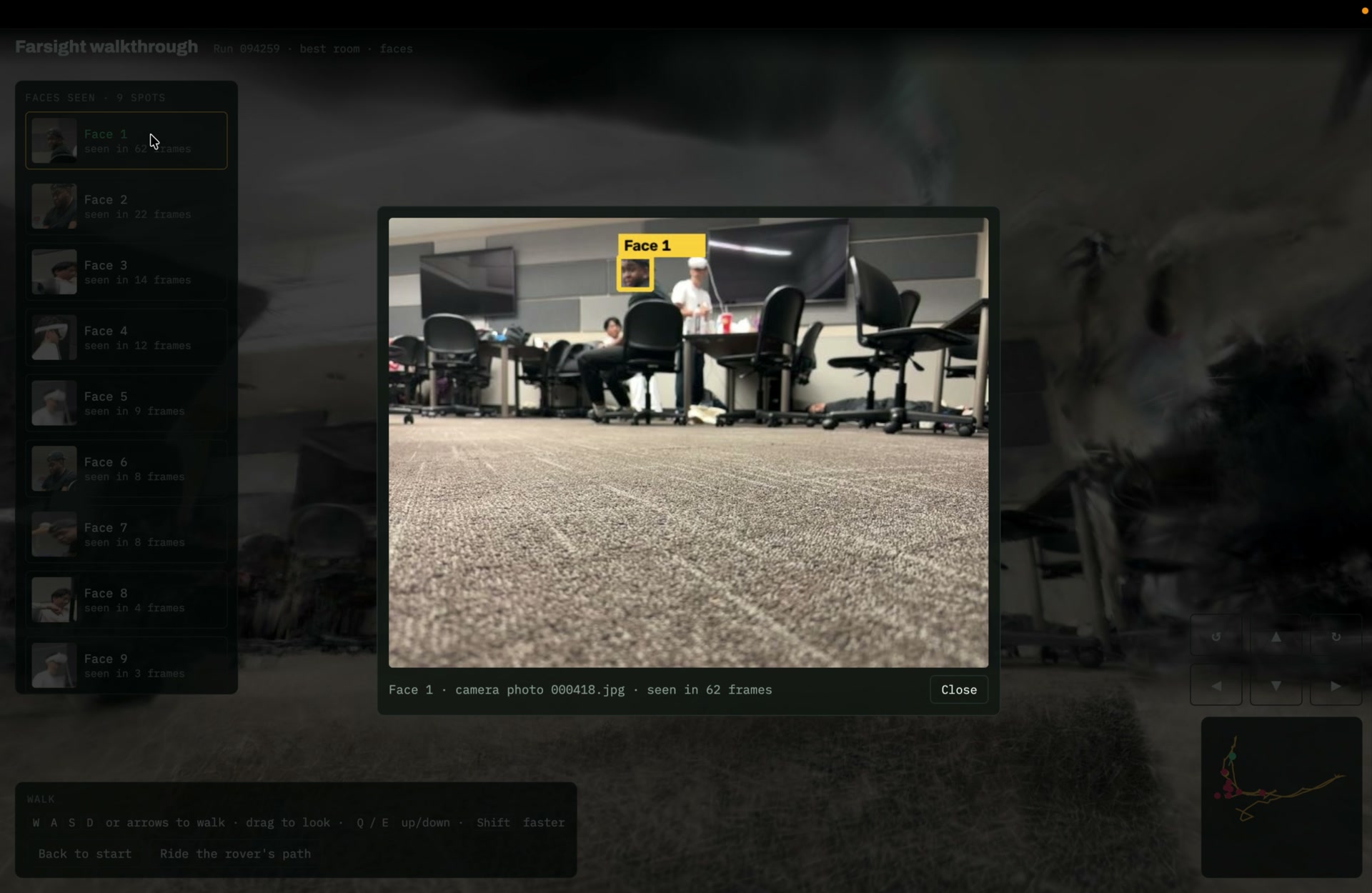
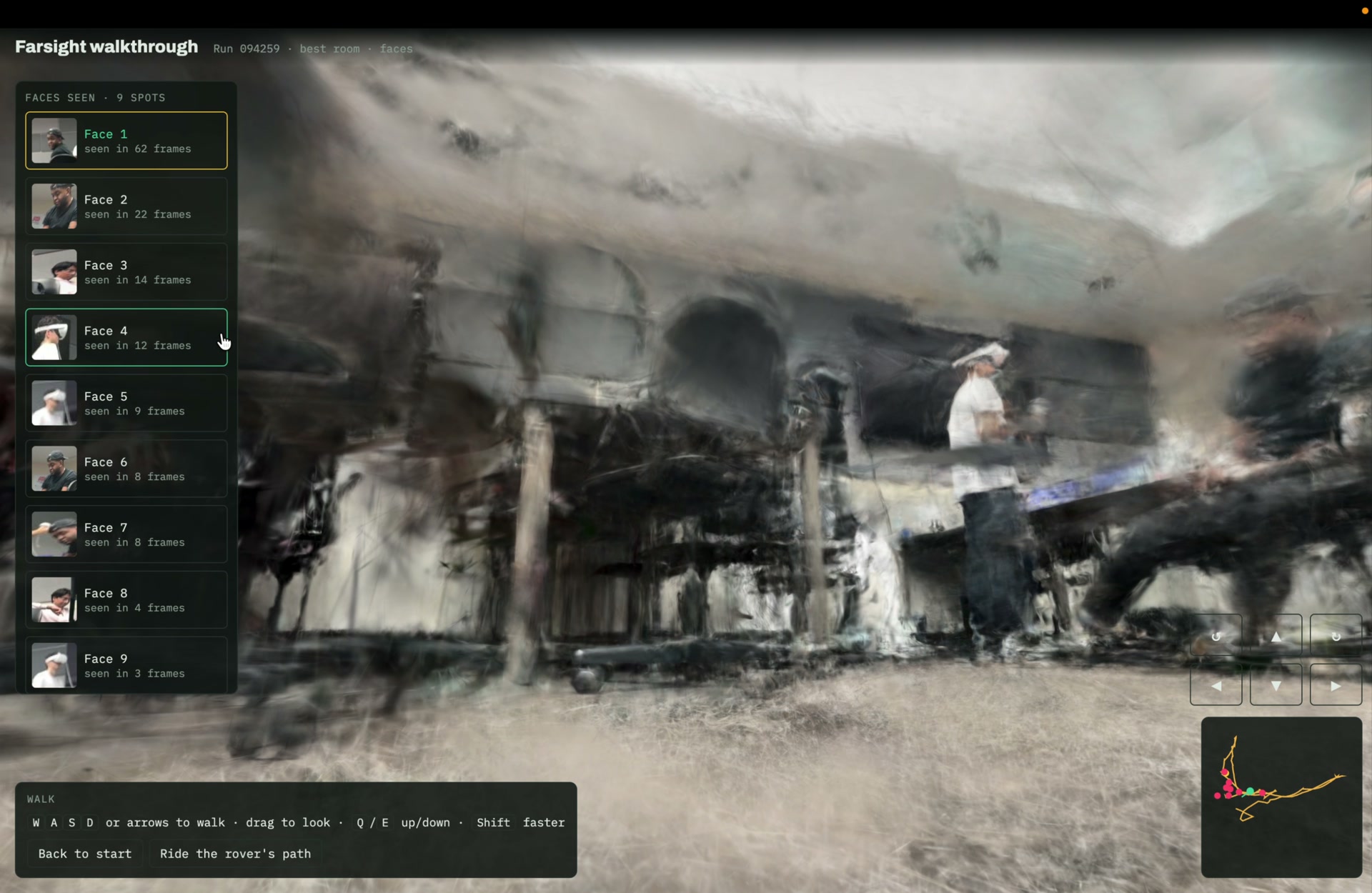
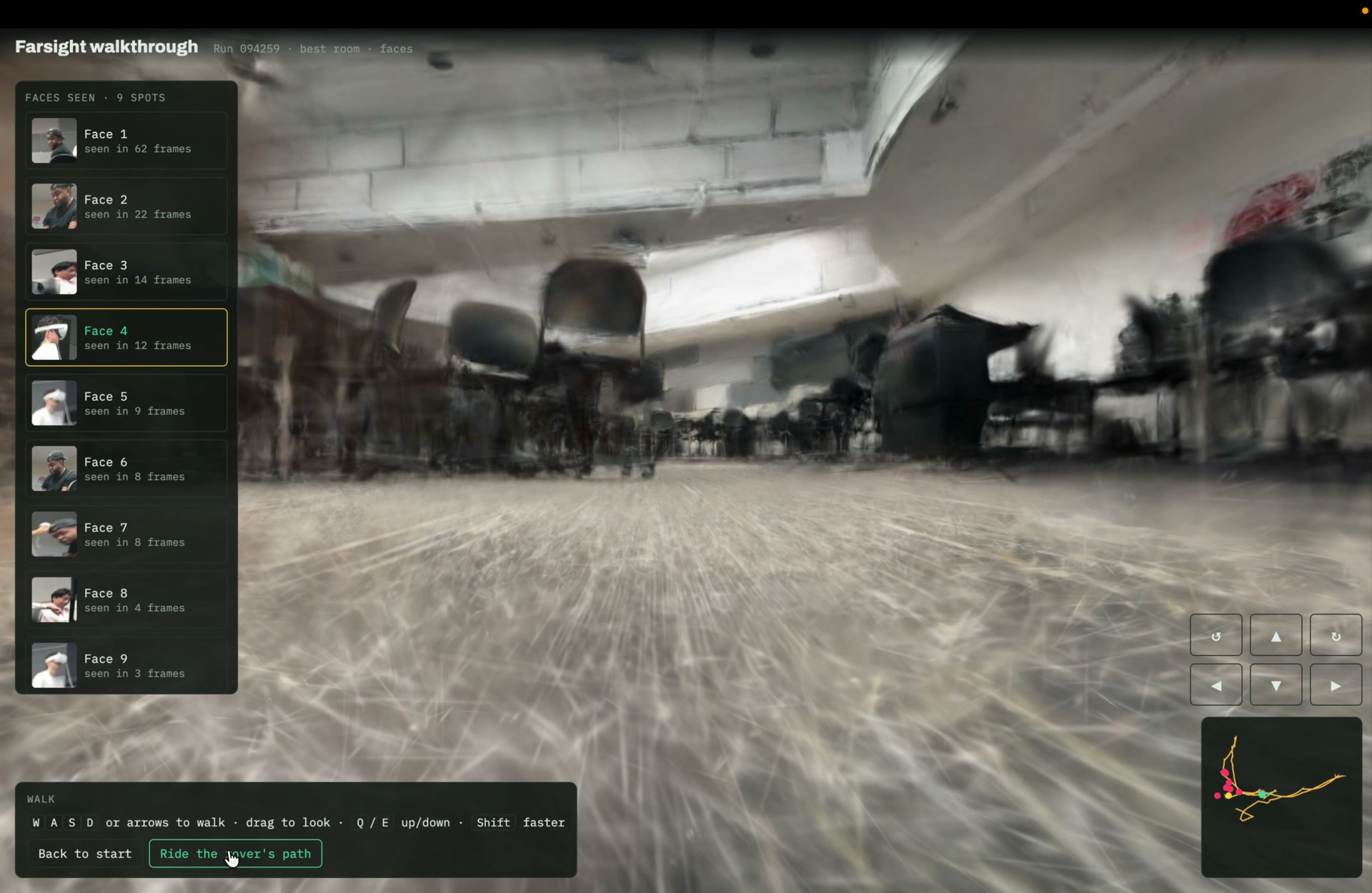
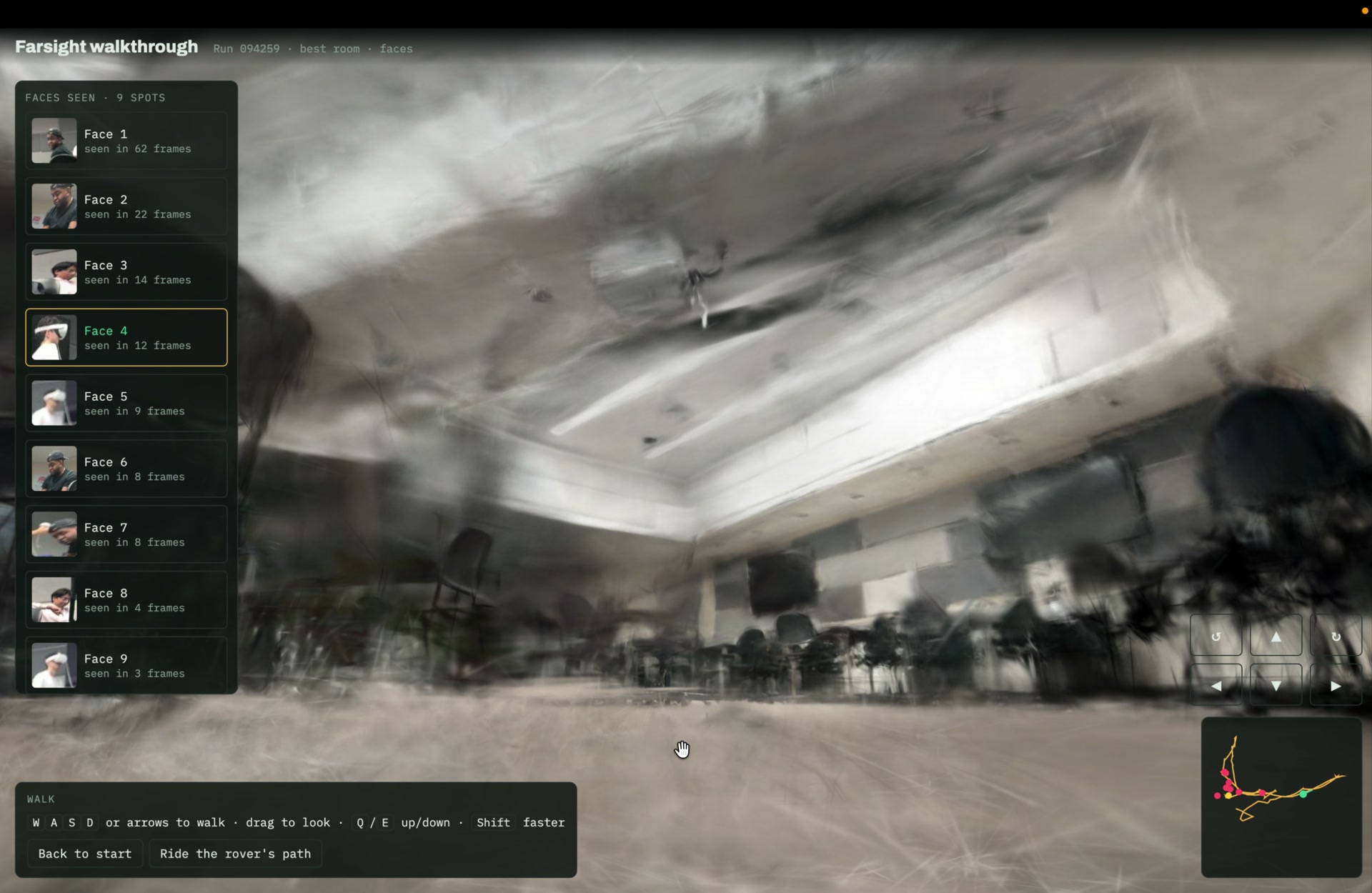
After the run, the Mac pulls the posed photos and measured LiDAR seed, then trains a Gaussian-splat reconstruction with Brush on Metal. Walk the room in a browser, replay the rover's route, or open the splat in the Quest. Dechante's face-enabled browser walkthrough puts red dots on the minimap; clicking a face jumps to its recorded viewpoint and opens the real camera frame with the face boxed. These are observed face locations, so a moving person may leave more than one spot.
How we built it
Swift and ARKit on the iPhone supply synchronized RGB, measured depth, camera intrinsics, and poses. The Jetson runs the Python/FastAPI rover server, YOLO11n-pose through TensorRT, Nav2 integration, and serial commands to the Arduino Uno. Two phone bridges carry the cellular/Tailscale connection. The Mac operator relay serves the TypeScript/Three.js/WebXR app to the Quest over USB using ADB reverse.
Our local assistant uses Hugging Face model artifacts: Qwen3-VL-2B-Instruct GGUF with its vision projector through llama.cpp, Whisper base.en through whisper.cpp, and Piper voices. The same vision-language service drafts SBAR notes from encounter crops and metadata.
The post-run pipeline selects a continuous drive, preserves its posed photos, seeds Brush with measured LiDAR points, trains on the Mac GPU, and prunes the output for Quest. A watcher waits for captures to stop changing before a SSH pull. Face processing runs on the CPU alongside GPU training. The browser walk combines the reconstructed room, recorded route, and face-pin evidence. The immersive Quest splat page provides stick walking and snap turns.
Challenges
We had to make camera streaming, perception, navigation, and motor control share a small computer and an uneven cellular link. Mapping and reconstruction also belong on different schedules: a detailed post-run room should not delay the live camera or control path.
A convincing reconstruction needs coherent camera poses and useful views. Parked stretches repeat images; malformed JPEGs can stop Brush; an oversized LiDAR seed can make a short training budget much slower. Reducing splat count for a headset can also introduce visible streaks even when the original training score looks good.
We kept measured LiDAR, learned reconstruction, simulation, and replay distinct. A face location is evidence of a sighting, not proof of a unique person, and a model-generated note still needs a responder's judgment.
Accomplishments
- Connected headset driving, live onboard perception, autonomous navigation, and mission evidence in one search-and-rescue prototype.
- Built a local vision/voice assistant with spoken answers and bilingual survivor phrases on the rover's Jetson.
- Turned real rover captures into walkable Gaussian-splat rooms with a Mac pipeline based on Dechante's LiDAR-seeded Brush method.
- Built a room and its face evidence in 114 seconds locally on an M5 Pro from a saved 60-second / 119-photo capture sample. Brush took 112 seconds at 5,000 steps, with 62 seconds of CPU face processing in parallel. A 10-second idle allowance and local-copy stand-in bring that to 124 seconds, excluding real Jetson transfer and browser loading. The sample reuses a longer run's LiDAR seed; it is not a live short-drive end-to-end timing.
- Added a browser walkthrough that connects face pins to the original boxed camera frames, making the room useful for reviewing what the rover saw.
What we learned
Give each device the work that fits it: the phone captures depth and pose, the Jetson handles perception and navigation beside the motors, and the Mac trains the post-run room. Capture quality and seed size matter as much as training steps. Measure the final pruned viewer result as well as the training score, and compare settings on the same held-out photos.
A useful search record connects a location to the actual observation. A red pin becomes much more informative when it opens the camera frame that created it. Keeping those links also makes it easier to spot duplicate sightings and model mistakes.
What's next
Improve room quality within a predictable end-to-end build budget, including transfer, face processing, and publication. Bring the browser's face-evidence interaction into the immersive Quest viewer. Evaluate localization, detection, and operator performance across repeated physical search-training runs, and make multi-room review easier.
Sponsor tracks
- Hugging Face — Best Use of Open Source AI: local vision, speech recognition, and synthesis use Hugging Face-distributed models for a responder's workflow.
- NVIDIA — Best Use of Jetson Nano: the Orin Nano runs onboard perception, local AI, navigation integration, camera streaming, and motor control.
- Encompass — Data Capturing Hardware: a rover-mounted LiDAR iPhone turns synchronized real-world observations into encounter records and a 3D room.
- Full Sail — Pathways & Perception: pathfinding, face detection, timed rescue drill scoring, and room walkthroughs support a search-training scenario.
Team: Aziz Umarov, Saicharan Ramineni, Dechante (Chang), Mehdi Chraibi.


Log in or sign up for Devpost to join the conversation.