-
-
Sustainability in Agriculture
Inspiration
Modern agriculture faces increasing pressure to achieve high productivity while maintaining environmental sustainability. Although large volumes of agronomic, climatic, and soil data are available, farmers and policymakers often lack effective decision-support systems that can translate these data into clear, location- and crop-specific sustainability actions.
Existing predictive models primarily focus on classifying farms or regions into sustainability categories; however, their performance often plateaus due to data quality limitations, composite scoring noise, and overlapping indicators. More importantly, these models provide limited guidance on how to improve sustainability outcomes once a prediction is made.
This results in a critical gap between sustainability assessment and actionable farm- and district-level interventions. Addressing this gap requires intelligent systems that go beyond prediction by integrating explainable analytics with context-aware, recommendation-driven insights—enabling data-informed, practical decision-making for sustainable agriculture.
What it does
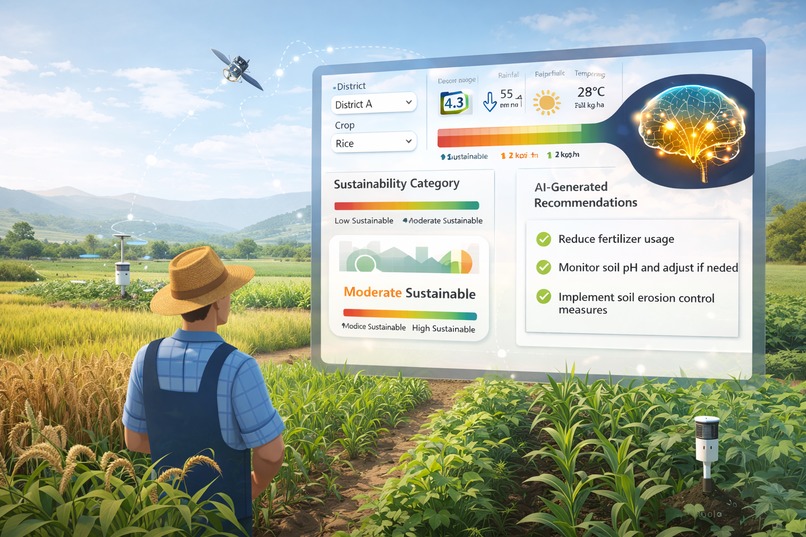
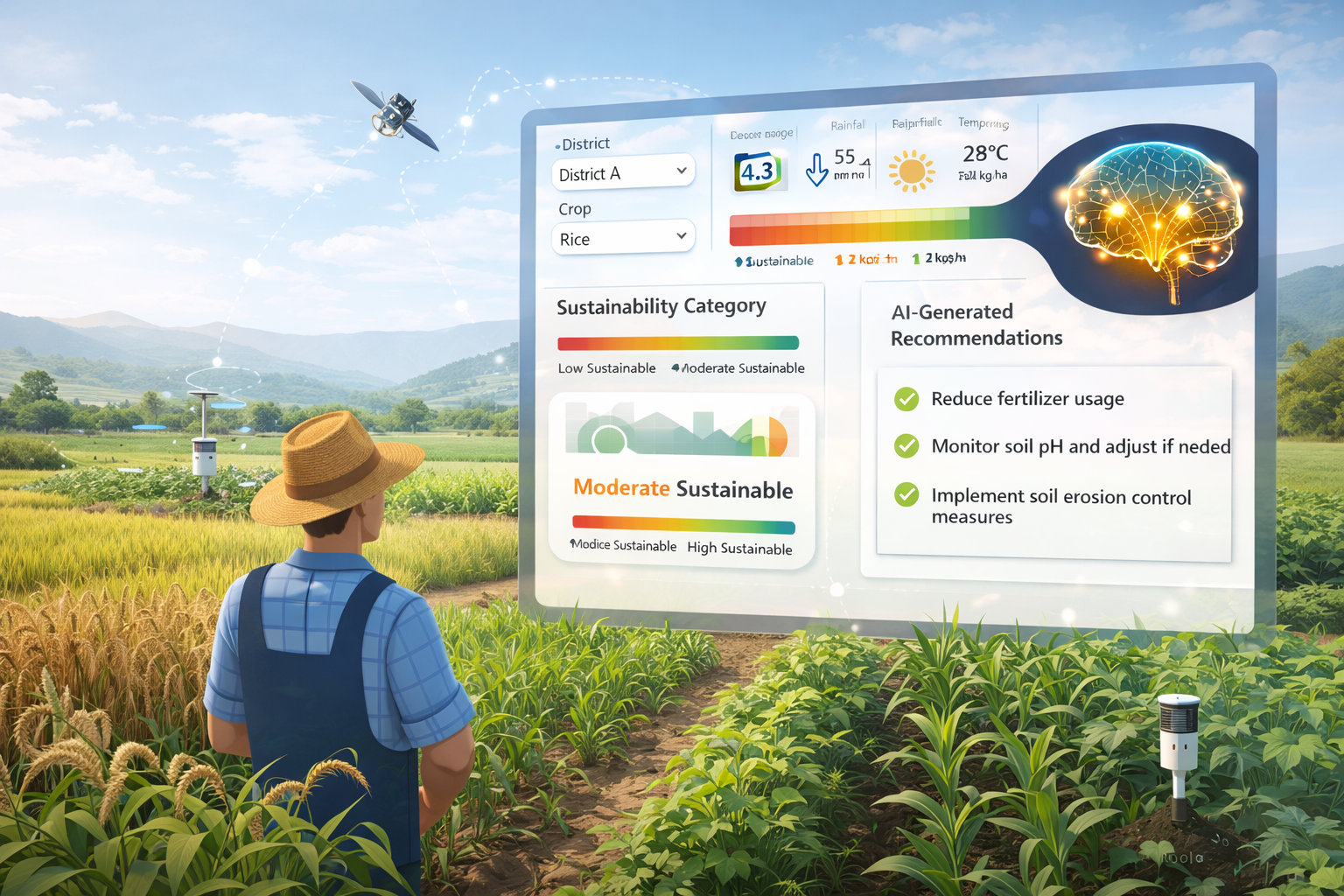
The system provides an AI-driven decision-support platform that predicts agricultural sustainability outcomes and transforms them into actionable recommendations. It combines machine learning–based sustainability classification with a Large Language Model (LLM) to deliver explainable, context-aware insights at the district and crop level.
Users select a district and crop type through an interactive interface, upon which the system:
1) Predicts the sustainability category of the selected farm or region
2) Identifies key agronomic and environmental risk factors influencing sustainability
3) Generates practical, crop- and location-specific recommendations to improve resource efficiency and environmental performance.
By integrating predictive analytics with intelligent recommendation generation, the platform bridges the gap between sustainability assessment and real-world agricultural decision-making, enabling farmers, extension officers, and policymakers to take targeted, data-informed actions toward sustainable farming practices.
How we built it
Challenges we ran into
While the model demonstrates strong performance in identifying low sustainability cases, its ability to distinguish highly sustainable farms plateaus due to overlapping class characteristics and noise introduced by composite sustainability scoring. Despite extensive outlier treatment, feature engineering, and model optimization, further gains were limited—indicating that performance constraints stem primarily from data quality and the absence of fine-grained agronomic and management variables rather than model capacity. Achieving meaningful improvements will require richer efficiency metrics, improved environmental stress indicators, and access to higher-resolution, longitudinal datasets.
Accomplishments that we're proud of
a) Built an end-to-end AI-driven sustainability assessment system that integrates machine learning predictions with LLM-based, context-aware recommendations.
b) Successfully transformed static sustainability scores into actionable, explainable guidance tailored to district- and crop-specific conditions.
c) Designed and implemented an intuitive Gradio interface that enables non-technical users to interactively explore sustainability insights and recommendations.
d) Demonstrated a realistic understanding of model limitations by rigorously evaluating data quality constraints and avoiding overfitting or misleading performance claims.
e) Established a scalable and modular architecture that can be extended to incorporate real-time data, longitudinal analysis, and advanced agronomic indicators in future iterations.
What we learned
1) Composite sustainability scores often introduce class overlap and noise, which limits discriminative power and highlights the importance of transparent score construction and explainability.
2) Integrating machine learning with large language models significantly improves usability by translating predictions into interpretable, context-aware recommendations.
3) High model performance is not always achievable through algorithmic complexity alone; data quality, feature relevance, and domain specificity play a decisive role in sustainability prediction.
What's next for FarmReason AI !!
1) Richer Data Integration: Incorporate high-resolution satellite imagery, IoT sensor data, and longitudinal farm records to capture temporal trends and reduce noise in sustainability signals.
2) Real-Time Decision Support: Enable near–real-time sustainability monitoring by integrating weather forecasts, market signals, and early-warning alerts for stress conditions.
3) What-If Analysis: Enable farmers to test scenarios such as reduced fertilizer use or altered irrigation schedules and observe sustainability trade-offs.
4) Localized Benchmarking: Compare farm sustainability performance against district or regional baselines.
Built With
- gradio
- langchain
- llm
- python
- txtai

Log in or sign up for Devpost to join the conversation.