Inspiration
FarmPilot AI was born from direct, personal experience in small-scale farming. As a tomato farmer managing a 200-square-meter plot, I consistently faced uncertainty in daily decision-making. I did not have reliable guidance on when to water, when to apply fertilizer, or how changing weather conditions would affect my crops. These decisions were often based on guesswork, which led to inconsistent yields and limited profit.
This challenge is not unique. Many local farmers across Cebu and across the Philippines operate under similar conditions—limited access to data, tools, and structured guidance. Despite their experience, they lack simple systems that translate farm conditions into clear, actionable decisions. FarmPilot AI was created to address this gap by providing a practical, accessible decision-support tool tailored for small-scale farmers.
What it does
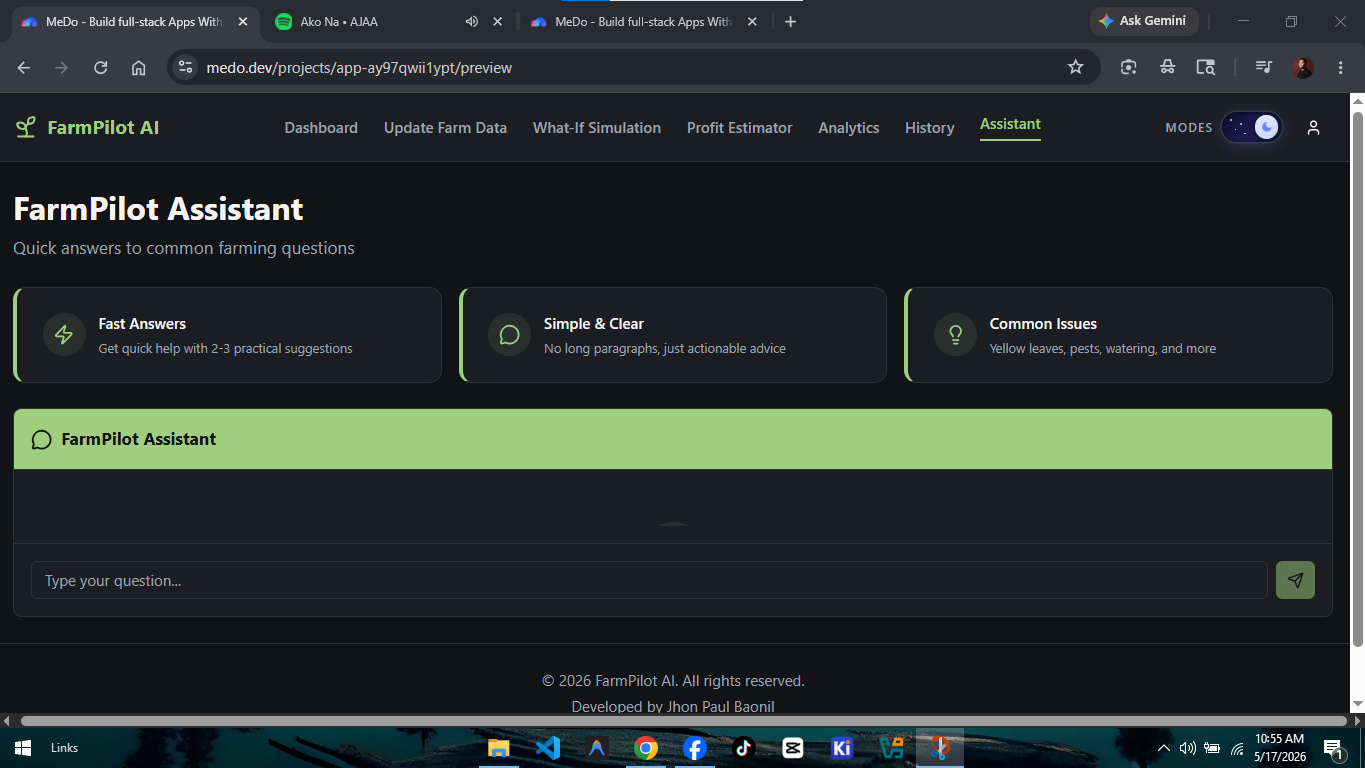
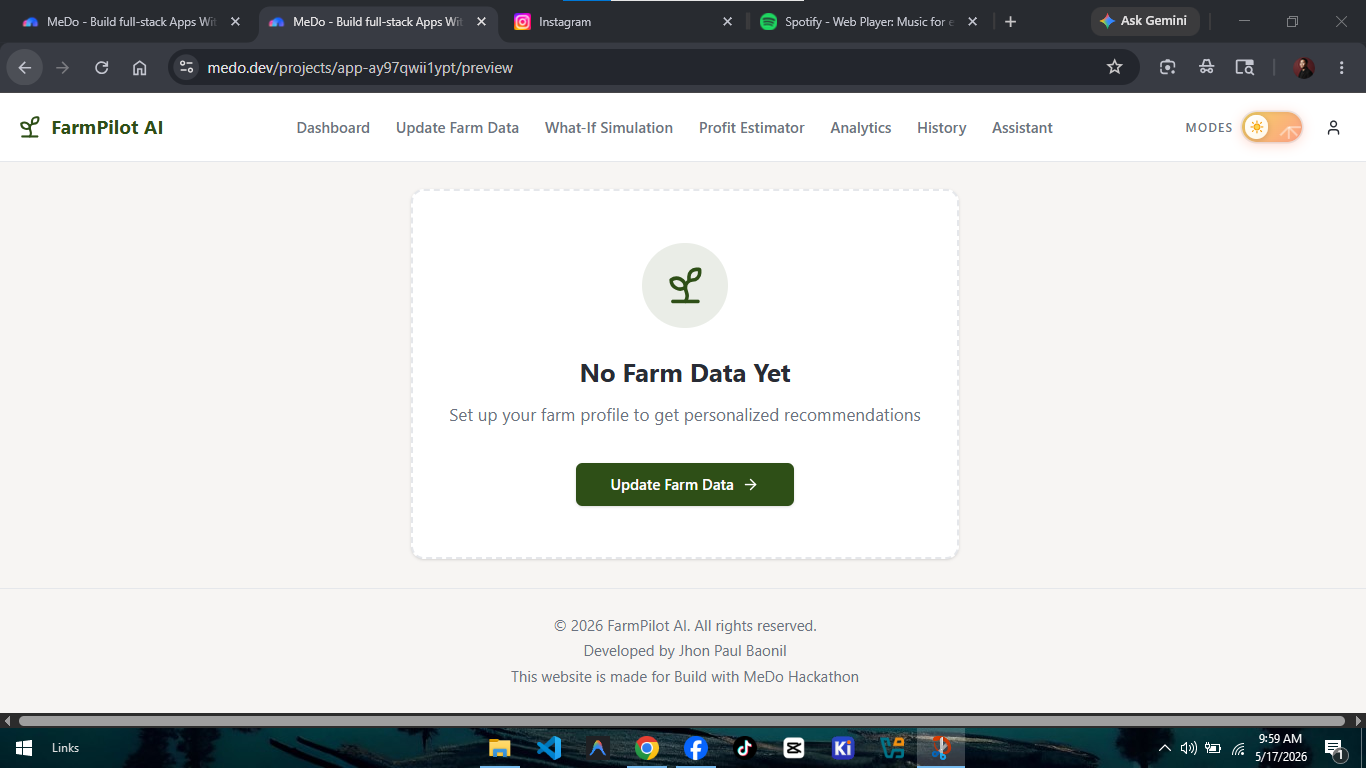
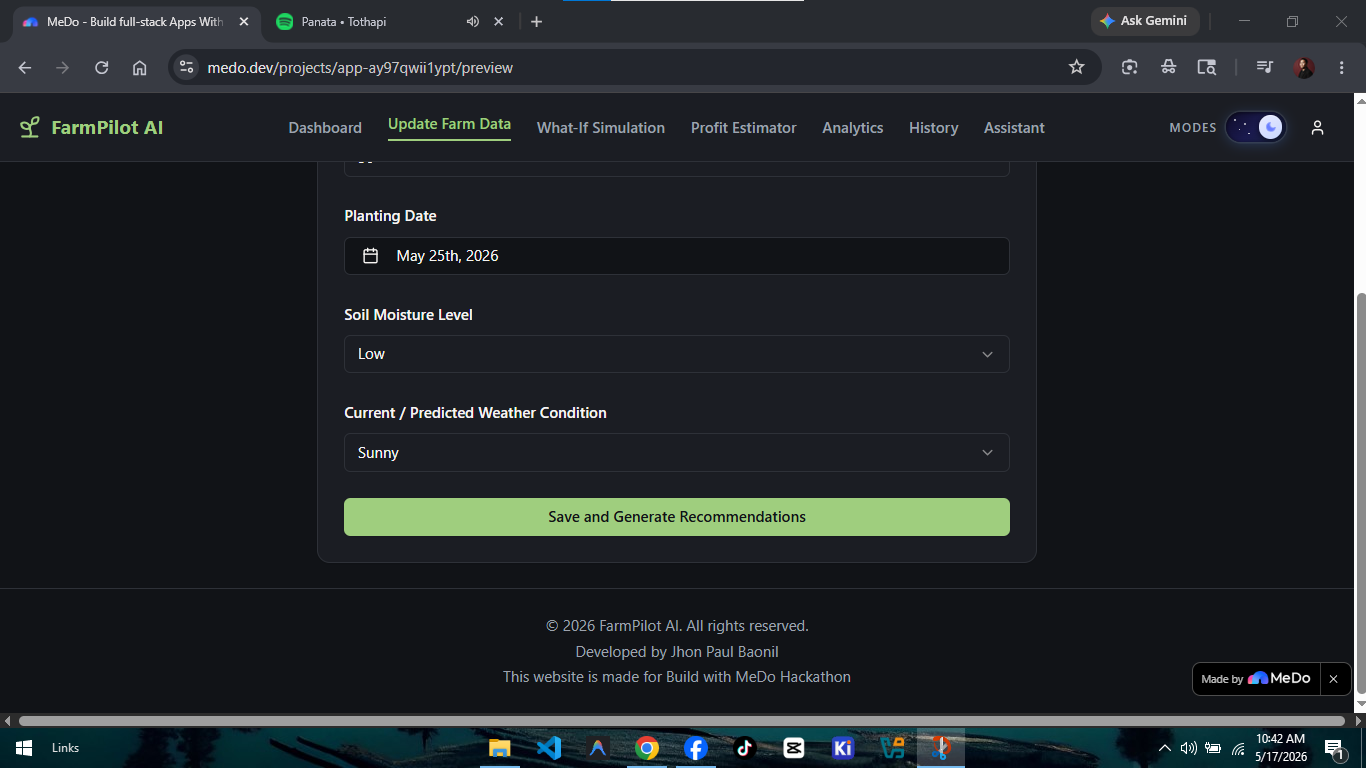
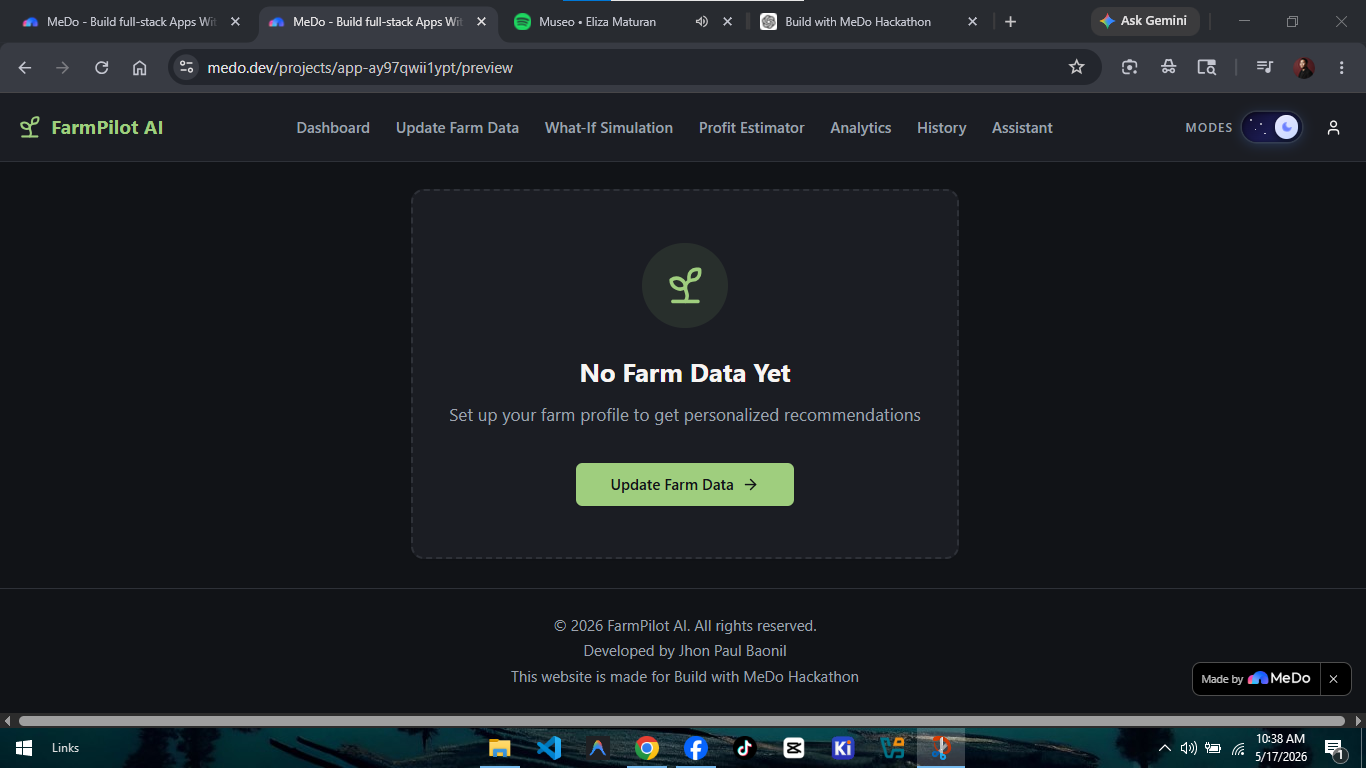
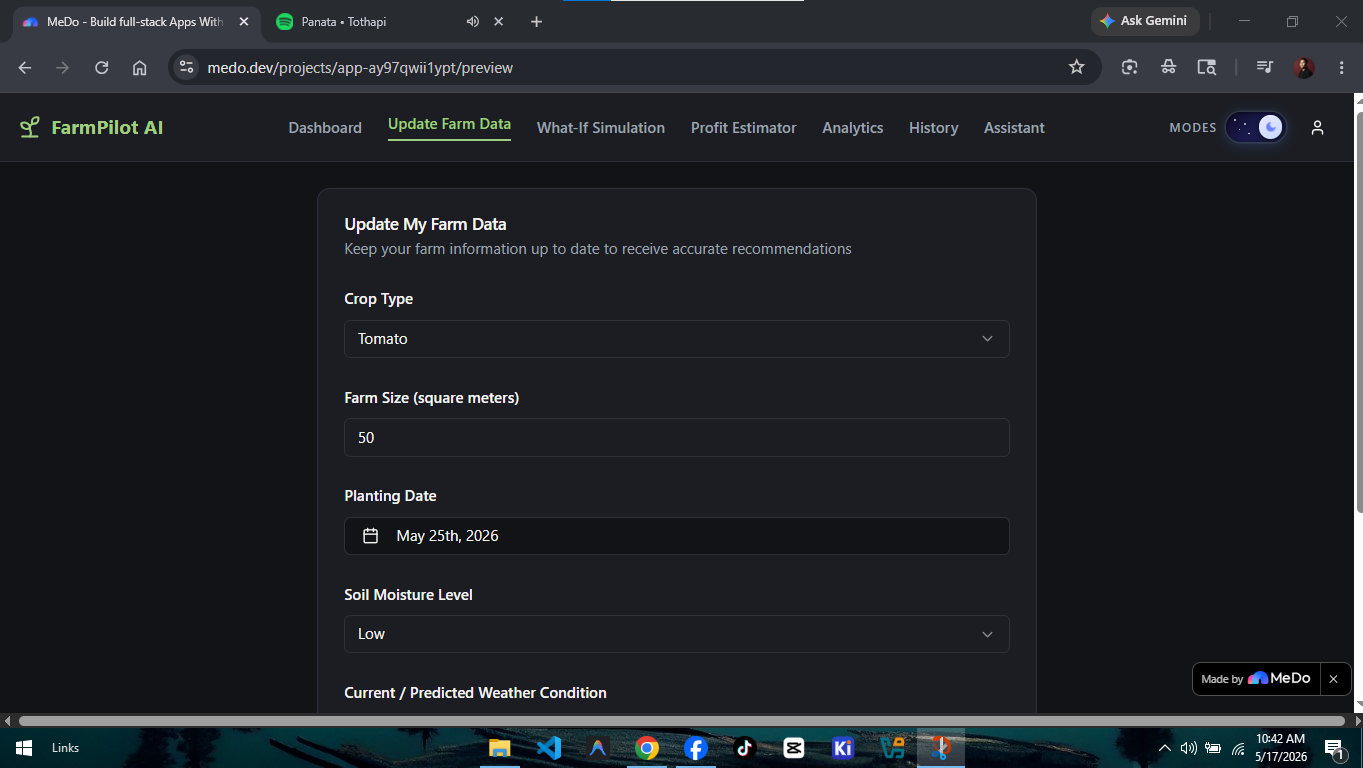
FarmPilot AI is a smart, AI-assisted web application that helps farmers make informed daily decisions based on their farm conditions. It generates personalized recommendations using inputs such as crop type, soil moisture, planting date, and weather conditions. Each recommendation is presented in clear, natural language with an explanation of why it is suggested.
The platform includes a daily dashboard that prioritizes critical actions, highlights risks such as disease or overwatering, and provides general guidance aligned with the crop’s growth stage. A What-If Simulation feature allows farmers to explore how changes in conditions, such as weather or soil moisture, would affect their decisions before taking action.
The Profit Estimator provides a simple financial model:
Estimated Revenue:
$$ \text{Revenue} = \text{Yield} \times \text{Selling Price} $$Estimated Profit:
$$ \text{Profit} = \text{Revenue} - \text{Operational Costs} $$
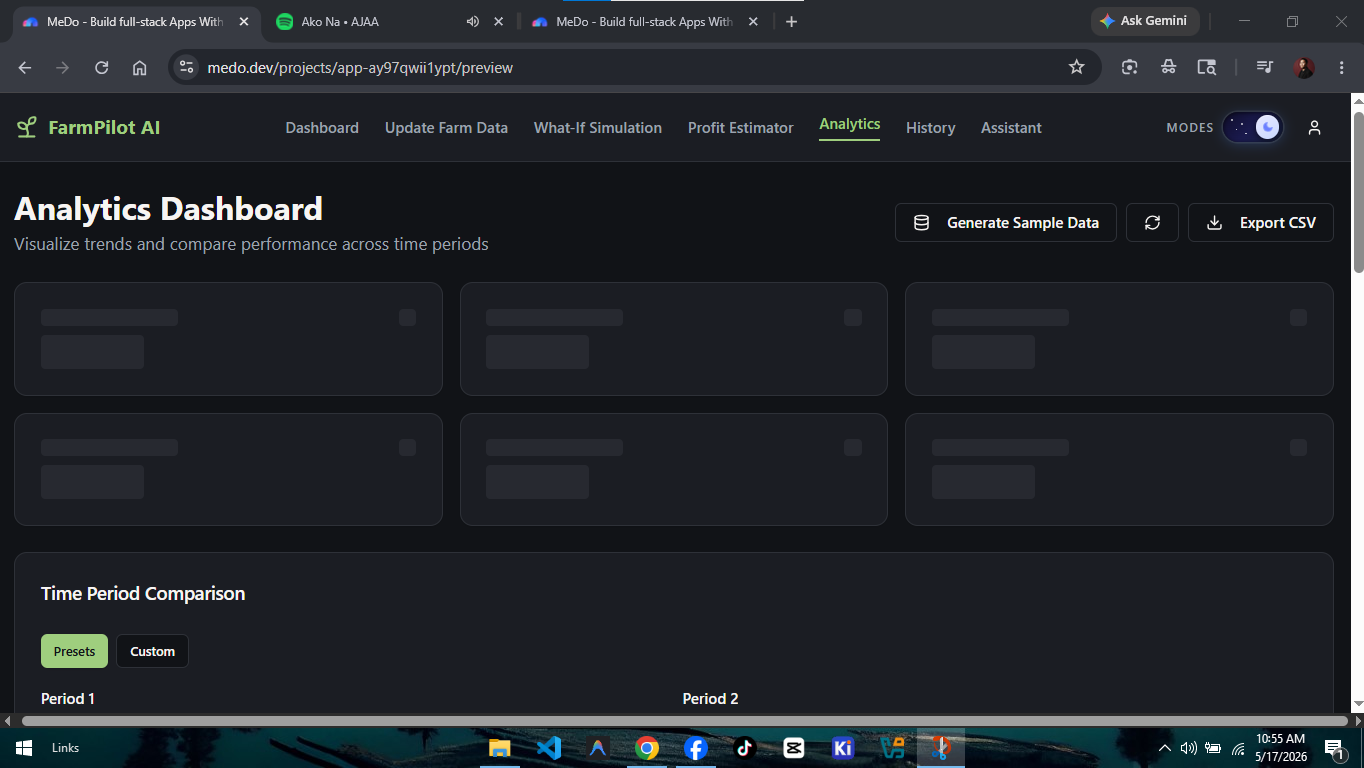
The Analytics Dashboard visualizes trends in performance, costs, and recommendation adoption over time, helping farmers evaluate their decisions using historical data.
To ensure usability in real-world environments, the application supports offline access to previously saved data and allows users to export their farm data and recommendations as a structured report.
How we built it
FarmPilot AI was designed as a structured web application with a clear separation between user interface, business logic, and data handling. The frontend was developed using standard web technologies, focusing on clarity, responsiveness, and ease of use for non-technical users.
At the core of the system is a rules-based recommendation engine. This engine evaluates combinations of farm inputs and generates context-aware recommendations with associated risk levels and explanations. The logic follows conditional evaluation patterns such as:
$$ \text{If } (\text{Soil Moisture} = \text{Low}) \land (\text{Weather} = \text{Sunny}) \rightarrow \text{High-Risk Action} $$
These rules are modular and can be extended to support additional crops and conditions.
Data persistence is used to store farm profiles, recommendation histories, and adoption events, enabling features such as historical tracking and analytics. Local caching mechanisms were implemented to support offline access, ensuring that farmers can still view their most recent data even without internet connectivity.
The Analytics Dashboard transforms raw data into structured insights through time-series analysis and aggregation:
$$ \text{Adoption Rate} = \frac{\text{Adopted Recommendations}}{\text{Total Recommendations}} \times 100\% $$
Challenges we ran into
One of the main challenges was translating real farming practices into a structured decision system. Farming decisions are often situational and experience-based, making it difficult to formalize them into deterministic rules without oversimplifying important nuances.
Another challenge was designing the application for users with minimal technical background. The interface needed to remain simple while still presenting complex information such as risk levels, comparisons, and analytics in a way that is easy to understand and act upon.
Handling offline functionality introduced additional complexity. The system needed to ensure consistency between cached data and server data while preventing invalid operations during offline states.
Finally, aligning advanced features such as analytics and simulation with the available data required careful validation to ensure that outputs remain meaningful and accurate.
Accomplishments that we're proud of
We successfully transformed a real-world farming problem into a functional digital solution that provides immediate practical value. The system does not only generate recommendations but also explains them, helping farmers understand the reasoning behind each action.
The What-If Simulation feature enables comparative analysis between current and hypothetical conditions, allowing farmers to evaluate decisions before implementation.
The inclusion of offline support ensures that the application remains usable in environments with limited connectivity, reflecting real-world constraints faced by many farmers.
The Analytics Dashboard introduces structured performance tracking, enabling users to move from intuition-based decisions to data-informed strategies.
What we learned
This project reinforced the importance of designing technology that aligns closely with real user needs. Direct farming experience provided critical insight into the actual problems that needed to be solved.
We learned that clarity is essential. Even when systems involve complex logic, outputs must remain concise and actionable. Providing explanations alongside recommendations significantly improves usability and trust.
From a technical perspective, we gained experience in structuring rule-based systems, handling application state across online and offline environments, and designing scalable data-driven features.
What's next for FarmPilot AI
The next phase for FarmPilot AI is to evolve from a rules-based system into a more adaptive and data-driven platform. This includes integrating real-time data sources and enhancing the recommendation engine with more advanced models.
We plan to expand data inputs to include operational metrics such as yield, labor, and input costs, improving the accuracy of analytics and financial insights.
Future development will also focus on broader accessibility, including support for additional crops, improved mobile usability, and localization for different farming communities.
The long-term objective is to build a reliable digital assistant that enables small-scale farmers to make informed decisions, optimize productivity, and achieve more sustainable and profitable farming outcomes.
Built With
- html5
- javascript
- json
- medo
- npm
- supabase
- typescript

Log in or sign up for Devpost to join the conversation.