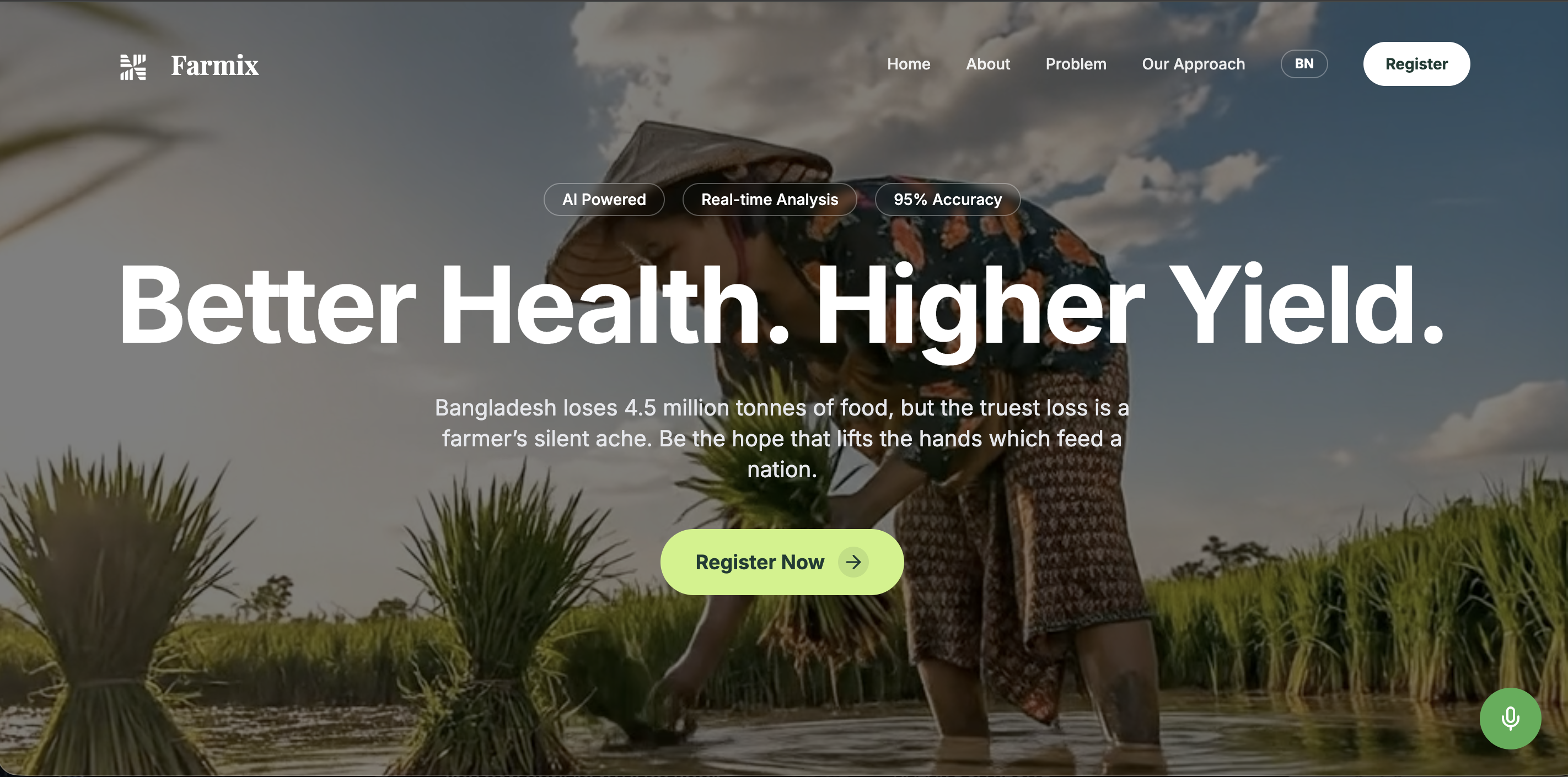
About the Project Inspiration The inspiration for Farmix stems from a stark reality in Bangladesh: while our farmers work tirelessly, nearly 30% of their produce is lost before it ever reaches a consumer. Seeing the struggle of local farmers dealing with predatory middlemen and lack of storage insights, I wanted to build a bridge. Farmix (formerly HarvestGuard) was born to transform the agricultural supply chain from a series of leaks into a streamlined, tech-enabled ecosystem.
What I Learned Building this project was a deep dive into the intersection of Agritech and Supply Chain Management. I learned that technology isn’t just about code; it’s about understanding the user’s environment. I gained significant experience in building resilient backends to handle real-time data and learned how to simplify complex UI for users who may not be tech-savvy.
How I Built It The project was developed with a focus on scalability and accessibility. I used a modern frontend framework to ensure the dashboard remains responsive on low-end mobile devices, which are common in rural areas. The core logic involves a matching algorithm that connects harvest timelines with market demand to minimize "idle" time for perishable goods.
Challenges Faced One of the biggest hurdles was designing a system that works with intermittent internet connectivity. I had to implement local caching strategies so farmers could input data offline. Additionally, creating a transparent pricing model that accounts for fluctuating market rates required careful data structuring.
Built With
- api
- authentication)-apis:-google-maps-api-(for-logistics-tracking)
- built-with-to-ensure-a-robust-and-scalable-application
- control:
- css3
- design:
- figma
- for
- git
- harvest
- i-utilized-the-following-tech-stack:-frontend:-html5
- javascript-(react.js)-backend-&-database:-firebase-(firestore-for-real-time-data
- planning)
- prototyping)
- ui/ux
- version
- weather


Log in or sign up for Devpost to join the conversation.