-
-
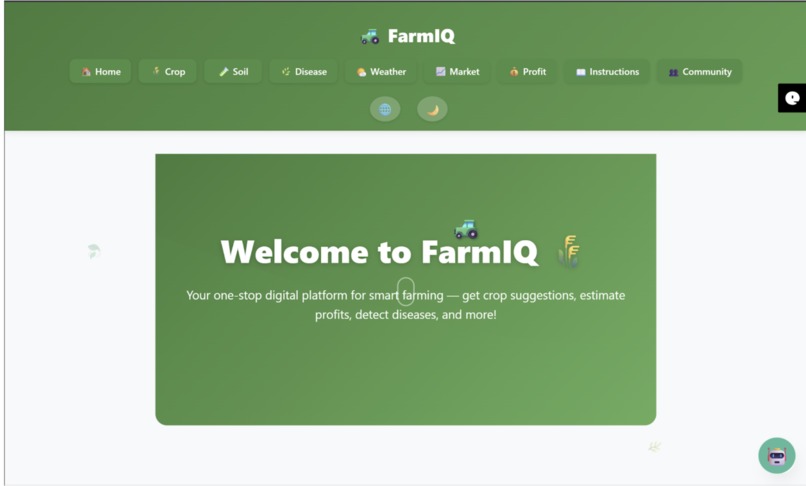
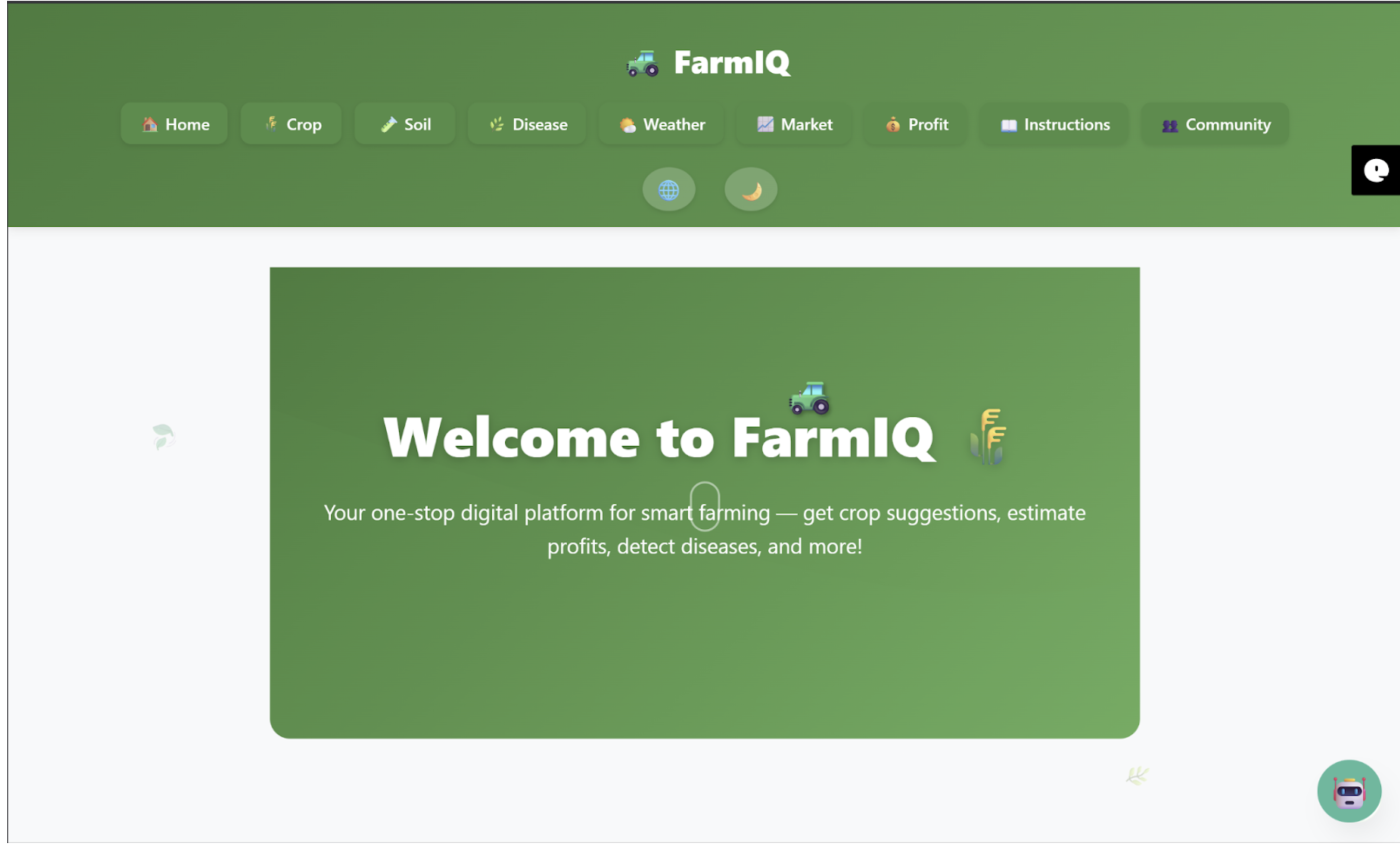
FarmIQ Dashboard
Inspiration Growing up in India, we see firsthand that farmers are the backbone of our country, yet they are often the most vulnerable to climate change and crop disease. We noticed a massive gap: while AI is transforming industries, the average farmer still lacks access to real-time, data-driven advice. We wanted to build FarmIQ to change that—moving from "guessing" to "knowing" by putting a data scientist in every farmer's pocket.
What it does FarmIQ is an all-in-one AI companion designed to maximize farm yield and minimize loss. It performs two core functions:
Precision Recommendation: By analyzing soil N-P-K levels and pH, it suggests the most profitable and sustainable crop for that specific patch of land.
Instant Diagnostics: Using computer vision, a farmer can simply take a photo of a struggling plant leaf, and the AI identifies the disease and provides immediate treatment advice.
How we built it We focused on a stack that ensures speed and reliability:
The Intelligence: We trained a HistGradientBoostingClassifier for the recommendation engine and a custom CNN (Convolutional Neural Network) using PyTorch for the image recognition.
The Engine: A FastAPI backend was chosen for its high performance and asynchronous capabilities, ensuring the AI models serve predictions instantly.
The Interface: A responsive React frontend designed with a "mobile-first" approach, keeping it intuitive for users who might not be tech-savvy.
Challenges we ran into The biggest hurdle was Data Diversity. Agricultural data is messy—soil types vary wildly by region, and leaf images taken in a field have varying light and backgrounds. Fine-tuning our CNN to distinguish between "healthy" and "slightly nutrient-deficient" leaves required rigorous data cleaning and augmentation to ensure the model didn't just work in a lab, but in a real, sun-drenched field.
Accomplishments that we're proud of We are incredibly proud of the Latency we achieved. By optimizing our PyTorch models, we managed to get diagnostic results back to the user in under two seconds. Seeing the system correctly identify a complex disease from a blurry smartphone photo was a "eureka" moment for the whole team.
What we learned This project taught us that AI is only as good as its accessibility. As developers, it’s easy to focus on accuracy metrics, but through FarmIQ, we learned that UI/UX is just as critical. If a farmer can’t navigate the app with one hand while in the field, the most accurate model in the world is useless.
What's next for FarmIQ - Farmer's AI Companion The roadmap includes:
Offline Support: Implementing "Edge AI" so the models can run without an active internet connection.
Market Integration: Connecting farmers directly to local vendors for the specific fertilizers or treatments recommended by the AI.
Vernacular Support: Adding voice-activated commands in regional Indian languages to make the tool truly inclusive for everyone.
Built With
- customwebscrapers
- fastapi
- git
- github
- googleaistudio
- javascript
- langchain
- openweathermap
- python
- pytorch
- react
- render
- scikit-learn
- sqlite
- torchvision

Log in or sign up for Devpost to join the conversation.