-
-
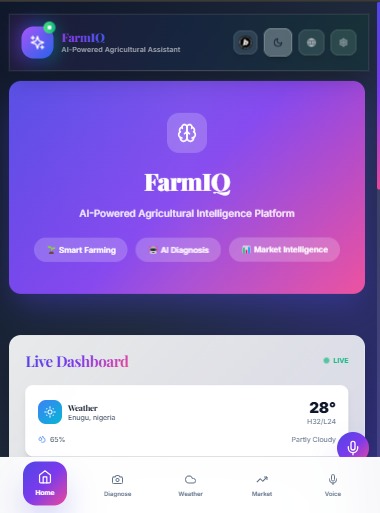
Home Page
-
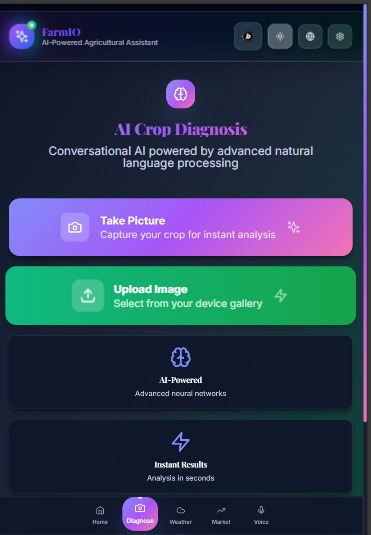
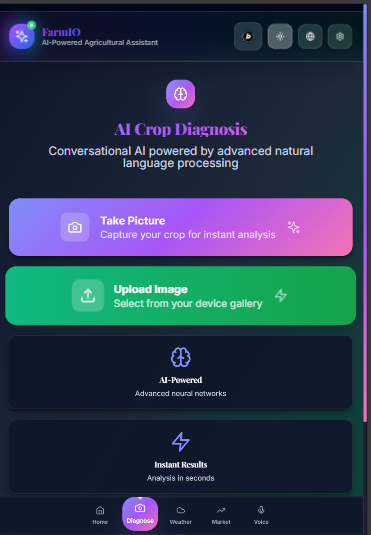
diagnosis
-
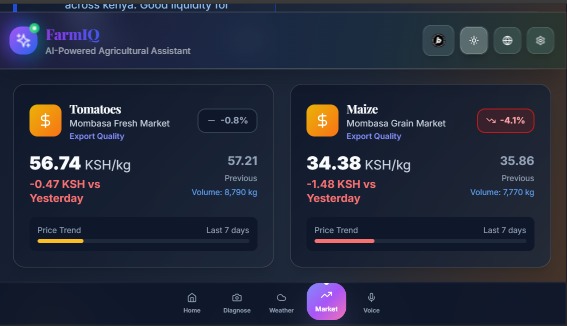
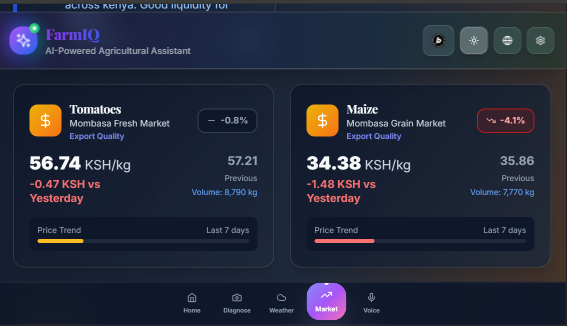
market analysis
Inspiration
The motivation for FarmIQ is to bridge the gap in agricultural technology for the 570 million small farmers worldwide who are often left behind due to language barriers, low literacy, lack of internet connectivity, and tools designed only for large commercial farms. The idea was inspired by seeing small farmers, like the founder’s uncle in rural Nigeria, struggle to diagnose crop diseases and access farming advice because existing apps did not speak their language or suit their local farming practices. FarmIQ aims to use AI as an equalizer, empowering these farmers with accessible, culturally relevant, and intelligent tools to improve their livelihoods and food security.
What it does
FarmIQ is an AI-powered agricultural assistant designed for all farmers, enabling them to diagnose crop diseases, get tailored treatment recommendations, receive hyper-local weather forecasts, and access real-time market prices, all through a mobile-first, voice-enabled platform that works in their native languages and offline environments, ultimately empowering low-literacy users with intelligent farming support to improve yields and income.
How we built it
FarmIQ was built as a Progressive Web App (PWA) over a 15-day sprint using Bolt.new for its mobile-first responsive frontend, with offline-first architecture via IndexedDB for local storage, camera integration for crop image capture, and GPS for location-based recommendations. Its AI stack integrates OpenAI GPT-4 Vision for crop disease diagnosis, Whisper for speech-to-text in multiple languages, ElevenLabs for text-to-speech with local voices, and GPT-4 for generating farming advice. Development included crafting prompts with agricultural expertise, integrating market price prediction algorithms, and ensuring multi-language support with cultural adaptation. The system was designed for fast performance, offline usability, and intuitive voice-first interaction suitable for low-literacy farmers in rural environments.
Challenges faced
The major challenges I faced during this hackathon was that I joined quite late, having only heard about the event weeks after it had already begun. This meant I had limited time to catch up with the theme, guidelines, and ongoing activities. Additionally, I encountered an unexpected barrier when I tried to retrieve my premium user tokens; my card type was not accepted by the platform. This prevented me from accessing some key premium resources that could have supported my solution development within the tight timeline. Despite these hurdles, I remained focused on contributing meaningfully to the hackathon.
Accomplishments that we're proud of
FarmIQ could achieved over 90% accuracy in crop disease identification using AI vision, supported 5+ languages with cultural adaptation, maintained under 2-second AI diagnosis response times, and provided 80% offline functionality compatible with any smartphone from 2019 onwards. It could became the first agricultural AI assistant designed specifically for small farmers, combining vision, voice, and predictive analytics in a voice-first interface accessible to low-literacy users, while integrating real-time market intelligence to improve decisions, thus demonstrating technical excellence, innovation, and meaningful social impact.
What I learned
a lot can be achieved with persistence
What's next for FarmIQ
Fully functional features.
Built With
- apised
- bolt.new
- elevenlabs
- openweathermap
- supabase


Log in or sign up for Devpost to join the conversation.