-
-
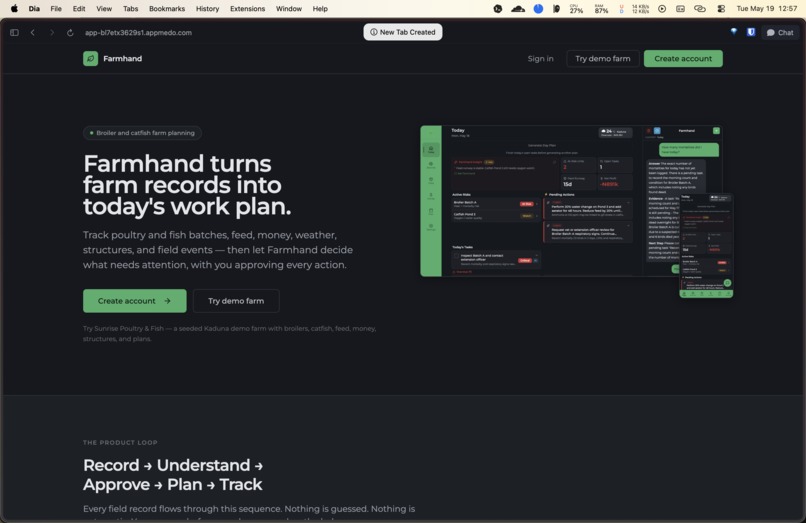
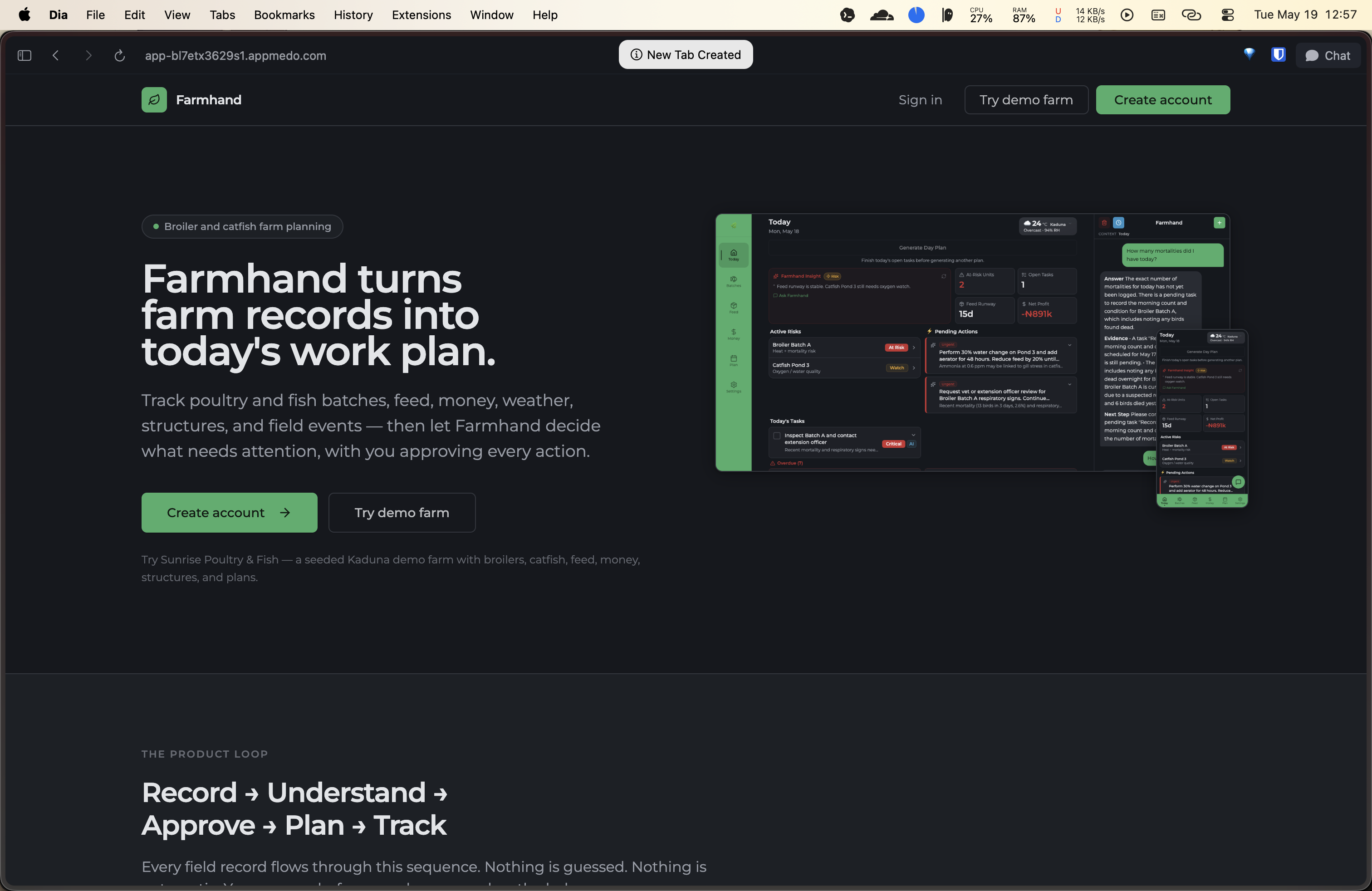
Homepage
-
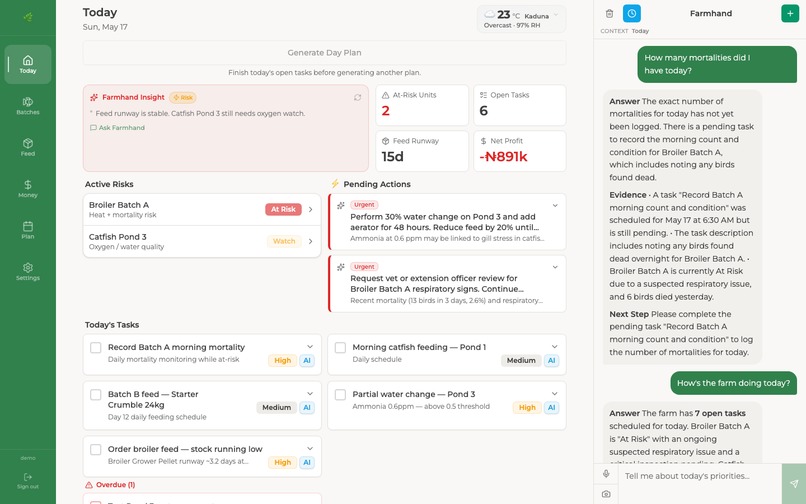
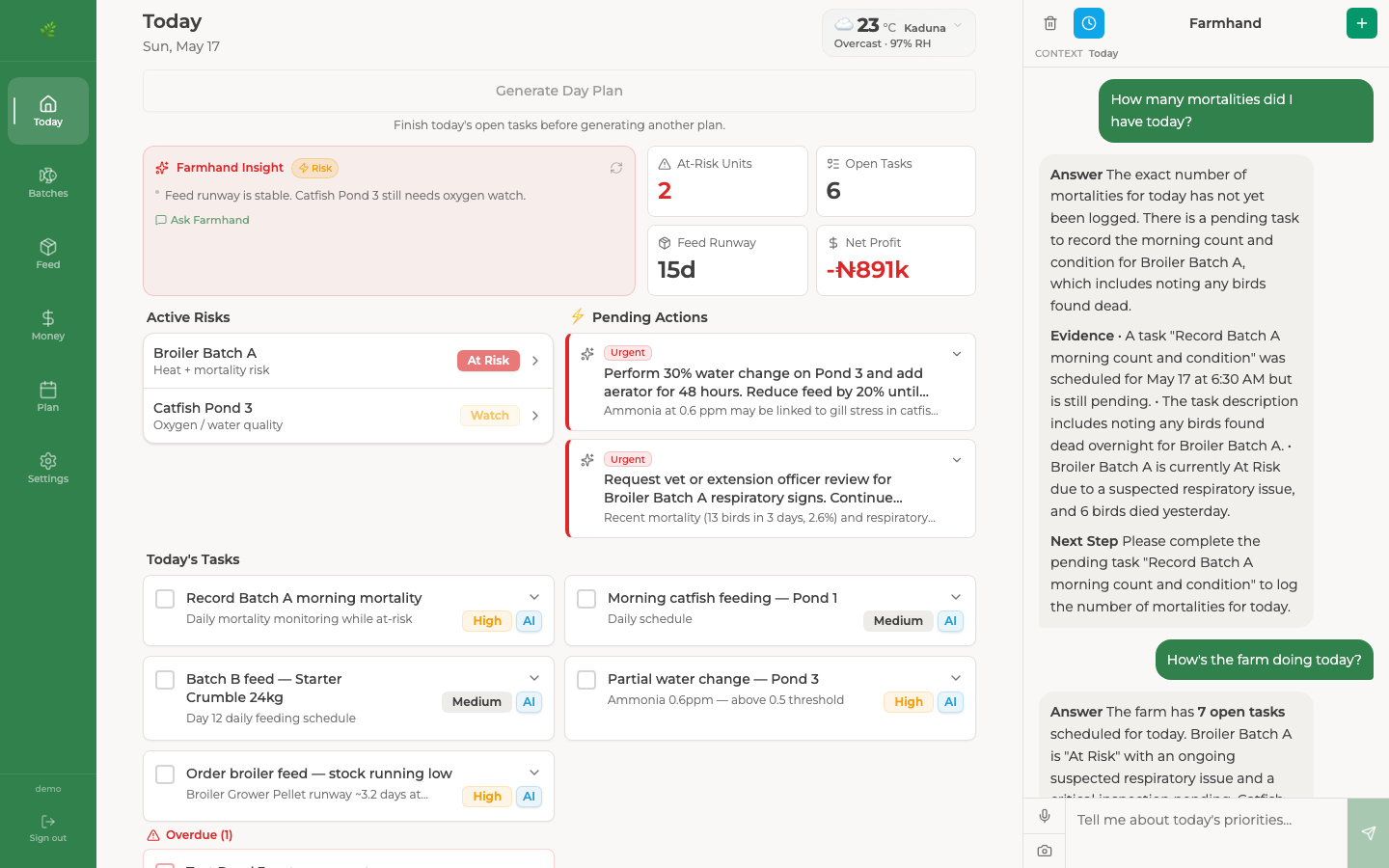
Today page showing the work for the day
-
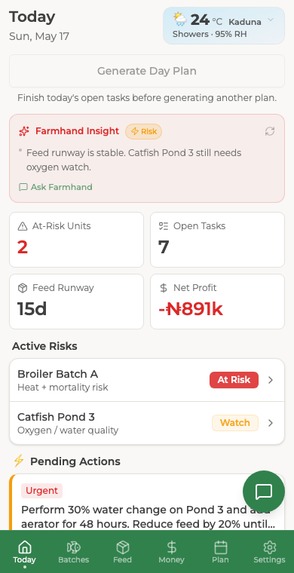
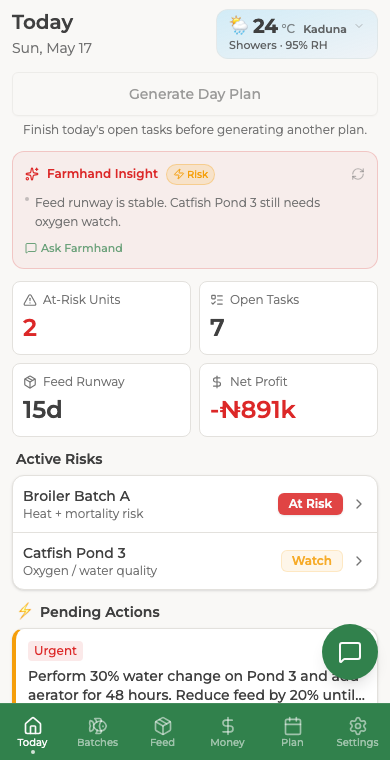
Today page on mobile light mode
-
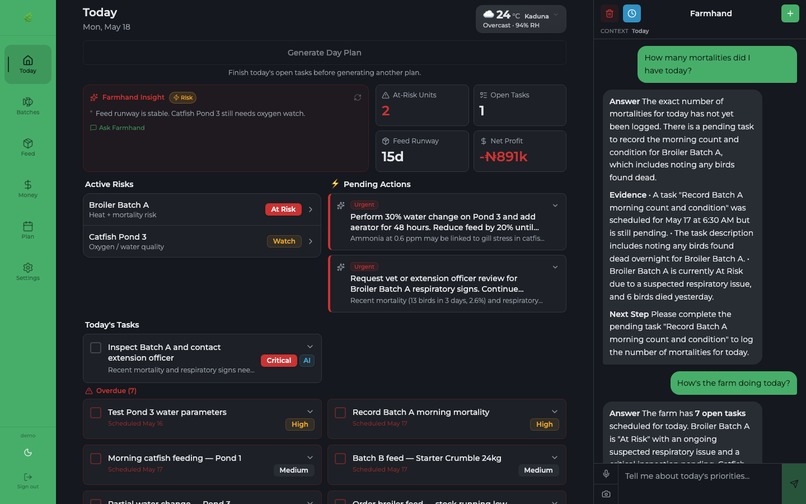
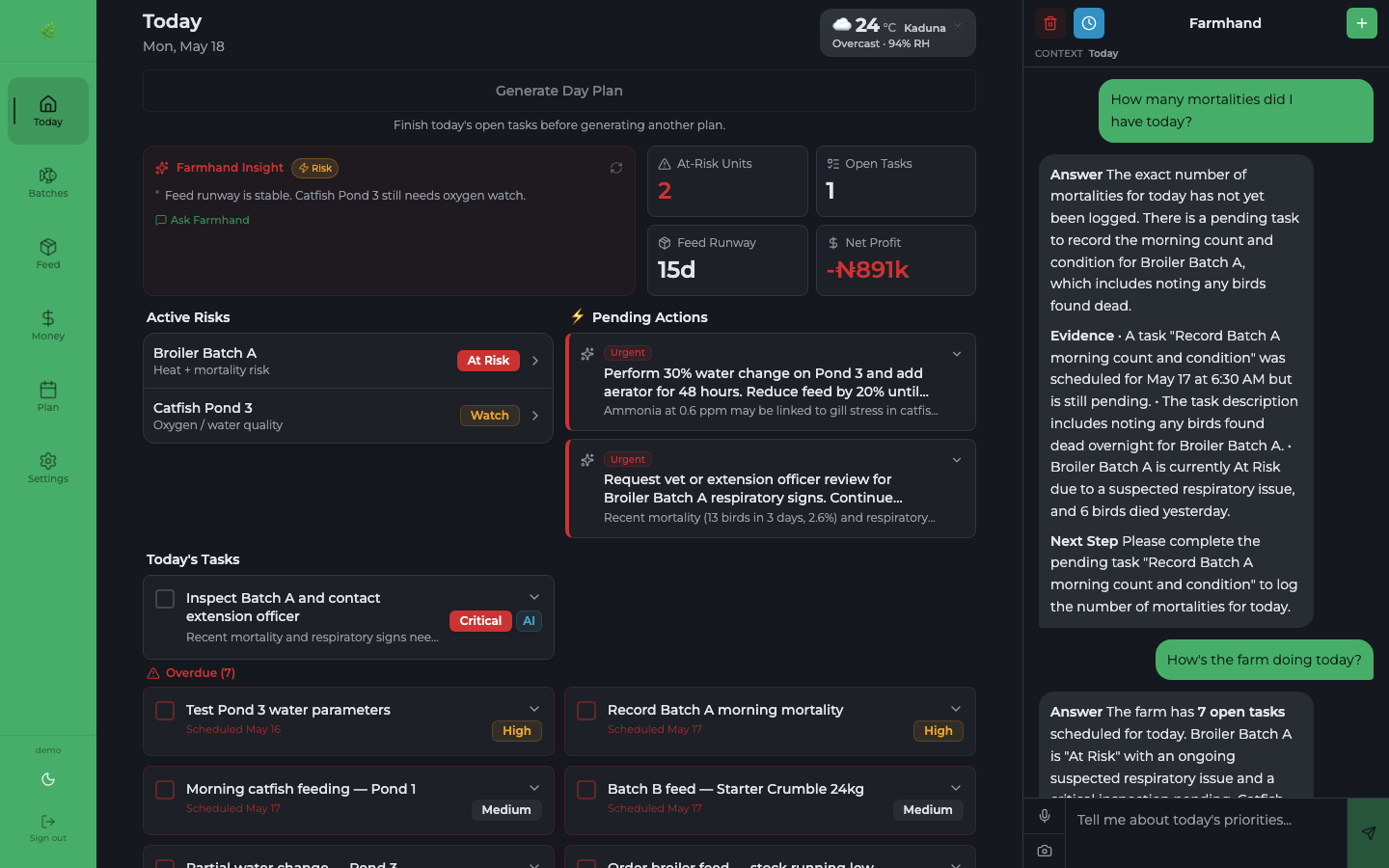
Today page in dark mode
-
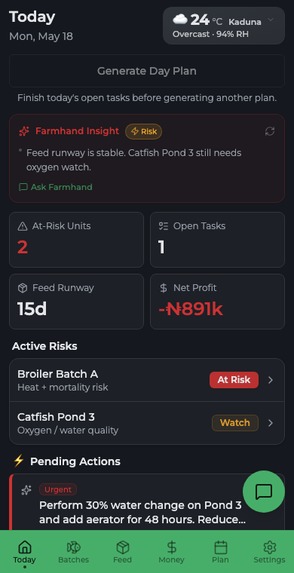
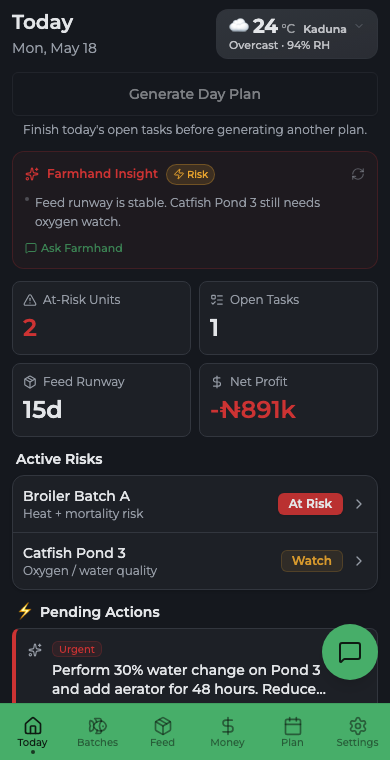
Today page on mobile dark mode
-
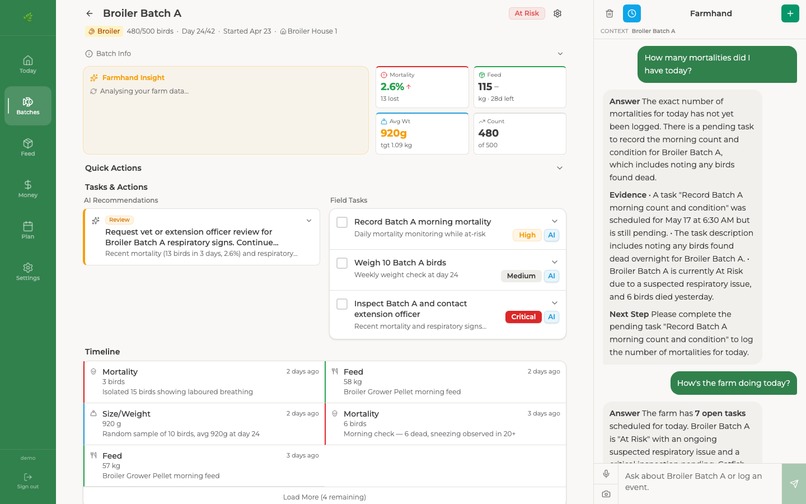
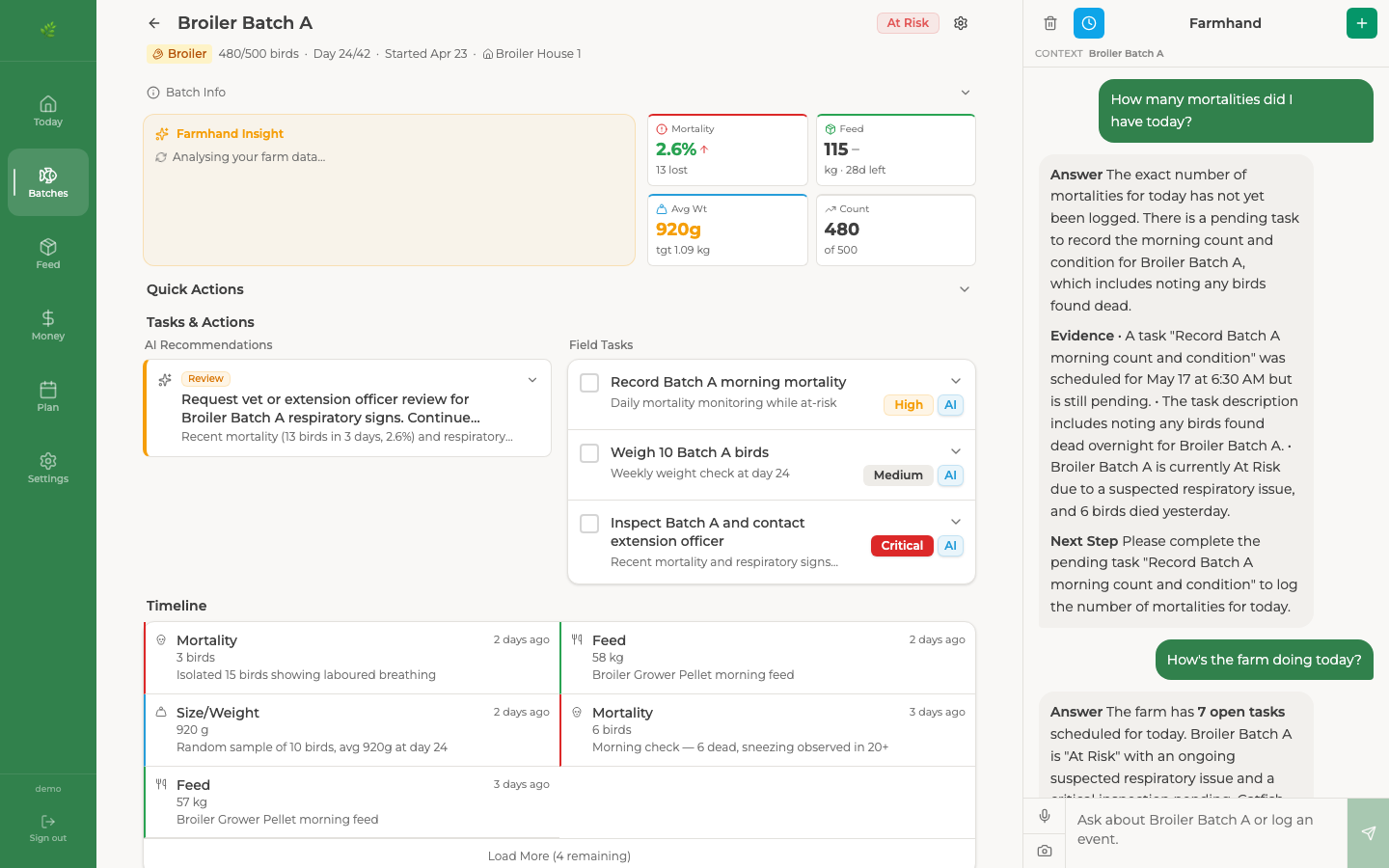
Batch Detail page, showing comprehensive batch details
-
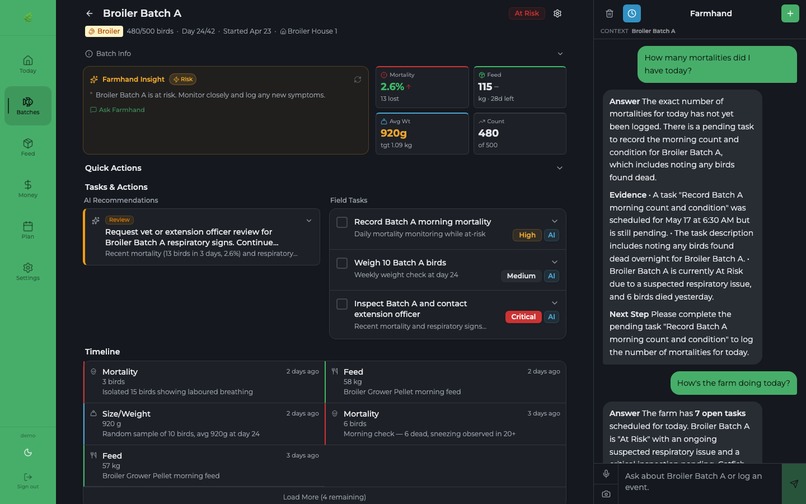
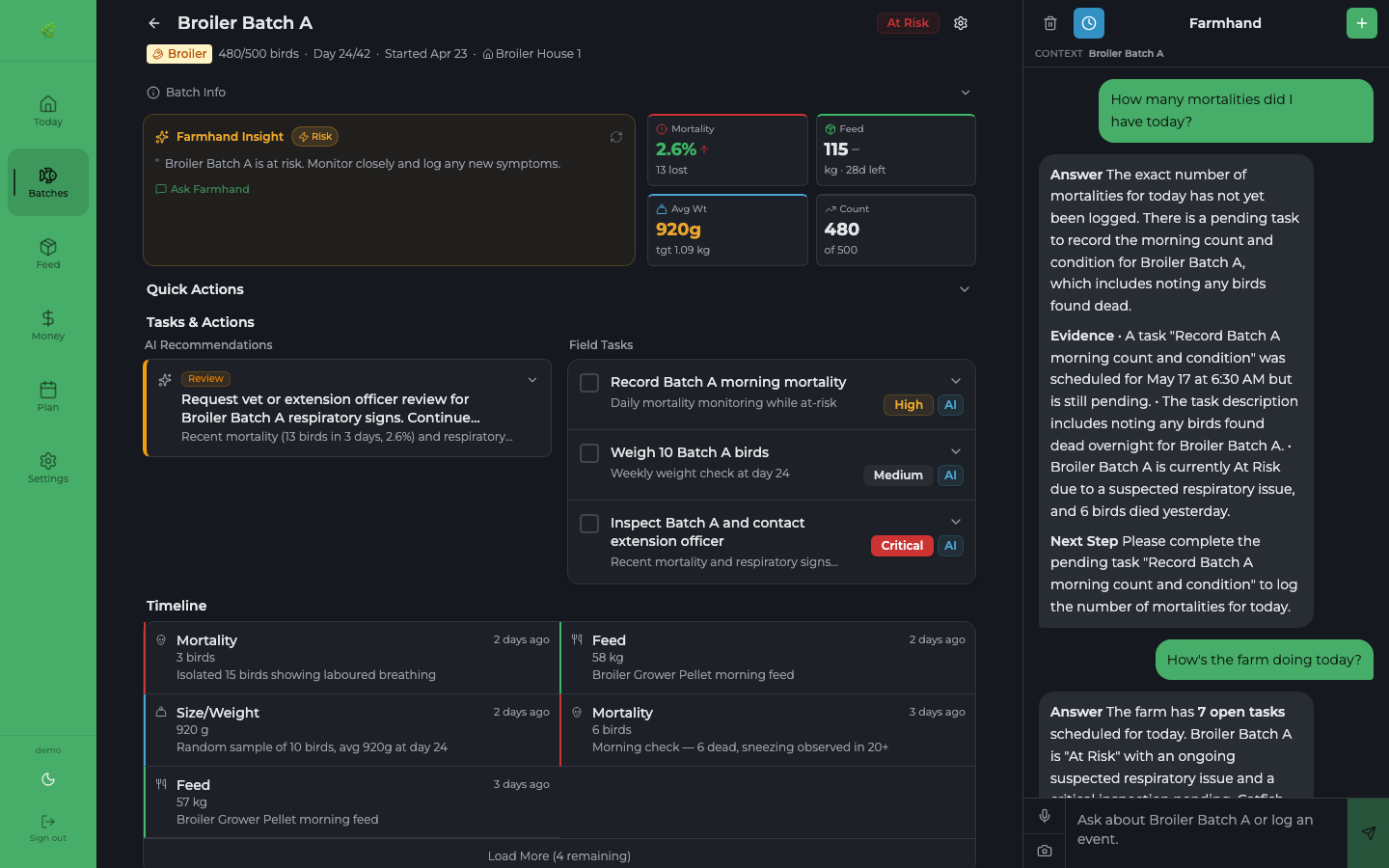
Batch Detail page in dark mode
-
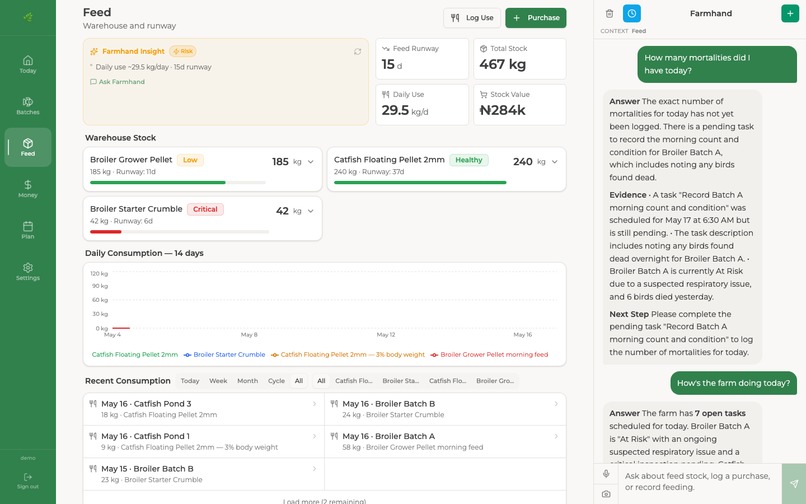
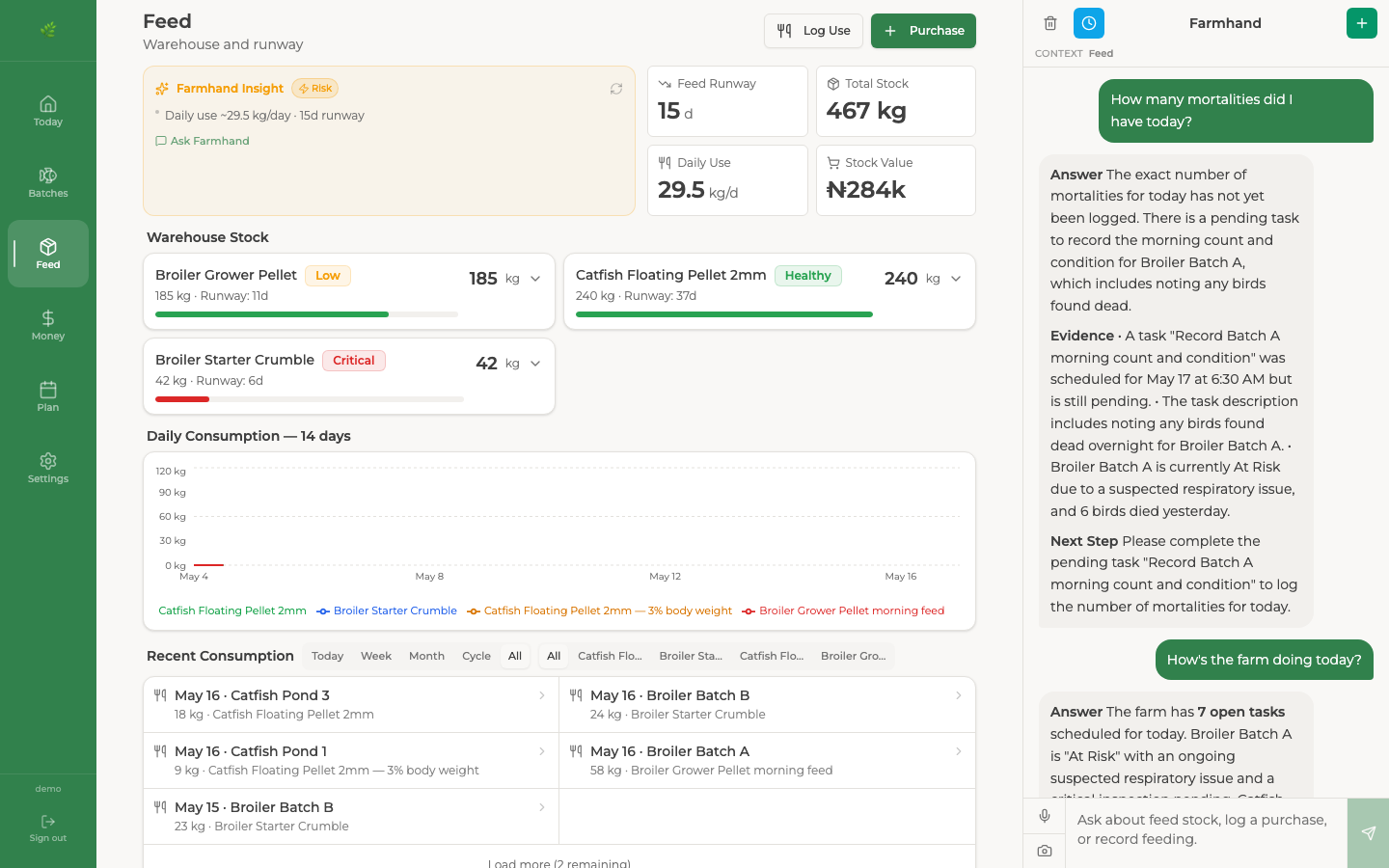
Feed page, for Feed Management
-
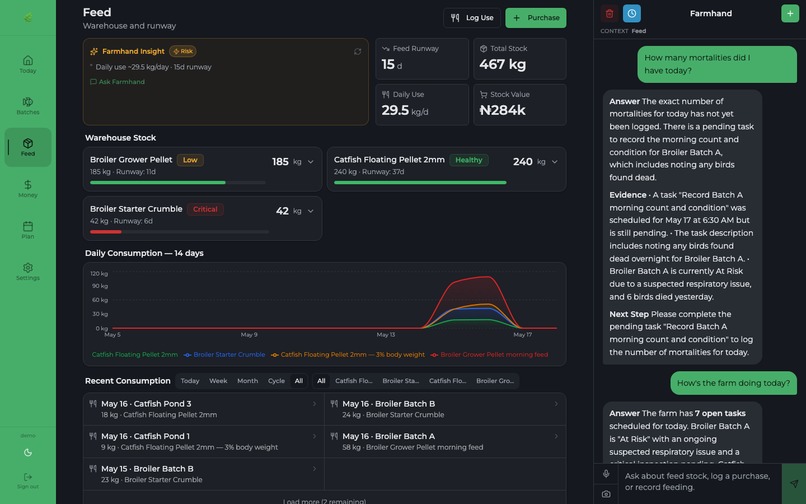
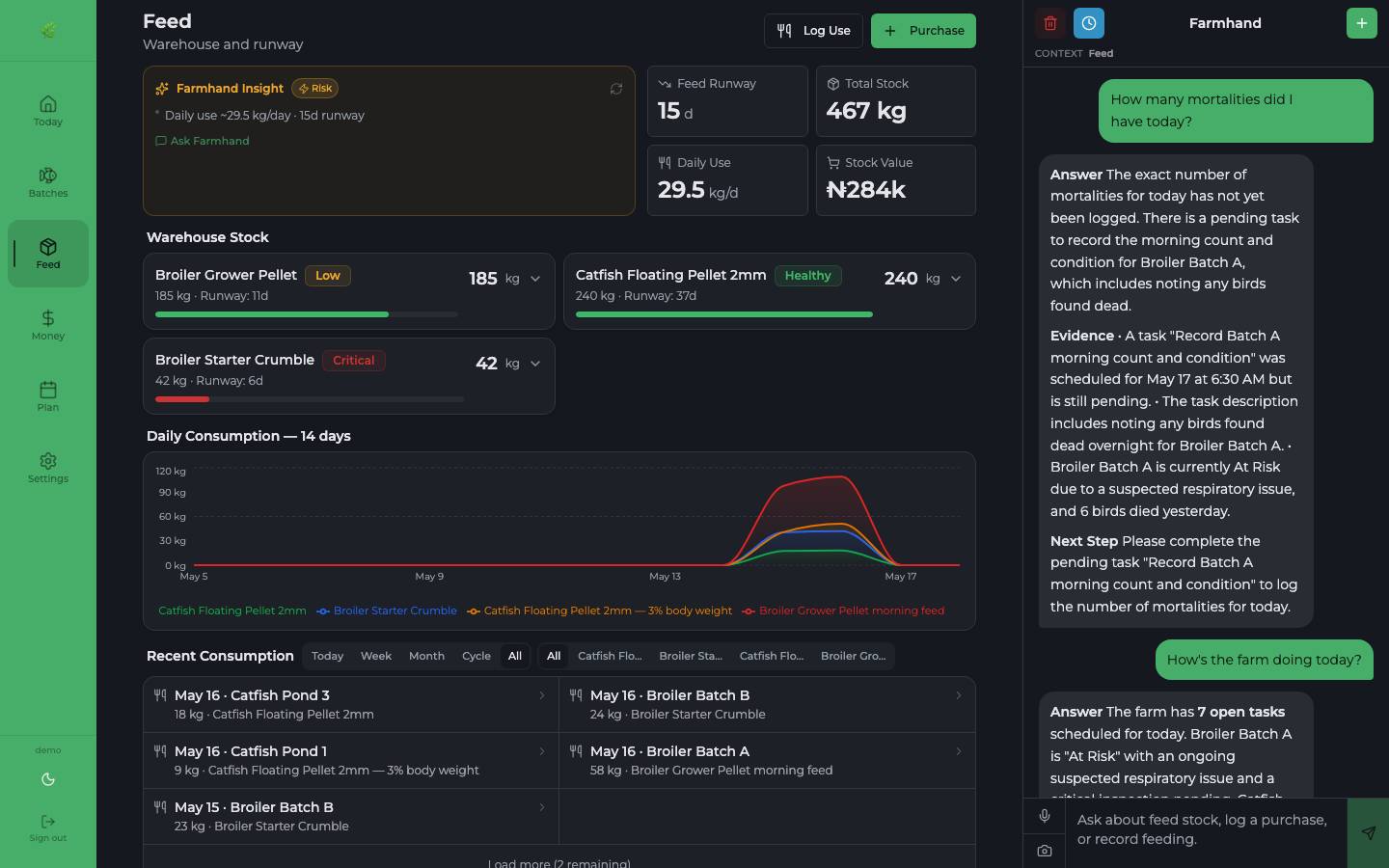
Feed page in dark mode
-
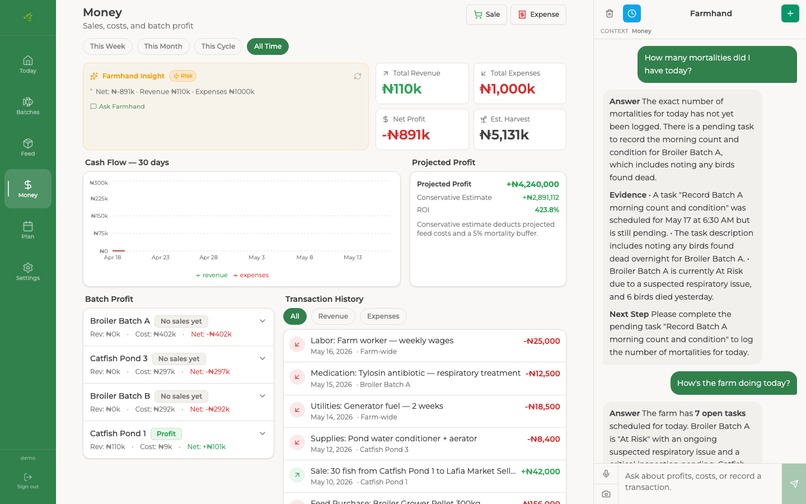
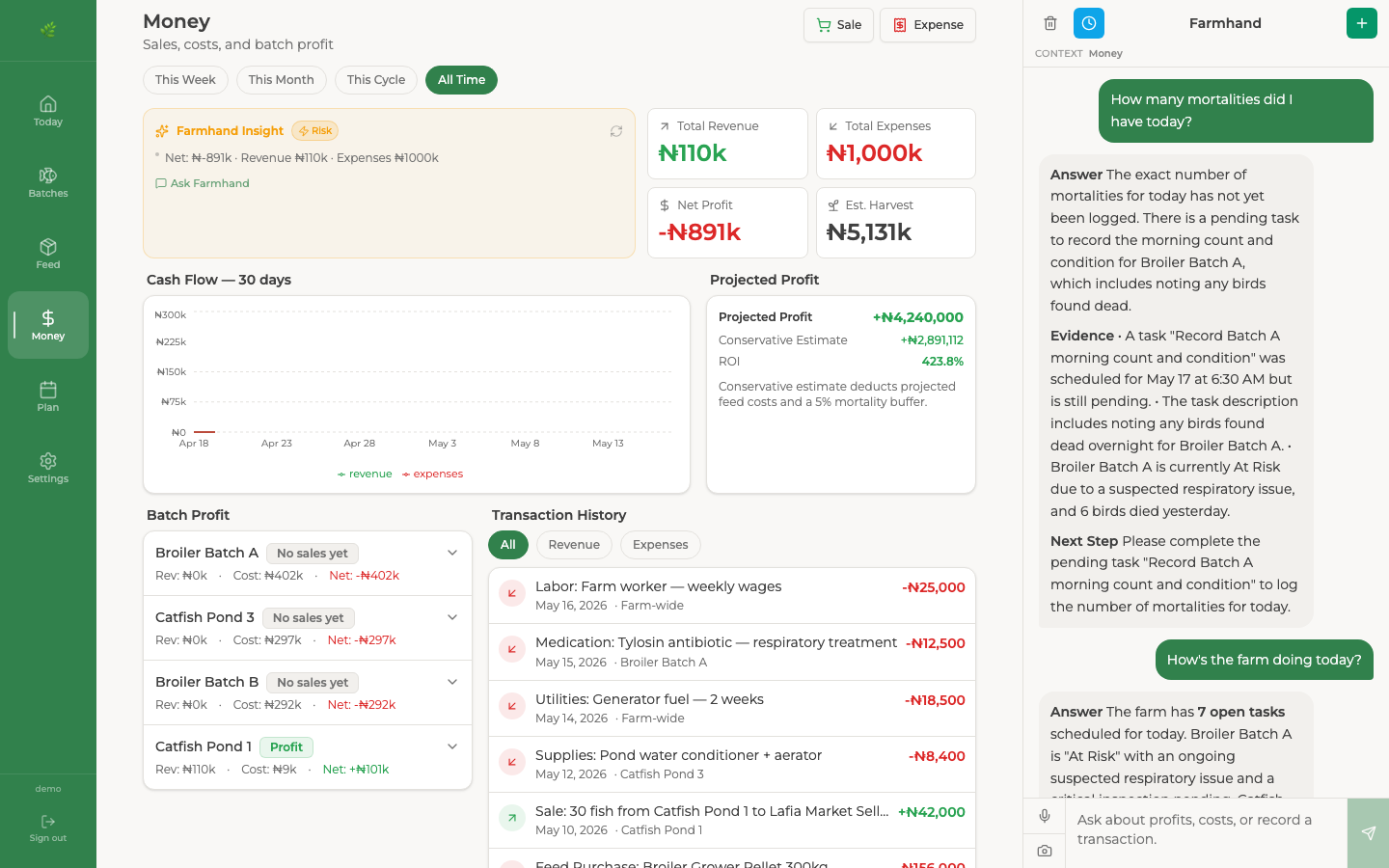
Money page for financial control
-
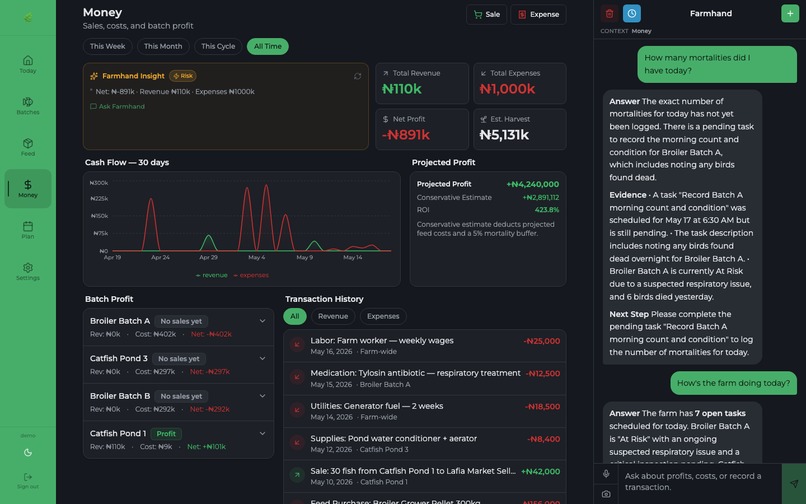
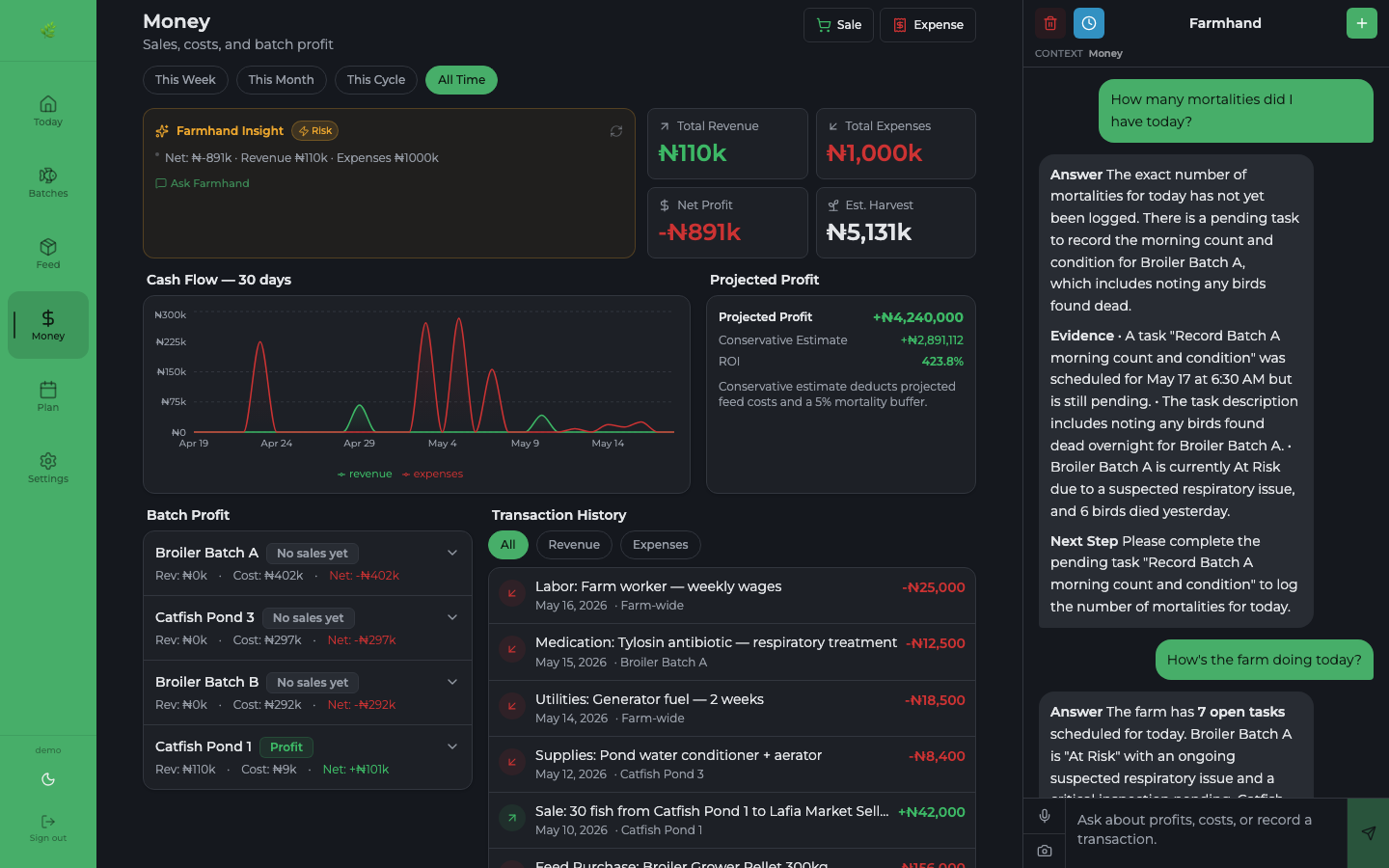
Money page in dark mode
-
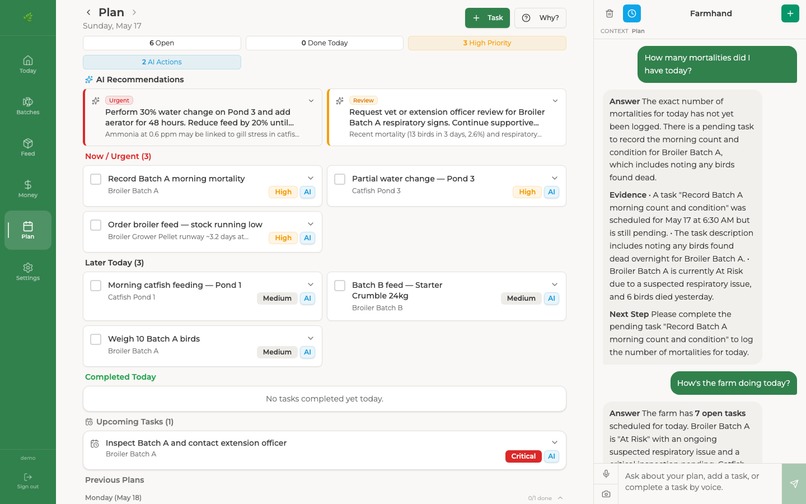
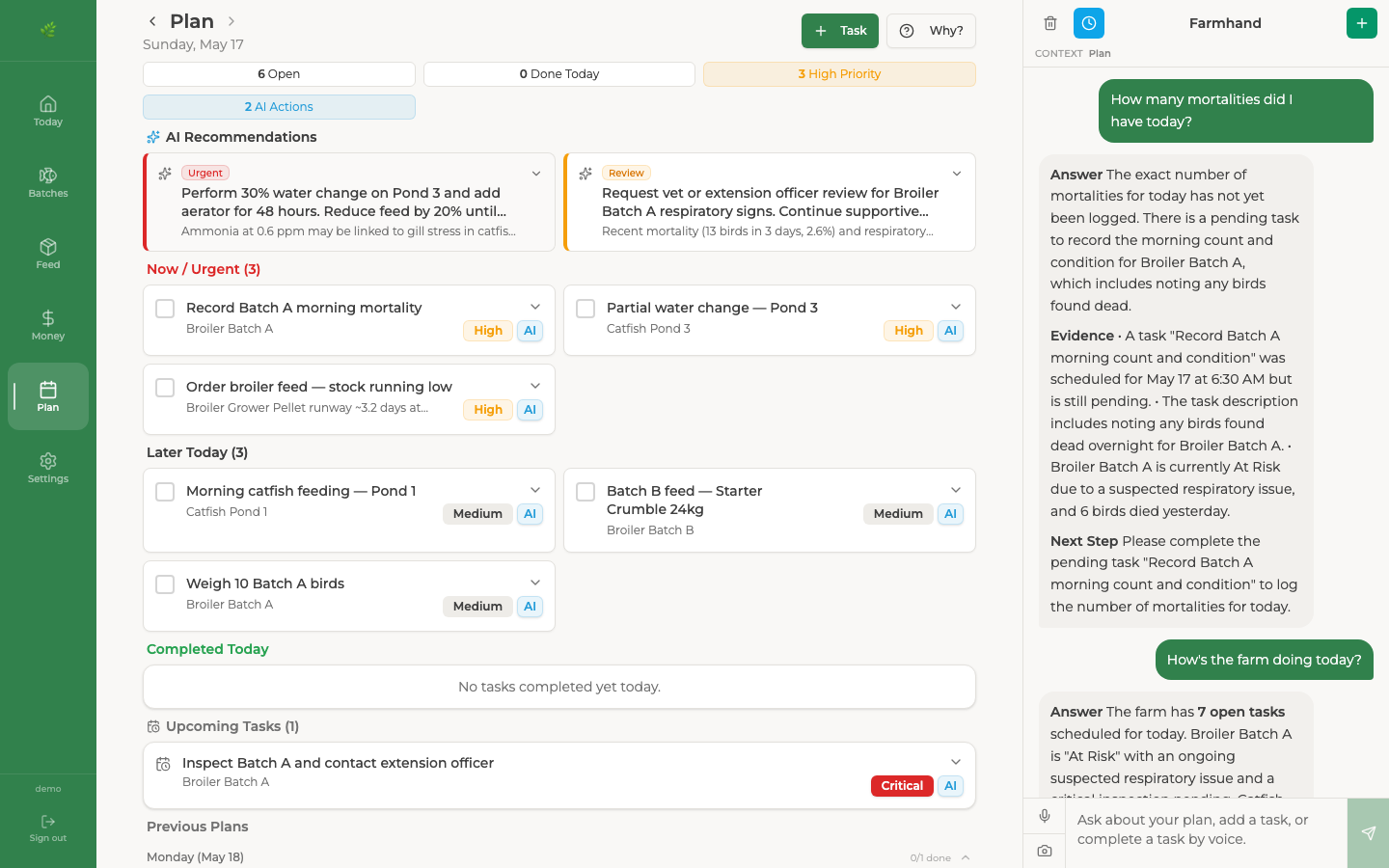
Plan page for taking control
-
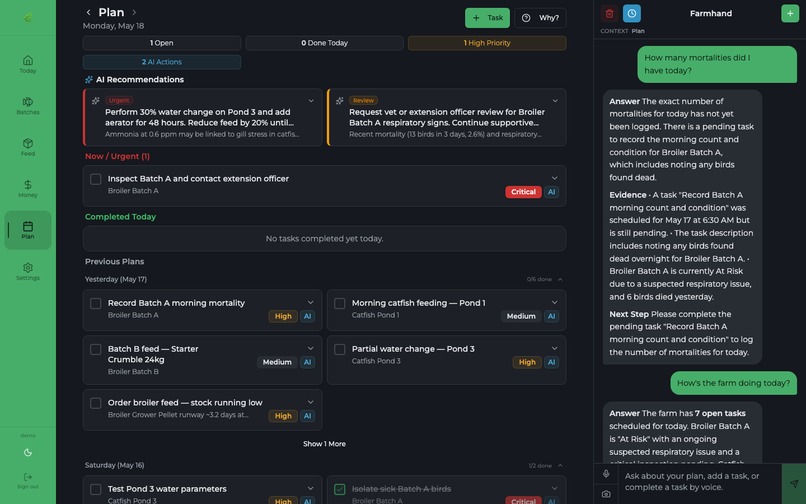
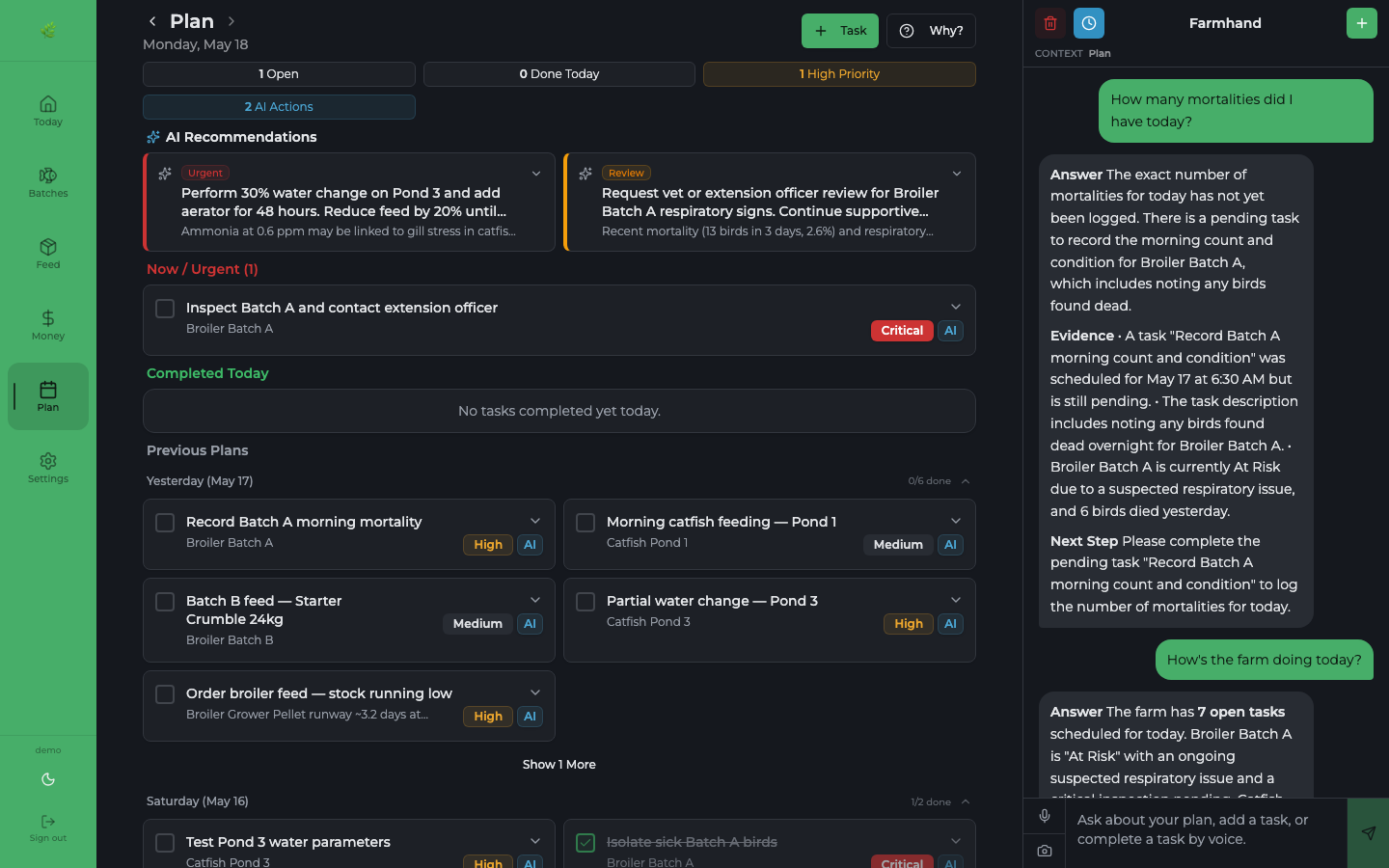
Plan page in dark mode
-
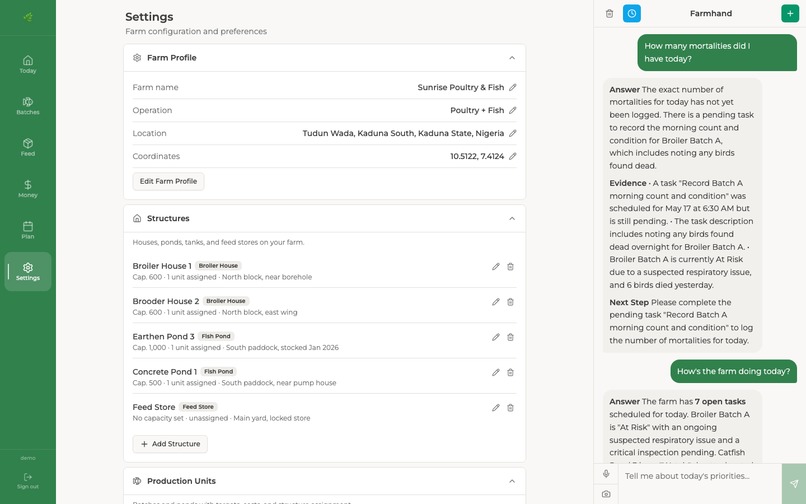
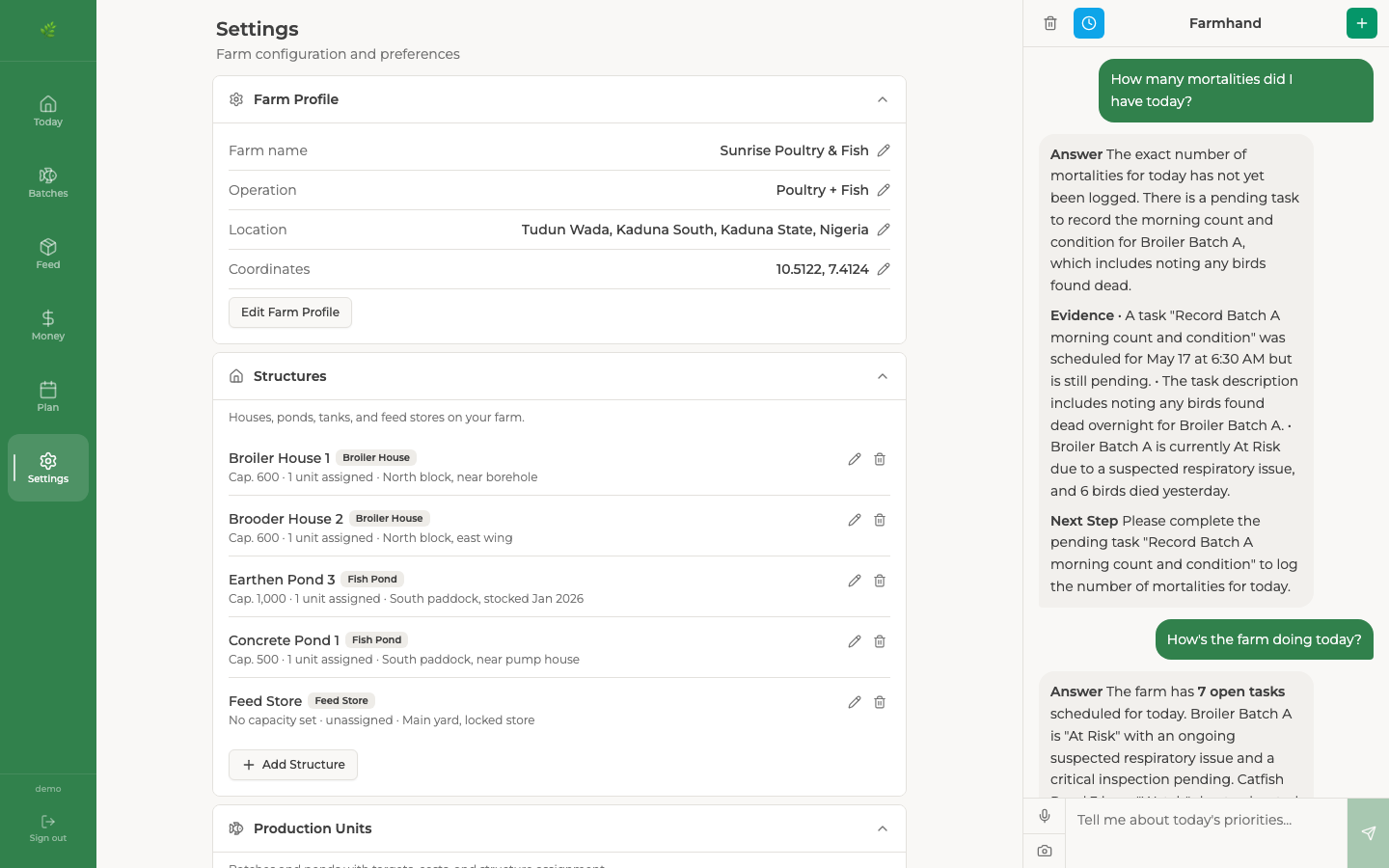
Settings page for set up, control and preferences
-
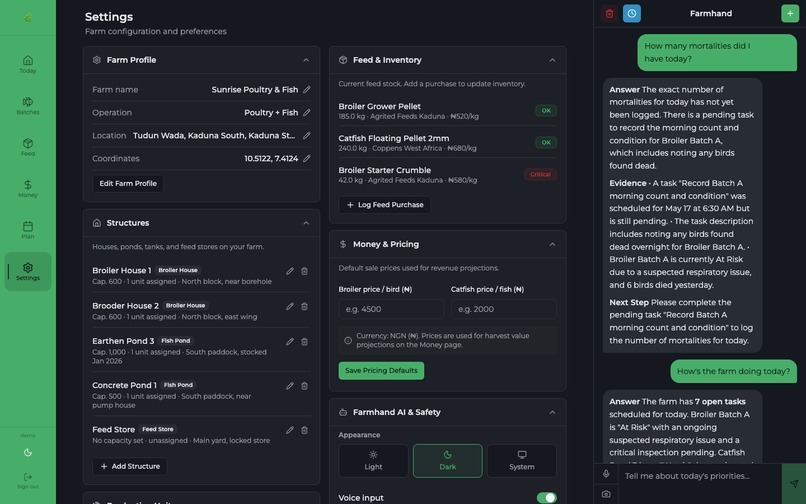
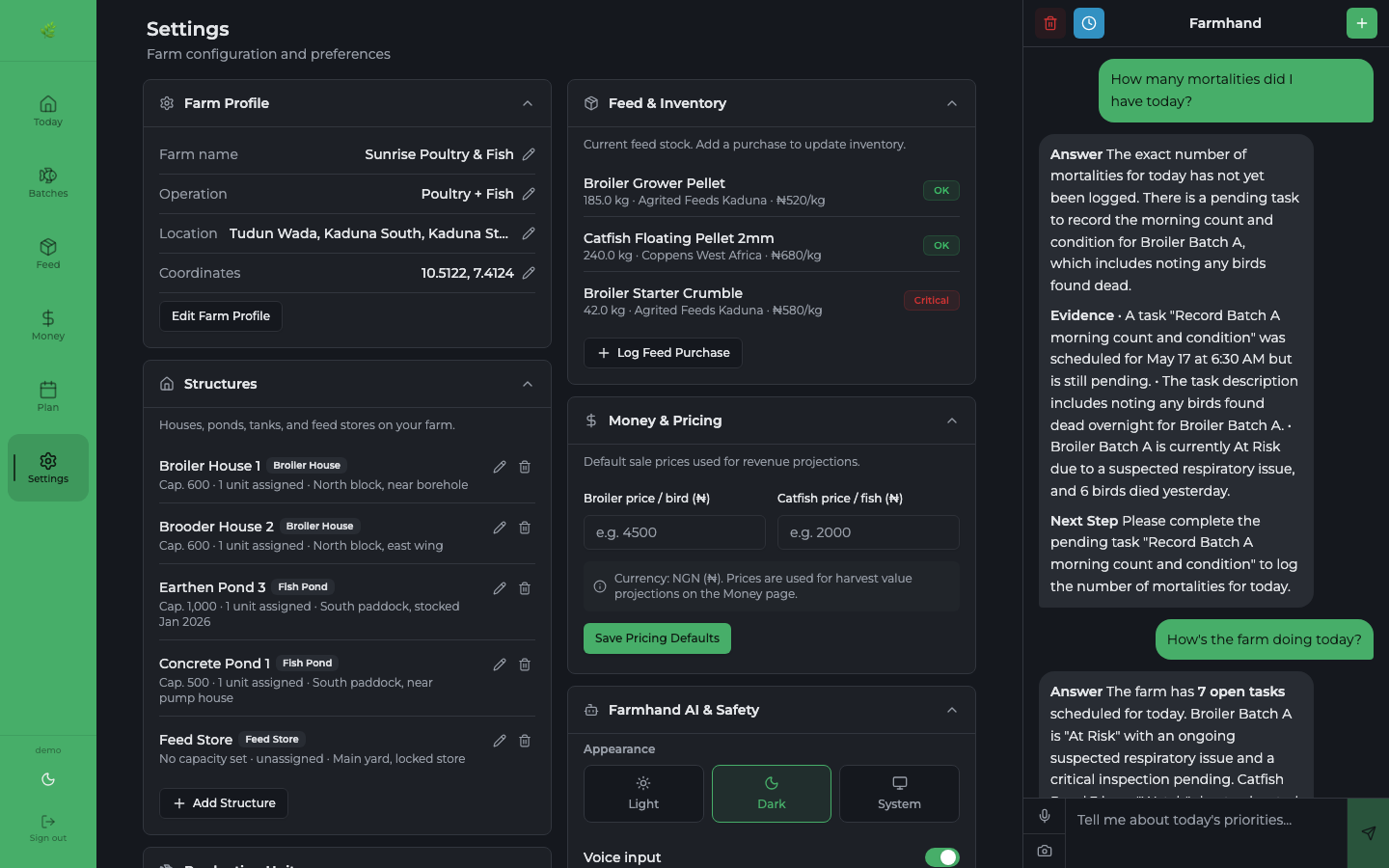
Settings page in dark mode
Inspiration
Small poultry and fish farms often run on memory, notebooks, WhatsApp messages, and scattered receipts. That works until a hot day, a mortality spike, low feed stock, or a cash-flow problem all happen at once.
Farmhand was inspired by a simple question: what if a farmer (me) could open one mobile-first app each morning and see what needs attention, why it matters, and what action should happen next?
What it does
Farmhand is a mobile-first farm operating assistant for broiler and catfish farmers.
It helps farmers:
- Track production units, structures, feed inventory, mortality, weight, water quality, sales, and expenses
- Generate a daily plan from weather, farm records, feed runway, money, and recent events
- Separate normal tasks from AI-generated recommendations that require approval
- Ask Farmhand questions about the farm’s current state
- Log records through forms, chat, voice input, or image-assisted drafts
- Review and correct records so the farm ledger stays usable
- Keep the farmer in control for risky, health-related, or financial actions
The demo farm includes broiler batches and catfish ponds in Kaduna, with realistic at-risk and healthy comparison units.
How I built it
Farmhand was built on MeDo as a mobile-first H5 app with a React interface, Tailwind styling, Supabase-backed data, and a skill/plugin-driven AI workflow.
The core app is structured around real farm records rather than chat messages. Batches, ponds, structures, feed inventory, farm events, tasks, AI actions, sales, expenses, weather, and previous approvals all become context for Farmhand. The assistant uses that context to generate insights, daily plans, recommendations, and structured record drafts.
I used MeDo plugins as the app’s capability layer:
- Farm Weather Lookup: a custom plugin that retrieves weather from Open-Meteo using the farm’s latitude and longitude. Farmhand uses it for daily planning, broiler heat-risk checks, and catfish water-watch checks.
- Large Language Model: used for reasoning over farm records, generating daily plans, explaining Farmhand Insights, drafting AI actions, parsing natural-language logs, and understanding uploaded farm images.
- Speech-to-Text: lets farmers speak field records such as mortality, feed use, water readings, sales, and expenses before Farmhand turns them into structured drafts.
- Text-to-Speech: lets Farmhand read back answers and drafts for accessibility and hands-busy farm use.
- OCR: extracts text from feed bags, receipts, labels, and written notes so purchases or expenses can become confirmation-ready drafts.
- Web Search: used only for optional market context, such as rough feed-price or supplier information, never for disease diagnosis or unsafe farm decisions.
- Login: powers registration, login, demo access, and authenticated farm setup so each farmer’s records stay scoped to their own farm.
The product is intentionally not chat-first. The main interface is an operating surface: Today, Batches, Feed, Money, Plan, and Settings. Farmhand AI is available as a persistent assistant on desktop and a floating assistant on mobile, but the farmer can still track work, records, feed, and money manually if AI is unavailable.
Challenges I ran into
The biggest challenge was turning AI from “chat” into controlled farm operations. It was not enough for Farmhand to answer questions. It needed to create tasks, draft records, update ledgers, explain risk, and still keep the farmer in control. That forced me to separate tasks from AI actions: tasks are normal farm work, while AI actions require review, approval, rejection, or editing before they can affect the plan or ledgers.
Another challenge was safety. Poultry and fish farming can involve health, financial, and animal-welfare decisions. Farmhand can identify visible concerns, summarize risk signals, and suggest practical next steps, but it must not silently diagnose disease, prescribe medication, make culling decisions, or save financial records without confirmation. Designing those approval gates was a major part of the product.
I also had to make the app feel like a real product rather than a hackathon screen. That meant adding authentication, onboarding, farm setup, structures, seeded demo data, settings, dark mode, mobile and desktop layouts, correction flows, and a demo reset path.
The final challenge was grounding. Early AI summaries were too generic. I had to make Farmhand reference actual farm data: mortality events, feed runway, water readings, task history, expenses, sales, projected profit, weather, and previous farmer decisions. The product only feels useful when the AI can explain "why" it is recommending an action.
Accomplishments that I'm proud of
I built Farmhand into a working farm operations product in about a week, not just a prototype screen.
I am especially proud that I:
- Built a full operating loop: record → insight → plan → task/action → approval → ledger update
- Designed a clear separation between normal farm tasks and AI-generated actions that need farmer approval
- Created a realistic Kaduna demo farm with broiler batches, catfish ponds, structures, feed stock, money records, risks, and healthy comparison units
- Connected farm records, weather, feed runway, sales, expenses, and previous decisions into Farmhand’s planning context
- Added farmer-controlled AI workflows for asking questions, logging records, voice input, image-assisted drafts, OCR, and read-aloud
- Implemented approval gates for financial records, risky recommendations, and health-adjacent actions
- Added authentication, onboarding, farm setup, structures, settings, dark mode, demo reset, and record correction flows
- Built a responsive interface that works as a mobile field tool and a desktop command center
- Made the app useful even without AI by keeping the core ledgers, tasks, batches, feed, and money workflows functional
What I learned
I learned that a useful farm AI has to be more than a chatbot. Farmers do not only need answers; they need records saved correctly, feed balances updated, sales confirmed, tasks scheduled, and risks explained in a way they can act on.
I also learned that structured data is what makes an agent useful. Once Farmhand had batches, ponds, structures, feed inventory, events, tasks, actions, sales, expenses, weather, and approval history, the AI could move from generic advice to grounded farm operations.
MeDo shaped the way I built the product. Its plugin system made it possible to combine authentication, LLM reasoning, weather lookup, speech-to-text, text-to-speech, OCR, image understanding, and web search inside one workflow. That helped me think of Farmhand as an operating system for farm work rather than a standalone AI chat window.
I also learned that fast AI app builders still require strong product judgment. MeDo made it quick to build, but I still had to carefully design data models, approval gates, safety rules, empty states, correction flows, mobile layouts, and demo data. The speed helped me iterate, but the quality came from being specific about how the agent should reason, when it should act, and when it should ask the farmer first.
Most importantly, I learned that trust depends on control. Farmhand is strongest when it explains the evidence behind a recommendation and lets the farmer approve, reject, edit, or correct the result.
What's next for Farmhand
Next, I want to turn Farmhand from a focused broiler-and-catfish operating assistant into a broader farm management platform.
Planned improvements include:
- Offline-first sync for farms with weak or unreliable connectivity
- More species and workflows, including layers, goats, sheep, cattle, and additional aquaculture systems
- Historical trends and cycle comparison, so farmers can compare mortality, feed conversion, weight gain, water quality, sales, and profit across production cycles
- Team roles, so owners, managers, and workers can record tasks without losing accountability
- Reports and exports for farm performance, expenses, sales, feed use, and cycle profitability
- Stronger market integrations for local feed prices, buyer prices, supplier discovery, and harvest timing
- Advisory integrations with veterinarians, extension officers, and trusted agronomy/livestock resources
- Richer AI evaluation and monitoring, so Farmhand recommendations can be checked for safety, grounding, actionability, and farmer approval outcomes
- Deeper MeDo plugin workflows, including more voice-first field logging, better image-assisted observations, and plugin-based automation for routine farm checks
- Post-hackathon production hardening, including audit logs, backup/recovery, permissions, and more robust data correction workflows
The long-term goal is for Farmhand to become a practical daily operating layer for small and mid-sized farms: one place to record what happened, understand what changed, plan what to do next, and keep the farmer in control of every important decision.
Built With
- medo
- react
- supabase
- tailwind

Log in or sign up for Devpost to join the conversation.