Inspiration
We are currently experiencing economic uncertainty across the nation. The Trump administration's unprecedented use of tariffs levied against foreign countries will have far-reaching financial implications that are difficult to predict and understand. Our team recognized that for farmers in particular, this change in export and import balance would be especially difficult to navigate. That is why we built WildTariffs, a website that helps farmers understand the impact that Trump's tariffs are going to have on their livelihoods and receive advice on the best crops to grow based on their location.
What it does
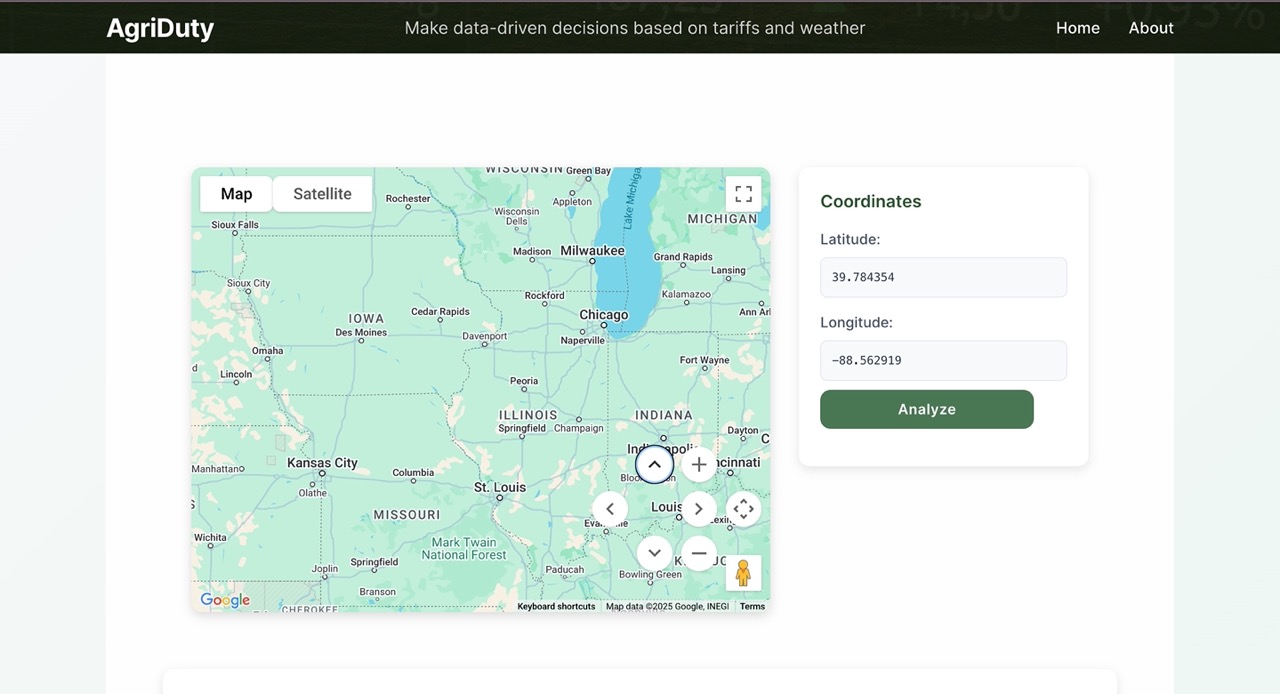
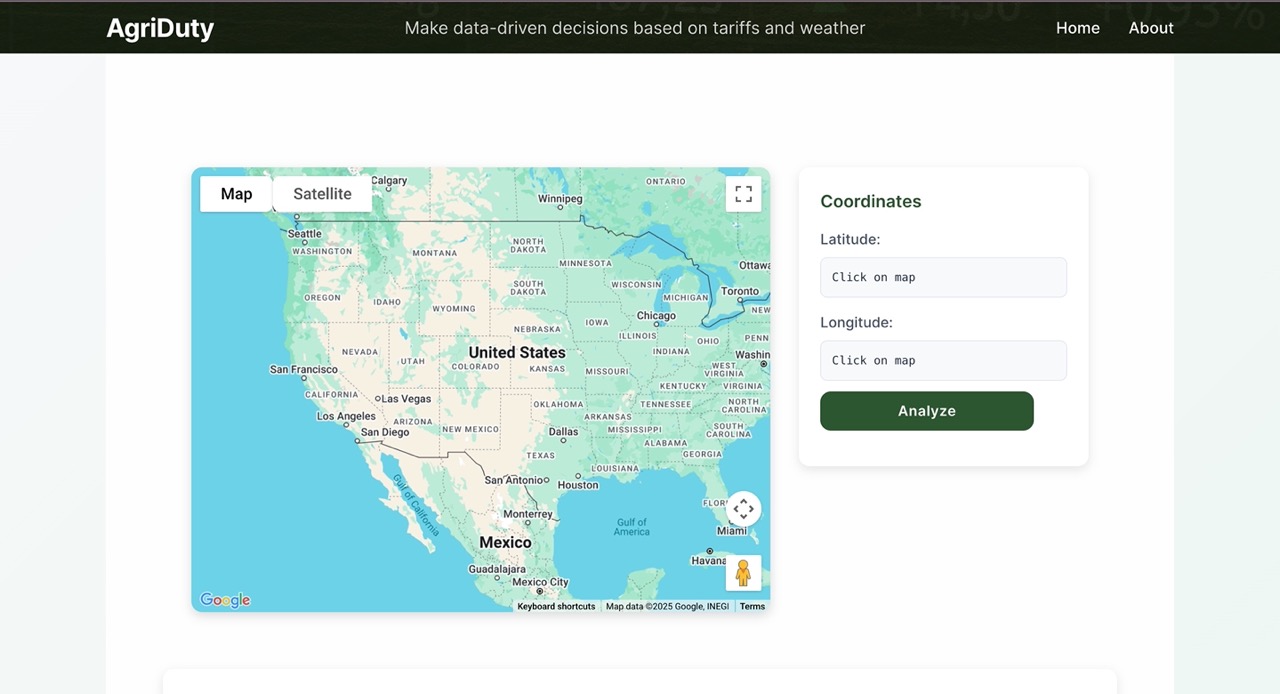
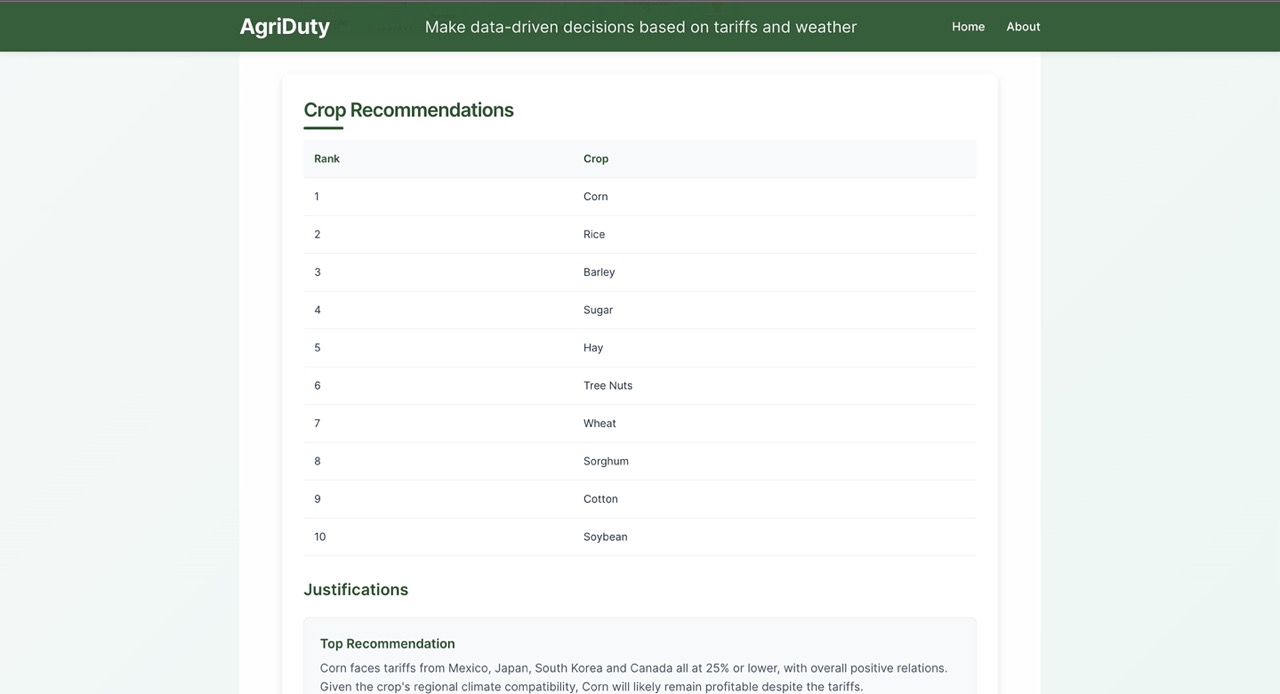
Our website provides crucial information in a critical time for farmers. Simply by selecting their location on our interactive map, a user receives detailed information that they can apply as well as a brief education on the impact of tariffs.
How we built it
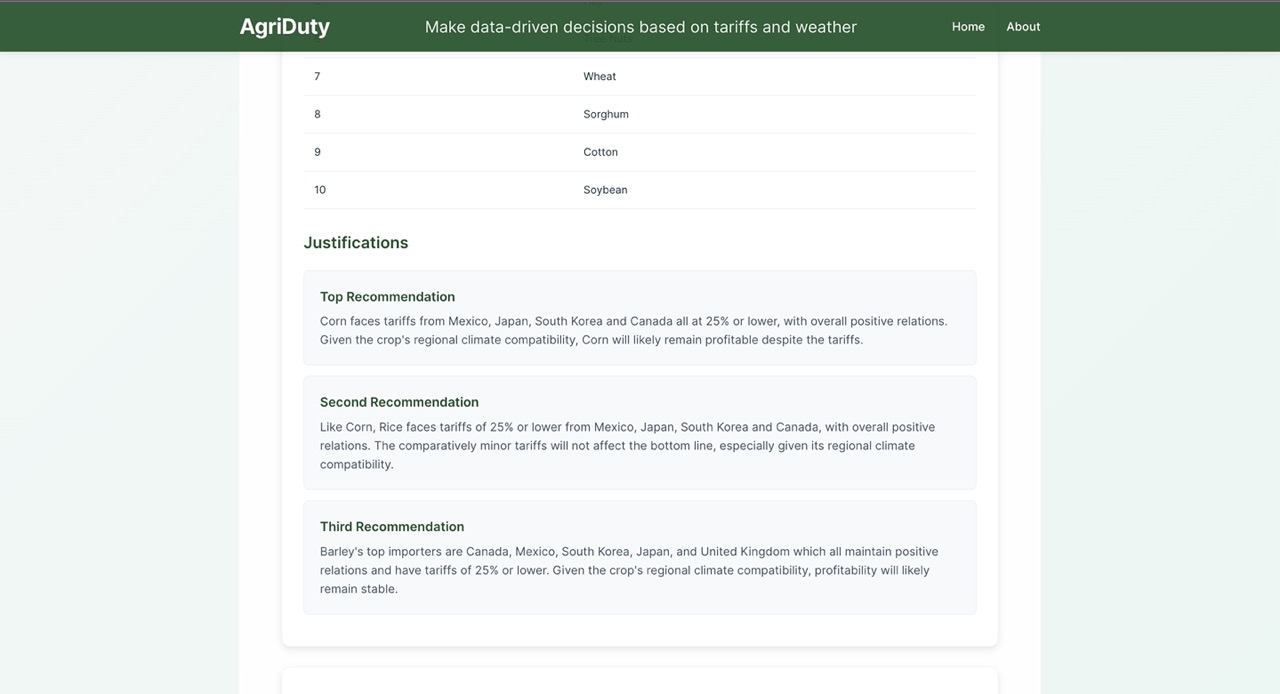
WildTariffs is a website where a user can select their precise location and receive advice on which crops to grow. When selecting their location, their geolocation is stored and sent to a weather API which returns information about the temperature (celsius), humidity, pressure, rainfall, and wind speed for the next 30 days. That information is then sent to our trained model which returns a measure of how optimal the specified conditions for a predetermined list of crops. The output from our model is then sent to Gemini through an API call, along with a list of the countries that are the highest importers of each crop and a list of all proposed Trump tariffs. We then ask Gemini to analyze the provided information and suggest to the user which crops they should grow along with a brief justification based on the user's climate and tariff implications.
Challenges we ran into
One of the biggest challenges of the project was figuring out how we could reliably provide tariff data. Since we are working with information that is so recent and volatile, it was difficult to find places where we could source data. Specifically, finding information about the retaliatory being imposed in response to Trump's tariffs was particularly burdensome since many countries have not yet announced what their countermeasures are going to be. Our team discussed building an ML model trained on previous trade wars that could predict retaliatory tariffs but we ran into difficulty trying to source certain parameters for our model (geopolitical relations between the US and the target country, the economic state of the target country, how much intertwined the target country's economy is with the US, etc). A second solution we discussed was simply having countries match whatever tariff the US is imposing against them. This solution seemed like a satisfactory and realistic approach since a lot of trade wars involve matching tariffs, however, we concluded that this approach might be too simplistic and not capture the nuances of trade wars. Eventually, we landed on sending as much information as we could to Gemini and letting it create its analysis. Due to Gemini's high token context window, we felt confident that the model could handle the heavy load of information and provide meaningful and accurate information for our users.


Log in or sign up for Devpost to join the conversation.