-
-
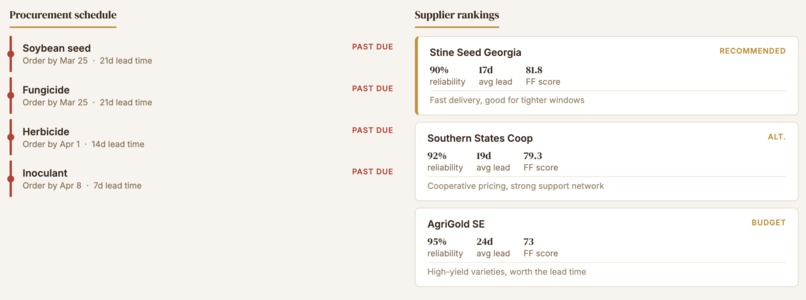
Procurement Schedule and Supplier Rankings
-
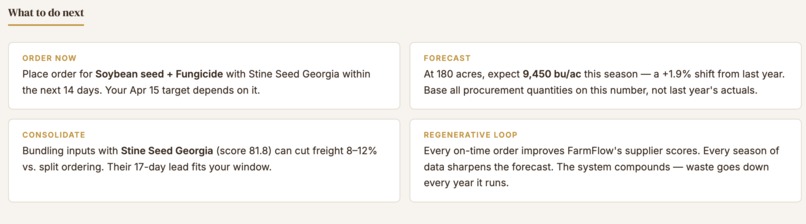
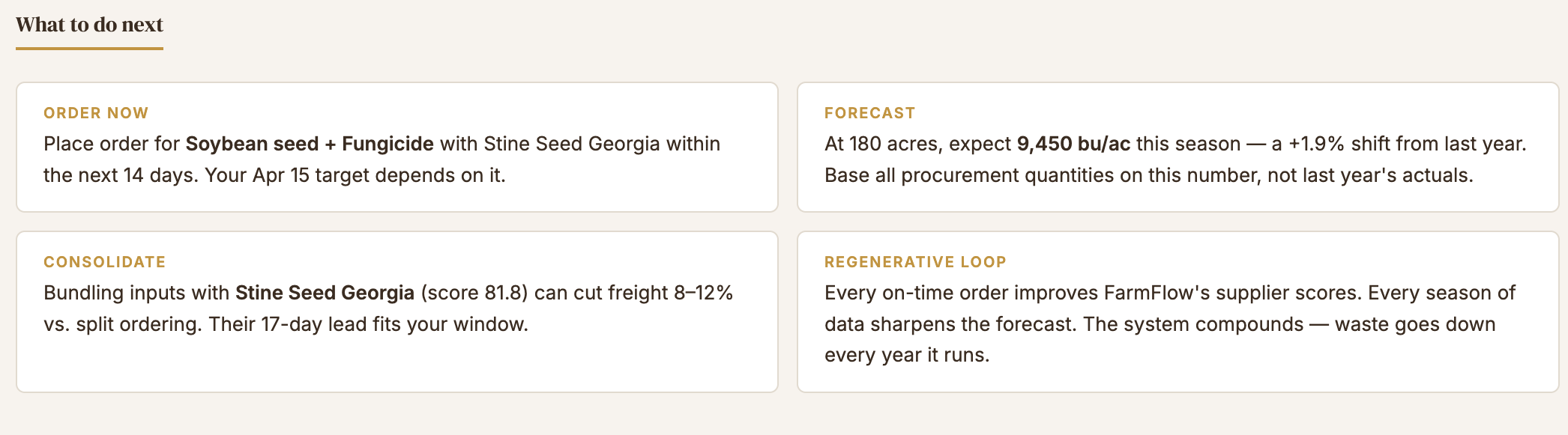
Next Steps for Marcus
-
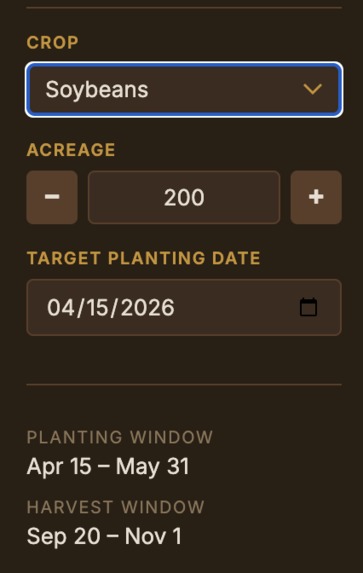
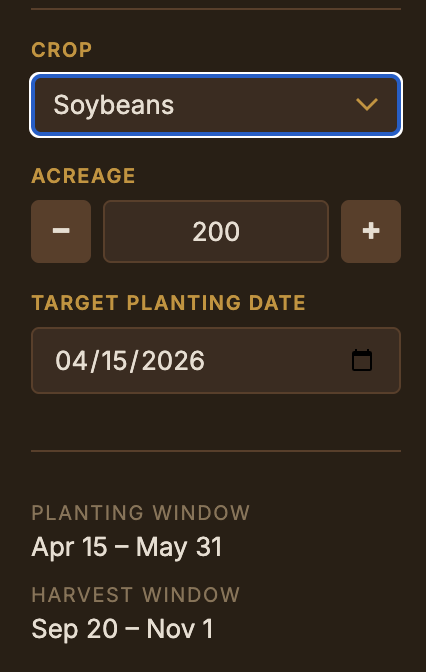
Type of Crop, Number of Acres, and Date Planted
What inspired FarmFlow:
I worked in Georgia Tech's Low-Cost Assistive Technology Program, where I didsupply chain analysis for 3D-printed pediatric devices deployed in Rwanda. The work taught me one thing above everything else: when resources are scarce and margins are thin, supply chain intelligence is not a luxury. It is survival infrastructure.
When I read Cox Farms' Agriculture track brief (specifically sub-problem #5 (Supply Chain Transparency) and sub-problem #2 (Food Waste)) I realized the exact same problem exists on Georgia's small farms. Farmers are losing thousands of dollars every season not because they are bad farmers, but because they have no procurement visibility at all. Same problem. Different cargo.
That is what inspired FarmFlow.
What FarmFlow does:
FarmFlow is a supply chain optimization platform for small Georgia farms — the 85% of operations under 500 acres that currently have zero supply chain tools.
It gives farmers three things they have never had before:
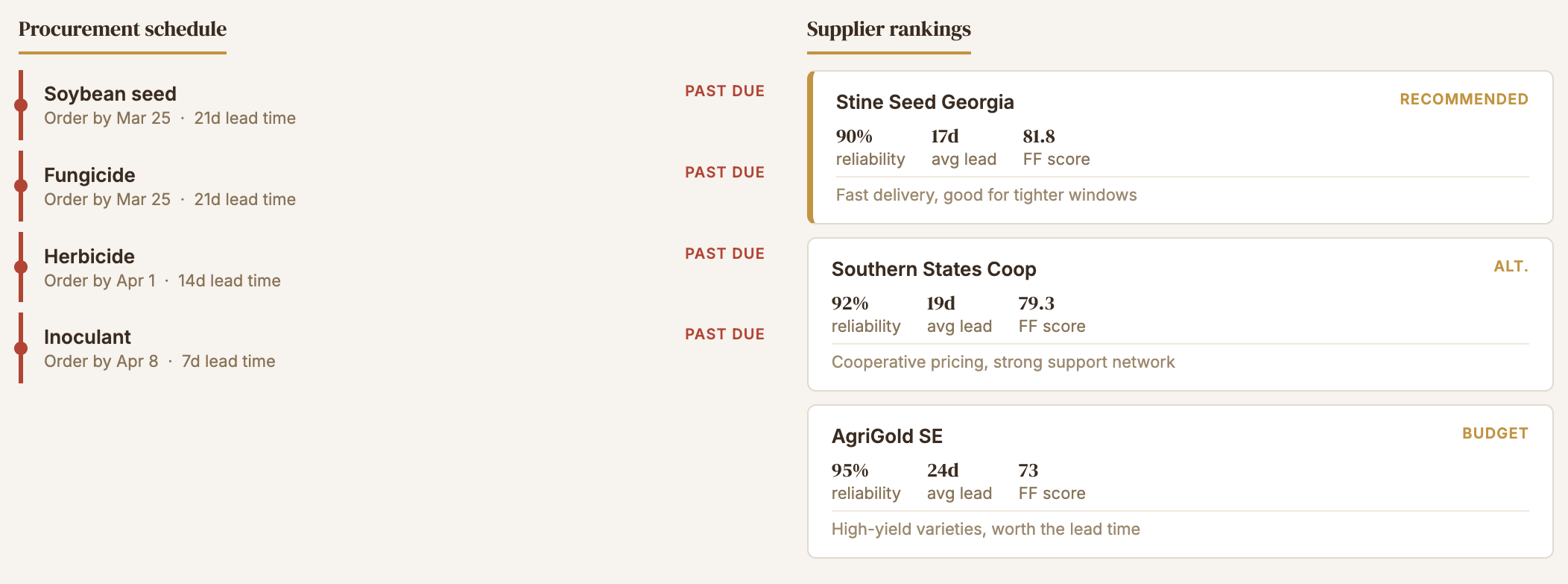
- Procurement timeline: color-coded, deadline-driven order schedules for every input, calibrated to each crop's actual supplier lead times
- Supplier rankings: a composite reliability score for regional Georgia suppliers based on delivery consistency, average lead time, and cost index
- Demand forecasting: a seasonal yield projection built from USDA NASS Georgia data, so procurement quantities are grounded in evidence, not last year's habits
How it addresses Cox Farms sub-problems:
Sub-problem #5 — Supply Chain Transparency: Every order placed through FarmFlow creates a traceable procurement record: what was ordered, from whom, on what date. That traceability starts at the farm level, before the seed goes in the ground. It is the foundation of a transparent food supply chain.
Sub-problem #2 — Food Waste: Over-procurement of inputs causes chemical runoff. Late deliveries delay planting and reduce yields. Emergency spot-price buying destabilizes supply. FarmFlow eliminates all three by replacing guesswork with data-driven procurement schedules, reducing waste upstream, before the crop is even planted.
How I built it:
The supplier scoring model uses a weighted composite metric:
$$\text{FarmFlow Score} = 0.50 \times \text{Reliability} + 0.30 \times \text{Lead Time Score} + 0.20 \times \text{Cost Score}$$
Crop yield forecasts use a trend-adjusted moving average seeded with USDA NASS historical Georgia crop data. The supplier database covers regional Georgia input providers across all five supported crops: corn, soybeans, cotton, peanuts, and sweet corn.
The methodology comes directly from my Georgia Tech research in the Low-Cost Assistive Technology Program: demand forecasting, vendor evaluation frameworks, and lead time optimization originally developed for medical device supply chains in resource-constrained environments.
What I learned:
Building FarmFlow taught me that the hardest part of applying supply chain engineering to a new domain is not the methodology , it transfers cleanly. The hard part is understanding the domain deeply enough to make the output meaningful to a real user.
I spent significant time understanding Georgia crop calendars, regional supplier dynamics, and the actual pain points of farms under 500 acres before writing a single line of code. That domain research is what makes FarmFlow feel like a tool built for farmers, not a generic dashboard with an agriculture skin.
Challenges:
Solo build in 72 hours. Every design, engineering, and research decision was mine alone. The constraint forced ruthless prioritization, I built one user flow perfectly rather than five flows partially.
Making supply chain methodology legible to non-engineers. The underlying math is straightforward, but translating vendor evaluation scoring into something a farmer in Tifton would trust required careful UX decisions about language, color, and information hierarchy.
Grounding the user persona in real data. Marcus, the composite farmer at the center of FarmFlow's story, is built from USDA cost-of-production data and Georgia Farm Bureau reports, not a single real person. Making him feel real and specific without misrepresenting any individual farmer required care.
Why it's regenerative:
FarmFlow is not a one-time tool. Every season it runs, the demand forecast improves. Every delivery rating sharpens the supplier scores. Every on-time order is one fewer emergency spot-price purchase. Waste compounds downward. Season after season. Farm after farm. That is what regenerative means.
(Built by Sagarika Sankar Ganesh · Georgia Institute of Technology · Industrial Engineering, Supply Chain Concentration · Cox Enterprises Play with Purpose Hackathon · June 2026)

Log in or sign up for Devpost to join the conversation.