-
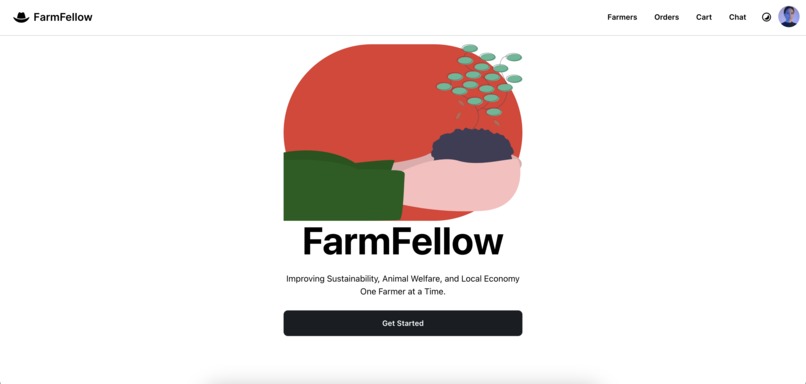
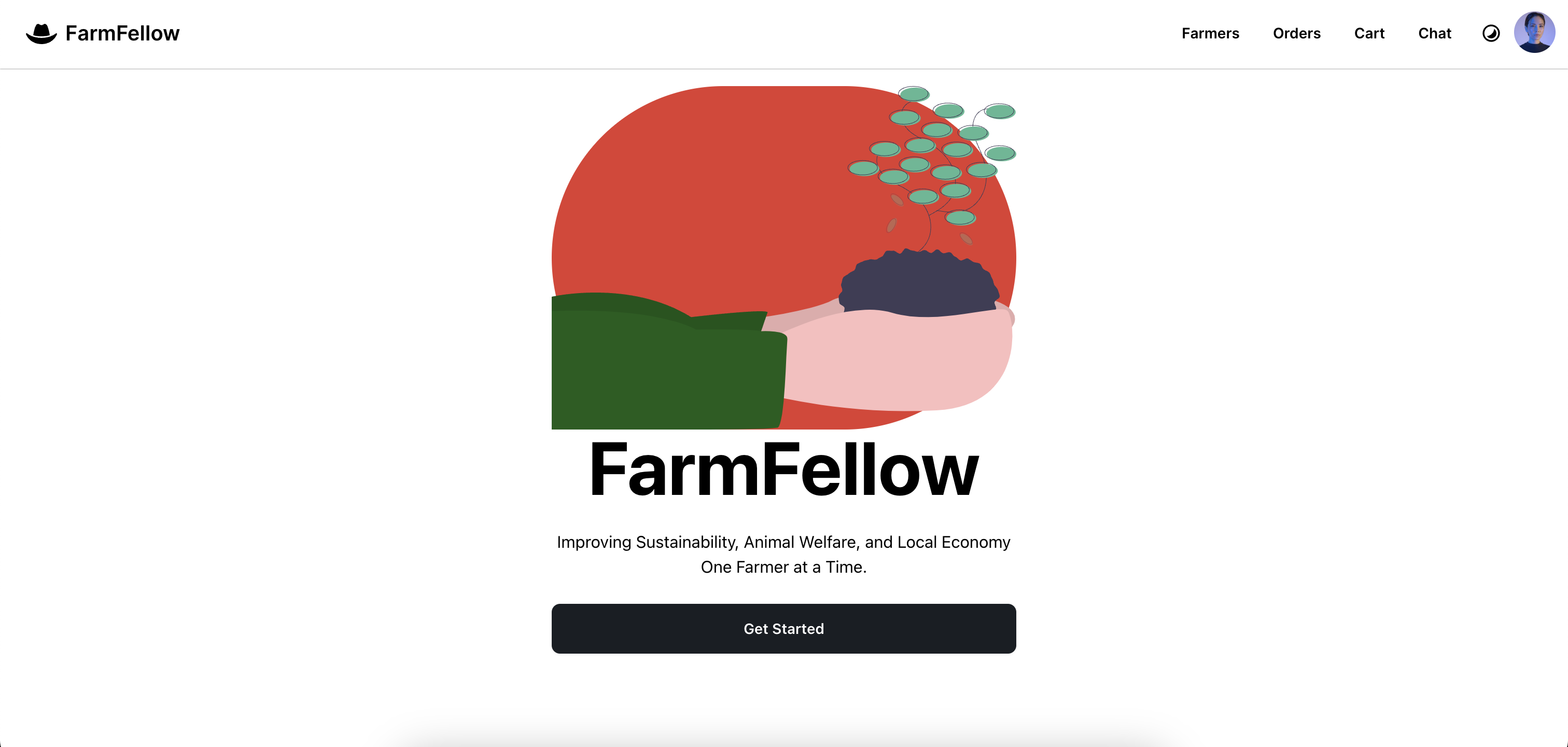
Landing page!
-
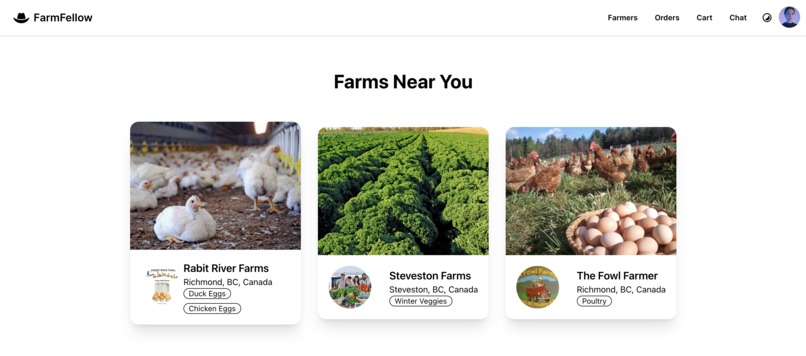
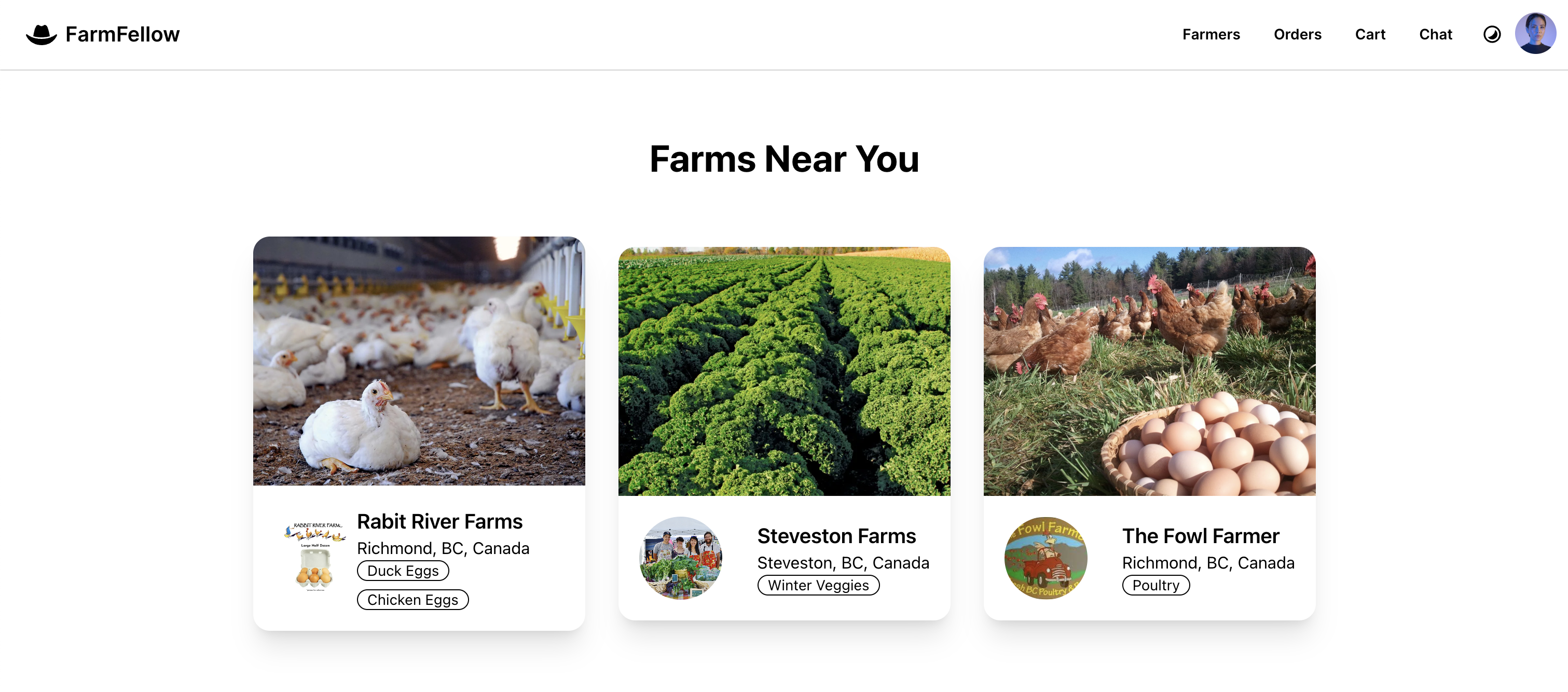
Farmer Catelogue!
Inspiration
Inspired by the popular online delivery services, FarmFellow allows individuals to directly support our local farmers by purchasing goods on demand anytime. Our goal is to increase awareness whilst providing an intuitive solution in an industry that is oftentimes underappreciated and carries a large potential for sustainability. Currently, there is a gap in knowledge of what supporting individual farmers have on sustainability, animal welfare, and our local economy. As a result, FarmFellow will eliminate the need for large farming corporations and suppliers that prioritize profits over passion!
What it does
FarmFellow allows users to directly support farmers in a marketplace fashion and utilizes artificial intelligence to help consumers product choices and workflow. This app should feel familiar to users, as the typical workflow is optimized to be easy to follow and intuitive. Users can browse from a list of farmers in their area and look into their catalogue of produce. They can then add items to the cart, select their quantity, and proceed to pick up their order from the farmer.
How we built it
Using a React and TypeScript frontend and Supabase as our database. We first proceeded with our ideation phase and researched the current gaps in the industry. Next, our prototype was made on Figma. By focusing on a welcoming, yet modern interface, users will feel a sense of control and learnability when using our application. When designing and implementing our interface, one member designed the interface on Figma while the other consecutively implemented the design using React. By using Supabase and React, we were able to use CRUD operations reliability and store user data for future use.
Challenges we ran into
The greatest challenge when developing FarmFellow was the logistics and potential pain-points of this service. As our application is SaaS (Software as a Service) oriented, our priority lies in ensuring that the users have the smoothest experience possible, to ensure that supporting local farmers is always easy and enjoyable. With that, as farmers typically live outside the city, it was likely that couriers or consumers would not prefer to travel to pick up their orders. Thus, we researched and found that farmers oftentimes visit the city and concluded that hub spots (meeting up at a common location for distribution to numerous customers) are the most sustainable, and easy for all users. Of course, technical issues also arose such as incorporating AI into our application as we were both new to Large Language Models and felt that this feature would greatly enhance the usability and enjoyability of our application.
Accomplishments that we're proud of
We are very proud to have identified an idea that carries such a substantial global impact that can improve several ongoing global issues at once (sustainability, animal welfare, economy, and community). With an evident gap and lack of awareness in this field, we hope that this application and submission can contribute to the increase of farmers around the globe.
What we learned
We learned how to utilize AI to enhance user experience and allow for custom prompts to be used. With greenhouse gasses contributing to 11-17% of global emissions, we also learned about the large need for the world to begin supporting their local communities. And have developed a passion in supporting this cause.
What's next for FarmFellow
We both aim to improve our AI features and user checkout flow in order to push this product to production. With that, we aim to market our app to our local communities and encourage users to support locally-grown produce. Ultimately, our goal is to create a lasting impact on the current sustainability and welfare issues that lie in the industry, and we hope that FarmFellow will act as an incubator towards this!
Built With
- cohortai
- figma
- react
- supabase
- tailwindcss


Log in or sign up for Devpost to join the conversation.