Inspiration
Every year Indian farmers lose money to crop diseases not because the diseases are unbeatable, but because most farmers never get in front of an expert in time. Ag experts are expensive, far away, or just not available when a farmer notices something wrong on a leaf. We wanted to put that expertise in every farmer's pocket, for free, in the language they actually speak.
What it does
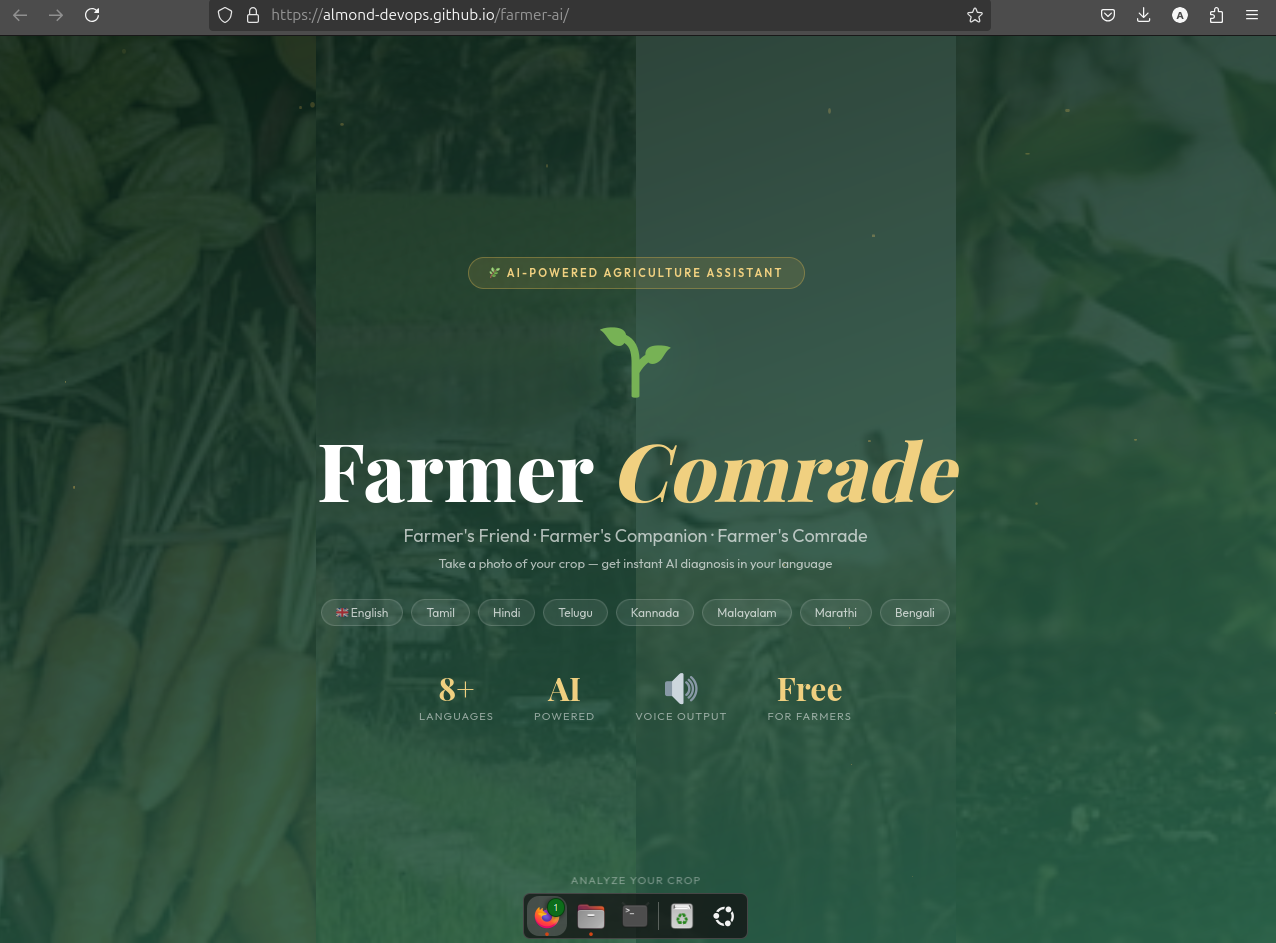
Farmer Comrade lets a farmer snap a photo of their crop and get back a full diagnosis in seconds: crop type, disease/problem, the cheapest and easiest treatment, a weather warning for what makes it worse, a quick soil health tip, and an urgency level so they know how fast to act. Then it reads the whole thing back out loud in English, Tamil, Hindi, Telugu, Kannada, Malayalam, Marathi, or Bengali so literacy or screen size is never a barrier.
How we built it
Backend is Flask, with Groq's Llama 4 Scout vision model doing the actual crop analysis from the uploaded image. We built a single structured prompt that forces the model into 6 consistent sections every time, so the output is always something a farmer can act on instead of a wall of text. Voice output runs through gTTS, cleaned of markdown symbols first so it doesn't read "asterisk asterisk" out loud. Frontend is one HTML file no framework kept deliberately simple so it loads fast on a low-end phone.
Challenges we ran into
Getting the AI's output to stay farmer-usable was the biggest one early responses were too technical or too long, so we tightened the prompt down to a strict 200-word cap and forced the 6-field structure. Multi-language voice output was trickier than expected too, since gTTS needed clean text and the right language code per language, and markdown characters from the AI's response kept leaking into the audio before we stripped them out.
Accomplishments that we're proud of
Getting from photo to full diagnosis to spoken-language output in one flow, working in 8 languages, is the thing we're most proud of that's the actual barrier for a lot of farmers, and we built past it. Keeping the whole thing usable with just a phone camera and no special equipment mattered a lot to us too.
What we learned
How much the presentation of AI output matters as much as the accuracy a technically correct diagnosis is useless if a farmer can't understand or act on it fast. Also learned a lot about balancing model speed vs. detail (why we capped responses at 200 words) and handling multilingual TTS cleanly.
What's next for Farmer-ai
Offline mode for areas with poor connectivity, a history/tracking feature so farmers can see disease patterns on their own land over time, SMS-based access for farmers without smartphones, and expanding treatment advice to include locally available remedies by region instead of generic suggestions.

Log in or sign up for Devpost to join the conversation.