Inspiration
What it does
How we built it
Challenges we ran into
Inspiration
Every day, millions of Kenyans depend on matatus to get to work, school, and home. Despite being one of the country's most common modes of transport, there is no centralized place where commuters can check transport fares before beginning a journey.
Instead, people often rely on asking friends, guessing the fare, or waiting until they reach the matatu stage. This uncertainty makes it difficult to budget, especially for students and daily commuters. In some unfortunate cases, passengers have even been forced to leave vehicles because they were just a small amount short of the required fare.
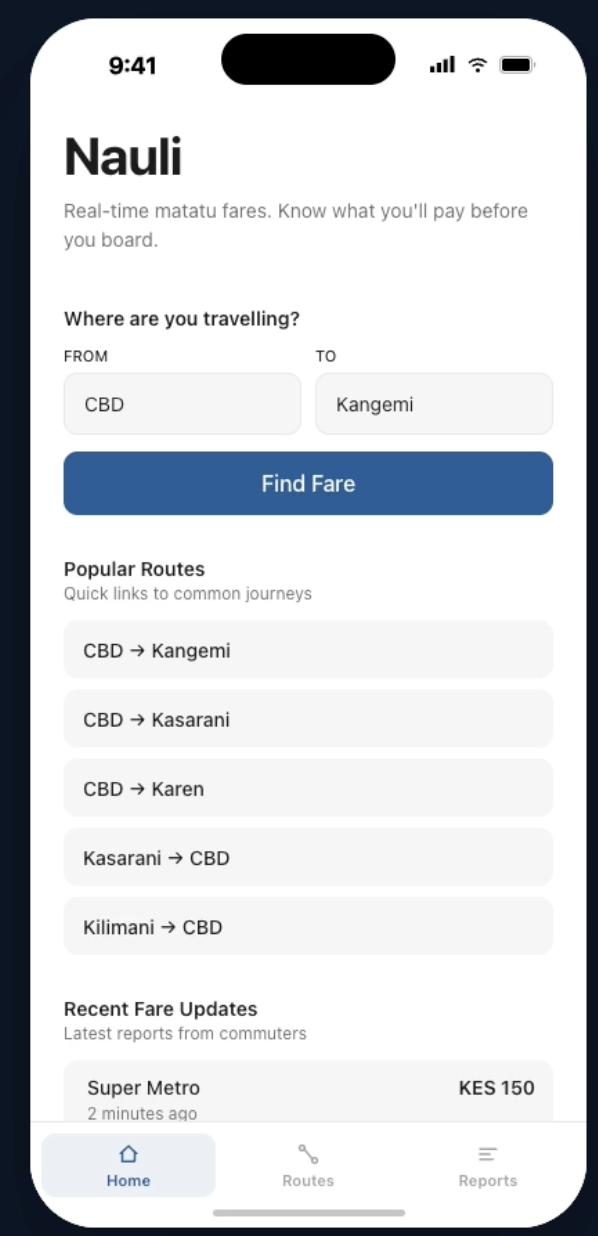
I built FareKE to solve this everyday problem by creating a simple, community-driven platform where people can search routes, view reported fares, and help build a centralized database of matatu fares across Kenya.
What it does
FareKE allows users to:
Search for transport routes between locations. View fares reported by the community. Contribute new fare reports to keep information current. Help build a reliable, centralized source of public transport fare information.
The goal is to make commuting more transparent and help Kenyans budget for their daily journeys.
How I built it
FareKE was built using modern web technologies with a focus on speed, simplicity, and mobile usability.
Throughout development, I used Codex extensively to accelerate the process. Codex helped me structure the application, build frontend components, implement features, and debug issues quickly. This allowed me to spend more time refining the user experience and ensuring the application solved a real problem instead of getting stuck on repetitive coding tasks.
The project combines community-generated data with an intuitive interface so users can easily search routes and contribute fare information.
Challenges I ran into
One of the biggest challenges was designing a system that remains simple while supporting community-generated fare reports.
Another challenge was creating an interface that commuters could use quickly, often while travelling. Every screen had to prioritize speed, readability, and ease of navigation on mobile devices.
Finally, since FareKE relies on community participation, designing the application in a way that encourages users to contribute accurate fare information was an important consideration.
Accomplishments that I'm proud of
I'm proud of turning a simple observation into a working product that addresses a real problem experienced by millions of Kenyans.
I'm also proud of building a polished application in a short period of time with the help of Codex, allowing me to focus on product design and user experience rather than repetitive implementation work.
Most importantly, FareKE demonstrates that local problems deserve local solutions.
What I learned
Building FareKE reinforced that the hardest part of software isn't writing code—it's identifying a meaningful problem and designing a solution that people will actually use.
I also learned how AI-assisted development with Codex can dramatically speed up prototyping and iteration while still requiring thoughtful product decisions, testing, and refinement.
What's next for FareKE
The long-term vision is to make FareKE the go-to platform for public transport fares in Kenya.
Future improvements include:
Real-time fare trends. Better route discovery. Community moderation and reputation systems. Wider coverage across Kenya. AI-powered insights that explain fare changes based on community reports and travel conditions.
Ultimately, FareKE aims to become Kenya's centralized source for public transport fare information, helping commuters make informed travel decisions every day.

Log in or sign up for Devpost to join the conversation.