-
-
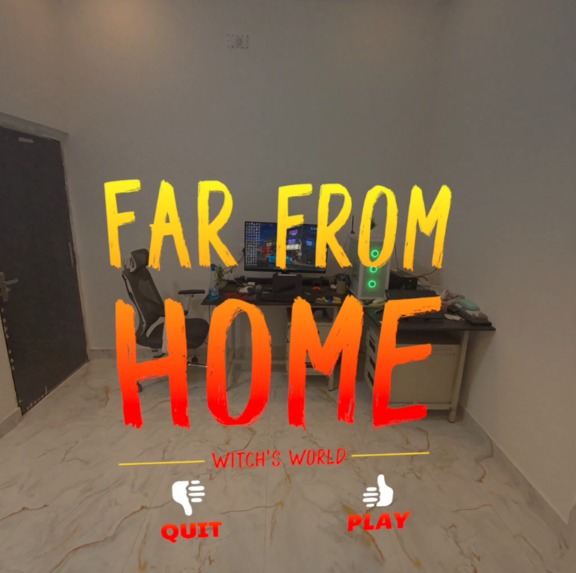
Start
-
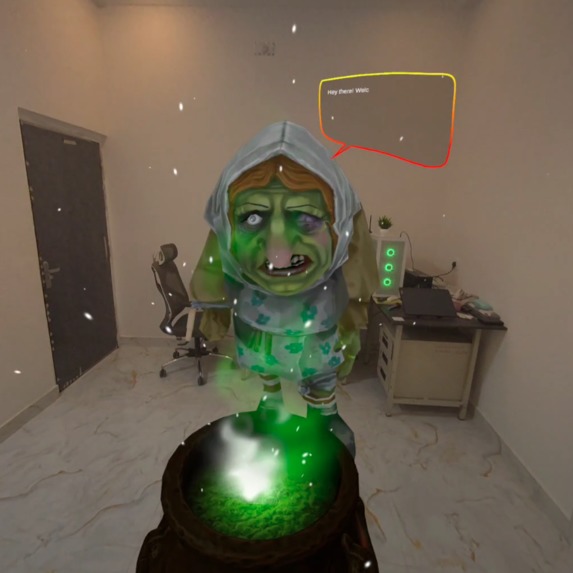
Story
-
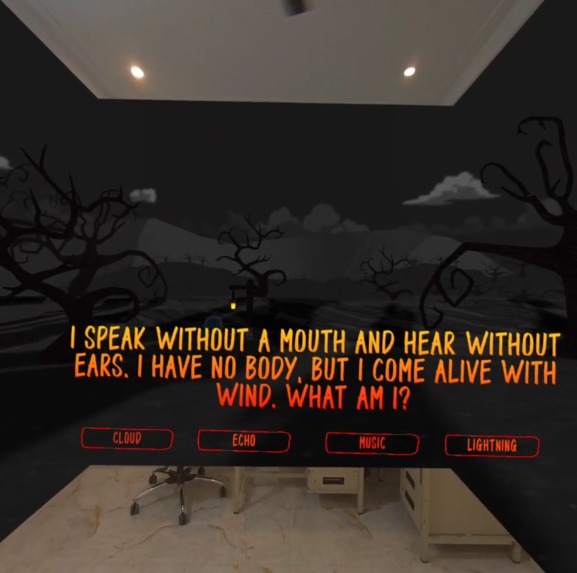
Riddle
-
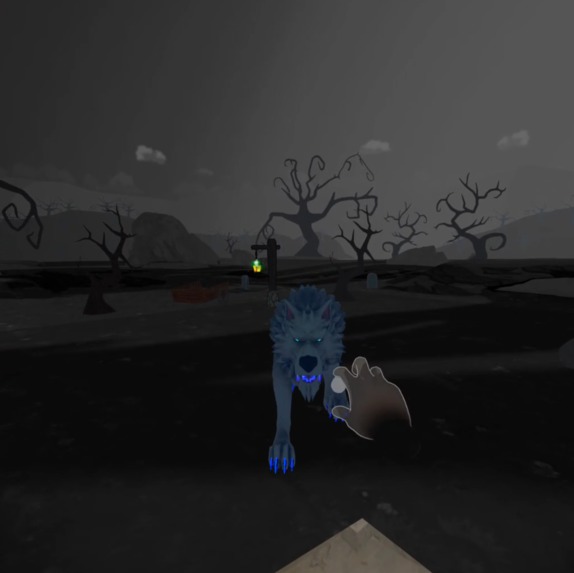
Action


Inspiration
The inspiration behind "Far from home: Witch's World" stems from the immersive gameplay experience offered by "First Encounter" on Quest 3. We were captivated by the idea of blending elements of horror, riddles, and mixed reality to create an engaging and unique gaming experience. Drawing from this inspiration, we set out to develop a game that would challenge players with mystical riddles while immersing them in a visually stunning mixed reality environment.
What it does
"Far from home: Witch's World" transports players into a realm inhabited by witches, where they must navigate through a series of magical riddles to escape. The game begins with the player spawning in the midst of a witch's abode, where they are greeted by a witch who provides them with spell-shooting powers and explains the lore of the world. The player's objective is to solve the riddles presented to them by the good witch in order to find their way back home.
However, the stakes are high, as incorrect answers to the riddles summon bloodthirsty wolves that threaten the player's safety. To survive, players must use the spell-shooting powers bestowed upon them by the good witch to fend off the attacking wolves and progress through the game.
How we built it
We utilized Unity engine along with Interaction SDK, passthrough, and scene API for mixed reality integration. Collaborative work and source control were managed via GitHub. 3D elements and animations were created using Blender, while Figma was employed for vector arts and GUI elements.
Challenges we ran into
Initially, integrating a voice SDK for user answers proved challenging due to errors, consuming significant time. As a workaround, we proceeded without the voice SDK.
Accomplishments that we're proud of
Despite challenges, we successfully delivered a finalized project before the deadline, implementing envisioned gameplay mechanics, albeit without the voice SDK.
What we learned
Developing "Far from home: Witch's World" provided us with invaluable learning experiences, particularly in the realm of mixed reality game development. We gained proficiency in utilizing Interaction SDKs for pose detection and scene API, allowing us to seamlessly integrate mixed reality elements into our game. Moreover, navigating through challenges such as error troubleshooting and adapting to unforeseen setbacks taught us important lessons in resilience and problem-solving.
What's next for Far from home: Witch's world
Future plans for the game include integrating AI for dynamic riddle generation, introducing diverse worlds beyond the witch realm (e.g., futuristic, retropunk), and incorporating multiplayer co-op functionality for collaborative gameplay experiences.


Log in or sign up for Devpost to join the conversation.