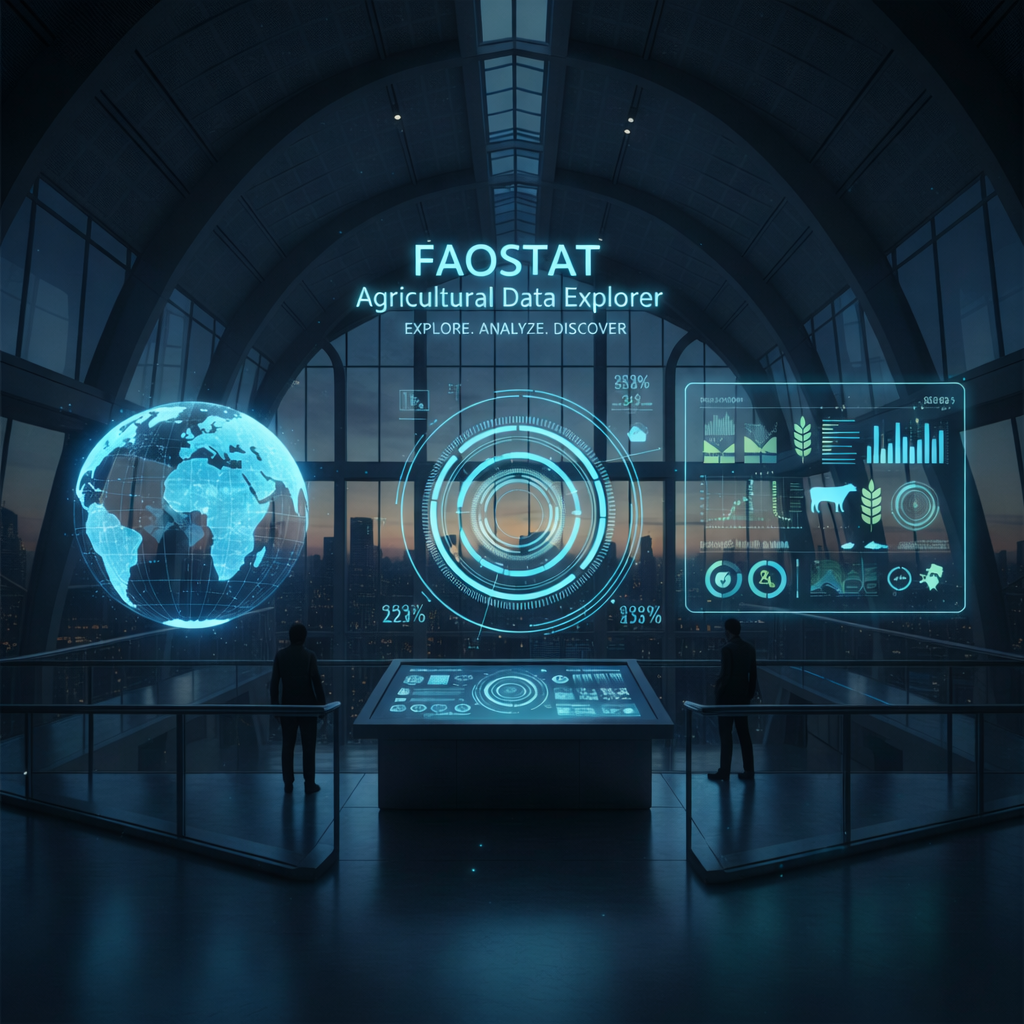
🌾 FAOSTATS Agricultural Data Explorer – Project Story
About the Project
Agriculture is the backbone of many economies, yet most agricultural data remains underutilized due to its complexity and inaccessibility. As a student of Computer Science and an AI enthusiast, I was inspired to bridge the gap between raw agricultural data and actionable insights. This motivation led to the creation of FAOSTATS Agricultural Data Explorer — an interactive web application that simplifies the exploration, analysis, and visualization of global agricultural statistics.
My goal was to build a tool that empowers farmers, researchers, students, policymakers, and analysts to make data-driven decisions without needing advanced technical skills.
Inspiration
Growing up in a region where agriculture plays a vital role in daily life, I have seen firsthand how farmers often rely on experience rather than data. At the same time, massive datasets like FAOSTAT exist but are difficult to navigate for non-technical users.
This project was inspired by three key factors:
- My passion for Artificial Intelligence and Data Science
- The global importance of food security and sustainable farming
- The lack of simple tools to explore FAO agricultural datasets
I wanted to create something that blends AI, data analytics, and real-world impact.
What I Built
FAOSTATS Agricultural Data Explorer is a Streamlit-based web application that allows users to:
- Explore multiple FAOSTAT domains:
- Production
- Trade
- Food Security
- Prices
- Emissions
- Production
- Filter data by:
- Country
- Commodity (e.g., Wheat, Rice, Beef, Milk)
- Year range
- Metrics
- Country
- Visualize trends using:
- 📈 Time-series analysis
- 📊 Descriptive statistics
- Year-over-year change calculations
- 📈 Time-series analysis
- Export filtered data in CSV format
The system is designed to be modular and scalable, with future-ready support for real FAOSTAT API integration.
How I Built It
The project was developed using the following technologies:
- Python – Core programming language
- Streamlit – For building the interactive web interface
- Pandas – Data manipulation and transformation
- Matplotlib & Seaborn – Data visualization
- FAOSTAT Dataset (Simulated) – For prototyping and testing
Architecture Overview
- Data Loading Layer – Reads and prepares FAOSTAT-like datasets
- Filtering Engine – Applies user-selected filters dynamically
- Analytics Module – Computes statistics and growth rates
- Visualization Layer – Renders charts and trends in real-time
- Export Module – Allows users to download results as CSV
Mathematically, year-over-year growth is calculated as:
[ Growth\ Rate = \frac{Value_{current} - Value_{previous}}{Value_{previous}} \times 100 ]
This helps users quickly identify trends and changes in agricultural production, trade, or emissions.
Challenges I Faced
1. Data Complexity
FAOSTAT datasets are large, multi-dimensional, and inconsistent across domains. Designing a flexible structure to handle different data formats was challenging.
2. Performance Optimization
Handling large datasets in Streamlit required careful filtering and efficient use of Pandas operations to avoid slow rendering.
3. UI/UX Design
Making the interface powerful yet simple was a key challenge. I iterated multiple times to ensure the app remains intuitive for non-technical users.
4. Scalability Planning
Although the current version uses simulated data, I designed the system to be API-ready so real-time FAOSTAT integration can be added easily in the future.
What I Learned
Through this project, I gained hands-on experience in:
- Designing end-to-end data pipelines
- Building interactive data applications
- Writing clean, modular Python code
- Working with real-world data problems
- Translating complex data into simple visual insights
More importantly, I learned how AI and data science can be used to solve real human problems, not just theoretical ones.
Impact & Future Vision
This project is a step towards AI-driven agriculture, where data supports smarter decisions, sustainable practices, and better food security.
In the future, I plan to add:
- Real-time FAOSTAT API integration
- Machine learning models for yield prediction
- Crop recommendation systems
- Geospatial visualizations
- AI-powered insights and alerts
Conclusion
FAOSTATS Agricultural Data Explorer is more than just a data app — it represents my vision of combining AI, data, and social impact. It reflects my journey as a Data Scientist and AI Engineer in building meaningful, scalable, and practical solutions.
This project strengthened my belief that technology can transform agriculture, and I am excited to continue innovating in this space.
Developed by: Muhammad Atif Latif
Built With
- netfliy
- python
- streamli


Log in or sign up for Devpost to join the conversation.